
The Power Threat Meaning Framework (PTMF) asks practicing therapists to set aside, at least provisionally, the question “What is wrong with you?” and replace it with “What has happened to you?” 1 Published by the British Psychological Society’s Division of Clinical Psychology in January 2018, it is an ambitious attempt to provide a structured, formulation-led alternative to functional psychiatric diagnosis 1. For clinicians who already think in terms of formulation and context, the framework will feel familiar in spirit; what is distinctive is its insistence on the operation of power as the organizing variable and its rejection of diagnostic categories as the unit of explanation 3.
Type & Discipline
The PTMF is best described as a meta-framework or conceptual system rather than a stand-alone therapy modality 3. It does not prescribe a specific set of session techniques; instead it offers a way of organizing information about a person’s distress that can sit underneath, or alongside, the therapies a clinician already practices LLM. Its home discipline is clinical psychology, and it emerged explicitly from a critical, formulation-based tradition within that field 3. The framework’s authors position it as an alternative to the biomedical, diagnostic conceptualization of emotional distress, unusual experiences, and troubled or troubling behavior 1.
Because it is a conceptual system rather than a protocol, the PTMF functions more like a lens than a treatment manual LLM. A therapist might apply it within cognitive, narrative, systemic, or psychodynamic work, using it to structure the formulation while drawing intervention methods from an established evidence-based modality LLM.
Creators & Lineage
The PTMF was led by clinical psychologists Lucy Johnstone and Mary Boyle, working with a project team and a group of service-user consultants under the auspices of the British Psychological Society 1. The full document and its accompanying overview were published in 2018 1. The peer-reviewed articulation of the framework appeared the same year as Johnstone and Boyle’s account of it as “an alternative nondiagnostic conceptual system” 3.
Its intellectual lineage runs through several converging traditions LLM. From formulation-based clinical psychology it inherits the commitment to individualized, narrative accounts of distress rather than categorical labels 3. From critical psychiatry and the broader social model of distress it inherits skepticism toward the assumption that experiences such as low mood, anxiety, or unusual beliefs are best understood as discrete medical disorders 3. From trauma-informed care it inherits the centrality of adversity and the survival value of symptoms LLM. The framework draws these strands together under the explicit organizing principle of power 3.
Core Principles
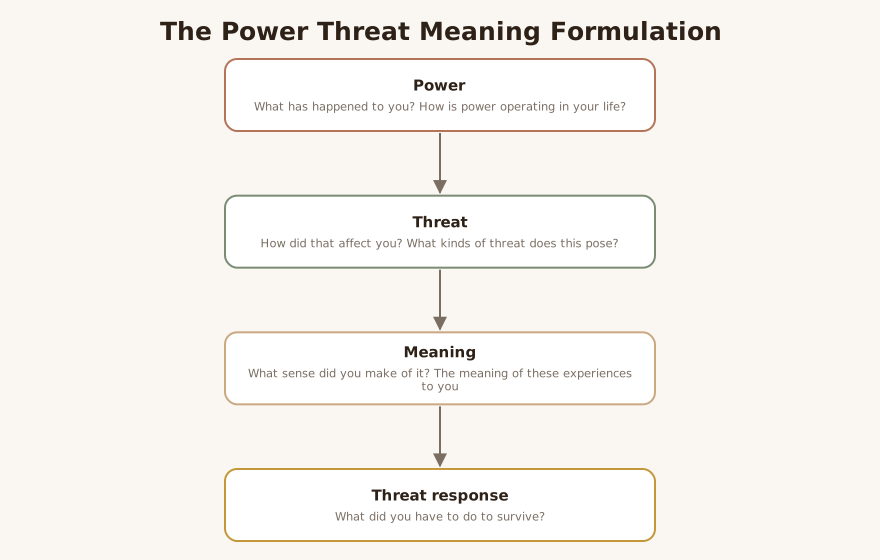
At the heart of the PTMF are a small number of questions that structure any formulation 1. They are usually summarized as:
- Power — “What has happened to you?” (How is power operating in your life?) 1
- Threat — “How did that affect you?” (What kinds of threat does this pose?) 1
- Meaning — “What sense did you make of it?” (What is the meaning of these experiences to you?) 1
- Threat response — “What did you have to do to survive?” (What kinds of threat response are you using?) 1
Two further questions widen the formulation: “What are your strengths?” (what access to resources and sources of power do you have?) and the integrating question, “What is your story?” — drawing the strands into a coherent personal narrative 1.
The framework’s analysis of power is deliberately broad. It distinguishes several forms, including coercive power (the use of force, violence, or intimidation), legal power, economic or material power, interpersonal power, social or cultural capital, and, importantly, ideological power — power over language, meaning, and what counts as legitimate knowledge 1. Johnstone and Boyle give ideological power particular weight, because it shapes how distress itself is named and understood 1.
A second core principle is that threat responses are described as verbs, not nouns — as things people do in order to survive, rather than things they have 1. What a diagnostic model might call a symptom, the PTMF reframes as a meaning-based, often embodied response to the negative operation of power that links back to core human needs for safety, belonging, and value 1. The framework also proposes provisional “general patterns” of such responses, intended to capture regularities across people without reifying them into the disorder categories the framework sets out to replace 1.
Interventions & Techniques
The PTMF is not a session-by-session technique set, so “intervention” here means the activities the framework structures rather than discrete procedures it invents LLM. The principal activity is collaborative, power-aware formulation: working with the person to map how power has operated in their life, what threats this created, the meaning they made, and the threat responses they developed 1. The integrating question — “What is your story?” — invites a narrative synthesis, which the framework treats as central because human beings are understood as fundamental meaning-makers and storytellers 1.
In practice, clinicians have applied the framework across a range of settings, including individual formulation, peer-led and self-help groups, team-level reformulation of cases, and broader systemic and educational contexts 4. The framework lends itself to group and community use precisely because narrative is a flexible vehicle for diverse perspectives 1.
LLM-generated illustrative example (not a guideline): A clinician working with a client who experiences recurrent flashbacks and chronic over-working might, instead of recording “PTSD with depressive features,” co-construct a formulation noting how childhood coercive power and material insecurity (power) generated a pervasive sense of danger and worthlessness (threat and meaning), to which hypervigilance and relentless productivity became survival strategies (threat responses). The intervention is the shared, validating reframe itself, delivered within an established trauma-focused modality. LLM
Evidence Base
Honesty about evidence is essential here: the PTMF’s empirical base is emerging, not established 4. A 2024 scoping review by Gallagher and colleagues, conducted to PRISMA-ScR standards, identified only 17 studies that had used the framework in their methodology in the roughly five years since publication 4. Those studies spanned clinical psychology, forensic psychology, general mental health, and education, with participants ranging from prisoners and prison officers to service users, psychology professionals, and members of the general public 4. The review read this diversity as reflecting the framework’s holistic ambitions and a genuine dissatisfaction among psychologists with the dominant diagnostic model 4.
Crucially, the existing literature is largely descriptive, conceptual, and exploratory rather than comparative or outcome-focused LLM. The scoping review noted that uptake of alternatives like the PTMF will be hindered without investment in training, professional collaboration, and service-level change — an implementation finding, not a finding of demonstrated clinical superiority 4. A 2025 critical narrative synthesis by Atkinson, Nathan, and Sukhera similarly concluded that there is limited evidence of effective implementation of the PTMF in real-world healthcare settings, even as it endorsed the framework’s socially conscious reframing of distress and its potential to reduce stigma 6. For a clinician deciding how much weight to place on the framework, the fair summary is that it is intellectually developed and increasingly discussed, but its claims to clinical and social benefit remain to be tested by rigorous outcome research 46.
Populations & Indications
The framework was designed to be broadly applicable to emotional distress, unusual experiences, and troubled or troubling behavior across adult populations 1. It has been explored with trauma survivors, survivors of abuse and adversity, people experiencing psychosis, and marginalized or disadvantaged groups for whom the operation of social, economic, and coercive power is especially salient 46. Its emphasis on power and adversity makes it a natural fit for work with people whose distress is closely tied to material deprivation, discrimination, or violence LLM.
The framework is frequently discussed in relation to severe and enduring difficulties, including presentations that diagnostic systems would label as psychosis, complex trauma, or severe mental illness, precisely because these are the areas where its authors argue the diagnostic model is weakest 3. It has also been applied with the general public and in non-clinical settings, reflecting its claim to be a general account of distress rather than a clinic-only tool 4.
Problems-for-Work
The PTMF is intended to be flexible enough to formulate a wide span of presenting problems, always by routing them back through power, threat, meaning, and response LLM.
- Trauma responses and PTSD: reframing flashbacks, hypervigilance, and avoidance as survival strategies in response to the threat created by past abuses of power 1.
- Self-harm: understood as a threat response that meets a core need (for example, regulating unbearable affect) rather than as a symptom to be suppressed 1.
- Psychosis and unusual experiences: formulated as meaning-laden responses to adversity and ideological power rather than as primarily biological dysfunction 3.
- Depression and anxiety: located within the operation of interpersonal, economic, or social power, and the meanings of defeat, entrapment, or threat these generate LLM.
- Dissociation and emotional dysregulation: read as embodied threat responses linked to survival under overwhelming circumstances 1.
- Effects of abuse and adversity: the framework’s central use case, mapping how coercive and other forms of power shaped subsequent distress 1.
Contraindications, Cautions & Cultural Humility
The PTMF is a way of understanding, not a crisis protocol, so it does not replace risk assessment, safety planning, or evidence-based intervention where those are indicated LLM. A formulation-only stance could be unsafe if used to defer urgently needed support, and clinicians should hold the framework alongside, not in place of, their duty-of-care obligations LLM.
Thoughtful clinicians should also engage with the framework’s serious critics. In a philosophical critique, Alastair Morgan argues that, despite its anti-diagnostic intent, the PTMF unfolds an account of distress quite similar to other accounts of mental illness, fails to justify its own criteria for what counts as distress, offers a reductive account of meaning that downplays existential dimensions of experience, and — most pointedly — collapses its rich concept of power into a narrower concept of threat, producing an oversimplified linear causality 5. Morgan’s conclusion is that the framework achieves less conceptual distance from psychiatry than its advocates claim 5. Clinicians should therefore avoid presenting the PTMF as a settled or proven alternative LLM.
On cultural humility, the framework’s strength is also a caution: by foregrounding ideological power and the politics of meaning, it explicitly invites attention to how distress is named differently across cultures and how dominant narratives can marginalize 1. Used well, this supports culturally responsive practice; used carelessly, a clinician could impose a particular socio-political reading of a client’s experience under the guise of empowerment LLM. The framework’s own emphasis on the person’s story should guard against this, keeping meaning-making in the client’s hands 1.
Treatment-Plan Suggestions & SMART Objectives
The framework does not generate goals on its own; the following illustrate how a clinician might translate a power–threat–meaning formulation into collaborative objectives within an established modality LLM.
| Goal | SMART objective (example) | Mechanism |
|---|---|---|
| Build a shared, non-diagnostic understanding of distress | Within 4 sessions, client co-constructs a written PTMF-informed formulation naming at least two operations of power in their life | Collaborative formulation; the four core questions 1 |
| Reframe a “symptom” as a survival response | Within 6 weeks, client reframes one identified threat response (e.g., self-harm) as a strategy meeting a core need, rated in session | Threat responses as verbs, not nouns 1 |
| Reduce shame attached to presenting problems | Over 8 sessions, client reports a 2-point drop on a self-rated shame scale linked to their distress | De-pathologizing, stigma-reducing reframe 6 |
| Strengthen access to personal and social resources | Within 8 weeks, client identifies and acts on two sources of support or power available to them | “What are your strengths?” question 1 |
| Integrate experience into a coherent narrative | By session 12, client articulates a personal story linking adversity, meaning, and response | Narrative integration; “What is your story?” 1 |
| Locate distress in social context | Within 5 sessions, client names one external/structural contributor to their distress | Power-aware formulation; social model of distress 3 |
| Improve affect regulation tied to threat | Over 10 weeks, client uses an agreed grounding skill during 3 of 4 distress episodes | Threat-response substitution within an established modality LLM |
Common Misconceptions
“The PTMF is a therapy.” It is a conceptual system for understanding and formulating distress, not a manualized treatment with its own session protocol 3. Intervention methods are drawn from established modalities LLM.
“The PTMF is evidence-based in the outcome sense.” The literature is emerging and largely descriptive; there is limited evidence of effective real-world implementation and no body of comparative outcome trials establishing superiority over diagnostic-led care 46.
“It denies biology entirely.” The framework prioritizes the operation of power and meaning over biomedical explanation, but it is a reframing of how distress is conceptualized rather than a wholesale denial that bodies are involved; threat responses are described as embodied 1.
“It is just diagnosis by another name.” Advocates dispute this, but it is a live critique: Morgan argues the framework remains closer to conventional accounts of mental illness than it claims 5. Clinicians should hold both views in mind LLM.
Training & Certification
There is no formal licensure or accredited certification in the PTMF in the way there is for established branded therapies LLM. The primary “training” resources are the BPS publications themselves — the full framework document and the shorter overview — together with the Division of Clinical Psychology’s hub and the peer-reviewed literature 12. Guided discussion materials and application examples produced around the framework support team and group learning 1. Given the emerging evidence base, clinicians adopting the framework should treat their use of it as reflective and provisional, and should keep their core intervention skills anchored in modalities with stronger outcome evidence LLM.
Key Terms
- Power — the operation, in many forms (coercive, legal, economic/material, interpersonal, social/cultural, ideological), of influence over a person’s life and circumstances 1.
- Threat — the dangers to needs such as safety, belonging, and value that arise when power operates negatively 1.
- Meaning — the sense a person makes of what has happened, shaped by personal history and by ideological power over language 1.
- Threat response — a survival strategy (described as a verb) that diagnostic models might label a symptom 1.
- General patterns — provisional regularities in threat responses proposed as an alternative to diagnostic categories 1.
- Ideological power — power over meaning, language, and what counts as legitimate knowledge, emphasized as especially important 1.
Resources & Further Reading
▶ Watch — a video introduction to this concept:
- The Power Threat Meaning Framework: Overview (BPS, January 2018)
- Power Threat Meaning Framework — BPS Division of Clinical Psychology hub
- Johnstone & Boyle (2018), The Power Threat Meaning Framework: An Alternative Nondiagnostic Conceptual System
- Gallagher et al. (2024), The PTMF 5 years on – A scoping review of the emergent empirical literature
- Morgan, Power, Threat, Meaning Framework: A Philosophical Critique
- Atkinson, Nathan & Sukhera (2025), The PTMF: A Socially Conscious Shift in the Conceptualization of Mental and Physical Health
Reflective / Supervision Questions
- When I formulate a client’s distress, how much weight do I give to the operation of power — coercive, economic, ideological — versus internal or biological factors, and what drives that balance? 1
- Can I describe a client’s most troubling “symptom” as a threat response, a verb, linked to a core human need? What changes in my stance when I do? 1
- Where might I be importing my own socio-political reading of a client’s experience under the banner of empowerment, rather than holding the meaning-making in their hands? 1
- How do I communicate to clients and teams that the PTMF is an emerging, contested framework rather than a proven alternative, while still using it usefully? 45
- If Morgan is right that the framework collapses power into threat, where in my formulations have I oversimplified a complex causal story? 5