
Type & Discipline
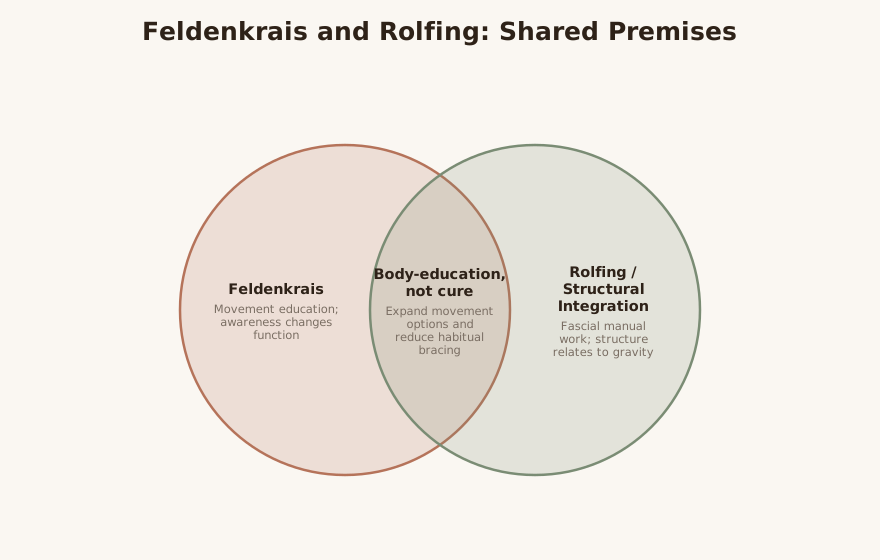
Feldenkrais and Rolfing (Structural Integration) are somatic education and bodywork systems, not psychotherapies, and they sit outside the discipline of clinical psychology LLM. The Feldenkrais Method is best understood as a learning-based intervention: its effects appear generic across conditions rather than disease-specific, which the systematic-review literature interprets as support for a learning model rather than a medical one 1. Rolfing/Structural Integration is a manual practice rooted in the osteopathic idea that the myofascial network is “the organ of form” and a key determinant of alignment, posture, and movement 2. For a practicing therapist, the useful framing is that both traditions treat habitual movement and connective-tissue patterns as something that can be re-learned or reorganized, and both are most defensibly used as adjuncts or conceptual lenses rather than as primary mental-health treatments LLM.
A shared organizing premise unites them: chronic protective bracing – guarded breathing, postural collapse, restricted range – becomes encoded in the body over time, and can be addressed through awareness, neuromuscular re-education, and (in Rolfing) direct fascial manipulation 25. This is the “sensorimotor / movement integration” foundation that downstream clinical somatic models draw on LLM.
Creators & Lineage
Moshe Feldenkrais (1904-1984) developed his method from his own background in physics, engineering, and judo, framing improved function as a problem of learning and self-organization rather than correction of pathology; his foundational text, Awareness Through Movement, presents structured movement lessons designed to expand the nervous system’s repertoire of options 5. The Feldenkrais Guild of North America (FGNA) is the professional body that defines training standards and credentials practitioners in the method 4.
Ida Pauline Rolf (1896-1979) was a biochemist who earned a doctorate from Columbia University and held an early research position at the Rockefeller Foundation before developing Structural Integration outside conventional medical channels beginning around 1940 2. Rolf synthesized osteopathy (including cranial osteopath William Sutherland), hatha yoga, Buckminster Fuller’s tensegrity concept, Alfred Korzybski’s general semantics, and Wilhelm Reich’s somatic psychology, and she explicitly studied movement-awareness methods including Feldenkrais and the Alexander Technique 2. Professionalization accelerated after 1971 with the founding of the institute now known as the Dr. Ida Rolf Institute, which today defines and certifies the practice 23. The two lineages are therefore historically intertwined, with Rolf herself drawing on Feldenkrais’s movement work 2.
These traditions in turn fed the wider field of somatic psychology, body psychotherapy, sensorimotor psychotherapy, and mind-body medicine – which is why a therapist may encounter their vocabulary (bracing, grounding, organizing the body in gravity) in trauma-oriented clinical models LLM.
Core Principles
Several principles cut across both systems. First, awareness changes function: Feldenkrais lessons assume that bringing attention to how a movement is organized, and exploring small variations, lets the nervous system discover more efficient and less effortful patterns 5. Second, structure relates to gravity: Rolf held that the adequacy of a person’s adaptation to gravity was central to physical and psychological function, with the goal of shifting the body’s relationship to gravity “from one of struggle and eventual collapse” toward structural integrity 2. Third, fascia is plastic and systemic: Rolf adopted the tensegrity insight that a locally induced strain alters the geometry of the larger structure, so that working one region affects the whole 2.
Fourth, both are education models, not cures: Feldenkrais’s effects read as generic learning gains rather than treatment of a specific disease 1, and Structural Integration was originally conceived for healthy people seeking a structural ideal, only later being applied to musculoskeletal pain 2. For a clinician, the load-bearing translation is that these methods aim to expand options and reduce habitual bracing, not to “fix” a diagnosis LLM.
Interventions & Techniques
Feldenkrais is delivered in two formats. Awareness Through Movement uses verbally guided group lessons in which clients explore slow, low-effort movement sequences and notice differences in ease, range, and effort 5. Functional Integration (the hands-on, individualized form) is referenced within the same tradition and credentialed through FGNA 4. The defining technique is attention to the quality of movement – effort, sequencing, breath – rather than repetition or stretching 5.
Rolfing/Structural Integration employs a standardized “10-session recipe,” each session targeting specific biomechanical goals through skilled fascial manipulation combined with sensorimotor education, with clinical hallmarks including bilateral symmetry, anterior-posterior horizontality, and more graceful movement 2. Many practitioners pair manual work with Rolf Movement, an educational component that helps clients explore and integrate new movement options so structural changes are carried into daily function 7.
LLM-generated illustrative example (not a guideline): A therapist notices that a client with chronic stress habitually holds the breath high in the chest and rounds the shoulders forward when describing conflict. A Feldenkrais practitioner might guide slow attention to the difference between breathing into the belly versus the chest, letting the client discover an easier pattern, while a Rolfer might work the thoracic fascia and then use Rolf Movement to help the client feel an upright, open-chested option LLM.
Evidence Base
Be honest with clients and referrers: these are established practices with relatively immature research bases LLM. The strongest synthesis for Feldenkrais is a systematic review of 20 randomized controlled trials across healthy volunteers, aging populations, multiple sclerosis, chronic low back pain, eating disorders, post-myocardial-infarction recovery, and pediatric sleep bruxism 1. Meta-analysis found favorable effects on balance in older adults – a Timed Up and Go improvement of about 1.13 seconds (95% CI -1.7 to -0.56) and a Functional Reach improvement of about 6.08 cm (95% CI 3.41 to 8.74) – with single studies reporting reduced perceived effort, improved dexterity, and enhanced body image 1.
Critically, the same review judged risk of bias to be high: fewer than 25% of trials had adequate randomization, only about a third used blinded outcome assessment, samples were small (mean ~41 participants), and clinical heterogeneity was substantial 1. The authors called the balance findings “promising” while explicitly stating that further high-quality research is required 1.
For Rolfing, controlled evidence is thinner. A retrospective cohort of 497 private-practice clients (1982-2005) who completed 10 sessions found statistically significant improvements (p<0.001) in passive hip and knee flexion, trunk-length symmetry, and thoracic expansion, with large effect sizes for joint range 6. However, the authors flagged no control group, a 23-year retrospective design, a single evaluator (measurement-bias risk), incomplete documentation of comorbidities, and no follow-up, concluding that no definitive causal conclusions could be drawn 6. Notably, almost none of this evidence addresses psychiatric or mental-health endpoints, so claims of psychological benefit should be made cautiously LLM.
Populations & Indications
The literature and tradition point to several populations. Older adults have the best-supported indication via balance gains in Feldenkrais 1. People with chronic pain and postural/movement restriction are common Rolfing referrals, consistent with the documented range-of-motion and trunk-symmetry changes 6, and with SI’s later application to musculoskeletal pain 2. People with movement disorders (e.g., the MS samples in the Feldenkrais review) have been studied, though without disease-specific superiority 1. Performers and athletes often use Feldenkrais for efficiency and reduced perceived effort 15.
For mental-health-adjacent populations – trauma survivors, individuals with somatic tension, and people with bodily hypervigilance – these methods are used in practice as adjuncts to address protective bracing, but the controlled evidence for psychological outcomes is limited, so indications here rest more on clinical reasoning than on trial data LLM.
Problems-for-Work
- Muscle tension and psychomotor tension: Feldenkrais’s low-effort exploration can reduce habitual over-effort, with documented reductions in perceived effort 1. Application: a client who “holds tension” everywhere is offered movement experiments to discover where effort is unnecessary LLM.
- Postural dysfunction and movement restriction: Rolfing showed measurable gains in range of motion and trunk symmetry 6. Application: a client with a collapsed, forward-rounded posture explores an upright organization in gravity 2.
- Chronic pain: addressed via fascial work and re-education, though as an adjunct given evidence limits 26.
- Stress and bodily hypervigilance: awareness-based movement may help a client notice and downregulate bracing, framed as learning rather than treatment 5LLM.
- Trauma-related bracing: somatic education can offer a graded, non-narrative entry point to the body, used alongside trauma-focused psychotherapy LLM.
- Somatic symptom disorder: these methods can support a re-relationship with bodily sensation, but should never substitute for evidence-based psychological care LLM.
Contraindications, Cautions & Cultural Humility
Neither method is a substitute for medical evaluation or evidence-based psychotherapy, and the research base does not support claims of curing psychiatric or pain conditions 16LLM. Manual fascial work (Rolfing) involves sustained pressure and may be inappropriate or require medical clearance for clients with acute injury, bleeding disorders, certain skin or vascular conditions, osteoporosis, or pregnancy, and should be coordinated with treating clinicians LLM. For trauma survivors, hands-on work and intense interoceptive focus can be activating; pacing, explicit consent, and the option to stop are essential, and somatic work should generally proceed in parallel with a trauma-informed psychotherapy rather than ahead of it LLM.
Cultural humility matters: comfort with touch, undress for bodywork, breath-focused attention, and the framing of the body in “gravity” or “alignment” carry different meanings across cultures, faith traditions, gender histories, and trauma histories LLM. Clinicians should avoid presenting an idealized “correct” posture as universal, given that SI’s structural ideals were articulated as aesthetic and biomechanical goals rather than validated health endpoints 2LLM. Referral to a credentialed practitioner, and clear scope-of-practice boundaries, protect both the client and the therapist 34.
Treatment-Plan Suggestions & SMART Objectives
| Goal | SMART objective (example) | Mechanism |
|---|---|---|
| Reduce habitual muscular over-effort | Within 8 weeks, client will identify 3 daily activities where they reduce effort, rating tension 30% lower on a 0-10 scale | Movement awareness expands lower-effort options 15 |
| Improve balance/mobility (older adult) | In 10 weeks, client will improve a functional balance/reach measure to a clinically meaningful degree | Sensorimotor learning generalizes to balance 1 |
| Increase interoceptive awareness | Within 6 weeks, client will name bodily cues of stress on 4 of 5 occasions before escalation | Attention to movement/breath quality 5 |
| Reduce trauma-related bracing | Over 12 weeks, client will tolerate 5 minutes of guided body attention without dissociating, 3 sessions running | Graded, consent-based somatic exploration LLM |
| Improve postural organization | In 10 sessions, client will report reduced effort maintaining an upright posture during a 20-minute task | Fascial re-education and movement integration 27 |
| Decrease perceived movement restriction | Within 8 weeks, client will report increased ease in one limited daily motion | Range-of-motion and re-education gains 6 |
| Strengthen body-based coping for stress | Over 6 weeks, client will use one self-directed awareness practice during 3 stress episodes weekly | Self-regulation via awareness practice 5LLM |
Common Misconceptions
A frequent misconception is that Feldenkrais treats specific diseases; the evidence instead suggests generic, learning-based effects, which is why the authors favor a learning model over a medical one 1. Another is that Rolfing has a robust outcome base – the most cited Rolfing cohort had no control group and could draw no causal conclusions 6. A third is that Rolfing is “deep-tissue massage”; it is a structured, multi-session educational and manipulative system aimed at organizing the body in gravity, not a relaxation massage 2. Finally, clinicians sometimes assume these methods are interchangeable with psychotherapy for trauma; they are adjuncts, and the body-of-evidence does not establish them as standalone mental-health treatments 16LLM.
Training & Certification
Feldenkrais practitioners complete multi-year professional training programs, and the Feldenkrais Guild of North America (FGNA) administers credentialing and standards for both Awareness Through Movement and Functional Integration practitioners 4. Rolfing/Structural Integration is taught and certified through the Dr. Ida Rolf Institute, which since its founding in 1971 has defined the standardized training and the 10-session protocol 23. Rolf Movement training is offered as a complementary educational track within the Rolfing community 7. Clinicians referring clients should verify current credentials through these bodies rather than relying on self-description 34.
Key Terms
- Awareness Through Movement (ATM): verbally guided Feldenkrais group lessons exploring movement quality and options 5.
- Functional Integration (FI): the hands-on, individualized form of Feldenkrais 4.
- Structural Integration (SI) / Rolfing: Ida Rolf’s manual and educational system organizing the body in gravity via fascial work 2.
- The 10-session recipe: the standardized Rolfing sequence, each session with specific biomechanical aims 2.
- Fascia / “organ of form”: the myofascial network treated as a key determinant of posture and movement 2.
- Tensegrity: Fuller’s tension-compression balance model applied to the body, where local strain alters global geometry 2.
- Rolf Movement: the movement-education component supporting integration of structural change 7.
Resources & Further Reading
▶ Watch — a video introduction to this concept:
- Hillier & Worley (2015) — Systematic Review of the Feldenkrais Method (Evid Based Complement Alternat Med)
- Jacobson (2011) — Structural Integration: Origins and Development (J Altern Complement Med)
- Rolfing Structural Integration and mobility/trunk symmetry — retrospective cohort (PMC12428785)
- Dr. Ida Rolf Institute
- Feldenkrais Guild of North America (FGNA)
- Feldenkrais, M. — Awareness Through Movement
- Rolf Movement — European Rolfing Association
Reflective / Supervision Questions
- When I am drawn to refer a client for somatic bodywork, am I clear about whether the indication rests on trial evidence (e.g., balance in older adults) or on clinical reasoning, and have I said so honestly to the client? 1LLM
- How do I hold the boundary between somatic education/bodywork and the psychotherapy I am licensed to bill and provide? LLM
- For a trauma survivor, how do I sequence somatic work and trauma-focused psychotherapy so the body work supports rather than destabilizes the treatment? LLM
- Am I presenting “ideal posture” or “alignment in gravity” as a validated health outcome when it was articulated as a structural ideal? 2LLM
- How do I attend to consent, touch, and cultural meaning when recommending hands-on modalities to a given client? LLM
- What would change in my treatment plan if the somatic adjunct produced no measurable change after a defined trial period? LLM