
Type & Discipline
Habit Reversal Training (HRT) is a behavioral technique—a multi-component treatment package rather than a single procedure—developed within the tradition of clinical psychology and behavior analysis to reduce unwanted repetitive behaviors 6. It sits in the behavior-therapy family for tics and habits and is grounded in operant learning principles, treating the target behavior as a learned response that is cued by identifiable antecedents and maintained by its consequences 6. For practicing therapists, the most useful framing is that HRT does not try to talk a client out of a habit or to suppress it through willpower alone; it teaches the client to detect the behavior at its earliest moment and to engage a deliberate, physically incompatible alternative 6. The approach is best understood as a skills-based, practice-heavy intervention in which competence is built through rehearsal both in session and between sessions LLM.
HRT is the engine inside two of the most widely used behavioral protocols for these conditions: Comprehensive Behavioral Intervention for Tics (CBIT) for tic disorders and the Comprehensive Behavioral (ComB) model for body-focused repetitive behaviors 45. Understanding HRT as a technique that can stand alone or be embedded in a larger, manualized program helps clinicians match the level of structure to the presentation in front of them LLM.
Creators & Lineage
HRT was introduced by Nathan Azrin and Gregory Nunn, who first described the habit-reversal procedure and then extended it to specific presentations such as trichotillomania in their 1981 Behaviour Research and Therapy paper 16. Their original package was elaborate, comprising a large number of components, and subsequent clinical and research work distilled it toward the elements that carry most of the therapeutic weight 6. The technique’s conceptual parents are operant conditioning and applied behavior analysis, from which it inherits its emphasis on antecedents, consequences, and the systematic shaping of an alternative response 6.
Over the following decades, HRT was absorbed into broader cognitive-behavioral frameworks and packaged into structured programs 6. For tic disorders, HRT became the core of Comprehensive Behavioral Intervention for Tics (CBIT), which surrounds the habit-reversal core with psychoeducation, function-based assessment, and relaxation strategies 4. For hair pulling and skin picking, the Comprehensive Behavioral (ComB) model places competing-response training alongside a functional analysis across sensory, cognitive, affective, motor, and place domains 5. The lineage therefore runs from Azrin and Nunn’s original technique through behavior analysis and cognitive-behavioral therapy into today’s named, manualized treatments 145.
Core Principles
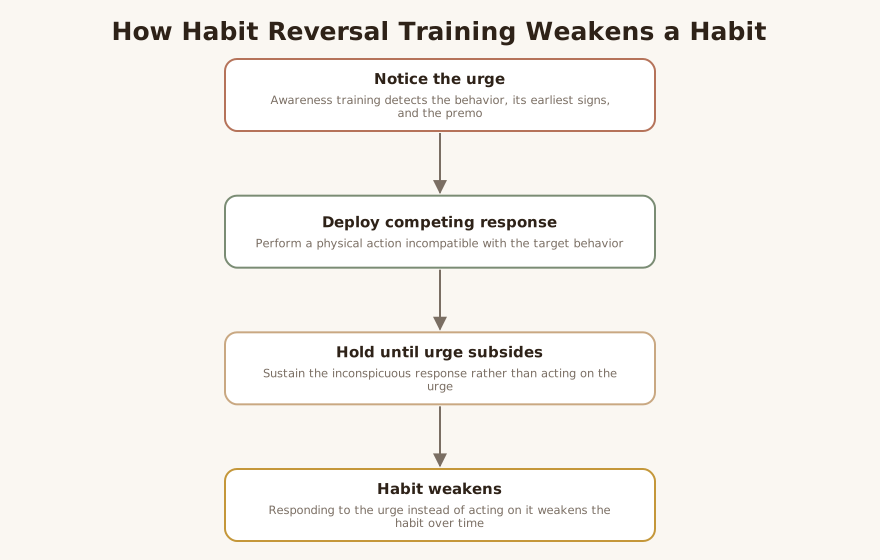
The first principle is awareness training: many tics, pulls, and picks occur outside full awareness or are preceded by a premonitory urge, and the client cannot interrupt what they do not yet notice 6. Awareness training teaches the client to detect the behavior, its earliest motor signs, and the situations and sensations (the premonitory urge) that reliably precede it 63. This is the foundation on which everything else is built, because the competing response can only be deployed if the client recognizes the moment to deploy it LLM.
The second principle is the competing response: once a behavior is detected or an urge is felt, the client performs a physical action that is incompatible with the target behavior and holds it until the urge subsides 6. The competing response is chosen to be inconspicuous, sustainable for a minute or more, and impossible to perform simultaneously with the habit—for example, gripping an object or clenching a fist instead of pulling hair 6LLM. Performing the incompatible behavior in response to the urge, rather than acting on the urge, is the mechanism by which the habit weakens over time 6.
The third set of principles supports generalization and durability: motivation procedures (such as reviewing the inconvenience and consequences of the habit and recruiting social support), relaxation to lower the arousal that can trigger behaviors, and structured practice 63. Function-based thinking ties it together: clinicians identify the antecedents and reinforcing consequences that sustain the behavior so that the intervention targets the actual contingency rather than the surface form 45.
Interventions & Techniques
The core technical sequence is awareness training followed by competing-response training 6. Awareness training typically includes response description (the client describes the behavior in detail), response detection (the clinician helps the client notice each occurrence, sometimes acknowledging tics or pulls as they happen), and early-warning and situational-awareness work to identify premonitory urges and high-risk contexts 63. Competing-response training then establishes a specific incompatible action, practiced until the client can hold it contingently for at least a minute or until the urge passes 6.
Motivation and social support are operationalized through a habit-inconvenience review and by enlisting a support person who praises correct use of the competing response and prompts it when the client misses an occurrence 6. Relaxation training—often diaphragmatic breathing and progressive muscle relaxation—is added to reduce general and situational tension 6. In the CBIT package these elements are joined by psychoeducation and a function-based intervention, in which antecedents and consequences that worsen tics are identified and modified 4. In the ComB model, competing responses and stimulus-control strategies (such as barriers that make pulling or picking harder) are selected after a multi-domain functional assessment 5.
LLM-generated illustrative example (not a guideline): A clinician treating an adolescent who pulls eyebrow hairs while reading first builds awareness by having her log each pull and the urge that precedes it for a week, then trains a competing response—closing both hands into loose fists resting in her lap and holding for sixty seconds whenever the urge arises—and recruits a parent to quietly praise her when she uses it. Stimulus control (reading with a fidget object in hand) is layered on once awareness is reliable LLM.
Evidence Base
The evidence base for HRT is best labeled established, and for tic disorders it has reached first-line status 7. A 2024 review describes Comprehensive Behavioral Intervention for Tics—built on the habit-reversal core—as a first-line treatment for Tourette and other tic disorders, reflecting its inclusion in contemporary treatment guidance 7. A dedicated review of habit reversal training for tic disorders likewise supports its efficacy and examines how its components, including awareness training and competing-response practice, contribute to tic reduction 3.
For obsessive-compulsive related disorders such as trichotillomania and excoriation, a 2019 systematic review evaluated the randomized controlled trial evidence for habit reversal therapy using CONSORT criteria, situating HRT as a supported behavioral approach while also scrutinizing the methodological quality of the trial literature 2. Azrin and Nunn’s original 1981 report on trichotillomania provided early evidence that the habit-reversal technique could substantially reduce hair pulling 1. Honesty about limits matters: the systematic review’s CONSORT evaluation signals that trial reporting and methodology in this area have not always been uniformly rigorous, and clinicians should hold the strength of evidence as “well-supported and recommended” rather than “definitively settled across every condition and population” 2LLM.
Populations & Indications
HRT is used across the lifespan, with established application in children, adolescents, and adults 46. Its strongest and best-known indications are tic disorders—Tourette’s disorder and persistent (chronic) motor or vocal tic disorder—where it forms the core of CBIT and is offered as a first-line option 74. It is also a primary behavioral treatment for body-focused repetitive behaviors, particularly trichotillomania (hair-pulling disorder) and excoriation (skin-picking) disorder, where it anchors the ComB model 51.
Beyond these flagship indications, the technique has been applied to a range of nervous habits, including nail biting (onychophagia), bruxism, thumb sucking, and stuttering 6. It can be adapted for individuals with developmental disabilities, with the level of caregiver involvement and prompting adjusted to the client’s awareness and capacity 6LLM. In every case the common thread is a repetitive, learned behavior that the client wants to reduce and can be trained to detect LLM.
Problems-for-Work
- Tics (Tourette’s / persistent tic disorder). Awareness training to identify premonitory urges, then a competing response held until the urge subsides, embedded in the CBIT package with function-based modification of triggers 47.
- Trichotillomania. Detection of pulling and its sensory antecedents, an incompatible competing response (e.g., fist clenching), and stimulus-control barriers selected via ComB functional analysis 51.
- Excoriation (skin-picking) disorder. The same awareness-plus-competing-response core, with attention to the sensory and emotional functions the picking serves 5.
- Nail biting, bruxism, thumb sucking. Habit detection and a sustainable incompatible action, supported by motivation review and social support 6.
- Stuttering and other nervous habits. Adapted habit-reversal procedures targeting the specific motor pattern 6.
LLM-generated illustrative example (not a guideline): For an adult with skin picking that spikes during evening screen time, a clinician might map the urge and its triggers, train a competing response of pressing palms flat against the thighs for a minute, and add stimulus control by wearing thin gloves during the high-risk window, reviewing the costs of picking to sustain motivation LLM.
Contraindications, Cautions & Cultural Humility
HRT has no significant medical contraindications, but several practical cautions apply LLM. The technique is effort-intensive and depends on consistent between-session practice; clients who cannot yet engage with self-monitoring, or whose awareness is very limited, may need awareness training extended or caregiver support increased before competing-response training will work 6LLM. For very young children or individuals with significant developmental disability, success typically hinges on a trained support person to prompt and reinforce the competing response 6LLM.
Clinicians should also be alert to comorbidity and context. Tic disorders and body-focused repetitive behaviors frequently co-occur with anxiety, attention problems, and obsessive-compulsive features, and a stand-alone competing response will not address an underlying driver that needs its own treatment LLM. Cultural humility means framing the behavior collaboratively rather than shamefully: the goal is the client’s own quality of life, not the elimination of behavior to satisfy others’ discomfort, and the competing response should be chosen to fit the client’s daily environment, social setting, and values LLM. Because the trial literature has acknowledged methodological limitations, practitioners should present HRT as well-supported while remaining transparent that response varies and that not every nervous habit has been studied to the same depth 2LLM.
Treatment-Plan Suggestions & SMART Objectives
| Goal | SMART objective (example) | Mechanism |
|---|---|---|
| Build tic awareness | Within 3 weeks, client will accurately self-detect and log at least 80% of a target tic’s occurrences across 3 consecutive days | Awareness training: response description, detection, premonitory-urge identification 3 |
| Implement competing response for a tic | Within 6 weeks, client will perform a chosen competing response within 5 seconds of urge onset in 75% of monitored opportunities | Contingent incompatible response held until urge subsides 6 |
| Reduce hair pulling | Within 8 weeks, reduce daily pulling episodes by 50% from baseline as tracked in a self-monitoring log | Competing response + stimulus control within ComB functional analysis 51 |
| Reduce skin picking | Within 8 weeks, client will use a competing response in 70% of high-risk situations identified in functional assessment | Awareness + competing response targeting the behavior’s sensory/affective function 5 |
| Lower triggering arousal | Within 4 weeks, client will apply diaphragmatic breathing in 3 documented high-tension situations per week | Relaxation reduces arousal that precipitates the behavior 6 |
| Strengthen adherence via support | Within 4 weeks, a designated support person will prompt/praise competing-response use in at least 5 logged instances weekly | Social support and motivation procedures sustain practice 6 |
| Generalize gains across settings | Within 10 weeks, client will demonstrate the competing response in 2 new settings at criterion | Programmed generalization of the skill beyond the training context 4 |
Common Misconceptions
- “HRT is just willpower or ‘try harder.’” It is a structured skills package built on awareness training and a trained physical competing response, not an exhortation to resist 6.
- “You suppress the tic or habit by stopping yourself.” The aim is to detect the urge and substitute an incompatible action, which weakens the behavior over time, rather than to white-knuckle suppression 6.
- “The competing response is the whole treatment.” Competing-response training is the centerpiece, but awareness training, motivation, social support, relaxation, and function-based assessment carry meaningful weight, especially in CBIT and ComB 45.
- “It only works for tics.” HRT is established across tics and a range of body-focused repetitive behaviors and nervous habits including hair pulling, skin picking, and nail biting 56.
- “Behavioral treatment of tics makes them worse or causes symptom substitution.” Contemporary evidence supports CBIT, with its habit-reversal core, as an effective first-line treatment for tic disorders 7.
Training & Certification
There is no single freestanding license for HRT; it is learned as a technique within behavioral and cognitive-behavioral training and is most often acquired through the manualized programs that contain it 6LLM. For tic disorders, clinicians typically pursue training in Comprehensive Behavioral Intervention for Tics through workshops and supervised practice offered by specialty centers and professional organizations 4. For hair pulling and skin picking, training in the Comprehensive Behavioral (ComB) model is available through the body-focused repetitive behavior community, including resources curated by the International OCD Foundation 5. Clinicians grounded in applied behavior analysis or cognitive-behavioral therapy already possess much of the conceptual scaffolding and can add HRT-specific competencies through focused continuing education and supervision 6LLM.
Key Terms
- Awareness training — teaching the client to detect the target behavior and the premonitory urge and situations that precede it 63.
- Competing response — a physical action incompatible with the target behavior, performed contingently and held until the urge subsides 6.
- Premonitory urge — the sensation or signal that reliably precedes a tic or repetitive behavior 3.
- Motivation procedures — reviewing the inconvenience and consequences of the habit to sustain effort 6.
- Social support — a designated person who prompts and praises correct competing-response use 6.
- CBIT — Comprehensive Behavioral Intervention for Tics, the manualized tic program built around HRT 4.
- ComB — the Comprehensive Behavioral model for hair pulling and skin picking, integrating HRT with multi-domain functional analysis 5.
- Body-focused repetitive behavior — a class of repetitive self-grooming behaviors (e.g., hair pulling, skin picking, nail biting) targeted by HRT 56.
Resources & Further Reading
▶ Watch — a video introduction to this concept:
- Azrin & Nunn (1981), The habit-reversal technique in treating trichotillomania (Behaviour Research and Therapy) 1
- Habit Reversal Therapy in OCD-Related Disorders: Systematic Review and CONSORT Evaluation of RCTs (Frontiers, 2019) 2
- Review of habit reversal training for tic disorders (PMC/NIH) 3
- Comprehensive Behavioral Intervention for Tics (CBIT) — Northwestern Medicine 4
- Comprehensive Behavioral (ComB) Treatment for Skin Picking and Hair Pulling — International OCD Foundation 5
- Habit reversal training — Wikipedia 6
- CBIT as First-Line Treatment for Tourette and Other Tic Disorders (2024, PubMed) 7
Reflective / Supervision Questions
- Have I confirmed that the client can reliably detect the target behavior and its premonitory urge before moving on to competing-response training? 63
- Is the competing response I selected genuinely incompatible with the behavior, inconspicuous, and sustainable in the client’s real-world settings? 6
- Have I conducted a function-based assessment so the intervention targets the antecedents and consequences maintaining the behavior, rather than its surface form alone? 45
- For this presentation, does the client need the fuller CBIT or ComB package rather than stand-alone competing-response training? 45
- Am I honestly representing the evidence as established and often first-line for tics while acknowledging methodological limits in the trial literature for related disorders? 72
- How am I structuring motivation, social support, and between-session practice so the skill is actually rehearsed and generalized? 6