
Type & Discipline
The GROW model is a coaching conversation structure rather than a school of psychotherapy 1. It originates in the fields of performance coaching, workplace coaching, and performance psychology, and is widely applied in athletics, business mentorship, music instruction, and personal-goal pursuit 2. Its purpose is to organize a goal-directed conversation into a clear, repeatable sequence that the coach can tailor to the individual 2. The acronym stands for Goal, Reality, Options, and Will (sometimes rendered as Way Forward) — four stages a coach moves through to help a person move from where they are to where they want to be 1. For a clinician, the most accurate framing is that GROW is a structured way of facilitating self-directed problem-solving, not a diagnostic or trauma-processing method LLM.
It is worth stating plainly at the outset what GROW is not LLM. It is not a billable psychotherapy modality, it carries no diagnostic logic, and it does not by itself address psychopathology, attachment, or trauma LLM. Its design assumption is a person with sufficient capacity for reflection and agency to set a goal and act on it LLM. That assumption matters greatly when deciding where it fits in clinical work LLM.
Creators & Lineage
The GROW model was co-developed in the United Kingdom in the mid-to-late 1980s by three people working together in business coaching: Sir John Whitmore, Graham Alexander, and Alan Fine 4. They had been using the four-step sequence informally before it acquired its name 4. According to the historical account, a communications specialist at a client site suggested a single metaphorical word to represent the sequence, proposing “GROW,” which the coaches adopted 4. Whitmore separately attributed the coining of the term to Max Landsberg in conversation with Graham Alexander, and the precise attribution has been disputed over the years 1. Although the model was co-developed by three people, it was primarily Whitmore who popularized it publicly through his 1992 book Coaching for Performance 4. A 2009 email from Whitmore confirmed he had “no disagreement with the historical circumstances as now described,” validating the three-person collaboration 4.
The deeper lineage runs through Timothy Gallwey’s Inner Game method, which fundamentally shaped modern coaching 4. Rather than giving direct instructions, the Inner Game approach asks awareness-raising questions that enable a person to “discover for themselves what was changing about their mind and body” 1. Whitmore noted that “all the leading exponents of business coaching today graduated from this” Inner Game tradition 4. The human-potential movement, centered at the Esalen Institute, is also cited as an influence on Whitmore and on the development of coaching more broadly 5. Coaching for Performance is described as “the founding text of the coaching profession,” and Whitmore is credited as “the pioneer of coaching in the workplace” and “creator of the GROW model, the most used coaching model in the world” 3.
For clinicians, the conceptual relatives are visible in this lineage LLM. The non-directive, question-led stance echoes motivational interviewing; the focus on a desired future state and existing resources echoes solution-focused brief therapy; the structured goal-and-action emphasis echoes goal-setting theory and cognitive behavioral coaching LLM.
Core Principles
The central principle is that performance and change are best generated by raising the person’s own awareness and responsibility rather than by instruction 1. The coach’s primary tool is the question, not the answer 1. The conversation is held loosely within a four-stage scaffold, and the coach retains flexibility to tailor the sequence to the individual rather than marching rigidly through it 2.
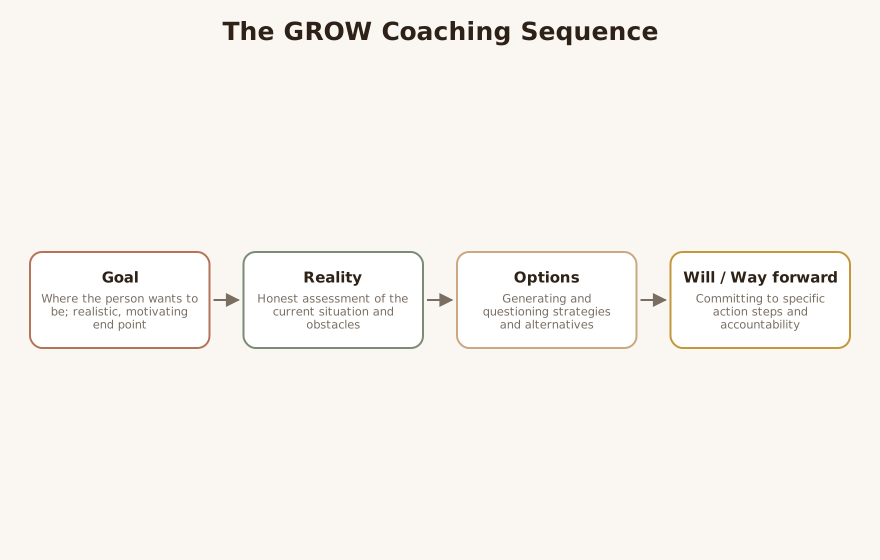
The four stages are defined as follows LLM. Goal (G) is the end point — where the person wants to be — and the coach and client work together to set realistic, achievable, and motivating goals grounded in clear benefits 12. Reality (R) is an honest assessment of the current situation, including the action taken so far and the obstacles standing in the way of progress 27. Options (O) is the generative phase in which the coach helps the person identify the means by which they might advance, outlining and questioning a variety of strategies and alternatives 27. Will, or Way Forward (W), is where the person commits to specific action steps and to accountability for taking them 27.
A key practical principle is to spend sufficient time on Goal 7. The Disruptive Leadership Institute account states that “the key to using GROW successfully is first to spend sufficient time exploring ‘G’ until the coachee sets a goal that is both inspirational and stretching,” then to move flexibly through the remaining stages, revisiting the goal if necessary 7. This same source distinguishes among types of goals — ultimate goals, performance goals, and progress goals — so that an aspirational end state is anchored by intermediate, controllable targets 7.
Interventions & Techniques
The intervention in GROW is essentially a sequence of well-timed questions 1. In the Goal stage, the coach helps the person articulate aspirations and desired outcomes and clarify the type and benefit of the goal 7. In the Reality stage, the coach asks the person to assess the current situation objectively and name the barriers to progress 27. The Wikipedia account gives an illustrative awareness-raising question for a weight-loss goal: “When you have been able to lose weight — what made the difference?” — a question designed to prompt the person to identify their own patterns and generate viable options 1.
In the Options stage, the technique is collaborative brainstorming — identifying possibilities and alternatives and questioning a variety of strategies before narrowing 7. In the Will stage, the coach helps the person create a summary and plan of action, consider future obstacles, and put accountability measures in place 7. The overall mechanism the model claims to drive is self-awareness and accountability, helping people navigate their own path toward a chosen outcome 2.
LLM-generated illustrative example (not a guideline): A client in the maintenance phase of treatment for depression says she wants to “get back into” her career. The clinician uses a GROW-shaped structure within a CBT session: Goal — “What would ‘back in’ look like in six months, specifically?” Reality — “What have you tried so far, and what got in the way?” Options — “Let’s list every possible next step, even ones you’d reject.” Will — “Of those, which one will you do before next week, and what would make it likely you actually do it?” The structure keeps the session goal-directed without the clinician supplying the answers LLM.
Evidence Base
The maturity of GROW is best described as established as a coaching framework, but not as an evidence-graded psychotherapy LLM. It is the most widely used coaching model in the world and the centerpiece of the founding text of the coaching profession, which is itself an indicator of practice adoption rather than of controlled trial evidence 3. Its claimed benefits — higher productivity, improved communication, better interpersonal relationships, and a better-quality working environment — are reported in the coaching literature and organizational practice, including its adoption by large companies to teach managerial coaching 7. The model is credited with fostering self-awareness and accountability and serving as “a simple yet effective method for enhancing performance and achieving personal aspirations” 2.
A clinician should hold these claims at the appropriate altitude LLM. The sources describe widespread professional use and face-valid benefits, not the randomized-controlled-trial evidence base that grounds therapies such as CBT for depression or prolonged exposure for PTSD LLM. GROW’s standing is that of a robust, durable conversational structure with strong field adoption; it is reasonable to use it as a session-organizing tool, not to present it to clients as an empirically supported treatment for a disorder LLM.
Populations & Indications
GROW is designed for and most studied in coaching clients, executives and managers, employees in workplace settings, students, athletes, and people pursuing personal goals 2. The common thread is a person with the reflective capacity and agency to set a goal and act toward it LLM. The model has been applied across athletics, business mentorship, music instruction, and gym training, illustrating its portability across goal-directed domains 2.
Within a therapy practice, the natural indication is the goal-directed phase of care with a higher-functioning client — for example, behavioral activation planning, return-to-work, academic or career goals, or relapse-prevention and maintenance work LLM. It fits clients who are past acute crisis and ready to convert insight into action LLM. It is well matched to presenting concerns such as goal-setting difficulties, procrastination, indecision, low motivation, and work-life balance, where the obstacle is direction and follow-through rather than unprocessed trauma or active psychopathology LLM.
Problems-for-Work
Goal-setting difficulties. The Goal stage directly targets the inability to define a clear, motivating end point, and the distinction between ultimate, performance, and progress goals helps a vague aspiration become an actionable target 7. Application: a client who “just wants to be happier” is helped to name a concrete six-month performance goal and a first progress goal for this week LLM.
Procrastination and low motivation. The Will stage converts intention into a specific, accountable action step, which addresses the gap between wanting and doing 7. The awareness-raising questions in the Reality stage surface what has actually been tried, exposing the real obstacle rather than the assumed one 17.
Indecision and problem-solving deficits. The Options stage is built to widen the field of possibilities through structured brainstorming before any narrowing, which counteracts premature closure 7.
Performance problems and career stagnation. The model’s home territory is performance: it is explicitly oriented to enhancing performance and achieving aspirations, making it a fit for stalled careers and underperformance 23.
Work-life balance issues. A balance concern can be framed as a goal with a current reality and a set of options, though here clinicians should watch for value conflicts and burnout that may need more than a goal structure LLM.
Contraindications, Cautions & Cultural Humility
The most important caution is that GROW’s behavioral, goal-directed focus can exclude the “philosophical aspects of life,” and it works better for concrete goal-directed contexts than for life-coaching or career conversations that call for more existential approaches 1. Translated to clinical work, GROW is contraindicated as a primary frame in acute crisis, active suicidality, trauma processing, severe depression with impaired agency, or any presentation where the implicit demand to “set a goal and act” would be invalidating or premature LLM. A person without the present capacity for forward-directed action should not be pushed through the stages LLM.
A subtler caution sits in the Reality stage: an honest assessment of the current situation may be genuinely difficult for some people to achieve, whether from shame, defensiveness, or limited insight, and the coach must not mistake difficulty in this stage for resistance 2. Cultural humility applies to the goal-setting premise itself: individual goal achievement, autonomy, and “stretch” goals reflect particular cultural and organizational values, and a clinician should not assume that an individualistic, achievement-framed conversation fits every client’s context, family system, or worldview LLM. The clinician should let the client define what a meaningful goal is, rather than importing a corporate performance frame LLM.
Treatment-Plan Suggestions & SMART Objectives
| Goal | SMART objective (example) | Mechanism |
|---|---|---|
| Clarify a vague aspiration into a workable goal | Within 2 sessions, client states one specific, time-bound goal and one weekly progress target, in own words | Goal stage; distinguishing ultimate/performance/progress goals 7 |
| Build accurate self-assessment of current situation | Within 3 sessions, client names 3 concrete obstacles and what has actually been tried so far | Reality stage; honest assessment of current circumstances 27 |
| Reduce indecision by widening options | By session 4, client generates at least 5 options before evaluating any, in 2 consecutive sessions | Options stage; structured brainstorming before narrowing 7 |
| Convert intention into committed action | Each session for 4 weeks, client commits to one specific action step with a stated accountability check | Will stage; action planning and accountability 7 |
| Increase self-directed problem-solving | Over 6 weeks, client independently applies the four-stage sequence to one new problem and reports the result | Awareness and responsibility raised through questions, not advice 1 |
| Improve follow-through on a performance goal | Client completes 80% of agreed weekly action steps over 4 weeks, tracked in session | Self-awareness and accountability driving performance 2 |
| Re-engage a stalled career or role | Within 8 weeks, client takes 2 concrete external steps (e.g., outreach, application) toward the stated goal | Performance orientation of the model applied to career stagnation 23 |
Common Misconceptions
A first misconception is that GROW is itself a therapy or has the evidence base of one; in fact it is a coaching conversation structure with strong field adoption but not a graded psychotherapy 13. A second is that it must be run as a rigid linear sequence; the model is meant to be tailored and revisited, with the coach moving flexibly and returning to the goal as needed 27. A third is that the coach supplies solutions — the defining stance is the opposite, raising the person’s own awareness through questions so they discover changes for themselves 1. A fourth is that it suits every conversation; its own limitation is that it can crowd out the philosophical and existential dimensions and fits goal-directed contexts better than reflective, meaning-centered ones 1. A fifth, of historical interest, is the assumption of a single inventor — the model was a three-person collaboration, and even the acronym was contributed by someone else 4.
Training & Certification
There is no single licensing body or certification specific to the GROW model itself; it is taught as a core method within coaching training and within Whitmore’s foundational text Coaching for Performance, now in its fifth, 25th-anniversary edition with practical exercises, coaching dialogues, and a glossary 3. The model is disseminated through coaching organizations and is used inside companies to teach managerial coaching skills 7. For clinicians, the practical path is to study the source text and the Inner Game lineage that informs the questioning stance, and to integrate the structure into modalities the clinician is already trained and licensed to deliver, rather than seeking a separate “GROW credential” LLM. Coaching credentials more broadly are governed by professional coaching bodies, but those sit outside the provided sources LLM.
Key Terms
Goal (G): The desired end point — where the person wants to be — set to be realistic, achievable, and motivating 12.
Reality (R): An honest assessment of the current situation, including action taken so far and obstacles to progress 27.
Options (O): The generative stage of identifying possibilities and alternatives and questioning a range of strategies 27.
Will / Way Forward (W): Commitment to specific action steps and to accountability for carrying them out 27.
Awareness-raising questions: Questions, drawn from the Inner Game tradition, that prompt the person to discover their own patterns and answers rather than receiving instruction 1.
Ultimate / performance / progress goals: A layering of goal types so an aspirational end state is anchored by controllable intermediate targets 7.
Resources & Further Reading
▶ Watch — a video introduction to this concept:
- GROW model — Wikipedia 1
- GROW model — EBSCO Research Starters (Business and Management) 2
- Whitmore, J. — Coaching for Performance (5th / 25th Anniversary Edition) 3
- GROW Coaching Model: The Fascinating Backstory — Workplace Psychology 4
- How Esalen & John Whitmore Influenced Coaching — Fielding Graduate University 5
- The G.R.O.W. Model for Performance Coaching — Disruptive Leadership Institute 7
Reflective / Supervision Questions
- For a given client, am I using GROW to serve their goals, or am I importing a performance frame that the client did not choose? LLM
- When a client struggles in the Reality stage, can I distinguish genuine difficulty with honest self-assessment from defensiveness or insufficient safety, and respond accordingly? 2LLM
- Where is the line, for this client, between coaching toward action and the clinical work — trauma, grief, meaning — that a goal structure would prematurely bypass? 1LLM
- Am I keeping my stance non-directive and question-led, or am I supplying the options and the will myself? 1
- Have I anchored this GROW-shaped work to a clinical treatment-plan goal within a modality I am licensed to deliver, and documented it as such? LLM
- For clients from collectivist or non-Western backgrounds, how do I adapt the individual goal-and-accountability frame to fit their values and relationships? LLM