
Type & Discipline
Cognitive Behavioral Coaching (CBC) is a coaching modality housed within coaching psychology rather than within clinical psychotherapy 4. It is the deliberate application of cognitive behavioral therapy (CBT) and rational emotive behavior therapy (REBT) principles to non-clinical concerns: goal attainment, performance, decision-making, and the management of everyday stress in functional populations 4. The orienting premise is the cognitive model itself—that “what we think about a situation, affects how we feel about it”—imported wholesale from its therapy parent and applied to obstacles such as indecisiveness, procrastination, impatience, low self-confidence, and weak assertiveness 4.
What distinguishes CBC as a coaching discipline rather than a therapeutic one is scope, not technique 5. CBC “comes from Cognitive Behavioural Therapy (CBT) and uses the same underlying model and tools as its therapy counterpart,” examining “how our thoughts, feelings and behaviours are connected” and “identifying blocks that keep us from our goals and developing practical strategies to overcome these blocks” 5. The same A-B-C logic, thought records, and behavioral experiments appear in both 5. The difference is that the coaching version is aimed at workplace functionality and performance rather than at treating “extensive psychological disorders like depression” 4. For therapists, CBC is therefore best understood as a familiar engine running in a different gear: the cognitive model deployed for enhancement and goal-striving rather than symptom remission LLM.
Creators & Lineage
CBC’s intellectual ancestry runs directly through the two foundational cognitive-behavioral traditions. Its CBT lineage traces to Aaron T. Beck and the concept of automatic thoughts; its REBT lineage traces to Albert Ellis 4. The coaching synthesis—formalizing the move from therapy to coaching—is most closely associated with Stephen Palmer and colleagues, whose work explicitly mapped the translation “From Cognitive Behaviour Therapy (CBT) to Cognitive Behaviour Coaching (CBC)” 2. The edited evidence-based account of the field, Cognitive Behavioural Coaching in Practice, was assembled by Michael Neenan and Stephen Palmer and remains a touchstone reference for practitioners 17.
Within this lineage, Michael Neenan also advanced a specifically REBT-flavored strand he termed rational coaching, applying Ellis’s disputational methods to coaching goals 3. Windy Dryden, a prolific REBT author and collaborator with Neenan across the cognitive-behavioral literature, is part of the same British REBT/CBT scholarly community from which the coaching adaptation emerged LLM. The practical effect is that CBC is not a single proprietary program but a family of closely related applications—Palmer’s cognitive-behavioral coaching, Neenan’s rational coaching, and their structured models—sharing the same conceptual spine LLM.
Core Principles
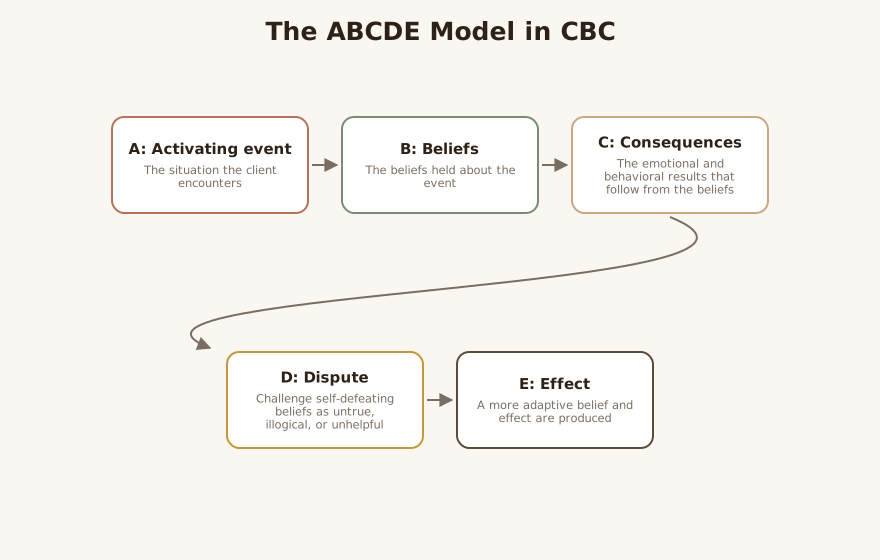
The first principle is the cognitive mediation model: emotional and behavioral consequences follow not from events themselves but from the beliefs held about them 4. CBC operationalizes this through the ABCDE structure, in which an Activating event, the Beliefs about it, and the emotional/behavioral Consequences are made explicit, then the self-defeating beliefs are Disputed and a more adaptive Effect is produced 4. Dispute in this framework is empirical, logical, and functional—asking whether a belief is true, whether it follows, and whether holding it helps 4.
A second principle is agency and reversibility: CBC works on the assumption that “if someone can talk themselves into ineffectiveness, they are also able to talk themselves out of it” 4. This optimistic, change-capable stance fits coaching populations who are functional and motivated rather than impaired LLM.
A third principle is the targeting of performance-interfering thoughts. CBC distinguishes the cognitions that block effective action and performance from those that enable it, and directs intervention at the former so the client can act in line with chosen goals 2. Where REBT-derived work is emphasized, this includes identifying rigid, demanding beliefs (musts, shoulds, awfulizing) and replacing them with flexible, preference-based alternatives 3.
A fourth principle is structure and collaboration: CBC is goal-directed, time-conscious, and explicitly collaborative, relying on between-session practice. It is “most useful” when clients are “highly motivated for homework between sessions,” “want to tackle difficult challenges,” and “can examine their thoughts and feelings” 5. These conditions are simultaneously the modality’s prerequisites and its boundary markers LLM.
Interventions & Techniques
The core technical toolkit is shared with CBT: thought records, “challenging beliefs, identifying biased thinking, and behavioral experiments” applied to coaching goals 5. The ABCDE model serves as the central analytic frame, walking a client from the triggering situation through belief, consequence, dispute, and a re-shaped, more effective outcome 4.
Structured coaching protocols organize these techniques into a workable session arc. The PRACTICE framework—associated with Palmer’s cognitive-behavioral coaching tradition—provides a stepwise sequence moving from problem identification through realistic goal-setting, generation of alternatives, consideration of consequences, targeting the most workable solution, implementation, and evaluation 12. The intent is to graft cognitive restructuring onto an explicit problem-solving and goal-attainment scaffold so that thinking work translates into action LLM.
Disputation and Socratic questioning are the engine of cognitive change, used to test performance-interfering beliefs against evidence and utility, particularly in the REBT-derived rational coaching strand 3. In applied delivery, sessions frequently blend these cognitive methods with adjacent skills—“values, mindful awareness, cognitive reappraisal, cognitive defusion, acceptance, opposite action, distress tolerance, effective communication”—as documented in a real-world video-delivered CBC program 6. This breadth signals that contemporary CBC, while cognitive-behavioral at its core, often integrates third-wave and skills-based elements in practice LLM.
LLM-generated illustrative example (not a guideline): A mid-career manager avoids volunteering for a high-visibility presentation. Using ABCDE, the coach helps surface the Activating event (the opportunity), the Belief (“If I stumble, everyone will see I don’t belong here”), and the Consequence (avoidance, missed advancement). Through Disputation the manager tests the belief’s evidence and utility, arriving at a flexible alternative (“I’d prefer to do well, but a stumble is survivable and recoverable”), then runs a behavioral experiment by presenting at a low-stakes team meeting first LLM.
Evidence Base
CBC’s evidence base is best described as established within coaching psychology—mature enough to support an “evidence based approach” framing in its core edited volume 17—while remaining thinner and less rigorously controlled than the parent CBT literature LLM. The most informative real-world dataset comes from a retrospective analysis of a video- and telephone-delivered CBC program offered through an employer benefit, in which 289 participants completing up to six 45-minute sessions with CBT-trained coaches showed large pre-post improvements: perceived stress (PSS) fell from 18.15 to 13.63 (Cohen’s d = 0.89) and mental wellbeing (WEMWBS) rose from 47.23 to 55.69 (Cohen’s d = 1.09), with roughly 61.9% demonstrating reliable improvement on at least one measure and satisfaction exceeding 95% 6.
These results are encouraging but must be read with their limitations foregrounded: the study had no randomized control group, no fidelity measurement, and substantial attrition, leaving open whether change reflects the intervention or natural improvement over time 6. Importantly, of more than a thousand initial enrollees, 150 were escalated to psychotherapy—a reminder that coaching cohorts contain people whose needs exceed the coaching frame 6. Honest practice therefore treats CBC as a credible, structured approach with promising effectiveness signals and a real but still-developing controlled evidence base, not as an intervention with the trial weight of clinical CBT LLM.
Populations & Indications
CBC is indicated for functional, motivated individuals pursuing goals or performance gains rather than disorder treatment 45. Its natural populations are working adults and professionals, executives and managers, employees referred through workplace wellbeing or employee-assistance programs, students and trainees, and coaching clients without an active clinical disorder 46. The video-delivery effectiveness study drew precisely from this kind of workforce population (mean age ~34) 6.
Indication hinges on readiness for the method. CBC fits best where the client is “highly motivated for homework between sessions,” willing to “tackle difficult challenges,” and able to “examine their thoughts and feelings” 5. For clients who want a strengths-first, deficit-avoiding stance, a positive-psychology coaching frame may fit better than CBC’s problem-and-block focus—a useful triage distinction at intake 5.
Problems-for-Work
CBC explicitly targets sub-clinical, performance-limiting concerns. Named applications include indecisiveness, procrastination, impatience, low self-confidence, and weak assertiveness, with performance anxiety a particularly common focus 4. In practice these map onto everyday coaching presentations LLM:
- Procrastination and follow-through: Use ABCDE to surface avoidance-maintaining beliefs (e.g., low frustration tolerance, “it has to feel right first”) and structure graded action via PRACTICE 41.
- Performance anxiety: Identify and dispute performance-interfering thoughts before high-stakes events, paired with behavioral experiments 25.
- Occupational stress: Apply cognitive reappraisal and skills-based methods; the video-CBC program produced large reductions in perceived stress with this toolkit 6.
- Assertiveness and self-confidence: Restructure self-critical or approval-demanding beliefs and rehearse assertive behavior 4.
- Goal attainment: Use the structured problem-solving arc to convert intentions into implemented, evaluated action 1.
Contraindications, Cautions & Cultural Humility
The central caution is scope: CBC is not therapy and is not designed to treat disorders such as depression 4. When clinical-level distress, risk, or impairment appears, the appropriate move is referral or escalation to psychotherapy rather than continued coaching—a boundary the video-CBC program operationalized by escalating 150 of its enrollees to psychotherapy 6. Clinicians who hold both coaching and therapy roles must be especially clear with clients about which frame is in use and avoid drifting into unbilled, unconsented treatment under a coaching label LLM.
The method is also demanding of the client: it presupposes motivation, capacity for self-examination, and willingness to complete between-session work, and may be a poor fit where those conditions are absent 5. A second caution concerns stance. CBC’s problem-and-block orientation, while effective, can feel deficit-focused; humility about when a strengths-based or culturally resonant frame would serve the client better is warranted, and CBC has no monopoly on coaching outcomes 5. Cultural humility further requires examining what gets labeled a “performance-interfering” or “irrational” belief, since standards of assertiveness, ambition, and emotional expression are culturally shaped and a coach’s defaults are not universal LLM.
Treatment-Plan Suggestions & SMART Objectives
The table below offers example coaching goals and SMART objectives. Note that CBC is a coaching modality for non-clinical, functional concerns; in a clinical setting these structures are adapted to the corresponding therapeutic frame LLM.
| Goal | SMART objective (example) | Mechanism |
|---|---|---|
| Reduce procrastination on a key project | Within 3 weeks, client completes one scheduled 30-minute work block daily on the target task, 5 days/week, logged in a thought-and-action record | ABCDE analysis of avoidance beliefs plus graded behavioral activation 41 |
| Manage performance anxiety before presentations | Before the next 2 presentations, client identifies and disputes at least 3 performance-interfering thoughts in writing, rating belief conviction pre/post | Identification and disputation of performance-interfering cognitions 25 |
| Lower occupational stress | Over 6 sessions, client’s self-rated stress decreases by a meaningful margin on a perceived-stress measure | Cognitive reappraisal and skills-based stress management 6 |
| Increase assertiveness at work | Within 4 weeks, client initiates one assertive request per week and records the outcome | Restructuring approval-demanding beliefs plus behavioral rehearsal 4 |
| Improve decision-making | By session 4, client applies a structured problem-solving sequence to one stalled decision and selects an action | PRACTICE problem-solving and goal-setting scaffold 1 |
| Build follow-through on a development goal | Client implements and evaluates one concrete step toward the goal each week for 4 weeks | Structured implementation and evaluation cycle 12 |
| Reduce self-critical thinking that blocks performance | Within 3 weeks, client replaces rigid self-demands with preference-based alternatives in 3 logged situations | REBT-style disputation of demanding beliefs 3 |
Common Misconceptions
A first misconception is that CBC is just CBT rebranded for clients who refuse therapy LLM. While it shares the cognitive model and core tools, CBC is deliberately bounded to non-clinical, goal- and performance-focused work, and is not intended to treat disorders 45. A second misconception is that the shared toolkit makes the two interchangeable in any direction; clinical-level distress belongs in therapy, and the responsible CBC pathway escalates such cases rather than absorbing them 6.
A third misconception is that CBC’s evidence is as robust as CBT’s LLM. The available real-world data are promising but largely uncontrolled, with notable attrition and no fidelity checks 6. A fourth is that CBC is purely “positive thinking.” It is disciplined cognitive testing—empirical, logical, and functional disputation of specific performance-interfering beliefs—not blanket optimism, and it is explicitly distinct from strengths-first positive psychology coaching 45.
Training & Certification
CBC is delivered by coaches trained in the cognitive behavioral model; in the documented video-delivery program, sessions were provided by coaches “trained in CBT principles” 6. The field’s professional grounding sits within coaching psychology, with the Neenan and Palmer edited volume functioning as a core evidence-based reference and training text 17, and dedicated centers (such as those associated with Palmer’s and Neenan’s REBT/CBC work) offering practitioner instruction 3. There is no single universal credential referenced in the provided sources; clinicians seeking to add CBC should look to recognized coaching-psychology training built explicitly on the cognitive-behavioral model rather than assume their existing CBT license alone defines competent coaching practice LLM.
Key Terms
- ABCDE model: Activating event, Beliefs, Consequences, Disputation, and Effect—the central analytic structure for examining and changing self-defeating beliefs 4.
- PRACTICE model: A structured problem-solving and goal-attainment sequence used to organize CBC sessions from problem identification to evaluation 12.
- Performance-interfering thoughts: Cognitions that block effective action and performance, the primary targets of CBC intervention 2.
- Disputation: Empirical, logical, and functional challenging of self-defeating beliefs 4.
- Rational coaching: Neenan’s REBT-derived strand of CBC emphasizing the disputation of rigid, demanding beliefs 3.
- Behavioral experiment: A planned action used to test the accuracy of a belief and build new learning 5.
Resources & Further Reading
▶ Watch — a video introduction to this concept:
- Neenan, M., & Palmer, S. (Eds.). Cognitive Behavioural Coaching in Practice: An Evidence Based Approach (Routledge)
- Palmer, S., & Williams, H. From Cognitive Behaviour Therapy (CBT) to Cognitive Behaviour Coaching (CBC) (ResearchGate)
- Neenan, M. Rational Coaching: A cognitive behavioural approach (UK Centre for REBT)
- Cognitive Behavioural Coaching (CBC) (Businessballs)
- Cognitive Behavioural Coaching vs Positive Psychology Coaching (Holbeck College)
- Effectiveness of a Cognitive Behavioral Coaching Program Delivered via Video in Real World Settings (PMC)
- Cognitive behavioural coaching in practice: An evidence based approach (APA PsycNet record)
Reflective / Supervision Questions
- When a coaching client’s distress edges toward clinical territory, what concrete signals do I use to decide between continued CBC and referral to therapy, and how do I document that judgment? LLM
- If I hold both coaching and therapy roles, how do I keep the frame explicit for the client and avoid drifting into unconsented treatment under a coaching label? LLM
- Whose standards am I importing when I label a belief “performance-interfering” or “irrational,” and how might the client’s cultural context reshape that judgment? LLM
- Given that CBC’s effectiveness evidence is largely uncontrolled, how do I communicate realistic expectations to clients without overselling the method? 6
- Does this client meet the readiness conditions—motivation, homework willingness, capacity for self-examination—that CBC presupposes, and if not, what alternative serves them better? 5