
Type & Discipline
A commitment device is a behavioral technique, not a therapy or a school of thought 3. It is a voluntary arrangement a person enters in the present in order to bind their own future behavior, typically by adding stakes or removing options so that the later, weaker-willed self is held to the present intention 3. The construct comes from behavioral economics and the economics of self-control, and it belongs to the family of intertemporal-choice tactics — the moves people make to manage the conflict between what they want now and what they want for themselves over time 1. It is a tool, not a model of mind, though it rests on a well-developed account of why such conflict exists 1. For the practicing clinician its value is operational: it offers a concrete, transferable method for converting a client’s stated intention into a structure that the intention can lean on when motivation falters, and it does so in a way that maps cleanly onto behavioral and contingency-based work already in the clinical toolkit LLM. It is best deployed inside an established behavioral framework rather than as a stand-alone treatment LLM.
Creators & Lineage
The intellectual lineage runs through the economics of self-control LLM. The economist Thomas Schelling is the foundational figure, having framed self-control as a strategic problem between a present self and a future self and described the tactics — burning bridges, raising the cost of defection — by which the present self can constrain the future one 3. Richard Thaler and Hersh Shefrin gave the idea a formal economic model in their 1981 paper “An Economic Theory of Self-Control,” which treats the individual as containing both a far-sighted “planner” and a myopic “doer,” and analyzes the rules, devices, and incentives the planner uses to govern the doer 1. This planner–doer framing is the direct theoretical ancestor of the modern commitment device 1.
The construct was then carried into experimental and applied work LLM. Dan Ariely and Klaus Wertenbroch demonstrated in a field experiment that students who were allowed to impose binding, self-chosen deadlines on themselves performed better than those left to a single end-of-term deadline, providing one of the cleanest empirical demonstrations that precommitment improves self-control 2. The behavioral economist Dean Karlan co-founded StickK, a platform that lets people sign binding commitment contracts with real stakes — money forfeited to a charity or “anti-charity” if the goal is missed — and a referee to verify the outcome, operationalizing the device at scale 6. Katherine Milkman extended the lineage with the idea of temptation bundling, pairing an activity a person knows they should do with one they want to do, so that the desirable activity helps power the difficult one 4. Thaler and Cass Sunstein later folded commitment devices into the broader popular framework of “nudges,” choice-architecture moves that steer behavior while preserving freedom of choice 7. The deeper roots reach into operant conditioning and contingency management, where behavior is shaped by arranged consequences, and into self-control and delay-discounting research, which studies why distant rewards lose their grip LLM.
Core Principles
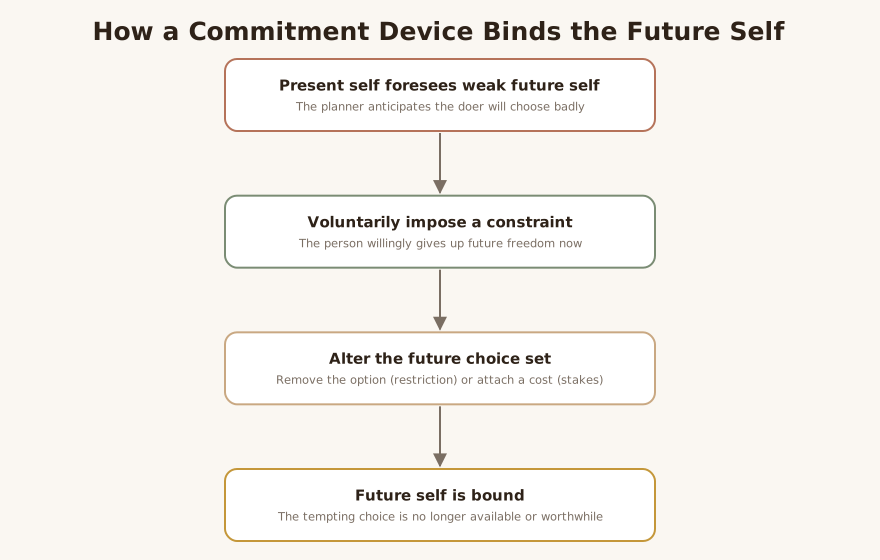
The animating principle is intrapersonal conflict across time: a person’s present self and future self can want genuinely different things, and the present self, foreseeing that the future self will be weak, acts to constrain it 3. In the Thaler–Shefrin model this is the planner trying to govern the doer; the planner cannot simply order the doer to behave, so it changes the doer’s incentives and options instead 1. A commitment device is the instrument of that governance 1.
From this follow several working principles LLM. First, the device is voluntary and self-imposed — the person willingly gives up future freedom now, accepting a constraint precisely because they do not trust their later self to choose well 3. Second, it works by altering the future choice set or its payoffs: it either removes a tempting option entirely or attaches a cost to it that makes the tempting choice no longer worthwhile 3. The two broad mechanisms are therefore restriction (eliminating the option, as when a person does not keep alcohol in the house) and stakes (raising the price of defection, as when money is put at risk) 4.
Third, the device must be binding enough to matter but not so rigid as to be harmful — its force comes from being genuinely costly to escape, which is also what creates its risks 3. Fourth, the underlying problem it addresses is present bias: the disproportionate pull of immediate rewards over larger later ones, which is why a person sincerely intends to study, save, or abstain and then does the opposite when the moment arrives LLM. Temptation bundling adds a fifth principle — that a single immediate reward can be borrowed to power a difficult behavior, so the “want” makes the “should” happen now rather than the device only punishing failure later 4.
Interventions & Techniques
In practice, commitment devices fall into a small number of recognizable forms LLM. The simplest is the binding deadline: a person imposes interim due dates on themselves rather than relying on a single distant one, which Ariely and Wertenbroch showed measurably improves follow-through 2. A second is the financial stake, the form StickK operationalizes — the person names a goal, a referee, and an amount of money that is forfeited if the goal is missed, often to a cause they dislike so the loss stings more 6. A third is restriction of access, removing the tempting option from the environment so the future choice never arises, such as deleting an app, locking food away, or self-excluding from a casino 4.
Temptation bundling is a distinct and clinically attractive technique because it adds a reward rather than only a punishment: the person permits themselves a “want” activity only while doing a “should” activity — listening to an addictive audiobook only at the gym, watching a favorite show only while folding laundry — so that the pleasurable activity becomes contingent on the difficult one 4. Social and public commitments form a further category, where announcing a goal to others, or designating a witness, raises the social cost of quitting 6. Across all forms the design logic is the same: make the desired behavior the path of least resistance and the undesired behavior costly, slow, or impossible 4.
The clinical contribution is to help the client design a device that is well-matched to the problem — neither so weak that it is ignored nor so harsh that failure becomes catastrophic — and to fit it within a behavioral plan that also addresses the skills and motivation behind the goal LLM. The device is the scaffolding; it does not replace the building LLM.
LLM-generated illustrative example (not a guideline): A clinician working with a client who wants to stop late-night online shopping helps the client move the credit card to a different room, remove saved payment details from the apps, and agree that any purchase after 10 p.m. is reported to a trusted friend. The pair also bundle the urge with a substitute reward — a favorite podcast saved only for evenings — so the difficult behavior of not shopping comes with an immediate “want.” LLM
Evidence Base
The maturity of commitment devices is best described as established — as a behavioral phenomenon and applied tool with real empirical support, though not as a manualized clinical treatment with its own trial base 2. The core claim that voluntary precommitment improves self-control has direct experimental backing: Ariely and Wertenbroch’s deadline study is a well-cited demonstration that people who bind their future selves outperform those who do not, and that they will choose to do so when given the chance 2. The theoretical foundation is similarly solid, with the Thaler–Shefrin planner–doer model providing a coherent economic account of why such devices work 1. The approach has been operationalized and deployed at population scale through platforms like StickK and popularized within the evidence-informed “nudge” literature 67.
Honesty requires several caveats for clinical use LLM. First, “established” describes the standing of the behavioral-economic phenomenon and the broad finding that precommitment helps; it does not certify any specific commitment-device protocol as an evidence-based therapy for a particular disorder LLM. Second, much of the supporting evidence comes from field and laboratory studies of ordinary goals — deadlines, saving, exercise — rather than from clinical trials in disordered populations, so the transfer to substance use disorder, gambling disorder, or binge eating is plausible and consistent with contingency-management evidence but is itself an extrapolation LLM. Third, devices vary widely in design and binding strength, and a poorly designed device can fail or backfire, so effectiveness is not a property of the idea but of the specific arrangement 3. The clinical inferences drawn here — about matching device to client, integrating with skills work, and watching for harm — are reasoned extensions of behavioral practice, not direct findings from the commitment-device literature LLM.
Populations & Indications
Commitment devices are most useful wherever a presentation turns on a gap between a sincere intention and the behavior that follows when temptation arrives LLM. People with substance use disorders are a natural application, since restricting access (not keeping the substance at home) and adding stakes are concrete ways to support an abstinence intention against in-the-moment craving 4. Smokers seeking cessation can use deposit-and-forfeit contracts and public commitments to raise the cost of relapse 6. People with behavioral addictions such as gambling disorder are well served by access-restriction devices, of which casino self-exclusion is the paradigm case — a person bans themselves in advance from a setting their future self cannot be trusted to resist 4.
Beyond addiction, individuals with obesity or overeating can use both restriction (keeping tempting food out of reach) and temptation bundling to support dietary goals 4. Adults struggling with procrastination or academic difficulties are the population in which precommitment was most directly demonstrated, through self-imposed binding deadlines 2. Adults with financial or saving difficulties can use commitment savings accounts and automatic transfers that make the future-oriented choice the default and the impulsive one costly 7. Across all of these, the device is an adjunct that operationalizes a goal, not a diagnosis-specific cure LLM.
Problems-for-Work
Procrastination. The construct supplies the cleanest demonstrated remedy: replacing a single distant deadline with self-imposed interim deadlines that bind the future self to steady progress, which improved performance in the original study 2.
Substance use disorder. Restriction-of-access and stakes-based devices give a client tangible ways to support abstinence between sessions — removing the substance from the environment, naming a witness, attaching a cost to use — that complement the skills and motivational work of treatment 4.
Gambling disorder. Self-exclusion is a textbook commitment device: the person uses their present resolve to ban their future self from the setting, closing the choice before craving can reopen it 4.
Impulsivity and poor self-regulation. Devices externalize self-control, moving it out of the unreliable moment of temptation and into a structure arranged in advance, which is the core logic of the planner constraining the doer 1.
Goal non-adherence and weight management. Temptation bundling reframes adherence by attaching an immediate “want” to the difficult “should,” so that the desired behavior carries its own reward rather than depending on willpower alone 4.
LLM-generated illustrative example (not a guideline): A client with a gambling disorder and the clinician review the client’s pattern of “deciding not to go” and then going anyway. Together they enroll the client in a formal self-exclusion program and set up a binding rule that the client’s paycheck is deposited into an account the client cannot access from a phone. The clinician frames both as ways the client’s planning self protects against the moment when craving takes over. LLM
Contraindications, Cautions & Cultural Humility
Because a commitment device is a tool rather than a treatment, its dangers come from misuse and overuse rather than from the idea itself LLM. The first caution is that a device strong enough to bind is also strong enough to harm: a harsh financial stake can deepen distress and shame when a client with an addiction or a mood disorder inevitably has a lapse, turning a normal slip into a punishing loss LLM. The clinician should help size the stakes so that failure is informative rather than catastrophic LLM. Second, restriction-based devices can collide with safety and autonomy: locking away food is contraindicated where it could feed an eating-disorder dynamic, and any device that removes a person’s options must be weighed against their right to change their mind for good reasons LLM. Third, a device can become a way to avoid the underlying skills, motivation, or ambivalence that drive the behavior, so it should accompany — not replace — that clinical work LLM.
Cultural humility matters in two ways LLM. First, what counts as an acceptable stake, an appropriate public commitment, or a tolerable loss of freedom varies across individuals and cultures, and a clinician should not assume the textbook device fits a given person’s circumstances, finances, or relationships LLM. Second, the entire framing of self-control as an individual’s “planner” governing an individual’s “doer” is culturally situated; for many clients goals are pursued and sustained within family and community systems, and a device built around social and relational accountability may fit far better than one built around private monetary stakes LLM. The clinician should offer the device collaboratively, co-design it to the client’s life, and revise or abandon it when it does not fit the person in the room LLM.
Treatment-Plan Suggestions & SMART Objectives
| Goal | SMART objective (example) | Mechanism |
|---|---|---|
| Reduce procrastination on a stalled task | Client sets 3 self-imposed interim deadlines for a project and meets 2 of 3 over 3 weeks | Binding deadlines constrain the present-biased future self 2 |
| Support abstinence between sessions | Client removes the substance from the home environment and confirms removal by next session | Restriction eliminates the tempting option before craving arises 4 |
| Add accountability to a behavior-change goal | Client names one witness and reports adherence to them 5 of 7 days for 4 weeks | Public commitment raises the social cost of defection 6 |
| Make a difficult routine self-rewarding | Client pairs one “want” activity with one “should” activity on 5 of 7 days for 3 weeks | Temptation bundling attaches an immediate reward to the hard behavior 4 |
| Reduce impulsive spending | Client removes saved payment details from 3 apps and routes income to a less-accessible account within 2 weeks | Choice-architecture friction makes the impulsive option costlier 7 |
| Close the gambling choice in advance | Client completes a formal self-exclusion enrollment within 2 weeks | Self-exclusion binds the future self out of the high-risk setting 4 |
| Attach a meaningful stake to a goal | Client sets one deposit-contract stake on a weekly goal and reviews outcomes for 4 weeks | A forfeitable stake raises the price of missing the goal 6 |
| Strengthen saving behavior | Client establishes one automatic transfer making saving the default by session 4 | Defaults make the future-oriented choice the path of least resistance 7 |
Common Misconceptions
A frequent misreading is that a commitment device is just willpower or motivation by another name 3. In fact its whole point is to substitute for willpower in the moment of temptation: the person acts in advance precisely because they expect their later self to lack the willpower, and the device removes the need to summon it 3. A second misconception is that a device must involve money or punishment; restriction of options and temptation bundling work without any stake, and bundling adds a reward rather than a penalty 4. A third is that more binding is always better — a device too harsh to survive a normal lapse can backfire into shame and abandonment of the goal, so the right strength is the issue, not maximum severity LLM. A fourth is that commitment devices are a stand-alone treatment for addictions or impulse problems; the evidence supports them as tools that operationalize a goal, best used inside a fuller behavioral and motivational plan LLM. Finally, some treat the planner–doer split as a literal claim about two selves; it is a useful model of intertemporal conflict, not a clinical account of dissociation 1.
Training & Certification
There is no certification, credential, or formal training pathway specific to commitment devices, because they are a behavioral technique rather than a practice modality LLM. Clinicians typically encounter the idea within behavioral economics, behavior-change coursework, or the applied “nudge” literature, and through the primary sources — the Thaler–Shefrin model and the Ariely–Wertenbroch experiment 12. Accessible explainer summaries and Ariely’s public talks lay out the everyday logic and are sufficient for most conceptual use 45. Applied platforms such as StickK demonstrate how the device is structured in practice, including the roles of stakes, referees, and consequences 6.
For competent clinical application, the relevant training is in the established behavioral methods the device fits inside — contingency management and operant techniques within behavioral and cognitive behavioral therapy, motivational interviewing for the ambivalence that surrounds change, and relapse-prevention planning — each with its own evidence base and training routes LLM. The most useful preparation is therefore to learn the technique well enough to co-design sound devices with clients while building credentialed skill in the treatments it complements LLM.
Key Terms
Commitment device: a voluntary, self-imposed arrangement that binds one’s future behavior by removing options or adding stakes, used to hold a later, weaker-willed self to a present intention 3.
Planner–doer model: Thaler and Shefrin’s account of the individual as containing a far-sighted “planner” and a myopic “doer,” in which self-control is the planner’s effort to govern the doer through rules and incentives 1.
Precommitment: the act of constraining one’s own future choices in advance, demonstrated to improve self-control when people impose binding deadlines on themselves 2.
Temptation bundling: pairing a “want” activity with a “should” activity so that the desirable one is permitted only alongside the difficult one, lending the hard behavior an immediate reward 4.
Stakes (deposit contract): a commitment device in which money or another valued thing is forfeited if the goal is missed, raising the cost of defection, often with a referee to verify the outcome 6.
Restriction of access: a device that removes the tempting option from the environment so the future choice never arises, as in casino self-exclusion or keeping a substance out of the home 4.
Present bias: the disproportionate weighting of immediate rewards over larger delayed ones, the self-control failure that commitment devices are built to counter LLM.
Nudge: a choice-architecture intervention that steers behavior toward a goal while preserving freedom of choice, the broader family within which commitment devices are often placed 7.
Resources & Further Reading
▶ Watch — a video introduction to this concept:
- An Economic Theory of Self-Control (Thaler & Shefrin, Journal of Political Economy 1981)
- Procrastination, Deadlines, and Performance: Self-Control by Precommitment (Ariely & Wertenbroch, Psychological Science)
- Commitment device — Wikipedia
- What are commitment devices? Binding future behaviour — SUE Behavioural Design
- Dan Ariely: Self control (TEDxDuke)
- StickK — commitment contract platform
- Nudge: Improving Decisions About Health, Wealth, and Happiness (Thaler & Sunstein)
Reflective / Supervision Questions
- When you help a client set up a commitment device, how do you size the stakes so that a normal lapse is informative rather than shaming, and how do you decide when a device is too harsh to use? LLM
- How do you tell whether a client needs a commitment device or whether the device would let them avoid the underlying ambivalence, skill gap, or motivation that is really driving the behavior? LLM
- For a client whose goals are embedded in family or community, how might a relational or social commitment device fit better than a private financial one? LLM
- Where in your caseload would a restriction-based device risk colliding with safety — an eating-disorder dynamic, for instance — and how would you assess that before recommending it? 3
- How do you introduce the planner–doer framing so it normalizes the client’s experience of “deciding one thing and doing another” rather than implying a failure of character? 1
- When a self-imposed deadline or stake works for a client, how do you help them generalize the skill rather than become dependent on ever-stronger external devices? 2