
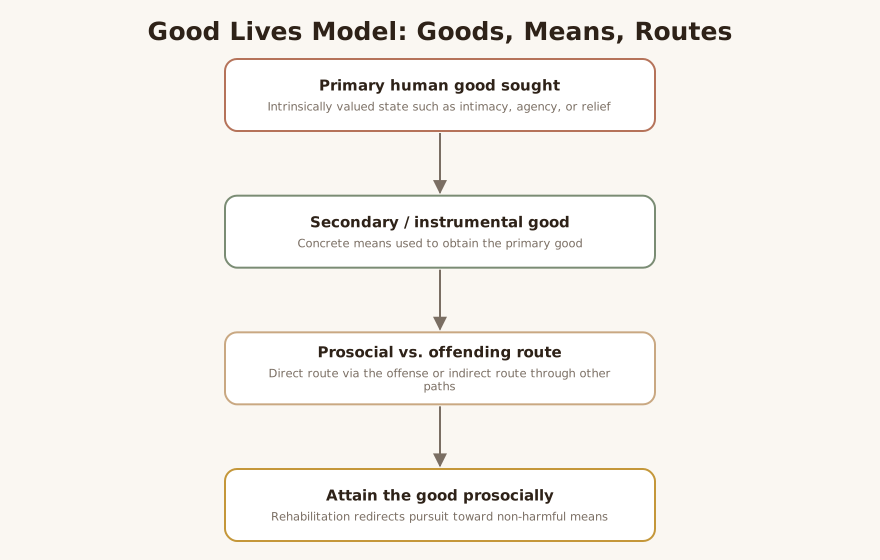
The Good Lives Model (GLM) is a strengths-based framework for rehabilitating people who have offended, organizing treatment around the things a person needs to live a worthwhile life rather than around deficits alone 1. It is documented as an established framework across multiple reference and encyclopedia treatments of offender rehabilitation 567. This article orients practicing clinicians to its structure, evidence, and concrete application, and is honest about where the model is strong (theory, engagement, adoption) and where it is still thin (controlled outcome data) LLM.
Type & Discipline
The GLM is a rehabilitation framework, not a discrete manualized therapy LLM. It sits within forensic psychology and the broader family of offender rehabilitation, and it is most accurately understood as an overarching theory of treatment that gives shape and direction to the specific interventions delivered within it 7. In practice this means a clinician does not “do GLM” the way one delivers a session of exposure therapy; rather, GLM provides the case-conceptualization and goal-setting scaffolding around an actual treatment modality such as cognitive behavioral therapy, the Risk-Need-Responsivity approach, or mentalization-based work 24. Reference catalogues of counseling approaches list it as a standalone strengths-based therapeutic approach focused on values, goals, aspirations, and overall well-being 1.
Because it is a meta-framework, its “interventions” are largely organizational and motivational: how you formulate the case, how you frame goals with the client, and how you sequence prosocial skill-building LLM. This is the single most common source of confusion for clinicians new to the model and is worth naming early LLM.
Creators & Lineage
The GLM was developed by Tony Ward and colleagues in the early 2000s as a response to perceived limitations of purely risk-management approaches to rehabilitation 5. It draws conceptually on desistance research — the study of how and why people stop offending — including the redemption-and-identity work associated with Shadd Maruna, whose narrative account of how former offenders reconstruct a prosocial self informs the GLM’s emphasis on identity and meaning LLM. Ongoing development and clinical operationalization have been carried forward by collaborators including Gwenda Willis and David S. Prescott, who co-authored the model’s first formal fidelity-monitoring tool with Ward 3.
The model is best read against its sibling and counterpoint, the Risk-Need-Responsivity (RNR) model LLM. RNR organizes treatment around assessing risk, targeting criminogenic needs (dynamic risk factors), and matching intervention to the client’s learning style. The GLM does not reject those targets; it reframes them, arguing that risk factors are best understood as internal or external obstacles to a person securing a good life, so that reducing risk and building a fulfilling life are two sides of the same intervention LLM. Several of the provided sources position the GLM as integrating, rather than discarding, risk-need-responsivity principles and cognitive behavioral technique 2.
Core Principles
The model rests on a small set of theoretical commitments. First, all people — including those who have offended — naturally seek primary human goods: states of affairs, experiences, and characteristics that are intrinsically valuable to human beings LLM. The commonly cited set of primary goods includes life (healthy living and functioning), knowledge, excellence in play, excellence in work (including mastery experiences), excellence in agency (autonomy and self-directedness), inner peace (freedom from emotional turmoil and stress), relatedness (intimate, romantic, and family relationships), community, spirituality (meaning and purpose), pleasure, and creativity LLM.
Second, secondary or instrumental goods are the concrete means by which primary goods are obtained — a job, a relationship, a hobby, a substance, an offense LLM. Offending, in this view, is frequently a maladaptive or destructive route to a normal human good: a person may pursue intimacy, control/agency, or relief from distress through behavior that harms others LLM.
Third, offending is theorized to arise through two broad routes LLM:
- A direct route, where the offense is itself the chosen means of securing a good (for example, pursuing intimacy or sexual gratification directly through an offense).
- An indirect route, where the pursuit of one good creates ripple effects — frustration, conflict, dysregulation, substance use — that culminate in offending.
Fourth, four kinds of problems in a person’s “good lives plan” become treatment targets: using harmful means to reach goods; lack of scope (a narrow, impoverished range of goods); conflict among goods or incoherence in how they are pursued; and capacity deficits — internal (skills, beliefs) or external (resources, opportunity) — that prevent the person from securing goods prosocially LLM. The therapeutic aim is a coherent, individualized Good Lives Plan that helps the client attain their valued goods through prosocial means while simultaneously addressing risk LLM.
Interventions & Techniques
GLM-informed work typically moves through a recognizable sequence, delivered inside a host modality LLM:
- Identify the client’s valued primary goods. Through collaborative interviewing, the clinician learns which goods the client most weights — agency, relatedness, inner peace — and how the offending behavior was (dysfunctionally) serving them LLM.
- Map the offense onto the goods. The clinician and client articulate which goods were being sought and through what harmful means, and where the plan showed problems of means, scope, conflict, or capacity LLM.
- Build the Good Lives Plan. Together they design prosocial routes to the same valued goods, and identify the internal capacities (emotion regulation, social skills, perspective-taking) and external conditions (housing, employment, supports) needed to realize them LLM.
- Deliver capacity-building through an evidence-based modality. This is where actual technique lives — CBT for cognitive distortions and skills, RNR-targeted work on criminogenic needs, or mentalization-based treatment for clients with antisocial personality features whose deficits in understanding mental states undermine relatedness and agency 24.
Byrne’s analysis argues that mentalization-based treatment and the GLM share substantial theoretical common ground and can be embedded together in forensic communities, with MBT supplying a mechanism (improved mentalizing) for the relational and agency goods the GLM prioritizes 4. This kind of pairing illustrates the model’s intended use: GLM as the organizing frame, a manualized therapy as the engine LLM.
LLM-generated illustrative example (not a guideline): A clinician working with a client on community supervision learns that the client most values agency and relatedness. The offense — repeated property theft — had been an indirect route: chronic powerlessness and isolation drove impulsive risk-taking that “felt like control.” The Good Lives Plan reframes the work around legitimate sources of agency (vocational training, a structured role) and relatedness (a recovery community), while CBT targets the impulsive decision chain. Risk reduction and a more livable life are pursued as one project. LLM
Evidence Base
The honest picture: the GLM is established as a framework — theoretically mature, widely adopted internationally, and well-documented in the reference literature — but the controlled outcome evidence that it reduces recidivism is still limited and mixed, and is not settled by the provided sources 567LLM. Much of the early literature is conceptual and case-formulation-oriented rather than randomized LLM.
A central, well-evidenced caveat comes from the fidelity literature: Prescott, Willis, and Ward developed the first tool to monitor therapist fidelity precisely because “programs claiming to use the GLM vary substantially in the extent to which the GLM informs treatment” 3. In other words, two programs both calling themselves GLM may be doing markedly different things — which makes outcome research harder to interpret and makes fidelity monitoring a clinical priority, not an afterthought 3. Their tool organizes fidelity into fundamental therapeutic processes, GLM-specific processes, and client-focused case-formulation questions 3.
For specific populations, the evidence is emerging rather than mature. In the literature on women who commit sexual offenses, reviewers note there are no empirically derived treatment models built on a comprehensive theoretical paradigm, and propose the GLM as an integrating structure rather than a proven protocol 2. Clinicians should present the model to clients and supervisors as a clinically coherent, engagement-friendly framework whose recidivism-outcome base is still developing LLM.
Populations & Indications
The GLM was developed primarily in work with people who have committed sexual offenses and has since been extended across forensic populations LLM. Indicated and studied populations in the provided literature include:
- Women who have committed sexual offenses, where the GLM is proposed as an overarching framework that integrates gender-responsive and gendered strength-based treatment, recognizing that women’s pathways to offending differ from men’s, and combining strengths-based work, risk-need-responsivity principles, cognitive behavioral technique, and relational process 2.
- Individuals with antisocial personality features in forensic services, for whom the GLM pairs well with mentalization-based treatment 4.
- Justice-involved adults more broadly, including those on community supervision or in reentry, where the model’s emphasis on a livable, prosocial future supports desistance and engagement LLM.
It is also used with adolescents in youth justice settings, where building a positive future identity is developmentally apt LLM.
Problems-for-Work
The model maps cleanly onto several clinical problems-for-work LLM:
- Offending and reoffending risk. The GLM treats risk factors as obstacles to a good life, so a problem-for-work is reframed from “managing risk of property offending” to “building prosocial routes to agency and stability that reduce property-offending risk” LLM.
- Low motivation in mandated treatment. Because the model starts from what the client values rather than what they have done wrong, it is well suited to clients who are defensive, shame-laden, or coerced into treatment; the problem-for-work is “engagement and approach-goal motivation” LLM.
- Maladaptive strategies for meeting normal needs. When intimacy, control, or distress-relief have been pursued through harmful means, the problem-for-work is building prosocial means to the same goods LLM.
- Identity and meaning deficits. Drawing on desistance and redemption narratives, the problem-for-work can be the construction of a coherent prosocial self LLM.
- Reintegration after incarceration. The Good Lives Plan operationalizes the external conditions (housing, work, community) and internal capacities needed for reentry LLM.
Contraindications, Cautions & Cultural Humility
The GLM is not a standalone treatment, and using it as one is the principal misuse: it must wrap an evidence-based modality that supplies the actual change mechanism, or it risks becoming pleasant goal-talk with no risk reduction LLM. Clinicians should never let the strengths-based framing eclipse genuine risk assessment and management; the model is explicit that securing goods and reducing risk are pursued together, not traded off LLM.
A specific caution: in higher-risk cases, a poorly supervised GLM emphasis on the client’s “valued goods” can be exploited or can drift away from victim safety. Fidelity monitoring and supervision are the safeguard, which is part of why a formal fidelity tool was developed 3.
On cultural humility: primary human goods are framed as universal, but how they are weighted, named, and pursued is profoundly shaped by culture, gender, and context LLM. The women-who-offend literature is a direct caution against importing a male-derived model wholesale — pathways, relational context, and trauma histories differ, and the framework must be applied in a gender-responsive way 2. Clinicians should treat the client as the authority on what their goods mean and resist substituting the clinician’s own vision of a good life LLM.
Treatment-Plan Suggestions & SMART Objectives
| Goal | SMART objective (example) | Mechanism |
|---|---|---|
| Clarify valued primary goods | Within 4 sessions, client will name their top three primary goods and one harmful past means for each, documented in a Good Lives Plan | Collaborative formulation; approach-goal motivation |
| Build prosocial route to agency | Within 8 weeks, client will enroll in and attend ≥80% of a vocational/skills program serving the “agency/work” good | Secondary-goods substitution; capacity-building (external) |
| Strengthen relatedness prosocially | Over 90 days, client will establish two prosocial supports and attend a community group weekly | Capacity-building; desistance-supportive identity |
| Improve emotion regulation (inner peace) | Within 6 sessions of CBT, client will demonstrate two distress-tolerance skills rated ≥3/5 in session | Internal-capacity building; indirect-route interruption |
| Develop perspective-taking | Within 12 sessions of mentalization-based work, client will accurately describe another’s mental state in 3 of 4 reviewed incidents | Mentalizing capacity supporting relatedness/agency |
| Reduce reoffending risk | Over 6 months, client will show a measurable decrease on the program’s dynamic risk measure | Risk reframed as obstacles to goods; integrated RNR targeting |
| Build a coherent prosocial identity | Within 90 days, client will articulate a future self-narrative linking valued goods to non-offending roles | Redemption/desistance narrative work |
Common Misconceptions
- “GLM is soft on risk / ignores risk.” It does not; it reframes risk factors as obstacles to a good life and pursues risk reduction and a livable life together LLM. The provided literature describes it integrating risk-need-responsivity principles, not replacing them 2.
- “GLM is a standalone therapy you can deliver by itself.” It is an organizing framework that requires a host modality to supply technique and mechanism 7LLM.
- “GLM means giving clients whatever they want.” The work is about prosocial means to legitimate goods, not endorsing every secondary good a client names LLM.
- “If a program calls itself GLM, it is doing GLM.” Implementation varies substantially; fidelity must be measured, not assumed 3.
- “The goods are fully universal and culture-neutral.” The goods are framed as universal, but their weighting and expression are culturally and gender-specific and require humility in application 2LLM.
Training & Certification
There is no single licensing body or formal “GLM certification” that governs practice; competence is built through the published literature, GLM-specific training delivered by its developers and affiliated trainers, and ongoing supervision LLM. The most concrete fidelity-oriented resource in the provided literature is the GLM fidelity-monitoring tool, which is explicitly designed to support supervision conversations and help teams answer “how well are we implementing the GLM?” 3. Clinicians should treat structured fidelity monitoring and supervision as the practical pathway to competent GLM practice, layered on top of credentialed training in whatever host modality (CBT, MBT, RNR-based programming) they are delivering 34LLM.
Key Terms
- Primary human goods — intrinsically valuable experiences and states (e.g., relatedness, agency, inner peace) that all people seek LLM.
- Secondary / instrumental goods — the concrete means used to obtain primary goods (a job, a relationship, an offense) LLM.
- Direct route — offending as the chosen means of securing a good LLM.
- Indirect route — offending arising from the ripple effects of pursuing goods (frustration, dysregulation, conflict) LLM.
- Good Lives Plan — the individualized, prosocial plan for attaining valued goods while reducing risk LLM.
- Problems of means / scope / conflict / capacity — the four ways a person’s pursuit of goods can go wrong and become treatment targets LLM.
- Fidelity — the degree to which delivered treatment actually reflects GLM principles, now formally measurable 3.
Resources & Further Reading
▶ Watch — a video introduction to this concept:
- Prescott, Willis & Ward — Monitoring Therapist Fidelity to the Good Lives Model 3
- Pflugradt & Allen — The Application of the Good Lives Model to Women Who Commit Sexual Offenses 2
- Byrne — How the Good Lives Model Can Complement Mentalization-Based Treatments 4
- Good Lives Model — Springer encyclopedia entry 5
- Good Lives Model — SAGE Encyclopedia of Criminal Psychology 6
- Good Lives Model — book chapter 7
- Luke Allen — Comprehensive List of Counseling Theories: Good Lives Model 1
Reflective / Supervision Questions
- When I describe my work as GLM-informed, which actual modality is supplying the change mechanism — and could I name it to a supervisor? 3LLM
- Am I holding risk reduction and a livable life as one project, or have I let the strengths framing quietly displace risk management? LLM
- Whose vision of “the good life” is in the Good Lives Plan — the client’s, or mine? LLM
- For this client, am I applying primary goods in a culturally and gender-responsive way, or importing a default template? 2LLM
- Where in this client’s history do I see the direct versus indirect route, and does my plan address the right one? LLM
- How would I score my own fidelity to GLM principles this month, and what would the score change if I were honest about it? 3LLM