
Type & Discipline
Goffman’s “moral career” is a sociological construct, not a treatment, diagnosis, or stand-alone therapy LLM. It originates in the discipline of sociology, within the symbolic-interactionist tradition, and it describes a process of identity change rather than prescribing any intervention 1. The concept names the “regular sequence of changes” in a person’s self-conception and in the framework of imagery by which they judge themselves and others, a sequence that a person undergoes as they move into and through a particular social status 4. Goffman applied it most famously to the status of “mental patient,” tracing the patterned alterations in self that accompany the passage into psychiatric care 2.
For a clinician, the value of moral career is not that it is something one delivers in session, but that it supplies a precise vocabulary and a developmental map for a recognizable class of presenting problems: the disorientation, grief, demoralization, and identity disturbance that follow being inducted into a devalued status LLM. Because it is a descriptive frame rather than a modality, it travels across treatment approaches and informs how a therapist reads a newly diagnosed patient, a psychiatric service user, or a person entering recovery, rather than constituting a therapy in itself LLM. Goffman’s central claim is that this transformation of self is not primarily a symptom of the underlying condition but a social product — the predictable result of how others, institutions, and the person themselves come to redefine who they are 1.
The construct has both an objective and a subjective side, and holding the two together is the point 4. Objectively, a moral career is the sequence of changes in a person’s formal social position and the public, official ways their identity is established 4. Subjectively, it is the corresponding shift in the person’s own felt sense of self, of “what sort of person” they have become, so that the same passage is at once a movement through a social structure and a transformation of inner life 4.
Creators & Lineage
The concept was developed and named by the Canadian-American sociologist Erving Goffman, most influentially in the essay “The Moral Career of the Mental Patient,” one of the four essays collected in his 1961 book Asylums: Essays on the Social Situation of Mental Patients and Other Inmates 3. Goffman’s empirical base for that work was an ethnographic field study conducted in 1955 and 1956 at a large federal psychiatric hospital, where he observed daily life largely from the patients’ point of view rather than the staff’s 3. The method was the engine of the theory: by attending closely to how patients experienced their own induction into the institution, Goffman reconstructed the staged transformation of self that the system produced 5.
Goffman borrowed the language of “career” deliberately and provocatively, lifting a term ordinarily reserved for respectable occupational progress and applying it to the passage into a stigmatized status 1. The move strips the word of its individualistic, achievement-oriented connotation and reframes identity change as something patterned, public, and socially scheduled rather than purely private and idiosyncratic 1. In Goffman’s usage the “moral” in moral career does not mean ethical virtue; it refers to the changes in the moral framework — the standards of self-judgment, the imagery of worth and worthlessness — through which a person comes to evaluate themselves 4.
The construct sits at the heart of Goffman’s larger project on the presentation and management of the self and is tightly bound to his work on stigma and spoiled identity, so that the moral career of the mental patient is in large part a career in acquiring and absorbing stigma 2. It therefore belongs to a family of mid-twentieth-century symbolic-interactionist work on how social settings construct, label, and degrade identity, and it has been read forward into the sociology of health, illness, and recovery 6. That the concept remains continuously taught, anthologized, and cited marks it as an established, foundational idea rather than a settled empirical law 7.
Core Principles
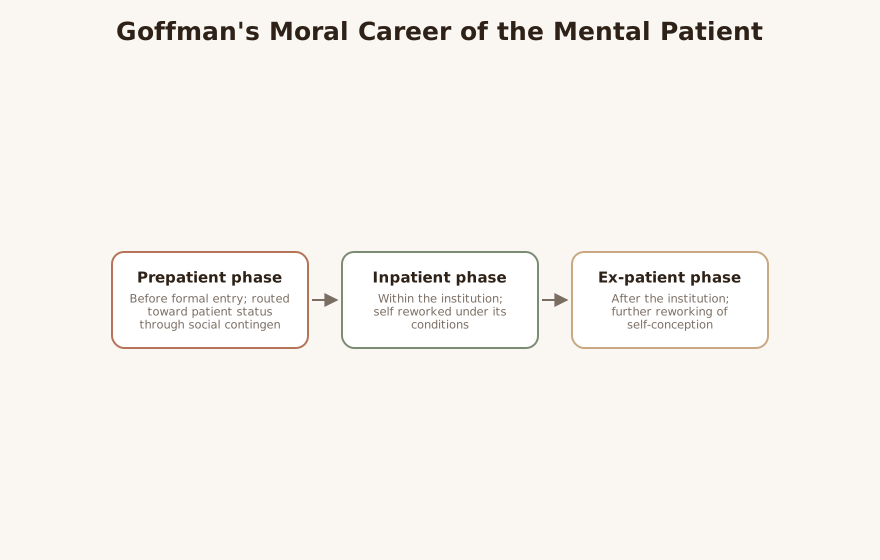
The first principle is that identity change of this kind is sequenced and patterned, not random 4. A moral career is a regular series of changes through which like-situated people tend to pass in a similar order, which is what makes the experience of one mental patient, or one newly diagnosed person, recognizably comparable to another’s 4. Goffman’s account of the mental patient’s career is conventionally described as moving through phases — a “prepatient” phase before formal entry, an “inpatient” phase within the institution, and an “ex-patient” phase afterward — each with its own characteristic reworking of self 5.
The second principle is that the transformation is interactional and contingent, produced by what Goffman called the person’s “contingencies” — the often arbitrary social circumstances, the actions of family members, complainants, and officials, that determine whether and how someone is routed into the patient status in the first place 5. Who ends up labeled is shaped less by the severity of an inner condition than by a “betrayal funnel,” the sequence of encounters in which the people closest to the prepatient — relatives, a referring physician, the institution — successively hand them along into patienthood, often experienced by the person as a series of betrayals by those they trusted 5. The self that emerges is thus the joint product of the person’s circumstances and the actions of a “circuit of agents” who process them 5.
The third principle is that the moral career reworks the moral framework of self-judgment, not merely the person’s external situation 4. As a person moves into a devalued status, the very standards by which they appraise their own worth shift, so that experiences and behaviors that once read as ordinary become evidence, retrospectively, of having “been sick all along” 1. This is the subjective core of the concept: a reorganization of self-imagery in which the person learns to see their own past and present through the lens of the new status, a process with obvious bearing on internalized stigma and demoralization 2.
Interventions & Techniques
Because moral career is a sociological construct rather than a therapy, there are no “moral-career techniques”; the concept works by shaping formulation and is then operationalized through recognized modalities LLM. The first practical move is staging: locating where a client sits in the arc of induction into a status — newly facing a diagnosis, deep in the patient role, or trying to build a life beyond it — and tailoring the clinical task to that phase rather than treating identity distress as a single undifferentiated problem 5. A person in the prepatient phase, reeling from how they were routed into the system, needs something different from a long-term service user reconstructing a self that is not exhausted by the patient role LLM.
A second move is externalizing the career from the person: helping a client see that much of the change in how they view themselves is a socially produced sequence, not direct evidence of being a lesser or broken person, which can loosen the grip of internalized stigma and the retrospective re-reading of one’s whole life as pathology 1. This maps closely onto the externalizing and re-authoring practices of narrative therapy, where the problem-saturated story is separated from the person’s identity LLM. A third move is naming the betrayal funnel where it applies — making discussable the often unspoken sense of having been handed along or let down by family and professionals during a hospitalization, so that the resulting mistrust is validated as an intelligible response rather than dismissed as paranoia or non-compliance 5. These moves are delivered through the clinician’s primary modality; the construct supplies the why and what to look for, while the modality supplies the how LLM.
LLM-generated illustrative example (not a guideline): A client recently discharged after an involuntary admission says, “I guess I’ve been crazy my whole life — I just couldn’t see it.” Using the moral-career frame, the clinician hears this not as insight to be reinforced but as the subjective signature of the career: the new status reorganizing the client’s self-imagery so that an ordinary past is rewritten as pathology. The clinician gently separates the social process from the person, validates the felt betrayal of how the admission unfolded, and orients the work toward a self-story in which “patient” is one chapter rather than the whole biography LLM.
Evidence Base
The honest appraisal is that moral career is an established and durably influential sociological construct, continuously taught and cited since 1961, but it is a conceptual and ethnographic framework, not an intervention with its own outcome trials LLM. The essay “The Moral Career of the Mental Patient” within Asylums is treated as a foundational text of medical sociology, and its enduring citation and in-print status are the form “evidence” takes for an idea of this kind — explanatory reach and conceptual fertility rather than randomized efficacy data 3. Its empirical base is a single ethnographic field study at one psychiatric hospital, which is a rich source for theory-building but is observational and interpretive rather than experimental 5.
The framework’s standing also rests on its continued generativity: it has been extended and re-read across the sociology of stigma, chronic illness, and identity, where scholars use the moral-career lens to analyze how people absorb devalued statuses well beyond the asylum Goffman first studied 2. For the clinician, two implications follow LLM. First, moral career should be offered as a powerful map of how social processing of a status changes the self, not as a validated treatment for a specific disorder, and not as a claim that a client’s diagnosis is “merely” a social label LLM. Second, the construct’s reliability is greatest as a formulation heuristic — a way to widen attention to the social and institutional origins of identity distress — and weakest if its mid-century portrait of the asylum is applied uncritically to modern, voluntary, or community settings that differ in important ways 6. Specific claims about how to apply the concept clinically are best held as clinical reasoning, since the source literature establishes the social process, not its therapeutic operationalization LLM.
Populations & Indications
The construct’s paradigmatic population is psychiatric service users and people with serious mental illness, the group Goffman studied first-hand as they passed into the “mental patient” status 2. It extends naturally to people with newly diagnosed conditions of any kind, chronically ill patients learning to live inside a long-term medical identity, and people in addiction recovery constructing a self defined by having left the using role, since each involves induction into a status that reorganizes self-conception 1. People transitioning major life roles — and anyone moving into a publicly recognized, identity-defining status — fit the same structure, in which an objective change in position is accompanied by a subjective transformation of self 4.
The concept is especially indicated when the presenting difficulty is organized around a change in self-concept following entry into a status, rather than around a discrete symptom cluster — when a client’s problem is less “I feel anxious” than “I don’t know who I am now that I’m a patient,” or “I’ve started to see my whole life as evidence that something was always wrong with me” LLM. It is well matched to the period just after a first diagnosis or first hospitalization, because the model gives both clinician and client a shared language for the strange, often shameful experience of being remade by a label 5. It is also useful in supervision and case formulation when a team is at risk of reading a client’s altered self-view or mistrust of services as simply part of their pathology, since the frame relocates part of the cause to how the person was processed into care 5.
Problems-for-Work
Moral career maps onto a recognizable cluster of problems centered on the change in identity and self-concept that follows induction into a devalued or illness status 4. Illness identity and self-concept change is the core target: the model treats the reorganization of self around the patient role as the central phenomenon, giving the clinician a non-pathologizing account of why a client’s sense of who they are has shifted so profoundly 2. Internalized stigma and demoralization are read here as the predictable subjective residue of a career in absorbing a spoiled identity, rather than as inexplicable low self-worth 2.
Grief and loss of the former self and adjustment difficulties follow directly from the passage out of one status of personhood into another, in which the person one used to be is, in an important sense, gone 1. Identity disturbance is the felt instability of self during the transition, when the old self-imagery has been undermined but a livable new one is not yet built LLM. Depression and anxiety about prognosis often cluster around the realization of what the new status is expected to mean for one’s future, and acceptance and meaning-making difficulties name the harder, slower work of integrating the status into a self-story one can live with LLM.
LLM-generated illustrative example (not a guideline): A client newly diagnosed with bipolar disorder reports that since the diagnosis “everything I’ve ever done feels like it was just the illness — even the good parts.” Formulated through moral career, the clinician hypothesizes that the new status is rewriting the client’s self-imagery wholesale, normalizes this as a known feature of entering an illness identity rather than as further symptom, and turns the work toward distinguishing the condition from the person and reclaiming authorship of a continuous life narrative LLM.
Contraindications, Cautions & Cultural Humility
The foremost caution is conceptual restraint and historical accuracy: Goffman’s account was drawn from the large custodial asylums of the 1950s, and a clinician should not treat every contemporary diagnostic encounter or inpatient stay as if it reproduced that institution, nor present “you’ve been processed into a status” as a diagnostic verdict LLM. Modern, voluntary, and community-based care differs in important ways, and applying the betrayal-funnel imagery wholesale can both misrepresent well-run services and obscure the real clinical picture 6. The model is a lens for understanding how statuses reshape the self, not a blanket indictment of diagnosis or psychiatric care, which is often necessary and protective LLM.
A second caution is clinical triage: the construct must never be used to imply that a client’s illness is “only” a social label, and it must never displace differential diagnosis, risk assessment, and indicated evidence-based care LLM. A profoundly altered self-view, hopelessness about prognosis, and demoralization can co-occur with major depression or acute suicidality, and where a client’s distress is acute or dangerous, stabilization and safety take priority over the sociological narrative, which is resumed only when it is safe to do so LLM.
A third caution concerns cultural humility about what the same status means across communities LLM. The stigma, the shame, and even the relief that attach to becoming a “patient” or a “person in recovery” are heavily shaped by culture, faith, family, race, and immigration history, so that the same diagnosis may be a devastating spoiled identity for one client and, for another, a legitimizing explanation that finally makes their suffering intelligible to their community LLM. The framework can also smuggle in an individualistic, Western assumption that autonomous self-redefinition is the goal, when for a client embedded in a collectivist or faith setting the new status may be negotiated communally rather than privately LLM. Cultural humility requires interpreting the career against the client’s own values and community, checking the clinician’s inference rather than asserting it, and remaining alert to the power the therapist holds in framing which version of the post-diagnosis self counts as “adjustment” LLM.
Treatment-Plan Suggestions & SMART Objectives
| Goal | SMART objective (example) | Mechanism |
|---|---|---|
| Recognize identity change as a social process, not proof of a lesser self | Within 3 sessions, client will name 3 ways their self-view changed after diagnosis or admission and reframe them as a socially produced sequence rather than personal defect | Externalizes the moral career from the person, loosening internalized stigma 1 |
| Separate the illness from the self | Within 8 sessions, client will produce a written self-statement describing who they are apart from the patient or diagnostic label | Counters the reorganization of self-imagery around the new status 2 |
| Process grief for the former self | Over 6 sessions, client will name 3 specific losses tied to becoming a patient and one valued thing they wish to carry forward | Works the grief of moving between statuses of personhood rather than leaving it unspoken 1 |
| Address internalized stigma and demoralization | Over 8 weeks, client will identify 2 self-judgments absorbed from the patient role and rehearse an alternative, chosen self-appraisal | Targets the shifted moral framework of self-judgment at the heart of the construct 4 |
| Make sense of how care was experienced | Within 6 sessions, client will narrate how they were routed into treatment and name any felt betrayals, distinguishing intelligible mistrust from current threat | Validates the “betrayal funnel” experience rather than reading mistrust as pathology 5 |
| Reduce anxiety about prognosis through meaning-making | Over 10 sessions, client will articulate a livable account of what the diagnosis does and does not mean for their future | Supports acceptance and integration of the status into a coherent self-story LLM |
| Build a continuing identity beyond the status | Within 12 sessions, client will initiate 2 value-aligned roles or relationships not defined by being a patient | Constructs a post-induction self and counters identity disturbance in the gap LLM |
Common Misconceptions
A frequent error is reading “career” in its everyday sense of chosen, upward occupational progress; Goffman used the term ironically to name a patterned, socially scheduled passage into a stigmatized status, with no implication of advancement or choice 1. A second misconception is taking “moral” to mean ethical goodness or blame, when it refers to the shift in the moral framework of self-judgment — the standards of worth through which the person comes to evaluate themselves 4. A third is treating the construct as a claim that mental illness is “not real” or “just a label,” when Goffman was describing the social processing of the patient status, not denying the existence of suffering or the legitimacy of care LLM.
A fourth misconception is that moral career is a therapy one “does,” when it is a descriptive frame from sociology that informs interventions delivered through other modalities LLM. A fifth is reading Goffman’s 1950s asylum as an accurate picture of modern psychiatric or community services without acknowledging the reforms and the deinstitutionalization his own work helped set in motion 3. Finally, the career is sometimes imagined as wholly determined and the person as passive, when the symbolic-interactionist core of the idea holds that people actively interpret, resist, and renegotiate the status they are being assigned 6.
Training & Certification
There is no certification in “moral career”; the construct is foundational theory studied within sociology, social psychology, and the sociology of health and illness rather than a credentialed clinical technique LLM. Clinicians typically encounter it through graduate coursework in sociology, the social context of mental health, or the history of psychiatry, where Goffman’s Asylums and its essay on the mental patient’s career are the standard primary readings 3. Reading that primary source, supported by accessible secondary summaries that situate the concept within symbolic interactionism, remains the most direct route to understanding the idea in its original terms 1.
For applied clinical competence, the relevant training lives in the recognized modalities that operationalize the frame — narrative and identity-focused therapy for re-authoring a self after a spoiled-identity career, recovery-oriented and trauma-informed approaches for the harms of coercive processing, and the general competencies of working with diagnosis, chronic illness, and life transitions — where supervised practice teaches clinicians to restore agency and authorship rather than merely document a deficit LLM. Generalist therapists can legitimately use moral career for formulation provided they represent its evidentiary and historical status honestly and deliver care through modalities in which they are trained LLM.
Key Terms
Moral career — the regular sequence of changes in a person’s self-conception and in the framework of self-judgment that they undergo as they move through a social status such as “mental patient” 4. Objective and subjective career — the two sides of the construct: the public, official changes in a person’s social position, and the corresponding shift in their felt sense of self 4. The “moral” in moral career — a reference to changes in the standards of worth and self-imagery, not to ethical virtue 4. Career contingencies — the often arbitrary social circumstances and the actions of others that determine whether and how a person is routed into a status 5. Betrayal funnel — the sequence of encounters in which those closest to the prepatient successively hand them along into patienthood, frequently experienced as betrayal 5. Prepatient, inpatient, and ex-patient phases — the conventionally described stages of the mental patient’s moral career, before, during, and after institutional processing 5. Spoiled identity / stigma — the devalued social identity that the moral career of the mental patient consists largely in acquiring and absorbing 2.
Resources & Further Reading
▶ Watch — a video introduction to this concept:
- Easy Sociology — “Moral Career: An Overview”
- Scambler, G. — “Erving Goffman: The Moral Career of Stigma and Mental Illness” (Palgrave/Springer chapter)
- Erving Goffman – Asylums (1961) — SozTheo
- “Moral career” — The Free Dictionary (Encyclopedia)
- GraduateWay — “Goffman’s ‘Moral Career of the Mental Patient’” (essay overview)
- “Moral career” — Routledge volume (DOI)
Reflective / Supervision Questions
- When a recently diagnosed client begins to re-read their whole life as evidence of illness, am I treating this as “insight” to reinforce, or recognizing it as the subjective signature of a moral career reorganizing their self-imagery 1?
- Am I helping this client build a self that is not exhausted by the patient role, or am I unintentionally reinforcing the very status that is reshaping how they see themselves 2?
- When a client mistrusts services after a hospitalization, have I considered the betrayal funnel — how they were actually routed into care — before reading the mistrust as part of their pathology 5?
- Whose cultural and personal frame am I using to judge what a “healthy” adjustment to a diagnosis looks like, and have I checked it against the client’s own values and community rather than defaulting to autonomous self-redefinition LLM?
- Am I applying Goffman’s 1950s asylum to a modern, voluntary, or community setting without acknowledging the real differences between them 3?
- In team or supervision discussions, am I noticing when a socially produced change in a client’s self-view is being read as fixed pathology, and can I offer the moral-career frame to relocate part of the cause 4?