
Type & Discipline
Epistemic injustice is a theory drawn from philosophy, specifically social epistemology — the branch concerned with how knowledge is produced, shared, and credited within social relations. 2 It is not a psychotherapy, a treatment manual, or a billable modality; it is a conceptual lens that names a particular kind of harm. 1 The core claim is deceptively simple: there is a distinctive wrong that occurs “when a wrong is done to someone specifically in their capacity as a knower.” 2 For clinicians, the value of the concept is that it gives precise language to dynamics we already encounter daily — the dismissed patient, the symptom no one can name, the client who has learned that telling the truth about their experience gets them labeled rather than heard. LLM
The framework matters clinically because mental health care is unusually saturated with epistemic transactions. LLM Assessment, diagnosis, formulation, and risk judgment all hinge on how seriously we take what a person tells us about their own inner life. 4 When that crediting goes wrong in patterned, prejudice-driven ways, the harm is not merely a clinical error — it is an injustice to the person as a knower. 4
Creators & Lineage
The term and its systematic theory come from the British philosopher Miranda Fricker, in her 2007 book Epistemic Injustice: Power and the Ethics of Knowing. 1 Fricker’s account sits at the intersection of epistemology and ethics, in the tradition of virtue epistemology, and draws heavily on feminist philosophy’s analysis of how power relations constrain women’s epistemic agency. 2 Her project connects “moral value, knowledge, and power” in ordinary social practice rather than in abstract theory. 2
The broader lineage runs through social epistemology, critical theory, and feminist standpoint theory, all of which had argued that knowledge is socially situated and that marginalized groups are systematically disadvantaged as knowers. 2 Fricker’s contribution was to isolate and name two specific mechanisms. 1 Subsequent scholars extended the framework — for example, arguing that credibility excess (inflated positive stereotyping) also harms, and that institutional, not merely individual, remedies are required. 2
The translation into mental health is most associated with Paul Crichton, Havi Carel, and Ian James Kidd, whose 2017 paper Epistemic injustice in psychiatry argued that psychiatric patients are especially vulnerable to these harms. 4 More recent service-level work has pushed the concept toward co-production and lived-experience leadership. 5
Core Principles
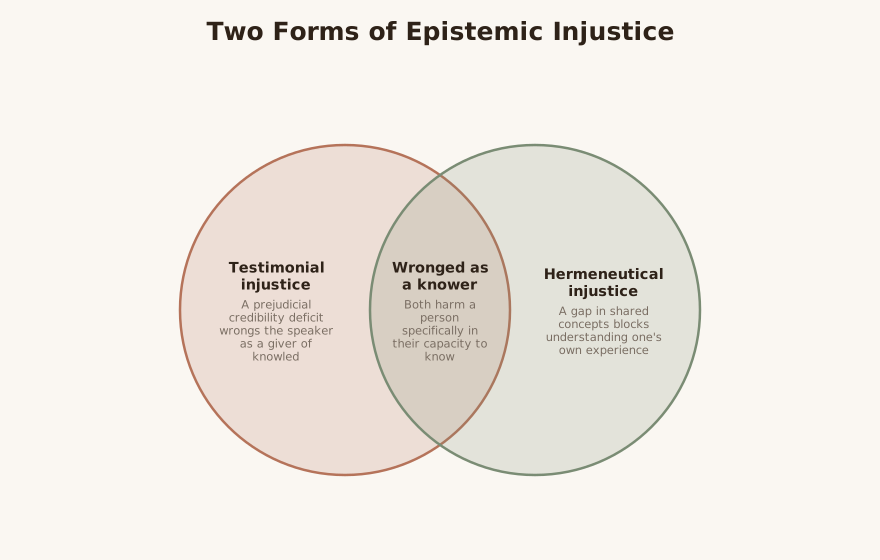
Fricker distinguishes two forms of epistemic injustice. 1
Testimonial injustice occurs when a hearer gives a speaker less credibility than they deserve because of prejudice against the speaker’s social identity — what Fricker calls an “identity-prejudicial credibility deficit.” 2 The speaker is wronged in their capacity as a giver of knowledge. 2 The classic illustration is a woman’s accurate, reasoned judgment being dismissed as mere “female intuition,” or a Black defendant’s testimony discounted through racial bias. 26
Hermeneutical injustice occurs when a gap in shared interpretive resources prevents someone from understanding or communicating their own experience. 1 Fricker’s central example: women who suffered sexual harassment before that concept existed in common language had no adequate way to name what was happening to them, and so interpreted it through distorting frames like “flirting.” 6 The harm here is not located in any single hearer; it emerges from systemic exclusion of certain groups from shaping society’s interpretive frameworks. 6
Three supporting concepts recur. Identity prejudice is the prejudicial stereotype, often operating non-consciously through the “social imagination,” that distorts a credibility judgment. 2 Identity power is the socially situated capacity to influence others’ behavior through shared understandings of social identity, which functions whether or not the participants endorse the stereotype. 2 And credibility deficit — the central case — names the gap between the credibility a speaker is owed and what they receive. 2
Interventions & Techniques
Epistemic injustice does not prescribe techniques in the manner of a manualized therapy; its “interventions” are correctives — dispositions and practices that reduce the harm. LLM Fricker frames the individual remedy as a virtue. 1
Testimonial justice is the virtue of the hearer who develops “reflexive critical awareness” — actively monitoring how their own social identity interacts with the speaker’s, and watching for prejudice distorting their credibility judgments. 2 For the clinician, this is a deliberate, ongoing practice rather than a one-time correction. 2
Hermeneutical justice is the more demanding virtue: providing an inclusive interpretive environment through “epistemic humility,” sustained attention, and openness to the possibility that an apparent communicative failure reflects a gap in shared concepts rather than the speaker’s unreliability. 2
In the psychiatric setting, Crichton, Carel and Kidd translate these into concrete recommendations: training clinicians to “believe what psychiatric patients tell them, unless there is good reason not to”; practicing conscious credibility correction (deliberately elevating credibility for patients prone to deficit); using Schwartz rounds to surface the existential and ethical dimensions of cases; and using multidisciplinary meetings to examine “problematic emotional contacts with patients.” 4 The overarching reframe is to treat the patient as a “participant in an epistemic search” rather than an object of clinical inquiry. 4
At the service level, the editorial literature proposes co-production models that integrate service-user knowledge into organizational culture, participatory and trauma-informed research methods, independent cultural advocacy, and lived-experience leadership in policy and practice. 5
LLM-generated illustrative example (not a guideline): A client reports that their psychiatrist “stopped listening the moment my chart said borderline.” In session, the therapist names this as a credibility deficit, validates that the client’s account is plausible, and explicitly contracts to treat the client’s self-report as primary data — modeling testimonial justice within the therapeutic relationship. LLM
Evidence Base
Honesty about maturity matters here. As a philosophical concept, epistemic injustice is well-established: Fricker’s framework is widely cited, has generated a large secondary literature, and has been refined and extended over nearly two decades. 2 In that sense it is mature theory. 1
As an applied clinical intervention, the evidence is far less developed. The psychiatry application is argued conceptually rather than demonstrated through controlled trials; Crichton, Carel and Kidd make a reasoned case supported by illustrative cases and epidemiological context (for instance, noting that the actual annual violence rate associated with schizophrenia, around 8%, is far lower than media stereotypes imply). 4 The mental-health editorial literature describes the field explicitly as “a work in progress,” and flags a significant evidence gap — notably the near-absence of work from low- and middle-income countries, which limits generalizability. 5
The honest clinical summary: the underlying concept is established and the face validity in mental health settings is high, but the outcome evidence for epistemic-injustice-informed interventions is early-stage and largely qualitative. LLM Clinicians should use it as a sensitizing framework, not as a validated standalone treatment. LLM
Populations & Indications
The framework is indicated wherever a patient’s identity, diagnosis, or history makes their testimony liable to systematic discounting. 4 Crichton, Carel and Kidd argue that psychiatric patients in general face heightened vulnerability to testimonial injustice relative to patients with physical illness, because mental illness is stereotyped as entailing unreliability, cognitive impairment, or emotional instability — and because clinical culture often privileges “hard” objective evidence over “soft” patient-reported experience. 4
Specific groups are at elevated risk. People with serious mental illness are subject to global credibility deflation. 4 Racial and ethnic minorities, women, LGBTQ+ individuals individuals, and people with disabilities face identity-prejudicial deficits, and the editorial literature stresses that “systems of oppressions intersect” to amplify discrimination, particularly for racialized communities. 5 Trauma survivors are vulnerable on both axes — discounted when their account is fragmented or affect-laden (testimonial), and, historically, lacking concepts to name experiences such as harassment or coercive control (hermeneutical). 6 Marginalized populations broadly are the paradigm case Fricker’s framework was built to illuminate. 2
Problems-for-Work
The framework speaks directly to several presenting problems. LLM
Invalidation and self-doubt: Repeated testimonial injustice teaches a person that their own perception is not to be trusted, eroding epistemic self-confidence. 2 Application: help the client distinguish “I was not believed” from “I was wrong.” LLM
Internalized oppression: When credibility deficits are absorbed, clients adopt the dominant group’s diminished view of their own knowing. 2 Application: externalize the deficit as something done to them, not a property of them. LLM
Trauma and identity-based distress: Hermeneutical gaps can leave survivors “passive and voiceless,” without language for what happened. 5 Application: co-construct vocabulary that fits their experience. 6
Therapeutic mistrust and help-seeking avoidance: A history of being dismissed by clinicians rationally produces wariness of the next clinician. 4 Application: name prior epistemic harm early and repair it relationally. 4
LLM-generated illustrative example (not a guideline): A woman from a community where her religious practice was once misread as a “symptom” — echoing the documented case of incense-burning mistaken for psychiatric pathology — arrives expecting to be pathologized. 4 The therapist opens by asking how previous providers got her wrong, signaling that her account, not the chart, is the starting point. LLM
Contraindications, Cautions & Cultural Humility
Epistemic injustice is a lens, not a clinical risk tool, and it carries cautions. LLM Fricker’s own corrective explicitly preserves the legitimacy of justified credibility judgments: testimonial justice is believing the patient “unless there is good reason not to,” not abandoning clinical reasoning. 4 Symptoms genuinely can affect reliability in specific instances, and the virtuous hearer recognizes a real “communicative handicap” without globally downgrading the person. 24 The error to avoid is the swing from credibility deficit to uncritical credibility excess, which the literature also identifies as an epistemic harm. 2
Risk assessment is the most delicate application. LLM The framework warns against dismissing a patient’s stated intentions because of diagnosis-driven prejudice — Crichton and colleagues cite a patient detained despite a consistent history of voluntary compliance — while not licensing the opposite error of ignoring genuine danger signals. 4 Clinical judgment and the concept must be held together. LLM
On cultural humility: the framework is itself a tool of humility, demanding reflexive awareness of one’s own identity and power in the encounter. 2 It aligns with multicultural counseling’s insistence that the clinician interrogate, rather than assume, the meaning of a client’s behavior across cultural frames. 4 Remedies that center lived-experience leadership and cultural advocacy are explicitly recommended at the service level. 5
Treatment-Plan Suggestions & SMART Objectives
| Goal | SMART objective (example) | Mechanism |
|---|---|---|
| Restore epistemic self-trust | Client will identify, in writing, 3 instances where their own perception was accurate but dismissed by others, within 6 sessions | Counters internalized credibility deficit by re-crediting the client as knower 2 |
| Repair therapeutic mistrust | Client will articulate one prior experience of being disbelieved by a provider and rate trust in the current relationship (0–10) by session 4 | Names and relationally repairs prior testimonial injustice 4 |
| Build interpretive vocabulary | Client will co-develop with the therapist 2–3 terms that accurately label a previously unnameable experience, within 8 sessions | Addresses hermeneutical gap by supplying shared concepts 6 |
| Reduce help-seeking avoidance | Client will attend ≥4 of next 5 scheduled appointments and report perceived credibility (0–10) at each | Demonstrates that testimony will be taken seriously, lowering avoidance 4 |
| Externalize internalized oppression | Client will distinguish “treated as untrustworthy” from “am untrustworthy” in 3 logged situations over 4 weeks | Separates identity-prejudicial deficit from self-concept 2 |
| Increase self-advocacy in care | Client will state one self-reported need to another provider and report the response by session 10 | Reasserts the client as a participant in the epistemic search 4 |
| Process identity-based distress | Client will complete a written narrative of one identity-related invalidation and identify its impact on self-trust within 6 sessions | Surfaces minority-stress-linked epistemic harm for processing 5 |
Common Misconceptions
“It just means believing everything the patient says.” No. Fricker’s corrective is to credit the speaker fairly — “unless there is good reason not to” — which preserves clinical judgment and recognizes real communicative limitations. 42
“It’s only about overt prejudice.” Identity prejudice typically operates non-consciously, through the “social imagination,” in clinicians who would sincerely reject the stereotype. 2 Good intentions do not exempt one from perpetrating it. LLM
“Testimonial and hermeneutical injustice are the same thing.” They are distinct: testimonial injustice is an individual-level credibility deficit; hermeneutical injustice is a structural gap in shared concepts that no single person authors. 6
“Credibility excess is harmless.” Inflated positive stereotyping is also an epistemic harm, flattening individuality and distorting judgment. 2
“It’s a treatment.” It is a sensitizing concept whose applied outcome evidence remains early-stage. 5
Training & Certification
There is no certification in epistemic injustice, and no credential is required to apply the concept clinically. LLM The foundational training is reading: Fricker’s 2007 monograph is the primary source, with the Internet Encyclopedia of Philosophy and Routledge Encyclopedia entries serving as rigorous secondary introductions, and shorter explainers offering rapid orientation. 1236 For clinical translation, the Crichton, Carel and Kidd paper is the key text, and the mental-health editorial literature points toward the service-level practices — co-production, lived-experience leadership — through which institutions operationalize the concept. 45
In practice, “training” looks like the reflexive disciplines Fricker describes: cultivating testimonial and hermeneutical justice as ongoing virtues, supported by supervision and structured reflective forums such as Schwartz rounds and multidisciplinary case discussion. 24
Key Terms
- Epistemic injustice — a wrong done to someone specifically in their capacity as a knower. 2
- Testimonial injustice — deflated credibility given to a speaker because of identity prejudice; an “identity-prejudicial credibility deficit.” 2
- Hermeneutical injustice — a gap in collective interpretive resources that prevents someone from understanding or communicating their experience. 1
- Credibility deficit / excess — receiving less (or more) credibility than one is owed; deficit is Fricker’s central case. 2
- Identity prejudice — a prejudicial stereotype, often non-conscious, that distorts credibility judgments. 2
- Identity power — capacity to influence others through shared understandings of social identity, operative regardless of endorsement. 2
- Hermeneutical marginalization — exclusion of a group from shaping shared interpretive resources. 2
- Testimonial / hermeneutical justice — the corrective virtues of reflexive credibility awareness and inclusive interpretive humility. 2
Resources & Further Reading
▶ Watch — a video introduction to this concept:
- Fricker, M. (2007). Epistemic Injustice: Power and the Ethics of Knowing. Oxford University Press.
- Epistemic Injustice — Internet Encyclopedia of Philosophy
- Epistemic Injustice (Testimonial Injustice) — Routledge Encyclopedia of Philosophy
- Crichton, Carel & Kidd (2017). Epistemic injustice in psychiatry. BJPsych Bulletin.
- Editorial: Addressing epistemic injustice in mental health — Frontiers (PMC)
- Epistemic Injustice — 1000-Word Philosophy
Reflective / Supervision Questions
- When did I last discount a client’s account, and was the reason clinical evidence or an identity-driven assumption I had not examined? 2
- Which of my caseload’s diagnoses carry the heaviest “credibility deflation” for me, and how might that shape my risk and capacity judgments? 4
- Where might a client’s apparent confusion actually reflect a missing concept — a hermeneutical gap — rather than their unreliability? 6
- Am I crediting fairly, or have I overcorrected into uncritical credibility excess? 2
- How do my own social identity and institutional power shape what I am willing to hear in the room? 2
- What service-level practices — co-production, lived-experience input — could reduce epistemic harm beyond my individual sessions? 5