
Type & Discipline
Fowler’s Stages of Faith is a structural-developmental theory drawn from the developmental psychology of religion and theology 1. It sits in the same intellectual family as Piaget’s cognitive stages, Kohlberg’s stages of moral reasoning, and Erikson’s psychosocial stages — models that describe qualitative, sequential shifts in the structure of how a person processes experience rather than the specific content of their beliefs 2. Critically, Fowler defines “faith” broadly: not as creed or religious affiliation, but as the universal human activity of making meaning, holding ultimate concerns, and orienting oneself toward what one trusts and values 1. By this definition, an atheist, a secular humanist, and a devout believer all have “faith” in Fowler’s sense, because all are engaged in constructing a center of value and meaning LLM. For clinicians, this reframing matters: Fowler offers a developmental lens on meaning-making that applies regardless of a client’s religious identity LLM.
Creators & Lineage
The model was developed by James W. Fowler III (1940–2015), an American theologian and developmental psychologist raised in a Methodist minister’s family, who became Professor of Theology and Human Development at Emory University’s Candler School of Theology and held the Charles Howard Candler Professorship 2. His major statement of the theory appeared in Stages of Faith: The Psychology of Human Development and the Quest for Meaning (1981) 1. Fowler’s lineage is explicitly structural-developmental: he built directly on Jean Piaget’s cognitive development, Lawrence Kohlberg’s moral development, and Erik Erikson’s psychosocial stages, extending those frameworks into the domain of faith and ultimate meaning 2. His theological influences included H. Richard Niebuhr and Paul Tillich, and his epistemology drew on Kant 2. The review literature frames his contribution as a “broadening and deepening” of the Piaget–Kohlberg–Erikson tradition, applying structural stage logic to faith rather than to cognition or moral reasoning alone 3.
Core Principles
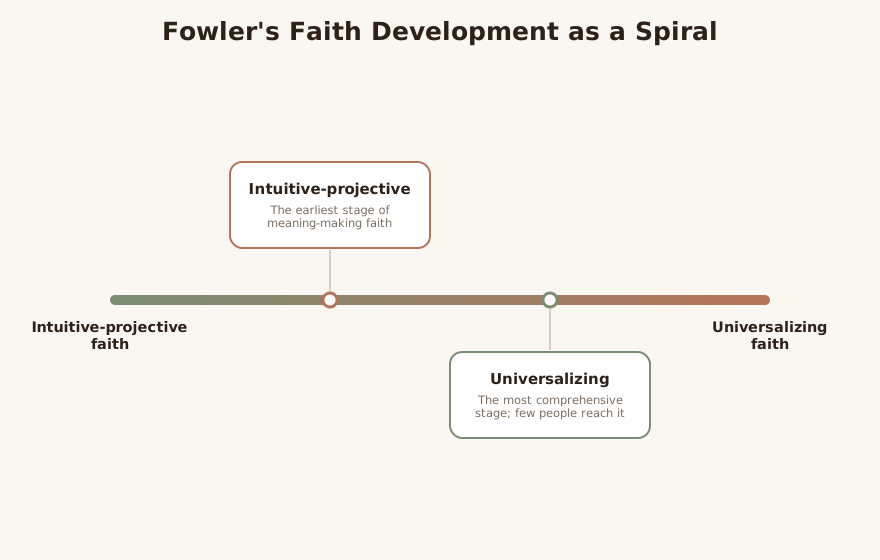
Several principles organize the model LLM. First, faith development is structural and sequential: stages emerge in a fixed order, each integrating and transcending the prior one, so a person does not skip stages 1. Second, the stages describe how a person knows and commits, not what they believe — two people of opposing religious views can occupy the same stage, and two people sharing a creed can occupy different stages 4. Third, transitions are driven by disequilibrium: when a person’s existing way of making meaning can no longer contain their experience, a developmental crisis pushes (but does not guarantee) movement to a more adequate structure 1. Fowler himself stressed that stage transitions are not automatic or inevitable, and many adults stabilize at a given stage for life 3. Fourth, the model is dynamic and spiral rather than a simple ladder, depicting the recursive interaction between self and environment over time 3. Higher stages are described as more comprehensive, but Fowler resisted reading them as straightforwardly “better” persons LLM.
Interventions & Techniques
Fowler’s Stages of Faith is a developmental theory and assessment lens, not a packaged set of interventions; it does not prescribe techniques in the way a manualized therapy does 1. What it offers the clinician is a conceptualization framework that can sharpen assessment and inform technique selection within an existing modality LLM. In practice, this means listening for the structure of a client’s meaning-making — how they hold authority, tolerate ambiguity, and integrate competing commitments — rather than only the content of their stated beliefs LLM. A clinician can use the model to (1) locate a client’s predominant stage and the developmental edge they are working at; (2) recognize a presenting “spiritual crisis” as a possible stage transition rather than pathology; (3) calibrate interventions to the client’s current structure, avoiding the error of pushing a Synthetic-Conventional client toward critical deconstruction before they have the scaffolding to tolerate it; and (4) normalize the disorientation that accompanies movement between stages LLM. The original “faith development interview” Fowler used was a long, semi-structured qualitative interview probing life history, relationships, values, and images of the ultimate 3.
LLM-generated illustrative example (not a guideline): A 34-year-old client raised in a tight-knit faith community presents with anxiety and guilt after beginning to question doctrines she once accepted without examination. Read through Fowler’s lens, this looks less like a disorder and more like a Synthetic-Conventional to Individuative-Reflective transition — a move from a faith embedded in group authority toward one she must own and author herself. Framing her distress as developmental, rather than as a loss of virtue, can reduce shame and orient the work toward tolerating ambiguity LLM.
Evidence Base
The honest appraisal is that Fowler’s model is established and highly influential but only weakly validated empirically 3. It is widely cited and taught across pastoral counseling, religious education, and developmental psychology, and the founding book is treated as “a seminal work” and “a classic” 3. However, its empirical foundation is thin by contemporary psychometric standards 3. The theory rests heavily on qualitative interviews, and the reviewer notes that the model’s signature illustrative case — a woman called “Mary” — was originally a counseling contact at the family’s request rather than a research participant gathered under standard protocols, which raises questions about methodological rigor 3. Stages are difficult to operationalize and measure reliably, and much of the cross-cultural and longitudinal follow-up that would test the model was never carried out by Fowler himself 2. Fowler openly acknowledged a Judeo-Christian, Western bias even while claiming universal applicability, and conceded that the validating cross-cultural studies remained to be done 3. The clinical takeaway: treat this as a thoughtful organizing heuristic, not as a validated measurement instrument or an evidence-based intervention LLM.
Populations & Indications
The framework is most useful with adults and older adolescents who are capable of reflecting on their own meaning-making, and with older adults taking stock of life and mortality 4. It is especially apt for clients in existential transition and people in spiritual or religious crisis, where presenting distress often coincides with a shift in how the person holds belief, authority, and meaning LLM. Because Fowler’s “faith” is non-sectarian, the lens applies to secular as well as religious clients confronting questions of ultimate concern 1. It can be particularly illuminating with clergy and other religious professionals, whose vocational identity is bound up with their developmental stage and who may experience acute crisis when their structure of faith outgrows the community that formed it LLM. The model is best used as one interpretive layer alongside standard clinical assessment, not as a diagnostic tool LLM.
Problems-for-Work
The model speaks directly to several presenting concerns LLM. Existential distress and loss of meaning can be reframed as the disequilibrium that precedes a stage transition, giving the client a developmental narrative for their disorientation 1. Spiritual and religious problems — the kind captured in the DSM’s V-code for religious or spiritual problems — map naturally onto stage conflict, for instance a believer who can no longer sustain a literal reading of sacred texts LLM. Identity confusion in late adolescence and emerging adulthood often reflects the Synthetic-Conventional to Individuative-Reflective edge, where the person must move from a borrowed identity to an authored one 2. Life transitions, grief, and demoralization frequently destabilize a previously adequate meaning structure, prompting either regression-like consolidation or growth LLM. Moral injury — the lasting damage of having violated or witnessed violations of one’s deepest moral commitments — can be understood as a rupture in the person’s center of value, which Fowler’s framework helps name and explore LLM.
LLM-generated illustrative example (not a guideline): A combat veteran carrying moral injury describes feeling that “nothing means anything anymore” after actions that contradicted his core values. Using Fowler’s lens, the clinician frames this not only as guilt but as a collapse of his organizing center of value, and the work becomes a careful reconstruction of meaning that can hold the contradiction — closer to a Conjunctive capacity to tolerate paradox than a return to his prior certainties LLM.
Contraindications, Cautions & Cultural Humility
The model carries real cautions LLM. Because Fowler acknowledged a Western, Judeo-Christian (and particularly Protestant) bias, clinicians must resist imposing his stage sequence as a universal yardstick on clients from collectivist or non-Christian traditions, where communal and “Synthetic-Conventional” faith may be a mature cultural norm rather than a stage to be transcended 3. There is an inherent hierarchical risk: framing “higher” stages as superior can subtly devalue a client’s family, community, or tradition and shade into therapist value-imposition, which violates basic ethical neutrality LLM. The stages are descriptive, not prescriptive — the clinician’s job is not to advance the client up the ladder but to support whatever developmental movement the client themselves is reaching for LLM. Because the model lacks validated measurement, stage “assignment” should be held loosely and never communicated as a diagnosis 3. Finally, distress that looks like a faith-stage transition can co-occur with, or be mistaken for, mood, anxiety, or psychotic disorders, so the lens supplements rather than replaces standard differential assessment LLM.
Treatment-Plan Suggestions & SMART Objectives
| Goal | SMART objective (example) | Mechanism |
|---|---|---|
| Normalize a spiritual crisis as developmental | Within 4 sessions, client will articulate their current distress as a possible shift in meaning-making rather than a moral or personal failing, rated weekly on a 0–10 shame scale | Reframing distress as stage transition reduces shame and mobilizes curiosity 1 |
| Increase tolerance of ambiguity | Over 8 weeks, client will identify and verbalize two areas where they can “hold both sides” of a previously either/or belief, without escalating anxiety | Builds the dialectical capacity associated with Individuative-Reflective and Conjunctive structures 4 |
| Author a personal value system | Within 6 sessions, client will write and discuss a one-page statement of their own ultimate concerns distinct from inherited beliefs | Supports the move from borrowed (conventional) to owned (reflective) faith 2 |
| Restore meaning after loss or moral injury | Over 12 weeks, client will name one renewed source of meaning and report engaging it at least weekly | Reconstructs a damaged center of value LLM |
| Reduce isolation during deconstruction | Within 8 weeks, client will identify two relationships or communities that can hold their changing beliefs, contacting at least one weekly | Provides relational scaffolding for stage transition LLM |
| Differentiate self from family/community authority | Over 10 sessions, client will distinguish three of their own positions from those of their family of origin and tolerate the resulting discomfort | Targets the Synthetic-Conventional to Individuative-Reflective edge 2 |
| Integrate paradox without regression | Within 12 weeks, client will describe one previously rejected viewpoint they can now appreciate, rated for openness on a self-report scale | Cultivates the Conjunctive capacity to hold tension and paradox 1 |
Common Misconceptions
A few errors recur LLM. First, that “faith” means religion — Fowler’s construct is the broader human act of meaning-making and so includes secular worldviews 1. Second, that higher stages mean a better or holier person — the stages describe structural complexity, not moral worth, and Fowler resisted that reading LLM. Third, that development is automatic with age — Fowler was explicit that transitions are neither automatic nor inevitable, and many adults remain at one stage permanently 3. Fourth, that the model is empirically validated — it is influential and theoretically coherent but rests on limited, qualitatively derived, Western-biased data 3. Fifth, that a clinician can reliably “score” a client’s stage as one would a standardized measure — the stages resist precise operationalization and should be held as interpretive hypotheses 3.
Training & Certification
There is no formal certification in Fowler’s Stages of Faith; it is a theoretical framework rather than a credentialed treatment modality LLM. Familiarity is typically acquired through the primary text, Stages of Faith (1981), and through coursework in developmental psychology, pastoral counseling, and the psychology of religion where the model is a standard topic 1. Clinicians who wish to apply it responsibly should pair it with training in the modality that will carry the work (e.g., existential or supportive psychotherapy) and with broader competency in spiritually integrated and culturally responsive care LLM. Reading Fowler’s lineage — Piaget, Kohlberg, and Erikson — deepens the structural-developmental logic that underlies the stages 2.
Key Terms
- Faith — Fowler’s term for the universal human activity of making meaning and orienting toward ultimate concern, not necessarily religious 1.
- Structural-developmental — A stage approach concerned with the form of cognition or meaning-making rather than its content 2.
- Stage 0 — Undifferentiated (Primal) Faith — Infancy (roughly 0–2), pre-conceptual trust and mutuality 2.
- Stage 1 — Intuitive-Projective — Early childhood (roughly 2–7), imaginative, fluid, image-driven faith 2.
- Stage 2 — Mythic-Literal — Childhood (roughly 7–12), literal, narrative, rule-bound faith 2.
- Stage 3 — Synthetic-Conventional — Adolescence onward, faith embedded in group identity and external authority 2.
- Stage 4 — Individuative-Reflective — Young/middle adulthood, faith critically examined and personally owned 2.
- Stage 5 — Conjunctive — Midlife onward, integration of paradox, symbol, and competing truths 2.
- Stage 6 — Universalizing — Rare, a decentered faith oriented to inclusive, universal justice and being 2.
Resources & Further Reading
▶ Watch — a video introduction to this concept:
- Stages of Faith: The Psychology of Human Development and the Quest for Meaning (James W. Fowler) — Internet Archive
- Stages of Faith: The Psychology of Human Development — Google Books
- James W. Fowler, Stages of Faith — PhilPapers record
- Review of Fowler, Stages of Faith (Boston University, W. Wildman)
- James W. Fowler — Wikipedia
- Fowler’s Stages of Faith Development — Toolshero
Reflective / Supervision Questions
- When a client describes a “loss of faith,” how do I distinguish a developmental stage transition from clinical depression or demoralization, and how does that distinction change my plan? LLM
- Am I, even subtly, treating “higher” Fowler stages as healthier or more desirable, and how might that impose my own values on the client? LLM
- How do I apply this Western, Judeo-Christian–derived model to clients from collectivist or non-Christian traditions without pathologizing communal faith? 3
- Given the model’s limited empirical validation, how loosely am I holding any “stage” I assign, and would I ever state it to the client as fact? 3
- How am I anchoring meaning-making work to a billable clinical concern and documenting observable change, rather than billing for “faith development” itself? LLM
- Where is this client’s developmental edge, and is my technique calibrated to the structure they actually have rather than the one I wish they had? LLM