
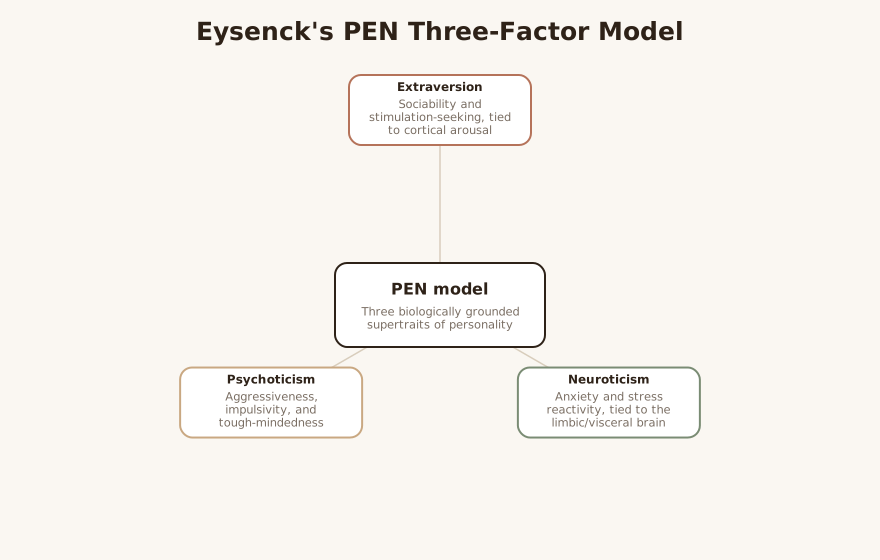
Eysenck’s PEN model is one of the founding frameworks of trait personality psychology, and unlike most personality taxonomies it makes explicit, testable claims about the biology that produces individual differences 3. For practicing therapists it is less a treatment in itself than a conceptual lens: it offers a parsimonious vocabulary for describing temperamental vulnerability, and it sits upstream of measures and constructs you already use, from the Big Five to behavioral activation and inhibition language 4. LLM
Type & Discipline
PEN is a theory within personality psychology, specifically the biological (psychobiological) tradition of trait theory 3. It is dimensional rather than categorical: every person falls somewhere along three continuous axes—Extraversion (E), Neuroticism (N), and Psychoticism (P)—rather than belonging to discrete personality “types” in the everyday sense 5. Eysenck organized personality hierarchically: specific responses (single behaviors) aggregate into habitual responses, which aggregate into traits (e.g., sociability, impulsivity), which in turn load onto the three superordinate dimensions or “types” at the top of the hierarchy 4. The three dimensions are statistically near-orthogonal, meaning a person’s standing on one says little about the others 6. LLM
Creators & Lineage
The model was developed by Hans J. Eysenck across several decades; the dimensional structure began as a two-factor model (E and N) and was extended to include Psychoticism, with the full biological rationale laid out in The Biological Basis of Personality (1967) 1. Eysenck favored criterion analysis and factor analysis applied to large samples, and he insisted that any adequate personality dimension must have a demonstrable genetic and neurophysiological basis rather than being a mere descriptive label 4. The measurement instruments that operationalize the model—the Eysenck Personality Inventory (EPI) and later the Eysenck Personality Questionnaire (EPQ), which added the P scale—are its empirical backbone 5.
PEN’s lineage runs in both directions. Upstream, it draws on the trait tradition and on Cattell’s factor-analytic work, against which Eysenck argued for fewer, broader factors 4. Downstream, the model directly shaped the Five-Factor Model (E and N appear in both taxonomies almost unchanged) and provoked Jeffrey Gray’s Reinforcement Sensitivity Theory, which reinterpreted Eysenck’s axes in terms of approach and avoidance systems 7. It also runs parallel to Zuckerman’s sensation-seeking model and Cloninger’s psychobiological model, which share Psychoticism’s behavioral and neurochemical correlates 2. LLM
Core Principles
Three supertraits. Extraversion–Introversion captures sociability, activity, and stimulation-seeking; high extraverts are outgoing and crave external stimulation, while introverts prefer quieter, lower-stimulation environments 5. Neuroticism–Emotional Stability captures the tendency toward anxiety, moodiness, and stress reactivity; high-N individuals experience negative affect readily and recover slowly, while stable individuals remain calm under pressure 5. Psychoticism–Normality captures aggressiveness, egocentricity, impulsivity, tough-mindedness, and a disposition toward antisocial or norm-violating behavior, alongside an association with creative potential 52.
Biology as the cause, not the correlate. The defining claim of PEN is that these dimensions reflect inherited neurophysiological differences 1. Extraversion is tied to baseline cortical arousal governed by the ascending reticular activating system: introverts are theorized to be chronically over-aroused and therefore avoid additional stimulation, while extraverts are under-aroused and seek it out to reach an optimal level 1. Neuroticism reflects the reactivity of the limbic/visceral brain and autonomic nervous system—high-N individuals show stronger, more easily triggered emotional and physiological responses to threat 1. Psychoticism has been linked to hormonal and neurochemical factors, including testosterone and low monoamine oxidase (MAO) activity, the latter a marker shared with sensation-seeking and antisocial behavior across rival models 52.
Heritability and diathesis. Because the dimensions are framed as biologically based temperaments, Eysenck treated them as partly heritable predispositions that interact with environment to produce behavior—a diathesis-stress logic in which trait standing sets a vulnerability that experience shapes 4. LLM
Interventions & Techniques
PEN is not a therapy and prescribes no protocol; its clinical utility is assessment and formulation, which then informs how you deliver an evidence-based modality 3. LLM In practice this means using trait language to (1) profile a client’s temperamental baseline, (2) anticipate how that baseline will interact with a given intervention, and (3) calibrate pacing and exposure intensity accordingly. LLM
- Trait-informed formulation. Conceptualize presenting problems in terms of E, N, and P standing—e.g., framing chronic worry as high trait Neuroticism expressed through a reactive threat system—to separate stable temperament from acute state 1. LLM
- Arousal-aware pacing. Use the arousal model to titrate stimulation: a high-arousal introverted client may need lower-intensity, slower exposure, whereas an under-aroused extraverted client may disengage from low-stimulation tasks 1. LLM
- Psychoeducation. Normalize temperament as partly biological and dimensional rather than a defect, which can reduce shame and support self-acceptance work 5. LLM
- Measurement. Administer the EPQ/EPI (or map existing Big Five data onto E and N) to anchor formulation in a structured profile rather than impression alone 5. LLM
LLM-generated illustrative example (not a guideline): A clinician treating a client with panic disorder notes very high Neuroticism and moderate Introversion. Rather than starting interoceptive exposure at full intensity, the clinician builds a longer arousal-regulation phase first, frames the client’s strong bodily reactivity as a sensitive threat system rather than weakness, and paces exposures in smaller steps—a CBT protocol delivered with PEN-informed calibration. LLM
Evidence Base
The maturity of PEN is best described as established but uneven. The descriptive dimensional structure is robust: Extraversion and Neuroticism replicate across cultures, instruments, and decades, and they map almost directly onto two of the Big Five factors 46. Heritability of the dimensions is well supported by behavioral-genetic work, consistent with Eysenck’s biological premise 4.
The causal mechanisms are more contested. The cortical-arousal account of extraversion received mixed empirical support and was substantially reworked by Gray, whose Reinforcement Sensitivity Theory argued that anxiety and impulsivity—rotated from Eysenck’s E and N axes—better correspond to underlying brain systems for punishment and reward sensitivity 7. Psychoticism is the weakest dimension psychometrically: its scales tend toward skewed distributions and lower reliability, and the construct blends several distinct facets (impulsivity, aggression, low agreeableness) that later models separated 2. Convergent biological evidence is strongest where PEN overlaps with Zuckerman’s and Cloninger’s systems—e.g., shared MAO and dopaminergic correlates of sensation-seeking and Psychoticism—rather than for Eysenck’s original mechanism in isolation 2. The honest summary: a foundational, well-replicated structure with a partially validated and frequently revised causal theory. LLM
Populations & Indications
PEN was built on and validated in the general adult population and in research participants, where the dimensions describe normal-range individual differences 6. It has been applied to forensic populations, where elevated Psychoticism (and the impulsivity/antisociality it captures) is studied in relation to offending and antisocial conduct 52. The Neuroticism dimension is directly relevant to people with anxiety disorders, for whom high trait N indexes vulnerability and reactivity 1. The framework extends to adolescents via age-appropriate EPQ forms and to people with personality disorders, where dimensional trait profiles complement categorical diagnosis 4. LLM As a temperament map it is broadly applicable, but it is descriptive rather than diagnostic—it characterizes disposition, not disorder. LLM
Problems-for-Work
- Generalized anxiety disorder and trait neuroticism: high N provides a parsimonious account of pervasive worry and threat sensitivity, framing GAD as the clinical end of a normal temperamental continuum 1. LLM
- Major depressive disorder: high N (negative affectivity) combined with low E (reduced positive affect and reward engagement) is a recognizable depressotypic profile that can guide behavioral-activation emphasis 5. LLM
- Antisocial personality disorder and impulsivity: elevated Psychoticism captures egocentric, aggressive, norm-violating tendencies relevant to forensic and conduct presentations 52. LLM
- Emotional dysregulation: high autonomic/limbic reactivity (high N) offers a temperamental substrate for affective lability, informing the rationale for emotion-regulation skills 1. LLM
- Behavioral inhibition: introversion plus high N maps onto avoidant, inhibited patterns and links conceptually to Gray’s punishment-sensitivity system 7. LLM
- Substance use disorder: the Psychoticism/sensation-seeking complex, with its low-MAO correlate, is associated with disinhibited risk-taking that bears on substance use vulnerability 2. LLM
LLM-generated illustrative example (not a guideline): In a substance-use intake, a clinician observes a profile of high Psychoticism and high Extraversion. They hypothesize that strong stimulation-seeking and disinhibition drive use, and they prioritize building alternative high-stimulation rewards and impulse-delay skills within a relapse-prevention framework rather than relying on quiet, low-arousal coping strategies alone. LLM
Contraindications, Cautions & Cultural Humility
PEN is a research and formulation tool, not a clinical instrument for prediction about individuals. Several cautions follow. The model has been criticized for a deterministic view of behavior, particularly the link between Psychoticism and criminality, which can slide into labeling clients as inherently dangerous or fixed 5. Trait scores describe tendencies, not destiny, and clinicians should resist using a high-P score to justify stigma or constrain a client’s agency 5. LLM
The emphasis on genetic and biological causation risks underweighting environment, trauma, and culture; Eysenck himself framed traits as diatheses that interact with experience, and good practice keeps that interaction in view 4. LLM Norms and item content were developed largely in Western samples, so cross-cultural application requires care: behaviors coded as “psychotic” or norm-violating are culturally situated, and what reads as low Extraversion in one culture may be normative reserve in another 6. LLM Finally, the Psychoticism scale’s measurement weaknesses mean clinical decisions should never rest on a P score alone 2. LLM
Treatment-Plan Suggestions & SMART Objectives
| Goal | SMART objective (example) | Mechanism |
|---|---|---|
| Reduce trait-Neuroticism-driven anxiety reactivity | Client will use a paced-breathing/grounding skill within 5 minutes of noticing physiological arousal in 4 of 5 logged episodes over 6 weeks | Down-regulates reactive limbic/autonomic threat system 1 |
| Increase reward engagement in low-Extraversion depression | Client will initiate 3 pre-scheduled pleasant/social activities per week for 8 weeks, rated for mood pre/post | Counters low positive-affect/approach tendency via behavioral activation 5 |
| Build impulse-delay in high-Psychoticism presentation | Client will apply a written “pause-and-plan” step before high-risk decisions in 80% of self-reported opportunities over 8 weeks | Adds top-down control to a disinhibited, low-MAO sensation-seeking pattern 2 |
| Improve emotion regulation in high reactivity | Client will identify the trigger, bodily cue, and one regulation skill for 5 distressing episodes weekly across 6 weeks | Increases awareness and modulation of high autonomic reactivity 1 |
| Substitute adaptive stimulation in sensation-seeking | Client will engage in 2 novel, low-harm high-stimulation activities weekly for 6 weeks instead of substance use | Meets stimulation/novelty drive through prosocial channels 2 |
| Psychoeducation and self-acceptance | Client will articulate their temperament profile and 2 strengths it confers by session 4 | Reframes dimensional temperament as non-pathological, reducing shame 5 |
| Calibrate exposure to arousal baseline | Therapist and client will co-design a graded hierarchy with step sizes matched to the client’s arousal tolerance over 4 sessions | Aligns exposure intensity with cortical-arousal/Neuroticism profile 1 |
Common Misconceptions
- “PEN gives you personality ‘types.’” It is dimensional; “type” in Eysenck’s hierarchy means a superordinate factor, not a discrete category one belongs to 4. LLM
- “Psychoticism means psychosis.” The P dimension indexes tough-mindedness, aggression, impulsivity, and antisociality, not psychotic illness 5. LLM
- “The arousal theory of extraversion is settled science.” The cortical-arousal mechanism is the model’s most contested claim and was substantially revised by Gray’s punishment/reward framework 7. LLM
- “PEN and the Big Five are rivals.” Extraversion and Neuroticism are essentially shared; the Big Five largely unpacks Eysenck’s Psychoticism into Conscientiousness and Agreeableness 4. LLM
- “A trait score predicts behavior deterministically.” Scores describe probabilistic tendencies operating through gene-environment interaction, not fixed outcomes 45. LLM
Training & Certification
There is no certification in “PEN therapy,” because it is a theoretical and assessment framework rather than a credentialed clinical modality 3. LLM Competence comes from (1) graduate-level personality-psychology coursework covering trait theory and its biological tradition 4, and (2) supervised training in the administration and interpretation of the EPQ/EPI or related trait instruments, which—like other psychological tests—should be used within one’s scope of practice and qualification level 5. LLM Clinicians more often encounter the constructs indirectly through Big Five measures or through Gray-derived behavioral activation/inhibition scales, and familiarity with the original PEN sources clarifies where those instruments came from 7. LLM
Key Terms
- Extraversion (E): sociability, activity, and stimulation-seeking; theorized to reflect low baseline cortical arousal 15.
- Neuroticism (N): proneness to anxiety, negative affect, and slow recovery; tied to limbic/autonomic reactivity 15.
- Psychoticism (P): aggressiveness, egocentricity, impulsivity, and tough-mindedness; linked to testosterone and low MAO 52.
- Cortical arousal / ARAS: activity of the ascending reticular activating system proposed to set the introversion–extraversion baseline 1.
- Hierarchy of personality: specific responses → habitual responses → traits → types (supertraits) 4.
- Criterion analysis: Eysenck’s validation strategy of testing whether dimensions discriminate criterion groups, beyond factor analysis 4.
- Reinforcement Sensitivity Theory (RST): Gray’s revision recasting personality in terms of reward/punishment system sensitivity 7.
Resources & Further Reading
▶ Watch — a video introduction to this concept:
- Eysenck, H. J. (1967). The Biological Basis of Personality — full text (Internet Archive)
- Relationships between Cloninger’s, Zuckerman’s, and Eysenck’s dimensions of personality (PMC)
- Great Ideas in Personality — Eysenck’s PEN Model (Personality Research)
- The Contribution of Eysenck’s PEN Model — Jang (Personality Research)
- Eysenck’s PEN Model of Personality (Psychologist World)
- Three Fundamental Dimensions of Personality — Eysenck (The Personality Project)
- The personality theories of H. J. Eysenck and J. A. Gray: a comparative review (ScienceDirect)
Reflective / Supervision Questions
- When I describe a client as “anxious by nature,” am I using trait language to formulate clearly, or to lower my expectations for change? LLM
- How do I hold the tension between PEN’s biological-diathesis framing and a trauma-informed, environmental understanding of the same presentation? 4 LLM
- If a client’s profile shows high Psychoticism, what safeguards do I have against letting that score bias my judgment toward stigma or dangerousness? 5 LLM
- Where in my current modality am I already pacing or sequencing in a way that PEN’s arousal model would predict—and could naming it sharpen my formulation? 1 LLM
- Given the contested status of the causal biology, how do I communicate trait feedback to clients without overstating certainty? 7 LLM