
Type & Discipline
Behavioral inhibition (BI) is a temperament construct in developmental psychology, not a treatment or therapeutic technique LLM. It names an early-emerging, persistent tendency to respond to novelty with fear, restraint, and physiological reactivity 3. The construct belongs to the tradition of temperament research, sits alongside trait theory and attachment theory in explaining individual differences, and is a foundational variable in developmental psychopathology LLM. For clinicians, BI matters not as something you treat directly but as a risk marker that shapes case formulation, prognosis, and prevention LLM.
Creators & Lineage
The construct is most closely associated with Jerome Kagan (1929–2021), a Harvard developmental psychologist widely regarded as one of the most influential of the past century 4. Kagan joined Harvard in 1963 and built a research program integrating biological and behavioral methods in longitudinal studies of children 4. His landmark 1988 Science paper with J. Steven Reznick and Nancy Snidman, “Biological Bases of Childhood Shyness,” argued that behavioral restraint versus spontaneity in unfamiliar situations reflects inherited differences in the arousal threshold of limbic brain regions 1.
Kagan tracked infants’ responses to novel stimuli across development, identifying a “high-reactive” group of roughly 25% of infants who cried and flailed at unfamiliar stimulation and a “low-reactive” group who showed calm attention 4. Crucially, he rejected genetic determinism, describing temperament as “an inherited proclivity whose manifestations were subject to modification” 4. He was, by his own description, a “Baconian empiricist” skeptical of grand theories, who insisted that constructs be interpreted in context and never from a single data source 4. The lineage of BI thus draws on temperament theory and trait theory for its dispositional core, attachment theory for the role of caregiving, and developmental psychopathology for its focus on pathways from early risk to later disorder LLM.
Core Principles
BI is defined as an early-emerging and persistent tendency to display fear to novelty, marked by social reticence with unfamiliar people and sensitivity to approach-avoidance cues 3. Several principles organize the construct LLM.
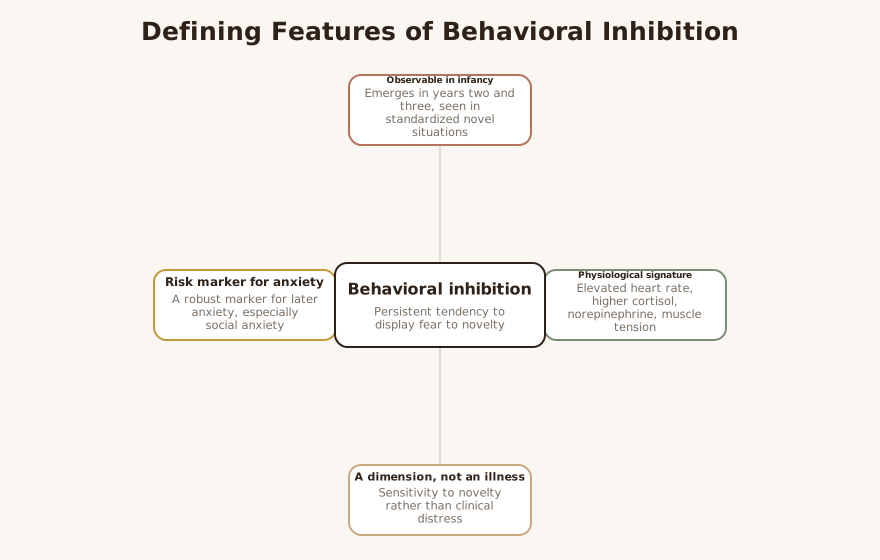
First, BI is observable in infancy and toddlerhood. It emerges in the second and third years of life and is identified through behavioral observation in standardized novel situations, not by questionnaire alone 3. Children who are inhibited at age 2 tend to remain quiet and socially avoidant by age 7, while uninhibited children become talkative and interactive 1.
Second, BI has a physiological signature. Kagan’s group linked the inhibited profile to peripheral markers including elevated and stable heart rate, higher salivary cortisol, and urinary norepinephrine, alongside muscle tension, consistent with a lower threshold of limbic arousal to the unfamiliar 1.
Third, BI is a dimension of reactivity, not a categorical illness. Roughly 15–20% of children show reactivity and response extreme enough to meet criteria for BI 3. The construct describes sensitivity to novelty rather than clinical distress, which is the key distinction between temperament and disorder 3.
Interventions & Techniques
There is no “behavioral inhibition therapy”; the relevant interventions are those that target BI to reduce the risk it confers LLM. Two evidence-based, parent-focused programs are well documented in the developmental literature 2.
Cool Little Kids (CLK) is a roughly six-week parent-focused program that addresses parental anxiety and overprotection; it significantly reduced behaviorally inhibited children’s anxiety symptoms and disorders at a three-year follow-up 2. The Turtle Program is an eight-week intervention combining parent-child interaction components with child social-emotional skills training, and it produced increased observed parental warmth and decreased parental negative control relative to CLK alone 2.
The active ingredients in these programs map onto recognized clinical techniques: reducing intrusive, overcontrolling parenting, which strengthens the BI-to-anxiety pathway, and increasing maternal warmth and encouragement, which buffer it 2. Mechanistically promising targets identified in longitudinal work include attention bias to threat, where inhibited children who show heightened bias toward threatening stimuli have stronger links to later anxiety, and the development of flexible, goal-directed (planful) attentional control, which appears protective 2.
LLM-generated illustrative example (not a guideline): A clinician treating an inhibited 4-year-old might coach the parent to tolerate the child’s slow warm-up at a birthday party rather than carrying him in, while practicing graded, encouraging approach steps — operationalizing the “reduce overprotection, increase warmth” mechanism within behavioral parent training LLM.
Evidence Base
The maturity of BI as a construct is established, and the honest core of the evidence is its heterogeneity LLM. Approximately 40% of children with early BI go on to develop an anxiety disorder, particularly social anxiety, in later childhood and adolescence — which means roughly 60% do not 2. BI is therefore a robust risk marker, not destiny LLM.
The magnitude of risk is substantial but not deterministic. A meta-analysis found that children high in BI carry an adjusted odds ratio of 7.59, or a relative risk of 4.12, for developing social anxiety compared with peers without BI, amounting to about a four-fold increase in anxiety by mid-adolescence 3. The biology is convergent: individuals with a childhood history of BI show increased amygdala activation to novel faces and greater right-frontal EEG asymmetry at rest 3, and adults with such a history exhibit greater neural responses to novelty on fMRI 2. The 1988 work grounded these findings in the hypothesis of inherited variation in limbic arousal threshold 1. The temperament-versus-prodrome debate remains unsettled, but the weight of evidence is that BI is primarily a temperamental risk factor rather than early-stage pathology, since most inhibited children never reach disorder-level social anxiety 3.
Populations & Indications
BI is identifiable across the developmental span the clinician is likely to encounter. It is first assessed in infants and toddlers through observed reactivity to novelty 1. In children, the inhibited profile of social reticence and avoidance is the clinically salient presentation 3. By adolescence, the construct’s predictive value crystallizes, with the typical onset window for social anxiety disorder falling around ages 13–15 2.
Parents and caregivers are an indicated population in their own right, because parenting moderates outcomes and parental anxiety predicts both child BI and child threat bias 2. High-risk youth — for example, the offspring of anxious parents — are a natural focus, since parental anxiety disorders predict the emergence of child BI, partly through anxious modeling during social interactions 2.
Problems-for-Work
BI is the temperamental substrate beneath a cluster of internalizing presentations LLM. Social anxiety disorder is the most strongly linked outcome, reflected in the four-fold mid-adolescent risk elevation 3. Shyness and social withdrawal — clinically, social reticence — are the proximal behavioral expressions, and intrusive maternal control strengthens the path from toddler BI to observed reticence in early childhood 2.
Other anxiety disorders fall within scope as well LLM. Separation anxiety and generalized anxiety disorder commonly co-travel with the inhibited profile, and selective mutism can be understood as an extreme expression of novelty-driven social fear in an inhibited child LLM. Temperamental reactivity itself — the heightened, stable autonomic responding documented physiologically — is the through-line across these presentations 1.
LLM-generated illustrative example (not a guideline): A 9-year-old with selective mutism who speaks freely at home but freezes at school may be conceptualized as a highly inhibited child whose fear-of-novelty system is triggered by the unfamiliar social setting; framing it this way directs treatment toward graded exposure and parent coaching rather than toward interpreting the silence as oppositional LLM.
Contraindications, Cautions & Cultural Humility
A construct has no contraindications; the cautions concern how clinicians use it LLM. The first is pathologizing normal temperament: because roughly 60% of inhibited children never develop a disorder, treating BI as if it were itself a diagnosis over-reaches the evidence 2. The second is the labeling effect — communicating “your child is anxious” to a family can shape expectations and, plausibly, parental overprotection, the very behavior that strengthens the risk pathway 2. Kagan himself emphasized that temperament is a modifiable proclivity, not a fixed fate 4.
Cultural humility is essential. Anxiety outcomes for inhibited children vary substantially by cultural context: in East Asian societies that value group harmony and self-control, BI and shy behaviors have not always been negatively evaluated or linked to negative outcomes 2. Those protective effects are not static, however — rapid sociocultural change, as in China’s economic liberalization, has been associated with a reversal as cultural values shifted toward valuing assertiveness 2. A behavior that reads as maladaptive reticence in one setting may be socially valued restraint in another LLM.
Treatment-Plan Suggestions & SMART Objectives
| Goal | SMART objective (example) | Mechanism |
|---|---|---|
| Reduce parental overprotection | Within 8 weeks, caregiver reduces observed intrusive “rescues” in novel situations from baseline to ≤1 per session in parent-coaching role-plays | Overcontrolling parenting strengthens the BI-to-anxiety pathway; reducing it weakens that link 2 |
| Increase parental warmth/encouragement | Within 8 weeks, caregiver demonstrates ≥3 encouraging approach prompts per structured play observation | Maternal warmth and encouragement buffer inhibited children’s anxiety risk 2 |
| Build graded approach to novelty | Child completes a 6-step social exposure hierarchy with SUDS ratings dropping ≥40% over 10 weeks | Flexible, goal-directed engagement with social novelty is protective 2 |
| Reduce attention bias to threat | Child engages an attention-retraining or attention-flexibility task 3x/week for 6 weeks with clinician review | Heightened threat bias strengthens the BI-to-anxiety link; redirecting attention is protective 2 |
| Reduce social reticence | Over 12 weeks, teacher-rated peer interactions increase from baseline to ≥2 spontaneous initiations per observed period | Social reticence is the proximal behavioral expression of BI 2 |
| Address caregiver anxiety | Caregiver completes a brief anxiety-management module and reports symptom reduction on a standardized measure within 6 weeks | Parental anxiety predicts child BI and threat bias via anxious modeling 2 |
| Time prevention to the risk window | For an inhibited 12-year-old, deliver a structured preventive course before age 13–15 | Social anxiety onset typically falls at ages 13–15; proactive control is protective in that window 2 |
Common Misconceptions
The most common error is equating BI with shyness, introversion, or social anxiety disorder LLM. BI is a temperament defined by fear of novelty and physiological reactivity, distinct from a preference for solitude (introversion) and from the clinical distress that defines disorder 3. A second misconception is that BI is destiny — yet the data show most inhibited children do not develop an anxiety disorder 2.
A third is over-reading the famous “25%” figure. Kagan’s high-reactive infant group was about 25% of infants on his novelty paradigm 4, which is a different number and a different threshold from the 15–20% of children who meet criteria for BI 3; the two should not be merged. Finally, the assumption that biology means immutability is mistaken: Kagan framed temperament as an inherited proclivity whose expression is modifiable by experience 4.
Training & Certification
There is no certification in “behavioral inhibition,” because it is a research construct rather than a credentialed therapy LLM. Relevant competency lives in two adjacent places LLM. The first is assessment: reliable identification of BI rests on standardized behavioral observation of reactivity to novelty rather than questionnaires alone, a method developed within Kagan’s longitudinal research tradition 3. The second is the intervention programs that target BI — Cool Little Kids and the Turtle Program — whose delivery presupposes training in the parent-focused CBT and parent-child interaction approaches on which they are built 2. Clinicians seeking to work with this population should pursue established credentialing in those modalities rather than a construct-specific certificate LLM.
Key Terms
Behavioral inhibition (BI): an early-emerging, persistent tendency to display fear to novelty, with social reticence and sensitivity to approach-avoidance cues 3.
Inhibited vs. uninhibited temperament: Kagan’s contrast between children who are restrained and avoidant in unfamiliar situations and those who are spontaneous and approach-oriented 1.
High-reactive / low-reactive infants: Kagan’s infant categories based on response to novel stimulation, roughly 25% high-reactive 4.
Limbic arousal threshold: the hypothesized inherited variation in limbic reactivity proposed to underlie the inhibited profile 1.
Attention bias to threat: heightened orienting toward threatening stimuli that strengthens the link from BI to later anxiety 2.
Temperament-versus-prodrome question: the open debate over whether BI is a risk-conferring trait or an early stage of anxiety disorder 3.
Resources & Further Reading
▶ Watch — a video introduction to this concept:
- Kagan, Reznick & Snidman (1988). Biological Bases of Childhood Shyness. Science, 240(4849), 167–171 — PubMed
- Fox et al. (2023). Annual Research Review: Developmental pathways linking early behavioral inhibition to later anxiety — PMC
- Clauss & Blackford (2012). Behavioral Inhibition: Temperament or Prodrome? — PMC
- Jerome Kagan, 92 — Harvard Gazette obituary
- Jerome Kagan — Wikipedia
Reflective / Supervision Questions
- When I describe an inhibited child to a family, am I framing temperament as a modifiable proclivity or implicitly communicating a fixed anxious identity? LLM
- For this case, am I targeting the parenting behaviors (overcontrol, low warmth) that the evidence identifies as the modifiable link, or am I working only with the child? 2
- Have I distinguished culturally valued restraint from clinically impairing reticence for this family’s context before setting goals? 2
- Given that most inhibited children never develop a disorder, what threshold of impairment justifies active treatment versus watchful monitoring in this case? 2
- Am I timing any preventive work to precede the ages 13–15 social-anxiety onset window for adolescents on my caseload? 2