
Type & Discipline
The Yerkes-Dodson law is a theoretical principle from psychophysiology and the psychology of motivation, not a treatment modality or a clinical technique 6. It belongs to the family of arousal-and-performance theory, sitting at the intersection of stress research, motivation science, and the study of attention and cognition under load 2. The law describes a lawful, nonlinear relationship between physiological or mental arousal and the quality of performance, rather than prescribing any course of treatment 4. For the practicing clinician its value is explanatory: it gives a compact account of why a moderate amount of stress or activation can sharpen performance while too little leaves a person flat and unmotivated and too much causes them to freeze, fragment, or “choke” 5. It is best used as a conceptual lens layered onto established cognitive-behavioral and exposure-based interventions, not as a stand-alone therapy LLM.
Creators & Lineage
The principle originates in a 1908 paper by the comparative psychologists Robert M. Yerkes and John Dillingham Dodson, “The Relation of Strength of Stimulus to Rapidity of Habit-Formation,” published in the Journal of Comparative Neurology and Psychology 1. Working with dancing mice, they trained the animals to discriminate between a brightly and a dimly lit chamber and used electric shock of varying intensity to motivate the correct choice 1. Their central finding was twofold: an intermediate strength of stimulus produced the fastest habit-formation, and the optimal strength fell as the discrimination task became harder, so that easy tasks were learned best under strong stimulation while difficult tasks were learned best under mild stimulation 1. The familiar “inverted-U” curve and the very label “Yerkes-Dodson law” were not drawn in the 1908 paper itself; the graphical inverted-U and the law’s modern framing in terms of arousal were popularized decades later, most influentially through Donald Hebb’s mid-century work on arousal and Robert Malmo’s activation theory 7. The lineage thus runs from a narrow 1908 animal-learning result into the broader twentieth-century psychophysiology of arousal, and from there into stress-and-coping theory, sport psychology, and the cognitive-behavioral tradition, all of which invoke the inverted-U to explain performance under pressure 7.
Core Principles
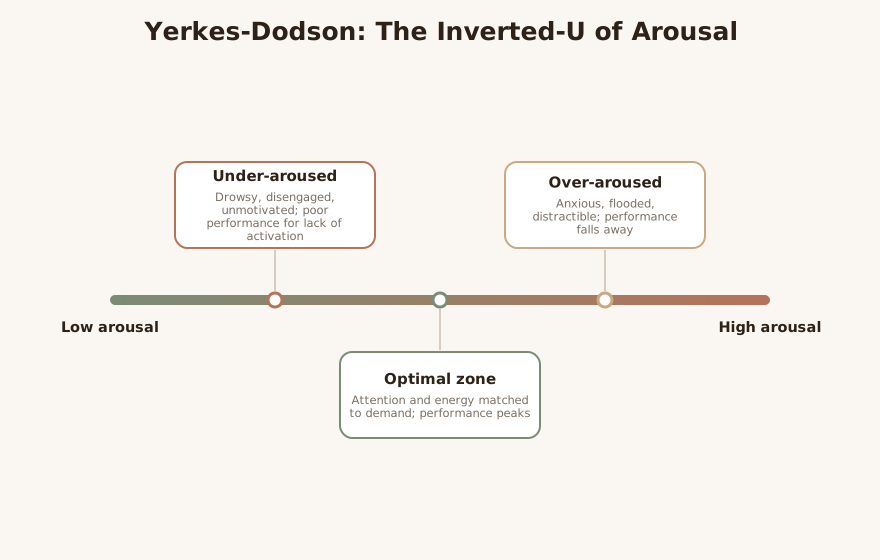
The first and most cited principle is the inverted-U relationship between arousal and performance: as arousal rises from a low baseline, performance improves up to an optimal point, and beyond that point further arousal degrades performance, tracing a curve shaped like an upside-down U 4. At the low end, a person is under-aroused — drowsy, disengaged, unmotivated — and performs poorly for lack of activation 5. In the middle lies an optimal zone of arousal in which attention, motivation, and energy are well matched to the demand and performance peaks 5. At the high end, the person is over-aroused — anxious, flooded, distractible — and performance falls away again 5.
The second principle, often lost in popular summaries, is task-dependence of the optimum: the location of the peak is not fixed but shifts with the difficulty or complexity of the task 6. For simple, well-learned, or routine tasks, the optimal level of arousal is relatively high, and performance can tolerate or even benefit from considerable activation 6. For complex, novel, or cognitively demanding tasks, the optimal level of arousal is lower, and the same activation that would help on an easy task will impair a hard one 4. This is the half of the law most directly traceable to the original 1908 data, in which harder discriminations were mastered best under weaker stimulation 1.
A third, more contemporary refinement is that the curve is not a static given but a regulable system 3. Recent work indicates that the peak of the Yerkes-Dodson curve can itself be shifted — for example, that catecholaminergic enhancement of arousal can move the optimum, so that the relationship between arousal and performance is better understood as adaptively tuned than as a fixed line every person and task must obey 3. In other words, the inverted-U is a robust population-level regularity whose exact shape and peak vary with the task, the person, and the underlying neuromodulatory state 2.
Interventions & Techniques
The Yerkes-Dodson law does not arrive packaged with proprietary techniques; it is a model that informs how a clinician conceptualizes and titrates a client’s level of activation within existing interventions LLM. Its most immediate clinical translation is psychoeducational: drawing the inverted-U for a client externalizes their experience, reframing “I always panic and blank out” as “my arousal is running past the top of the curve, where everyone’s performance falls” LLM. This normalizes the symptom and converts a global self-judgment into a regulable variable LLM.
From there the model points to two complementary directions of work LLM. For the over-aroused client sitting to the right of the peak, the task is arousal down-regulation — paced breathing, grounding, progressive muscle relaxation, and other physiological-calming skills that move the person leftward toward the optimal zone before a feared performance LLM. For the under-aroused, avoidant, or amotivated client sitting to the left of the peak, the task is the opposite: arousal up-regulation through behavioral activation, stakes-raising, or energizing routines that move the person rightward into the productive middle LLM. The law’s task-dependence principle adds a crucial nuance for exposure and skills work: because the optimal arousal is lower for complex than for simple tasks, a clinician can grade challenges so that demanding, novel material is practiced at lower activation while over-learned skills are rehearsed until they tolerate higher arousal 4. Over-learning a performance routine to the point of automaticity effectively shifts a task from “complex” toward “simple,” raising the arousal a person can sustain before performance breaks down — a rationale for rehearsal and exposure that the law makes explicit LLM.
LLM-generated illustrative example (not a guideline): A clinician working with a graduate student who freezes during oral exams sketches the inverted-U and marks where the student’s racing heart and blank mind fall — well past the peak. Together they treat the exam as a “complex task” with a low optimal arousal, build a pre-exam down-regulation routine of paced breathing, and over-rehearse the opening two minutes until that segment becomes a “simple task” the student can deliver even while activated. LLM
Evidence Base
The maturity of the Yerkes-Dodson law is best described as established — as a long-standing and widely cited principle, not as an evidence-based treatment 6. The inverted-U relationship between arousal and performance is one of the oldest empirical regularities in psychology, has been observed across many tasks and species, and remains a standard reference point in textbooks, sport psychology, and stress research more than a century after the original study 4. Contemporary cognitive neuroscience continues to take the curve seriously enough to revisit and refine it, examining its theoretical and neural basis rather than discarding it 2.
Honesty requires several substantial caveats for clinical use LLM. First, “established” describes the standing of the principle, not the outcomes of any therapy derived from it; there is no manualized “Yerkes-Dodson treatment” with its own trial base, and the clinical applications here are reasoned extensions of established practice rather than direct findings from the original research LLM. Second, the law has drawn sustained methodological criticism: the inverted-U has been called difficult to test rigorously and easy to confirm post hoc, because “arousal” is a broad, hard-to-measure construct and a poor outcome can always be attributed to being on one side of an unobserved peak 2. Third, the simple single curve oversimplifies: arousal is not one thing, performance is multidimensional, and a 2024 reappraisal argues the relationship is more nuanced and context-dependent than the textbook U implies 2. Fourth, the modern finding that the peak can be pharmacologically and adaptively shifted means the curve is not a fixed law every person obeys but a tunable, individually varying relationship 3. The honest summary is that the inverted-U is a useful, well-worn heuristic with real empirical roots and real conceptual limits, best held loosely as a formulation aid rather than a precise predictive instrument LLM.
Populations & Indications
The law is most clinically illuminating wherever a presentation turns on activation being mismatched to a demand — too high to perform, or too low to engage LLM. People with performance anxiety are the paradigm case, because the experience of being so activated that skill collapses is precisely the right-hand descent of the inverted-U 5. Students and test-takers with test anxiety show the same pattern in evaluative settings, where mounting arousal past the optimal zone disrupts recall and reasoning on what is, by definition, a complex task 5. Athletes and performers are the population in which the law is most explicitly applied, since sport psychology routinely uses the inverted-U to help competitors find and hold their optimal activation 4.
Beyond performance settings, adults with anxiety disorders and clients living with chronic hyperarousal can be understood through the right side of the curve, where a persistently elevated baseline pushes everyday tasks past their optimum and produces the attention and concentration difficulties that often accompany anxiety 5. Working professionals facing high-stakes deadlines and presentations occupy the same territory, balancing the energizing value of pressure against the cost of flooding 5. The law also speaks, more gently, to the left side of the curve: clients whose under-activation shows up as procrastination, flatness, or avoidance can be framed as needing more, not less, arousal to reach their productive zone LLM. Across all of these the construct is an adjunct formulation lens, not a diagnosis-specific protocol LLM.
Problems-for-Work
Performance and test anxiety. The inverted-U gives client and clinician a shared map: the goal is not to eliminate arousal but to move from the over-aroused right side back toward the optimal zone, which reframes “calm down completely” into the more accurate “dial it down to your peak” 5.
Choking under pressure. The law names choking as performance collapse caused by arousal overshooting the optimum on a complex skill, which supports both down-regulation before the event and over-learning of the skill so it tolerates higher activation 4.
Hyperarousal and attention difficulties. Framing a chronically elevated baseline as sitting past the peak of the curve explains why concentration suffers and motivates arousal-reduction skills as a route back into the productive zone 5.
Procrastination and under-activation. For the under-aroused, avoidant client on the left of the curve, the model reframes the problem as too little activation rather than too much, pointing toward behavioral activation and stakes-raising to climb toward the optimum LLM.
Stress. The law offers a non-pathologizing account of stress as activation that helps up to a point and hurts beyond it, validating that some pressure is useful while targeting the excess that tips performance down 5.
LLM-generated illustrative example (not a guideline): A working professional reports “completely shutting down” before client presentations yet feeling listless and unable to start preparing on ordinary days. The clinician maps both states onto the curve — flooded and past the peak before presentations, under-aroused and avoidant beforehand — and builds two distinct plans: down-regulation skills for the presentation and behavioral activation to climb the curve during preparation. LLM
Contraindications, Cautions & Cultural Humility
Because the Yerkes-Dodson law is a conceptual model rather than a treatment, it carries no direct contraindications, but its misuse does LLM. The chief caution is not to let an elegant curve substitute for assessment or evidence-based care; the law should sit alongside established interventions, never replace them LLM. A second caution follows from the model’s own limits: because “arousal” is a loose construct and the peak is unobservable in the moment, the clinician should resist the temptation to explain every good or bad performance after the fact by pointing to the curve, which can become an unfalsifiable story 2. A third caution is that the law can be misread as prescribing that clients should manufacture stress to perform; the clinically responsible message is about finding an individual’s optimal zone, not about valorizing pressure, and the optimum varies widely by person and task 3.
Cultural humility matters in two ways LLM. First, what counts as “optimal” activation, and how arousal is expressed and valued, varies across individuals and cultures; a performance style or affective intensity that one frame would call “over-aroused” may be culturally normative and effective for a given client, and the clinician should not impose a textbook midpoint as the universal target LLM. Second, for clients shaped by trauma or by genuinely unsafe environments, a high baseline of arousal may be an accurate adaptation to real threat rather than a miscalibration to be corrected, so framing their vigilance as merely “past the peak of the curve” would be both inaccurate and invalidating LLM. The clinician should offer the model tentatively, check how it lands, and set it aside whenever it does not fit the person in the room LLM.
Treatment-Plan Suggestions & SMART Objectives
| Goal | SMART objective (example) | Mechanism |
|---|---|---|
| Build awareness of personal arousal-performance zones | Client rates arousal (0-10) and performance before and after 1 challenging task daily for 2 weeks | Externalizes the inverted-U as a self-monitored, regulable variable 4 |
| Reduce over-arousal before performance | Client completes a 5-minute paced-breathing or grounding routine before 5 of 7 anticipated stressors over 4 weeks | Moves arousal leftward from past-peak toward the optimal zone 5 |
| Increase activation for avoided tasks | Client initiates 1 avoided task within 10 minutes of a scheduled start time on 5 of 7 days for 3 weeks | Behavioral activation climbs the left side of the curve toward the optimum LLM |
| Lower the difficulty-driven optimum through over-learning | Client rehearses a defined performance segment to fluency across 8 practice trials before the event | Shifts a complex task toward “simple,” raising the arousal it tolerates 1 |
| Tolerate moderate arousal during a feared task | Client completes a graded exposure remaining engaged at an arousal of 5-7/10 across 5 sessions | Builds capacity to perform within, rather than escape, activation 2 |
| Reframe stress as workable rather than wholly harmful | Client articulates the inverted-U in their own words and applies it to 2 personal examples by session 3 | Psychoeducation reduces catastrophizing about normal arousal 5 |
| Match preparation to task complexity | Client identifies 3 upcoming tasks as “simple” or “complex” and sets a target activation for each by session 4 | Applies task-dependence of the optimum to real demands 6 |
Common Misconceptions
A frequent misreading is that “more arousal always helps performance,” which captures only the left half of the curve; the law’s defining claim is the inverted U, in which activation helps up to an optimum and then hurts 4. A closely related error is the opposite — that arousal is simply bad for performance — when the model’s clinical usefulness lies precisely in identifying a productive middle zone rather than driving arousal as low as possible 5. A third misconception is that the optimal level is the same for every task; the law’s second, frequently forgotten principle is that the optimum is lower for complex tasks and higher for simple ones, so there is no single correct arousal level 6.
A fourth misconception attributes the tidy inverted-U graph and the term “arousal” to Yerkes and Dodson themselves; the 1908 study was a narrow animal-learning experiment about strength of stimulus and task difficulty, and the curve and arousal framing were added by later researchers 7. A fifth is treating the law as an exact, fixed instrument: the peak is not a constant but varies by person and can even be shifted neuromodulatorily, so the curve is a flexible heuristic rather than a precise predictor 3. Finally, clinicians sometimes treat the law as a validated therapy in its own right, when its standing concerns the arousal-performance relationship, not the outcomes of any branded treatment LLM.
Training & Certification
There is no certification, credential, or formal training pathway specific to the Yerkes-Dodson law, because it is a theoretical principle rather than a practice modality LLM. Clinicians typically encounter it within graduate coursework in motivation, learning, physiological psychology, or sport and performance psychology, and through the primary literature beginning with the 1908 paper 1. Accessible explainer summaries and reference entries are widely available and are sufficient for most clinical conceptual use 45.
For applied competence, the relevant training is in the established interventions the law informs — arousal-regulation and relaxation skills, exposure-based methods, behavioral activation, and cognitive restructuring within cognitive behavioral therapy, alongside the performance-psychology techniques used in sport LLM. The most useful preparation is therefore to learn the principle well enough to use it as psychoeducation and case formulation, while building credentialed skill in the treatments it complements LLM.
Key Terms
Arousal: the broad construct of physiological and mental activation — ranging from drowsiness to high alertness — that the law relates to performance 5.
Inverted-U (curve): the upside-down-U-shaped relationship in which performance rises with arousal to an optimal point and then declines with further arousal 4.
Optimal level of arousal: the activation level at the peak of the curve, where performance is best; it varies with the person and the task rather than being fixed 6.
Task-dependence (difficulty effect): the principle, traceable to the 1908 data, that the optimal arousal is lower for complex or novel tasks and higher for simple or well-learned ones 1.
Over-arousal: activation past the peak, associated with anxiety, flooding, distractibility, and the performance collapse colloquially called choking 5.
Under-arousal: activation below the productive zone, associated with disengagement, low motivation, and procrastination 5.
Peak shifting: the contemporary finding that the location of the curve’s optimum is not fixed and can be moved, for example by catecholaminergic enhancement of arousal 3.
Resources & Further Reading
▶ Watch — a video introduction to this concept:
- Yerkes, R. M., & Dodson, J. D. (1908). The Relation of Strength of Stimulus to Rapidity of Habit-Formation — Journal of Comparative Neurology and Psychology
- Arousal and performance: revisiting the famous inverted-U-shaped curve — Trends in Cognitive Sciences (2024)
- Adaptive arousal regulation: shifting the peak of the Yerkes-Dodson curve by catecholaminergic enhancement of arousal — PNAS
- Yerkes-Dodson Law of Arousal and Performance — Simply Psychology
- Yerkes-Dodson Law: How It Correlates to Stress, Anxiety, Performance — Healthline
- Yerkes-Dodson law — Oxford Reference
- Yerkes-Dodson law — Wikipedia
Reflective / Supervision Questions
- When a client describes “shutting down” under pressure, how do you assess whether they are over-aroused (right of the peak) or under-aroused (left of the peak), and how does that distinction change your intervention? LLM
- How do you use the task-dependence principle to grade exposures and rehearsals, so that complex material is practiced at lower arousal while over-learned skills tolerate more? 1
- How do you guard against the unfalsifiable use of the inverted-U, in which any outcome is explained after the fact by an unobservable peak? 2
- For a trauma-shaped client whose high baseline arousal tracks real or past danger, how do you avoid framing accurate vigilance as a mere miscalibration to be corrected? LLM
- How do you introduce the curve so it normalizes a client’s symptom as a regulable variable rather than implying they should manufacture stress to perform? 3
- Where in your caseload would naming an “optimal zone” rather than “be calm” or “try harder” give a client a more workable, individualized target? LLM