
Type & Discipline
Disability Justice is a movement and values framework, not a clinical treatment modality 2. It belongs to the lineage of critical disability studies and disability activism rather than to psychotherapy proper, and it is best understood by clinicians as an orienting lens that reshapes case conceptualization, the therapeutic stance, and goal-setting LLM. It is explicitly intersectional: it holds that ableism cannot be understood in isolation from white supremacy, capitalism, and heteropatriarchy 1. Where the medical model locates the “problem” of disability inside the individual body or mind, Disability Justice — building on the social model — locates much of the harm in inaccessible, exclusionary, and oppressive systems 6. For the practitioner, this means a meaningful share of a disabled client’s presenting distress is reframed as a sane response to structural conditions rather than as intrapsychic pathology LLM.
Creators & Lineage
Disability Justice emerged in 2005 in the San Francisco Bay Area, developed by queer, disabled activists of color who began discussing a “second wave” of disability rights 5. The principal early architects were Patty Berne, Mia Mingus, and Stacey Milbern, later joined by Leroy F. Moore Jr., Eli Clare, and Sebastian Margaret 5. These thinkers became connected through Sins Invalid, a disability-justice-based performance and political arts project that articulated the framework’s foundational principles 5. Patty Berne is generally credited with drafting the movement’s defining working document and its ten guiding principles 2.
The framework was born as a direct critique of the mainstream disability rights movement 2. Berne and colleagues argued that traditional disability rights, while advancing important independent-living philosophy, was “single issue identity based” and centered people with mobility impairments while marginalizing other forms of impairment 2. More pointedly, they held that it had “invisibilized” the lives of people living at intersecting junctures of oppression — disabled people of color, immigrants with disabilities, and queer and trans disabled people among them 2. Disability Justice thus draws on intersectionality, recognizing that each person holds multiple community identifications and that each identity can be a site of privilege or oppression 2. Its intellectual neighbors include the social model of disability, critical race theory, and the broader disability rights movement it both extends and challenges 5. The guiding ethic “Nothing about us, without us” frames the movement’s insistence on disabled leadership 4.
Core Principles
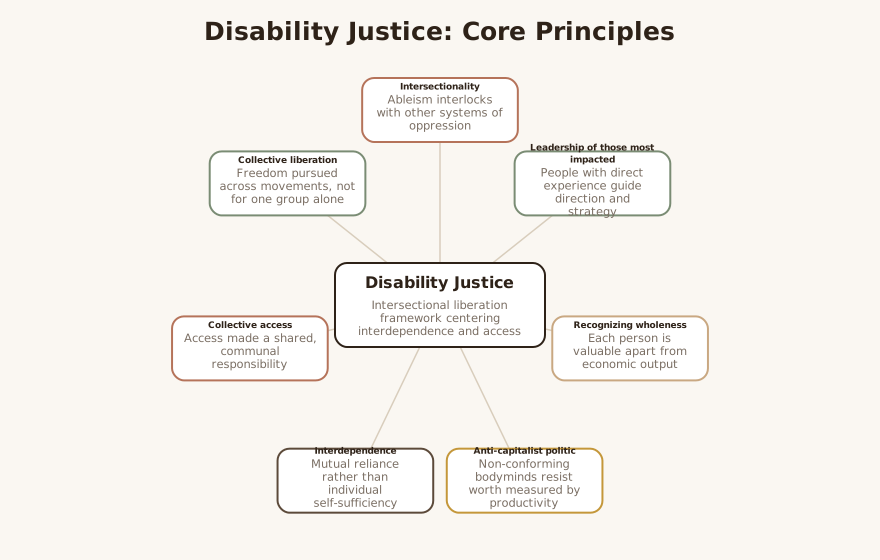
Sins Invalid articulates ten principles of Disability Justice, several of which carry direct clinical resonance 1. Intersectionality opens the list, naming the way ableism interlocks with other systems of oppression 1. Leadership of those most impacted holds that people with direct experience of oppressive systems should guide direction and strategy — in Berne’s words, “we are led by those who most know these systems” 2. Anti-capitalist politic observes that disabled people, by existing in non-conforming bodyminds, resist an economy that measures human worth by productivity 1.
The remaining principles include commitment to cross-movement organizing, recognizing wholeness (people have inherent value independent of economic productivity), sustainability (pacing to avoid burnout), commitment to cross-disability solidarity, interdependence, collective access, and collective liberation 1. Three of these are especially generative in the consulting room LLM. Recognizing wholeness directly counters internalized ableism by asserting that each person brings unique history and experience and is valuable apart from output 1. Interdependence rejects the “myth of independence” and instead embraces mutual reliance and the dignity of having needs — a reframe with obvious clinical leverage for shame and self-worth 6. Collective access treats accommodation not as an individual burden but as a shared, creative community practice 1. Collective liberation insists that comprehensive change requires moving together and leaving no one behind 1.
Interventions & Techniques
Disability Justice does not supply a protocol, a session structure, or a set of validated techniques LLM. What it offers the clinician is a stance and a set of reframes that can be integrated into established, evidence-based modalities LLM. In practice this looks like (a) reframing internalized ableism by surfacing the difference between the body/mind itself and the ableist systems that pathologize it 6; (b) explicitly validating that distress arising from inaccessibility, discrimination, and exclusion is a reasonable response to real conditions rather than cognitive distortion LLM; and (c) using the principle of interdependence to reduce the shame attached to needing help, asking for accommodation, or relying on others 6.
The framework also reshapes the therapeutic relationship itself. “Leadership of those most impacted” translates clinically into centering the client’s own expertise about their bodymind and lived experience, and treating the client as the authority on their needs 2. “Recognizing wholeness” supports interventions that affirm worth independent of productivity, a useful counterweight for clients whose self-esteem is fused with their capacity to work or perform 1.
LLM-generated illustrative example (not a guideline): A neurodivergent client says, “I’m broken because I can’t do an eight-hour shift like everyone else.” A clinician working from this framework might separate the bodymind from the demand — gently distinguishing the client’s actual capacities from a capitalist productivity norm that, per the framework, treats non-conforming bodyminds as defective — and then explore accommodations and interdependent supports rather than pushing the client to “fix” themselves to meet the norm LLM.
Evidence Base
The evidence base for Disability Justice as a clinical intervention is emerging at best, and clinicians should be candid about this LLM. Disability Justice originated as an activist and arts-based movement framework, not as a psychotherapy, and it has not been operationalized into a manualized treatment with controlled outcome trials 2. There is, to date, no body of randomized or large-scale effectiveness research demonstrating that “Disability Justice therapy” reduces symptoms, because no such standardized treatment exists LLM.
What can be claimed honestly is narrower LLM. The framework’s core commitments — locating distress partly in oppressive systems rather than solely in the individual, and treating identity-based stress as real — are consonant with established clinical literature on minority stress and discrimination-related distress, even though the Disability Justice sources cited here are movement and explainer documents rather than empirical studies LLM. Practitioners should therefore treat Disability Justice as a values and conceptualization framework that can inform care, while drawing the actual change methods from modalities that do have an evidence base LLM. Presenting it to clients or in documentation as an empirically validated treatment would overstate what the sources support LLM.
Populations & Indications
The framework was built by and for people living at intersecting margins, which shapes where it is most apt 2. It is indicated when working with people with disabilities broadly, and it is particularly resonant for disabled people of color, LGBTQ+ individuals individuals, and immigrants with disabilities — precisely the populations the founders felt the mainstream movement had rendered invisible 2. It extends naturally to chronically ill and neurodivergent individuals, for whom the social-model reframe and the interdependence principle often map closely onto lived experience LLM.
More broadly, the framework is well suited to members of marginalized communities whose distress is bound up with systemic oppression 6. Indications, in clinical terms, include presentations where ableism, intersecting stigma, and structural exclusion are salient drivers of the client’s suffering — for example internalized ableism, minority stress, and discrimination-related distress LLM. It is also useful for clients in active disability-identity development, where affirming wholeness and disabled community can be stabilizing 1.
Problems-for-Work
Disability Justice offers a generative reframe for several common problems-for-work LLM.
- Internalized ableism and low self-esteem. The “recognizing wholeness” principle gives a clinical handhold: worth is inherent, not earned through productivity, which directly contests the belief that a non-conforming bodymind is defective 1.
- Minority stress and discrimination-related distress. Naming intersecting oppression as a real and external stressor can reduce self-blame and reframe symptoms as responses to conditions 2.
- Social isolation. The collective-access and interdependence principles point toward building and leaning on community and mutual support rather than enforced self-sufficiency 1.
- Disability-related trauma. The framework’s insistence on the client as the authority on their own bodymind can support a non-pathologizing, choice-centered stance 2.
- Systemic oppression effects and identity development. Locating harm in systems and affirming disabled identity as a site of value and solidarity can support a coherent, non-shamed sense of self 1.
LLM-generated illustrative example (not a guideline): For a client reporting profound isolation after acquiring a chronic illness, a clinician might use the collective-access reframe to reposition “I’m a burden when I ask for rides” as participation in interdependent community, and pair that cognitive shift with concrete behavioral steps toward reconnection LLM.
Contraindications, Cautions & Cultural Humility
There are no “contraindications” in the pharmacologic sense, but there are important cautions LLM. First, the framework is not a substitute for indicated, evidence-based treatment of acute or high-risk conditions; using a values lens does not replace appropriate care for, say, severe depression, suicidality, or psychosis LLM. Second, clinicians should avoid imposing a political or activist identity on clients who do not share it; the principle of “leadership of those most impacted” cuts against the therapist projecting their own framing onto the client 2.
Cultural humility is intrinsic to the framework rather than an add-on LLM. Because Disability Justice was explicitly created to correct the centering of “straight white men with physical disabilities” in earlier movements, a clinician applying it must attend to the client’s specific intersections of race, gender, sexuality, class, and impairment rather than treating “disabled” as a monolith 5. The framework holds that disabled people of the global majority share particular ground in confronting colonial and intersecting powers, and a non-disabled or differently-situated clinician should hold their own positionality with humility 4. The honest stance is to use the framework to widen the clinician’s view while keeping the client as the authority on their own experience 2.
Treatment-Plan Suggestions & SMART Objectives
The table below offers illustrative, non-prescriptive examples for translating the framework into plan language LLM.
| Goal | SMART objective (example) | Mechanism |
|---|---|---|
| Reduce internalized ableism | Within 8 weeks, client will identify and reframe 3 self-critical beliefs that equate worth with productivity, rated weekly | Recognizing wholeness; cognitive reframing of ableist standards 1 |
| Decrease shame around needing support | Within 6 weeks, client will make 2 accommodation or support requests and process the experience in session | Interdependence; rejecting the “myth of independence” 6 |
| Reduce social isolation | Over 10 weeks, client will engage in 1 disability-affirming or peer community activity per week | Collective access; community as a shared resource 1 |
| Buffer minority stress | Within 8 weeks, client will distinguish externally-driven (discrimination) from internally-driven distress in 4 logged incidents | Intersectionality; externalizing systemic stressors 2 |
| Strengthen disability identity | Over 12 weeks, client will articulate 3 valued aspects of their disabled identity | Recognizing wholeness; affirmative identity development 1 |
| Increase self-advocacy | Within 8 weeks, client will assert a need or boundary in 3 documented interpersonal or institutional situations | Leadership of those most impacted; client as authority on own bodymind 2 |
| Reduce productivity-driven burnout | Over 6 weeks, client will implement 2 pacing/rest practices and rate self-criticism before and after | Sustainability; pacing to prevent burnout 1 |
Common Misconceptions
A first misconception is that Disability Justice is simply a newer name for disability rights LLM. The founders framed it as a distinct “second wave” precisely because they found the rights movement single-issue and centered on mobility impairments and on people not otherwise marginalized 2. A second misconception is that it is interchangeable with “disability inclusion” or “diversity” language; the Disability & Philanthropy Forum stresses that it specifically prioritizes those at intersecting margins rather than inclusion in the abstract 6. A third is that interdependence means dependence or helplessness — in fact the principle reframes mutual reliance as a strength and a rejection of the myth that independence is the marker of dignity 6. Finally, clinicians sometimes assume the framework supplies validated techniques; it supplies principles and a stance, and the change methods must come from elsewhere LLM.
Training & Certification
There is no licensing body, credential, or formal certification in Disability Justice for clinicians, and none of the provided sources describes one LLM. The movement is organized around community, arts, and education rather than professional gatekeeping, consistent with its anti-credentialist and “leadership of those most impacted” ethic 1. Clinicians seeking competence are best served by reading the primary movement texts directly — Patty Berne’s working draft and the Sins Invalid principles — and by curated educational guides such as Barnard’s reader’s guide 2. Ongoing learning should foreground disabled-led voices and the client’s own expertise rather than a top-down certification model 2.
Key Terms
- Disability Justice — an intersectional, second-wave disability framework centering those at multiply-marginalized intersections 2.
- Interdependence — the principle that mutual reliance and the having of needs are sources of dignity, not deficits 6.
- Collective access — treating accommodation and access as a shared, creative community practice rather than an individual burden 1.
- Recognizing wholeness — the view that human worth is inherent and independent of economic productivity 1.
- Leadership of those most impacted — the commitment that people with direct experience of oppression guide the work 2.
- Intersectionality — the recognition that each identity can be a site of privilege or oppression and that ableism interlocks with other systems 1.
- Social model of disability — the underlying view that disability arises substantially from inaccessible and exclusionary systems rather than the body or mind alone 6.
Resources & Further Reading
▶ Watch — a video introduction to this concept:
- 10 Principles of Disability Justice (Sins Invalid) 1
- Disability Justice — a working draft by Patty Berne (Sins Invalid) 2
- 10 Principles of Disability Justice, 2nd Edition (Sins Invalid PDF) 3
- Disability Justice: A Reader’s Guide (Barnard College Library Guides) 4
- Disability justice (Wikipedia) 5
- What is Disability Justice? (Disability & Philanthropy Forum) 6
Reflective / Supervision Questions
- Where in my current case conceptualizations am I locating a disabled client’s distress inside the individual when it may be substantially produced by inaccessible or oppressive systems? 6
- How do my own positionality and ability status shape what I treat as a “problem” in session, and how am I holding that with humility? 4
- Am I genuinely centering the client as the authority on their own bodymind, or am I importing my own framing of their disability? 2
- When a client expresses shame about needing help, am I reinforcing the “myth of independence,” or am I able to reframe needs through interdependence? 6
- For clients at intersecting margins, am I attending to the specific interplay of race, gender, sexuality, class, and impairment, or defaulting to a monolithic view of disability? 5
- Where am I treating this framework as a validated treatment rather than a values lens layered onto evidence-based methods, and how would I document that honestly? LLM