
Type & Discipline
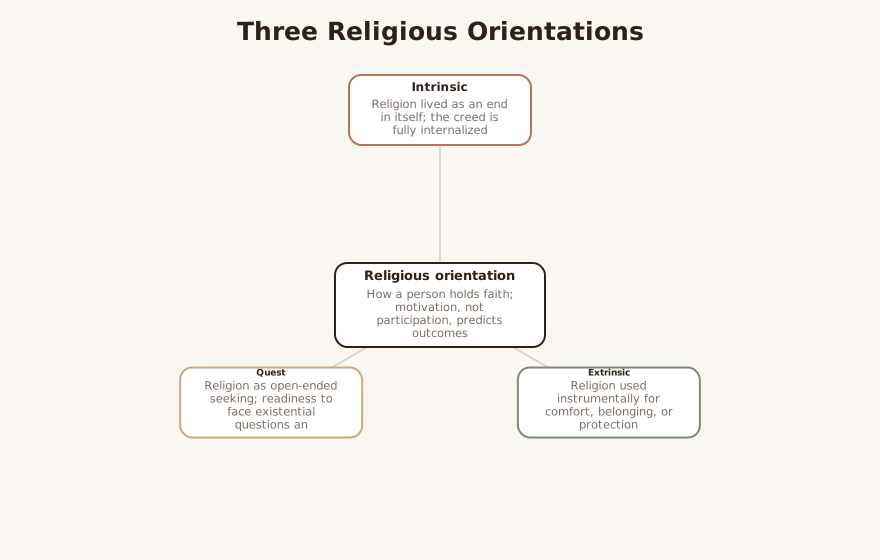
Religious orientation is a motivational construct from the psychology of religion, not a treatment modality 3. It describes how a person holds faith rather than what they believe or how much 1. The classic typology distinguishes three motivational styles: an intrinsic orientation, in which religion is the internalized master motive that organizes a life; an extrinsic orientation, in which religion is a means to non-religious ends such as security, sociability, status, or self-justification; and a quest orientation, in which religion is an open-ended search that treats existential questions as important and worth living with even without final answers 15. For clinicians, the value of the construct is diagnostic and relational: it gives language for the difference between faith that buffers distress and faith that is enlisted defensively or held with anxious certainty LLM. Because it is a construct, religious orientation is something a therapist assesses and works with inside an established modality, never a stand-alone therapy LLM. It sits alongside related frameworks such as religious coping and religious and spiritual struggles within the broader field LLM.
Creators & Lineage
Gordon Allport, the Harvard personality psychologist, introduced the intrinsic–extrinsic distinction to explain a paradox: why religious people on average showed more prejudice than the nonreligious, yet the most devout showed less 1. With J. Michael Ross he operationalized the distinction in the 1967 Religious Orientation Scale, the field’s foundational instrument 17. Daniel Batson later argued that intrinsic and extrinsic dimensions failed to capture a mature, questioning religiousness, and proposed the quest dimension as a third axis emphasizing complexity, doubt, and tentativeness 5. Batson, Schoenrade, and Ventis synthesized this three-dimensional model and its social-psychological evidence in their 1993 text 2. The lineage runs through personality psychology and the psychology of religion, and it directly informs later constructs including religious coping and the study of religious and spiritual struggles LLM.
Core Principles
The central principle is that motivation, not mere religious participation, predicts psychological and social outcomes 1. Intrinsic and extrinsic are not opposite ends of one scale but largely independent dimensions, so a person can score high or low on both 4. An intrinsically oriented client lives religion as an end in itself and tends to internalize its creed fully 3. An extrinsically oriented client uses religion instrumentally, for comfort, belonging, or protection, treating belief as lightly held where it conflicts with self-interest 1. The quest orientation reframes religion as a process rather than a possession, marked by readiness to face existential questions, self-criticism about doubt, and openness to change 5. Later work refined the extrinsic dimension into personal-extrinsic and social-extrinsic facets, recognizing that using faith for private comfort differs from using it for social gain 4. A core clinical implication is that the same denominational label can house very different psychological functions LLM.
Interventions & Techniques
Religious orientation is applied, not delivered: clinicians use it as an assessment lens and a frame for meaning-focused work within an established modality LLM. The most direct technique is structured assessment, using the Religious Orientation Scale or its quest extension to map a client’s motivational profile and open dialogue about it 75. Within spiritually integrated and meaning-centered psychotherapy, the construct guides values clarification, helping clients examine whether faith functions as an internalized end or a defensive means LLM. Within Acceptance and Commitment Therapy, a clinician can treat the client’s intrinsic religious values as chosen life directions and use them to anchor committed action LLM. Cognitive approaches can target the rigid, all-or-nothing thinking that correlates with extrinsic orientation, distinguishing the belief content from the distorted form it sometimes takes 6. Quest-oriented clients often benefit from validation of doubt as a developmental strength rather than a failure of faith 5.
LLM-generated illustrative example (not a guideline): A client presents with anxiety after a faith crisis. Mapping her orientation reveals high quest and low rigid certainty; the clinician reframes her doubt as a sign of maturing faith rather than spiritual failure, reducing shame LLM.
Evidence Base
The evidence base is established but is best read as construct validity, not treatment efficacy: there are no randomized trials of “religious orientation therapy” because it is a construct, not a therapy LLM. The Religious Orientation Scale has been used and revised across decades and many populations, supporting the intrinsic–extrinsic distinction as a replicable, measurable difference 47. The most robust finding is the original one: extrinsic orientation correlates positively with racial, ethnic, and other prejudice, while intrinsic and especially quest orientations are associated with lower prejudice, though intrinsic shows inconsistent results for sexual-orientation bias 13. Mental-health correlations are real but modest and correlational: intrinsic orientation tends to track with better adjustment and, in one Muslim student sample, with fewer cognitive distortions, while extrinsic orientation tracked with more 6. Honest caveats matter: the measures are Western and largely Christian-centric, the quest construct is contested as possibly tapping doubt or agnosticism more than religiousness, and psychometric debates about the scales persist 54. None of these associations establish that changing orientation causes better outcomes LLM.
Populations & Indications
The construct is most useful with religious and spiritual clients and members of faith communities, for whom motivation is often more clinically relevant than denomination 1. It is indicated when working with adults exploring meaning and values, where the intrinsic–extrinsic–quest frame clarifies what faith is for in the person’s life 5. It is valuable in identity development, including with adolescents and emerging adults who are actively negotiating inherited versus chosen belief LLM. Clergy and other religious professionals may present with strain at the intersection of vocation and personal faith, where the orientation frame helps separate genuine commitment from role-driven performance LLM. Quest assessment is especially apt for clients in transition or deconstruction, where openness and doubt are central 5. The construct also supports work on prejudice and intergroup bias, given its documented links to that domain 1.
Problems-for-Work
The construct maps onto several clinical problems-for-work LLM. For a religious or spiritual problem (V62.89) and broader religious and spiritual struggles, orientation assessment clarifies whether distress stems from rigid extrinsic certainty or from a stalled quest 15. For existential distress and loss of meaning and purpose, locating where faith functions as an internalized end can guide meaning-centered work 5. For values clarification difficulties, separating intrinsic ends from instrumental means helps the client name what they actually stand for 4. For identity disturbance, particularly in younger clients, the frame distinguishes inherited from chosen commitment LLM. For prejudice and intergroup bias presenting in therapy, the extrinsic-prejudice link offers a non-shaming entry point for reflection 1.
LLM-generated illustrative example (not a guideline): A client scrupulously fears damnation. Assessment shows high intrinsic but anxiety-driven rigidity; the clinician targets the all-or-nothing cognitive form rather than the faith itself, addressing the religious or spiritual struggle directly LLM.
Contraindications, Cautions & Cultural Humility
The first caution is measurement bias: the scales were developed in Western, predominantly Christian samples and may misrepresent the orientations of Muslim, Jewish, Hindu, Buddhist, Indigenous, or other clients 64. A clinician should never present extrinsic orientation as “bad faith” or intrinsic as “good faith”; the labels are descriptive, and communal or social uses of religion are normative and adaptive in many cultures 1. The quest construct is genuinely contested and may pathologize settled faith or romanticize doubt, so it should be offered tentatively 5. Therapists must guard against imposing their own religious or secular values, treating assessment as collaborative inquiry rather than evaluation LLM. The construct describes correlations, not destinies, and a client’s score should never be used to predict their character or worth LLM. Religious orientation is not a substitute for evidence-based treatment of any diagnosable disorder LLM.
Treatment-Plan Suggestions & SMART Objectives
| Goal | SMART objective (example) | Mechanism |
|---|---|---|
| Clarify how faith functions in the client’s life | Within 4 sessions, client completes an orientation self-assessment and names two ways faith currently serves as an end versus a means | Structured assessment surfaces motivational profile 7 |
| Reduce shame about religious doubt | Over 6 weeks, client reframes at least three “doubt = failure” statements as signs of an active quest, rated weekly | Quest framing normalizes doubt as development 5 |
| Address rigid all-or-nothing religious thinking | Within 8 sessions, client identifies and restructures 5 cognitive distortions tied to extrinsic-style certainty | Targeting form, not content, reduces distortion 6 |
| Anchor committed action in intrinsic values | By session 10, client names three faith-based values and one weekly action aligned with each | Values function as chosen life directions LLM |
| Resolve a religious or spiritual struggle | Within 3 months, client reports a 2-point drop on a struggle distress rating | Meaning-focused work on the specific struggle 1 |
| Support identity integration in an emerging adult | Over 8 sessions, client articulates which beliefs are inherited versus chosen, in writing | Differentiating sources clarifies identity LLM |
| Reduce extrinsically linked intergroup bias | Within 6 sessions, client reflects on two instances where faith was used defensively toward an out-group | Non-shaming reflection on the extrinsic link 1 |
Common Misconceptions
A frequent error is treating intrinsic and extrinsic as opposite poles of one scale; they are largely independent dimensions, and a client can be high or low on both 4. Another is equating intrinsic with “more religious” and extrinsic with “less”; the distinction is about motivation, not degree of devotion 1. Many assume quest simply means weak or wavering faith, but Batson defined it as an active, self-critical engagement with existential questions, not a deficit 5. Clinicians sometimes read the prejudice findings as proof that religion causes bigotry, when the data show it is extrinsic orientation, not religiousness as such, that tracks with prejudice 13. Finally, the modest mental-health correlations are often overstated as causal protection, which the correlational evidence does not support 6.
Training & Certification
There is no certification in religious orientation, because it is a construct rather than a credentialed therapy LLM. Competence comes from training in the modalities that carry it, such as spiritually integrated psychotherapy, meaning-centered approaches, and Acceptance and Commitment Therapy LLM. Clinicians can learn the framework directly from Allport and Ross’s original paper and Batson, Schoenrade, and Ventis’s synthesis 12. Familiarity with the Religious Orientation Scale and its quest extension supports informal assessment, though formal psychometric use warrants supervised training 75. General competence in spiritual and religious diversity, consistent with professional ethics codes, is the relevant standard LLM.
Key Terms
Intrinsic orientation — religion lived as the central, internalized motive and an end in itself 1.
Extrinsic orientation — religion used instrumentally for security, belonging, status, or comfort 1.
Quest orientation — religion approached as an open-ended search that embraces doubt and existential questions 5.
Religious Orientation Scale (ROS) — Allport and Ross’s 1967 instrument measuring intrinsic and extrinsic dimensions 7.
Personal vs. social extrinsic — a later refinement distinguishing private-comfort from social-gain uses of faith 4.
Resources & Further Reading
▶ Watch — a video introduction to this concept:
- Allport, G. W., & Ross, J. M. (1967). Personal religious orientation and prejudice
- Batson, C. D., Schoenrade, P., & Ventis, W. L. (1993). Religion and the Individual: A Social-Psychological Perspective
- Batson, C. D., & Schoenrade, P. (1996). Religion as Quest: The Self-Directed Pursuit of Meaning
- Maltby, J., & Lewis, C. A. (2006). The means and ends of religiosity
- The Relationship Between Religious Orientation and Gender With a Cognitive Distortion (PMC)
- Religious orientation (Wikipedia)
- Religious Orientation Scale (Psychological Scales & Instruments Database)
Reflective / Supervision Questions
- How do I distinguish, in my own assessment, between a client’s extrinsic use of faith and a culturally normative communal practice that I should not pathologize? LLM
- When a client expresses religious doubt, do I reflexively read it as a problem to resolve or as a quest to be respected? LLM
- Whose values are guiding my framing of “healthy” versus “unhealthy” faith, and how do my own religious or secular commitments shape that? LLM
- Am I applying instruments validated mostly on Western Christian samples to clients whose traditions they may not fit? LLM
- How would I notice if I were using this construct to evaluate a client’s character rather than to understand their motivation? LLM