
Type & Discipline
Cybernetics is a theoretical framework, not a manualized therapy, drawn from systems science and applied to human interaction. LLM It belongs to the broader family of systems theory and supplies the conceptual machinery — feedback, regulation, recursion — that underpins systemic, strategic, and structural family therapies. LLM The core wager is that behavior is governed less by fixed internal traits than by the loops of mutual influence in which a person is embedded, so that symptoms are read as moves within an ongoing pattern rather than as properties of an isolated individual. LLM
Two layers of the theory matter clinically. First-order cybernetics studies “observed systems,” treating the system as a black box that an external observer attempts to regulate or manipulate. 63 Second-order cybernetics studies “observing systems,” positioning the therapist inside the cybernetic circuit itself, “eliminating unilateral control” and acknowledging that the clinician’s observation is itself a participating act. 63 For a practicing therapist, this is the difference between believing you are fixing a family from outside and recognizing that you have joined a feedback loop the moment you sit down with them. LLM
Creators & Lineage
The word cybernetics was coined by the mathematician Norbert Wiener to name the study of control and communication in animals and machines, and W. Ross Ashby developed its formal account of regulation and self-correcting systems. LLM The figure who carried these ideas into the human and clinical sciences was the anthropologist Gregory Bateson, whose work at Palo Alto generated the epistemology that later therapists built upon. 34 Bateson contributed a participant-observer stance at the Mental Research Institute (MRI), and Heinz von Foerster extended the framework into second-order cybernetics, which he glossed as “the control of control and the communication of communication.” 6 Margaret Mead’s 1967 keynote pushed cyberneticians to accept responsibility for the systemic consequences of their interventions, a moral note that resonates in clinical ethics today. 6
From this root grew the clinical lineage most relevant to therapists. LLM Bateson’s cybernetics became the explicit basis of MRI brief therapy, which reframed problems as maintained by interaction rather than by intrapsychic deficit. 4 Watzlawick, Beavin Bavelas, and Jackson formalized the communicational reading of these ideas in Pragmatics of Human Communication, and later strategic and structural family therapies inherited the same feedback-centered worldview. 1 Bradford Keeney’s Cybernetic Patterns in Family Therapy then argued that earlier therapeutic applications were “too short-sighted, missing the more important ecological perspective,” pressing the field toward a fuller second-order, aesthetic understanding of recursion. 3
Core Principles
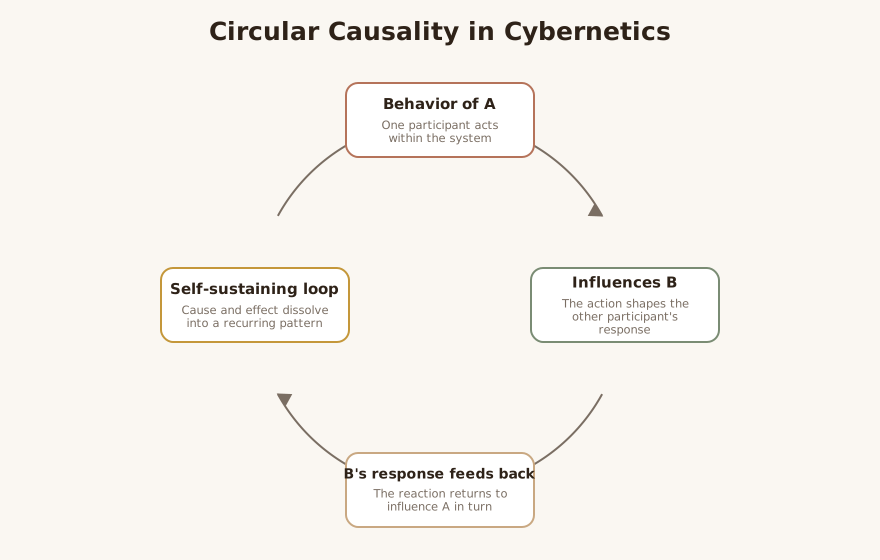
The foundational principle is circular rather than linear causality. LLM In a linear model A causes B; in a cybernetic model A and B influence each other recursively, so that cause and effect dissolve into a self-sustaining loop. 3 This is why the framework treats “change and stability as complementary elements” rather than opposites. 3
Feedback comes in two kinds. Negative (deviation-correcting) feedback restores a system toward a set point and produces homeostasis, the tendency of a family or couple to maintain a familiar equilibrium even at the cost of a symptom. 2 Positive (deviation-amplifying) feedback magnifies a change, escalating it away from the prior steady state; in family systems theory positive feedback is the engine of escalation and, when it loosens old structures, of morphogenesis or genuine reorganization. 2 A vicious cycle of mounting conflict is positive feedback at work; a couple who unconsciously re-stabilize around one partner’s symptom show negative feedback defending homeostasis. 2
A second cluster of principles is communicational. LLM Pragmatics of Human Communication argues that one cannot not communicate, that every message carries both a content and a relationship-defining (metacommunicative) level, and that participants punctuate a shared sequence differently — each seeing their own behavior as a reaction to the other’s. 1 Keeney names this punctuation as one of Bateson’s central methodological tools, alongside logical typing and double description. 3 Clinically, the divergent punctuation of a single loop (“I nag because you withdraw” / “I withdraw because you nag”) is often the presenting complaint itself. LLM
The third principle is recursion applied to the helper. LLM In second-order terms the therapist and family “form a recursive feedback mechanism,” a sociofeedback loop in which the clinician’s interventions are themselves fed back into the system they are trying to read. 3 The observer is a participant rather than a detached external entity, which means objectivity in the classical sense is unavailable. 6
Interventions & Techniques
Cybernetics is a lens that organizes technique rather than a fixed protocol. LLM The first move in any cybernetically informed session is mapping the loop: tracking the repetitive sequence of who does what, when, and in response to whom, until the maintaining pattern becomes visible to the clinician and ideally to the family. 4LLM Because problems are seen as maintained by interaction, the target of change is the pattern, not a person inside it. 4
The most distinctive MRI-derived intervention follows from the observation that the attempted solution often is the problem. 4 When a family applies “more of the same” corrective effort — more reassurance for anxiety, more control for a teenager’s defiance — and the effort feeds the very loop it means to break, the strategic task is to interrupt that solution rather than amplify it. 4LLM Reframing changes the punctuation and the meaning assigned to a behavior so the loop can no longer run on its old terms. 1LLM
LLM-generated illustrative example (not a guideline): A father escalates curfew penalties each time his son misses curfew; the son, feeling controlled, returns later still. The therapist maps the loop, names the “more of the same” punishment as the fuel rather than the fix, and coaches the father to hand the son responsibility for one consequence — interrupting the deviation-amplifying cycle so a new pattern can emerge. LLM
Second-order practice adds reflexive techniques: the clinician uses their own position in the sociofeedback loop deliberately, attends to how the family responds to the therapy itself, and treats the therapeutic relationship as data. 36 Keeney’s argument for grounding therapy in aesthetic rather than narrowly technical principles is a caution against mechanical application of any single maneuver. 3
Evidence Base
The maturity of cybernetics as a theory is best described as established and foundational: it is the accepted conceptual basis of MRI brief therapy and of systemic family therapy more broadly, and it remains in active clinical use and training. 45 A clinical psychology trainee’s recent reflective account confirms that circular causality and systemic feedback continue to be taught and practiced as core systemic ideas. 5
Honesty requires a distinction the framework itself invites. LLM Cybernetics is a well-validated way of organizing clinical thinking, but it is not itself a treatment with its own randomized-controlled-trial pipeline; the empirical evidence belongs to the therapies that operationalize it — systemic, strategic, and structural family therapies and couple work. LLM Second-order cybernetics, by foregrounding the observer and rejecting classical objectivity, sits closer to epistemology than to a testable intervention, and clinicians should hold it as a stance rather than a proven mechanism. 6LLM The theory’s strength is heuristic and explanatory; its weakness is that its central claims about recursion and observer-inclusion are difficult to falsify directly. 6LLM
Populations & Indications
The framework is most obviously indicated for relational units: families and couples, where the loop is literally shared in the room. 5LLM It scales to systems and organizations, where homeostasis and escalation describe team and institutional dynamics as readily as family ones. 2LLM It is equally applicable to individuals with repetitive symptom cycles, because a single client’s behavior is still embedded in feedback with partners, family, and their own attempted solutions. 4LLM
Clients in formal family therapy are the prototypical population, and the lens is well suited to people with addictive behaviors, where maintenance loops involving relief, consequence, and renewed use are central. 5LLM Across these groups the common indication is the same: a presenting problem that persists despite — or because of — repeated efforts to solve it. 4LLM
Problems-for-Work
Self-reinforcing symptom cycles are the signature application: any complaint that recurs in a predictable sequence is a candidate for loop-mapping and solution-interruption. 4LLM Relationship conflict and broader communication problems are addressed through punctuation and metacommunication — surfacing how each partner reads the same exchange differently. 1LLM
Family dysfunction and maladaptive interactional patterns are reframed from “who is the problem” to “what pattern maintains the problem,” shifting blame off the identified patient. 4LLM Emotion dysregulation can be read as a deviation-amplifying loop between an internal state and an interpersonal response that escalates it. 2LLM Addiction maintenance loops and anxiety reinforcement cycles are classic positive-feedback structures where the attempted relief feeds the next iteration. 24LLM Codependency is understood as a homeostatic arrangement in which a partner’s accommodating behavior stabilizes the system around the symptom. 2LLM
LLM-generated illustrative example (not a guideline): A client’s panic prompts a partner to cancel plans and provide reassurance; the relief is real but transient, and the accommodation teaches the system that panic produces care, tightening the loop. The clinician treats the couple’s reassurance routine as part of the maintaining pattern, not merely the individual’s anxiety. LLM
Contraindications, Cautions & Cultural Humility
The chief caution is that a purely systemic, pattern-level framing can obscure power, abuse, and individual responsibility. LLM Treating intimate-partner violence as a mutually maintained loop is clinically and ethically dangerous; safety and accountability take precedence over circularity, and the framework should never be used to imply that a victim co-causes their own harm. LLM Likewise, framing a symptom as serving family homeostasis must not slide into blaming the family for an illness with strong biological determinants. 2LLM
Second-order cybernetics supplies its own corrective here: because the observer is a participant, the clinician’s own assumptions, culture, and position enter the loop and must be examined rather than disguised. 6 Mead’s call for cyberneticians to accept responsibility for systemic consequences translates directly into clinical accountability for how a reframe lands. 6LLM Cultural humility requires recognizing that what one therapist reads as “dysfunctional” homeostasis may be a culturally normative and protective family arrangement; the punctuation a clinician imposes is theirs, not nature’s. 16LLM
Treatment-Plan Suggestions & SMART Objectives
| Goal | SMART objective (example) | Mechanism |
|---|---|---|
| Make the maintaining loop visible | Within 3 sessions, the couple will jointly describe their recurring conflict sequence (trigger → response → escalation) in their own words during session. | Loop-mapping converts a vague complaint into an observable interactional pattern. 4 |
| Reduce “more of the same” attempted solutions | Over 4 weeks, the client will reduce reassurance-seeking episodes from daily to ≤2 per week as tracked in a log. | Interrupting the deviation-amplifying solution loosens the cycle that sustains the symptom. 42 |
| Shift divergent punctuation | By session 6, each partner will state one way their own behavior contributes to the loop, without blaming the other. | Metacommunication exposes how each reads the same sequence differently. 1 |
| Replace escalation with a new sequence | Within 6 weeks, the family will implement one agreed alternative response to the trigger in ≥3 of 5 instances. | Introducing a different move converts positive feedback into a reorganizing (morphogenic) change. 2 |
| De-center the identified patient | Within 2 sessions, the family will reframe the presenting problem as “our pattern” rather than “[member]’s problem” in their own statements. | Reframing redistributes responsibility off the identified patient. 4 |
| Strengthen stabilizing (negative) feedback for safety | Over 4 weeks, the couple will use one agreed de-escalation signal to halt escalating conflict in ≥3 instances. | Deliberate negative feedback restores a safer set point during escalation. 2 |
| Use the therapeutic relationship reflexively | By midpoint review, the clinician will document how the family’s response to interventions informed at least 2 plan adjustments. | The sociofeedback loop between therapist and family is treated as data. 36 |
Common Misconceptions
A frequent error is reading “the system maintains the symptom” as “the family is to blame.” LLM The cybernetic claim is about pattern and recursion, not culpability, and second-order practice explicitly folds the therapist into the same loop rather than positioning the family as the sole defective object. 36
Another misconception is that cybernetics is anti-individual or denies internal experience. LLM It does not erase the person; it situates the person’s behavior within loops of mutual influence, which is compatible with attending to emotion, biology, and history. LLM A third is the assumption that the therapist is a neutral engineer applying levers from outside — precisely the first-order, black-box stance that second-order cybernetics corrects. 36 Finally, clinicians sometimes treat positive feedback as “good” and negative as “bad”; in this framework the labels are directional (amplifying vs. correcting), not evaluative, and both can be either helpful or harmful depending on context. 2LLM
Training & Certification
There is no certification in “cybernetics” as such; competence is acquired as part of training in systemic and family therapy, where these concepts are taught as core theory. 5LLM A recent trainee account illustrates how circular causality and systemic feedback are learned experientially within supervised clinical psychology and family-therapy placements. 5 Foundational reading runs through Watzlawick, Beavin Bavelas, and Jackson’s Pragmatics of Human Communication, the MRI brief-therapy literature on Bateson’s cybernetics, and Keeney’s Batesonian synthesis for the second-order, ecological view. 143 Clinicians seeking formal credentials typically pursue recognized family/systemic therapy training and supervision rather than a cybernetics-specific pathway. LLM
Key Terms
Feedback loop — a recursive circuit in which a system’s output is returned as input, regulating its behavior. 3LLM Negative feedback — deviation-correcting feedback that restores a set point and produces homeostasis. 2 Positive feedback — deviation-amplifying feedback that escalates change away from the prior state. 2 Homeostasis — a system’s tendency to maintain a familiar equilibrium, sometimes around a symptom. 2 Morphogenesis — structural reorganization of a system into a new pattern. 2 Circular causality — mutual, recursive influence replacing linear cause-and-effect. 3 Punctuation — how participants segment a shared sequence so each sees their behavior as a response to the other’s. 13 First-order cybernetics — study of observed systems; therapist as external regulator. 63 Second-order cybernetics — study of observing systems; therapist inside the loop (“control of control”). 6 Sociofeedback loop — the recursive mechanism formed by therapist and family together. 3 Attempted solution — the corrective effort that, applied as “more of the same,” maintains the problem. 4
Resources & Further Reading
▶ Watch — a video introduction to this concept:
- Pragmatics of Human Communication (Watzlawick, Beavin Bavelas & Jackson, 1967)
- Positive Feedback in Family Systems Theory — Encyclopedia of Couple and Family Therapy (Springer)
- Cybernetic Patterns in Family Therapy: A Batesonian Epistemology (Keeney dissertation, Purdue)
- Bateson’s cybernetics: The basis of MRI brief therapy (Prologue)
- Systemic family therapy through the eyes of a clinical psychology trainee (Robinson, 2025)
- Second-order cybernetics (Wikipedia)
Reflective / Supervision Questions
- In your current caseload, where have you been working as a first-order external “fixer” when a second-order, observer-included stance might serve better? LLM
- For a stuck case, what is the client or family’s “attempted solution,” and how might it be the very thing maintaining the problem? 4LLM
- Whose punctuation are you privileging when you formulate a couple’s conflict, and what would the other partner’s punctuation reveal? 1LLM
- Where might a homeostasis framing risk blaming a family for a problem with strong biological or external causes, and how will you guard against that? 2LLM
- How does your own presence change the loop you are observing, and what assumptions of yours are entering the system unexamined? 6LLM