
Type & Discipline
Berry’s acculturation model is a conceptual framework within cross-cultural psychology, not a treatment modality LLM. It describes how individuals and groups change — psychologically and behaviourally — when they come into sustained first-hand contact with a culture different from their own 1. The framework belongs to the literature on migration, intercultural contact, and minority adaptation, and it is the dominant heuristic taught in that field 2.
What the model does is organise a complex process into a manageable typology LLM. It proposes that acculturation is best understood along two independent dimensions rather than a single continuum from “old culture” to “new culture,” and that the way a person resolves those two dimensions predicts how stressful the adaptation will be and how well they ultimately adapt 1. For the practising clinician, it offers a shared vocabulary for talking with a migrant client about a process the client is living but may have no words for LLM.
It is important from the outset to distinguish the framework’s status as a teaching tool from its status as a measurement instrument LLM. As an organising lens it is firmly established; as a rigid four-box classification of real people it has accumulated serious empirical criticism, which this article treats honestly 2.
Creators & Lineage
The model is the work of John W. Berry, a Canadian cross-cultural psychologist whose research program from the 1970s onward defined the modern study of acculturation 1. Berry built on earlier anthropological definitions — notably the classic 1936 formulation in which acculturation comprises the changes that result when groups of different cultures enter continuous contact — and reworked that group-level idea into a psychological framework that also operates at the level of the individual 6. His central innovation was to reject the older “unidimensional” assumption that becoming more like the host culture necessarily means becoming less like one’s heritage culture 2.
Berry’s framework is most fully developed in his synthesis “Acculturation: Living successfully in two cultures” and in the textbook Cross-Cultural Psychology: Research and Applications, co-authored with Poortinga, Breugelmans, Chasiotis, and Sam 15. A defining feature of his later work is the insistence that acculturation is a two-way street: the strategies available to a migrant depend heavily on what the receiving society permits, so the model includes the orientations of the larger society (multiculturalism, melting pot, segregation, exclusion) alongside the individual’s preferences 1.
The conceptual relatives worth naming for clinicians sit in the culturally responsive-care tradition LLM. Berry’s model is upstream of much work on cultural humility, multicultural counseling, minority stress, and cultural psychiatry, and it converses with frameworks such as cultural safety that share its concern with power and minority experience — though Berry’s emphasis is descriptive and dimensional rather than overtly power-analytic LLM. The most consequential lineage development is the critical re-theorising by Schwartz and colleagues, who both build on and substantially revise the original typology 2.
Core Principles
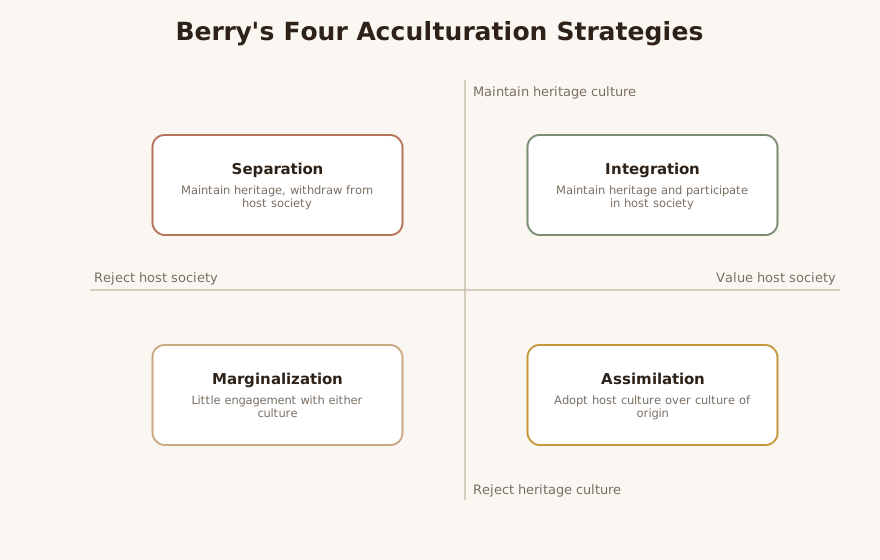
First, acculturation proceeds along two independent dimensions, each captured by a question 3. The first asks, in effect, “Is it of value to maintain my heritage culture and identity?”; the second asks, “Is it of value to seek and maintain relationships with the larger society?” 3. Because the answers are independent rather than two ends of one scale, a person can say “yes” to both, “no” to both, or “yes” to one and “no” to the other 1.
Second, crossing the two dimensions yields four acculturation strategies 1. Integration means valuing both — maintaining the heritage culture while also participating in the host society, producing biculturalism 3. Assimilation means adopting the host culture’s norms over one’s culture of origin 3. Separation means rejecting or withdrawing from the host culture in favour of preserving the heritage culture 3. Marginalization means little engagement with either — rejecting or being excluded from both the culture of origin and the dominant culture 3.
Third, the strategy a person can actually use is constrained by context, not chosen in a vacuum 1. Integration, in particular, can only be freely pursued when the dominant society is open and inclusive; mutual accommodation is required, and where the larger society enforces assimilation or excludes the minority, integration is not genuinely available 1. The same labels therefore name a mutual relationship between the migrant’s preference and the host society’s stance 1.
Fourth, the model carries a clear empirical claim about adaptation: integration is generally associated with the most favourable psychological and sociocultural outcomes, and marginalization with the least favourable 3. This “integration hypothesis” is the model’s best-known prediction, and also one of its most contested 2.
Interventions & Techniques
Berry’s model is a framework, not a manualised therapy, so it does not prescribe techniques in the way a protocol does LLM. What it offers the clinician are assessment and formulation moves that can be embedded inside whatever modality the therapist already uses LLM.
The first move is dimensional assessment rather than categorical labelling LLM. Because the two dimensions are independent, the clinician can ask separately about heritage-culture maintenance (language, food, religious practice, ties to community of origin) and host-society participation (work, friendships across groups, civic engagement), instead of collapsing both into a single “how American/Canadian have you become?” question 2. Schwartz and colleagues sharpen this further: practices, values, and identifications can each change at different rates, so a client may behave like the host culture, hold heritage values, and identify with both 2.
The second move is reframing distress as acculturative rather than purely intrapsychic LLM. When a migrant client presents with anxiety, low mood, or family conflict, the model invites the clinician to ask whether the difficulty tracks the friction of negotiating two cultural worlds — what Berry calls acculturative stress — rather than assuming a context-free disorder 1.
The third move is locating the client’s current strategy and the strategy they would prefer, then attending to the gap 1. A client may want integration but live in a setting that only permits separation or pushes assimilation; naming that mismatch externalises a problem the client may be experiencing as personal failure 1.
LLM-generated illustrative example (not a guideline): A clinician working with a 19-year-old whose parents migrated when she was six maps her orientations explicitly: at home she speaks the heritage language and observes religious practice (high heritage maintenance), while at university most of her friendships and her sense of belonging are with the host culture (high host participation). Naming this as integration — and as a legitimate, often healthiest pattern — reframes her guilt about “not being a real” member of either group as the ordinary texture of biculturalism rather than a deficiency. LLM
Evidence Base
Honesty requires separating two senses of “established” LLM. As a framework, Berry’s model is thoroughly established: it is the most widely cited and most widely taught account of acculturation, structures decades of research, and provides the vocabulary the field uses 2. Its two-dimensional insight — that heritage maintenance and host participation are separable — is broadly supported and was a genuine advance over earlier unidimensional models 2.
As a predictive typology of real people, the evidence is mixed and the criticism substantial 2. The most damaging finding concerns marginalization: when researchers use empirically rigorous methods such as cluster analysis and latent class analysis rather than imposing median or midpoint cut-points, they repeatedly find small or non-existent marginalization groups, and marginalization scales show poor reliability and validity relative to the other three 2. Schwartz and colleagues argue that the fourth category may be largely an artefact of the method used to create it 2. Empirical clustering often yields three categories plus variants, not a clean fourfold structure 2.
Two further criticisms matter clinically LLM. First, the common practice of splitting people into “high” and “low” on each dimension by an arbitrary cut-point assumes all four categories exist and are equally valid, which the data do not support 2. Second, most studies use unidimensional measures that cannot tell whether an outcome — for instance the “immigrant paradox,” in which more-acculturated immigrants sometimes show worse health — is driven by acquiring host-culture practices, losing heritage-culture practices, or both 2. Even the categories themselves do not capture people neatly: research shows the same person may use different strategies in public versus private life, and situational and environmental conditions strongly shape which strategy is realistically available 3.
The integration hypothesis — that integration is healthiest — has empirical support but is correlational, vulnerable to the measurement problems above, and confounded with context: integration tends to be available precisely in the more welcoming, less discriminatory settings that independently support wellbeing 12. The reasonable clinician’s summary: a powerful, durable organising framework whose dimensional core is sound, but whose four-box typology should be held loosely and never used as a diagnostic instrument LLM.
Populations & Indications
The model is indicated whenever cultural transition or sustained intercultural contact is part of the clinical picture LLM. Its primary populations are immigrants, refugees and asylum seekers, sojourners such as international students and expatriate workers, and the second-generation and bicultural youth who grow up negotiating two cultural worlds at once 1. Berry’s framework was developed across all of these contact situations, and he explicitly notes that the conditions of contact differ — voluntary migration, involuntary displacement, and Indigenous experience of colonisation are not equivalent 1.
It is also indicated, with care, for Indigenous peoples and long-settled ethnocultural minorities, for whom “acculturation” is the product of colonisation or generations of minority status rather than recent migration 6. Here the clinician should foreground that these groups did not choose contact and that the host-society stance was often coercive, which changes the meaning of every strategy 1.
The framework is most useful as an indication when a client’s presenting distress plausibly involves the negotiation of cultural maintenance and participation — for example, family conflict across generations, identity questions, or stress that intensified after relocation 1. It is correspondingly less central where culture is not a live axis of the problem LLM.
Problems-for-Work
The model maps onto several presenting problems that are partly products of cultural transition LLM.
- Acculturative stress. The friction of managing two cultural systems can present as anxiety, low mood, somatic complaints, or demoralisation; Berry’s framework names this directly and links its intensity to which strategy is being used and how welcoming the host context is 1. Higher stress is typically associated with separation and marginalization, and lower stress with integration 1.
- Identity confusion and bicultural identity questions. Clients negotiating “who am I in each world” can be helped by the recognition that heritage identification and host identification are independent and can coexist 2.
- Intergenerational and family conflict. Acculturation gaps — parents oriented toward heritage maintenance, children toward host participation — are a common driver of family friction, and the two-dimensional map makes the gap visible and discussable 2.
- Discrimination-related distress and minority stress. The context-of-reception literature shows that discrimination, neighbourhood quality, and community support shape outcomes; a hostile reception can force separation or marginalization regardless of the client’s preference 2.
- Social isolation and help-seeking barriers. Separation and marginalization both narrow a client’s social and service connections, which the formulation can surface as a target 1.
LLM-generated illustrative example (not a guideline): A father reports constant conflict with his teenage son, whom he describes as “becoming a stranger.” Mapping the family onto the two dimensions reveals an acculturation gap: the father is oriented toward heritage maintenance with limited host participation (separation), while the son strongly participates in the host culture and has thinned his heritage ties (assimilation-leaning). Framing the conflict as a predictable gap rather than disrespect or rejection lowers the temperature and gives the family a shared problem to work on. LLM
Contraindications, Cautions & Cultural Humility
There is no contraindication to thinking dimensionally about a client’s cultural transition LLM. The cautions are about misuse of the typology LLM.
The central caution is reification: treating the four strategies as fixed personality types or as a diagnosis 2. The empirical record is clear that people do not fall neatly into four boxes, that marginalization in particular is often an artefact of measurement, and that the same person uses different strategies across settings and over time 23. A clinician who pins a client as “an assimilator” or “marginalized” has mistaken a heuristic for a fact about the person LLM.
A second caution concerns the integration hypothesis LLM. It is tempting to treat integration as the goal the clinician should steer the client toward; this risks imposing the therapist’s value, ignoring that integration is only freely available when the host society is inclusive, and pathologising clients in hostile contexts who cannot access it 1. Separation can be an adaptive, protective response to discrimination rather than a deficit LLM.
A third caution is cultural humility about the framework’s own situatedness LLM. The model can flatten the very different meanings of voluntary migration, forced displacement, and colonisation, and its labels carry evaluative weight that the clinician should hold lightly 1. The humble use of the model treats it as a conversation-opener whose categories the client is invited to confirm, complicate, or reject — not as a verdict the clinician renders LLM.
Treatment-Plan Suggestions & SMART Objectives
The following objectives translate the framework into documentable, client-centred work LLM.
| Goal | SMART objective (example) | Mechanism |
|---|---|---|
| Map the client’s cultural orientations | By session 2, clinician and client will collaboratively map heritage maintenance and host participation as two separate dimensions, in the client’s own words | Two-dimensional assessment 1 |
| Reframe distress as acculturative | Within 3 sessions, client will identify two stressors that track negotiating two cultural worlds rather than personal failing | Acculturative-stress framing 1 |
| Reduce guilt around bicultural identity | By session 4, client will articulate one way heritage and host identifications can coexist without one negating the other | Independence of identifications 2 |
| Address an acculturation gap in the family | Over 6 weeks, family will name the parent-child orientation gap and agree one shared expectation that honours both | Acculturation-gap formulation 2 |
| Strengthen supports against discrimination | Within 30 days, client will add one concrete heritage-community or host-society connection that improves context of reception | Context-of-reception support 2 |
| Clarify the preferred vs available strategy | By session 5, client will distinguish the strategy they prefer from the one their environment currently permits, and one feasible next step | Preference-context mismatch 1 |
| Monitor adaptation over time | Monthly, client will rate sociocultural and psychological adaptation and review whether strategies are shifting across settings | Adaptation is dynamic and context-bound 3 |
Common Misconceptions
The most common error is treating acculturation as a single continuum — assuming that becoming more host-cultured necessarily means becoming less heritage-cultured 2. Berry’s whole contribution is that the two are independent, which is why biculturalism (integration) is possible at all 1.
A second misconception is that the four strategies are stable types that describe people cleanly; in reality the categories are leaky, the same person uses different strategies in public and private, and marginalization is frequently a measurement artefact rather than a real group of people 23. A third is that integration is simply the “right” strategy everyone should reach; integration depends on a welcoming host society and cannot be freely chosen where the larger society excludes or coerces, so it is as much a property of context as of the individual 1.
A fourth misconception is that acculturation is one-directional — something migrants do while the host society stays put 1. Berry’s framework is explicit that the larger society’s orientation (multiculturalism versus assimilationist or exclusionary stances) is part of the model and shapes which outcomes are possible 1. Finally, some assume that because the framework is canonical it is fully validated; its dimensional core is sound, but its fourfold typology and the integration hypothesis remain genuinely contested 2.
Training & Certification
There is no certification in Berry’s acculturation model; it is a body of theory and research, not a credentialed therapy LLM. Clinicians typically encounter it within graduate training in cross-cultural or multicultural psychology, and the canonical entry points are Berry’s own synthesis papers and the Cross-Cultural Psychology textbook he co-authored 15.
For applied competence, the more relevant training is in culturally responsive practice broadly — the multicultural counseling, cultural humility, and minority-stress literatures within which the model is most usefully embedded LLM. A clinician wanting to use the framework well should also read the critical literature, especially Schwartz and colleagues, so as not to apply the typology more confidently than the evidence warrants 2. In practice, competence is built through supervised work with migrant and minority clients and reflective attention to one’s own cultural assumptions rather than through any course completion LLM.
Key Terms
- Acculturation — the psychological and cultural change that results from sustained first-hand contact between two cultural groups 6.
- Heritage-culture maintenance — the degree to which a person retains the identity, values, and practices of their culture of origin; the first dimension 3.
- Host-society participation — the degree to which a person seeks contact with and participation in the larger society; the second dimension 3.
- Integration — maintaining the heritage culture while also participating in the host society; biculturalism 3.
- Assimilation — adopting the host culture’s norms over one’s culture of origin 3.
- Separation — preserving the heritage culture while rejecting or withdrawing from the host culture 3.
- Marginalization — low engagement with both heritage and host cultures, often through exclusion as much as choice 3.
- Acculturative stress — the stress response arising from the demands of negotiating two cultural systems 1.
- Context of reception — the host environment’s discrimination, support, and opportunity structure, which shapes which strategies are available 2.
Resources & Further Reading
▶ Watch — a video introduction to this concept:
- Acculturation: Living successfully in two cultures (Berry, 2005)
- Rethinking the Concept of Acculturation (Schwartz, Unger, Zamboanga & Szapocznik, 2010)
- Berry’s Model of Acculturation — Culture and Psychology (open textbook)
- What Is Acculturation and Why It Happens — Simply Psychology
- Cross-Cultural Psychology: Research and Applications (Berry, Poortinga, et al.)
- Acculturation — Wikipedia
Reflective / Supervision Questions
- Am I using Berry’s four strategies as a conversation-opener I invite my client to confirm or complicate, or as a label I have quietly assigned them? 2
- Have I assessed heritage maintenance and host participation as two separate dimensions, or collapsed them into one “how acculturated are you?” question? 2
- When a client uses separation, am I reading it as deficit, or considering that it may be an adaptive response to a hostile context of reception? 1
- Whose value is “integration” in this case — the client’s, or mine — and is integration even available in the environment my client actually lives in? 1
- For this client, is the distress better understood as acculturative stress tied to cultural transition than as a context-free disorder? 1
- If I am working with an Indigenous client or a forced migrant, am I honouring how different their contact history is from voluntary migration, rather than applying the same labels flatly? 1