
Problem Management Plus (PM+) is the World Health Organization’s attempt to compress the active ingredients of cognitive behavioural therapy into something that an ordinary community member with a high-school education and eight days of training can deliver in five sessions 12. It exists because there are not, and will not soon be, enough psychologists and psychiatrists to reach the hundreds of millions of people living with common mental health problems in conflict zones, refugee camps, and low-resource health systems 1. For a clinician trained in the global North, PM+ is worth understanding less as a tool you will personally deliver and more as a model of how psychotherapy’s core moves can be stripped to their essentials, made transdiagnostic, and handed to non-specialists without losing efficacy LLM.
Type & Discipline
PM+ is a manualized psychological intervention belonging to the field of global mental health, where its defining problem is the treatment gap: the distance between the number of people who need care and the number of specialists available to provide it 1. It is described by WHO as “a scalable psychological intervention” that adapts “aspects of Cognitive Behavioural Therapy (CBT)” for resource-limited settings 2. Two features locate it precisely within its discipline. First, it is low-intensity, meaning it is deliverable by non-specialists after brief training rather than requiring a licensed clinician 1. Second, it is transdiagnostic, meaning it applies “the same underlying principles across mental disorders, without tailoring the protocol to specific diagnoses” 1.
This places PM+ inside the broader WHO strategy of task-shifting, or task-sharing, in which selected clinical functions are redistributed from scarce specialists to trained lay providers so that care can reach populations that specialists never will 1. The discipline shapes how a clinician should hold the intervention: PM+ was engineered for adversity-affected, low-resource contexts, not as a premium psychotherapy for well-resourced clinics, and its design choices, brevity, simplicity, and delegability, are constraints turned into the method itself 1LLM.
Creators & Lineage
PM+ was developed by the World Health Organization and described in a 2015 World Psychiatry paper authored by Katie S. Dawson, Richard A. Bryant, Melissa Harper, Alvin Kuowei Tay, Atif Rahman, Alison Schafer, and Mark van Ommeren 1. It was produced as part of WHO’s Mental Health Gap Action Programme (mhGAP), the agency’s flagship effort to scale up services for mental, neurological, and substance-use disorders in low- and middle-income countries 1. Mark van Ommeren, of WHO’s mental health unit, and the Australian clinical-research group around Richard Bryant and Katie Dawson are the figures most associated with its design and trials 1.
The lineage is deliberately conventional. PM+ does not invent new techniques; it selects empirically supported strategies and simplifies them. Its problem-management component “extends traditional problem-solving” approaches, its “Get Going, Keep Doing” component is behavioral activation, and its overall frame is an adaptation of cognitive behavioural therapy 12. The intellectual ancestors are therefore problem-solving therapy, behavioral activation, and CBT, recombined and pared down for delegability 1LLM. PM+ also sits alongside other WHO low-intensity products in the same family, and it exists in both an individual format and a group format, the latter delivered in roughly three-hour sessions at a ratio of no more than one facilitator to eight participants 1.
Core Principles
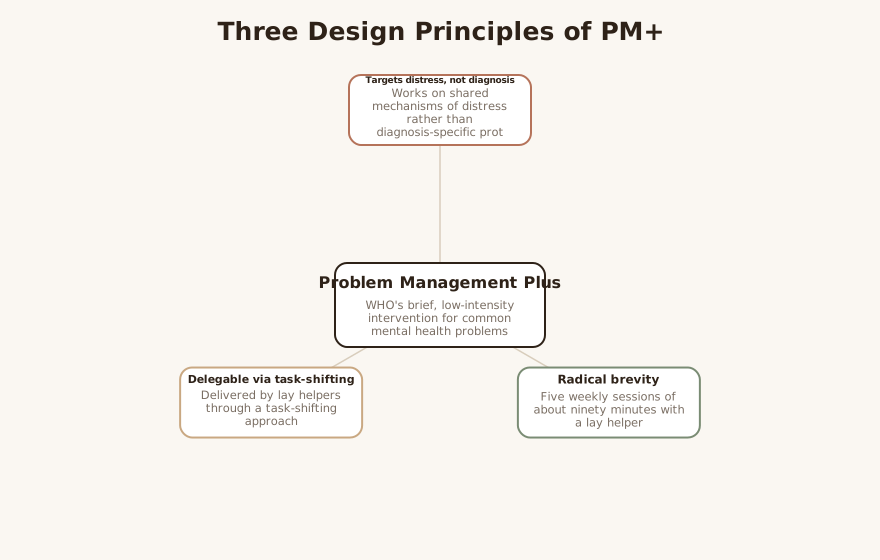
The first principle is transdiagnostic targeting of distress rather than diagnosis. PM+ is built for “adults suffering from symptoms of common mental health problems (e.g., depression, anxiety, stress or grief),” and it works on shared mechanisms of distress rather than on diagnosis-specific protocols 1. WHO states that it “can help people with depression, anxiety and stress, whether or not exposure to adversity has caused these problems” 2. This is a practical bet: in a community where every household carries loss, sorting people into diagnostic categories before treating them is neither feasible nor necessary LLM.
The second principle is radical brevity. The individual program is “five weekly sessions with a lay helper,” each lasting “90 min,” with that length chosen to allow “adequate time for explanation of a strategy and application to client-identified problems” 1. The intervention assumes that a small number of well-rehearsed strategies, practiced on the client’s own concrete problems, can produce meaningful symptom reduction 1.
The third principle is delegability through task-shifting. PM+ uses a “task shifting approach” delivered by “lay helpers who have completed at least high school but without previous mental health training” 1. The entire design, the scripted manual, the limited set of strategies, the focus on practice over insight, exists to make competent delivery achievable for someone outside the mental health professions 1LLM.
The fourth principle is scalability without dilution of safety, expressed in clear inclusion and exclusion boundaries. PM+ is explicitly “not suitable for people presenting with severe mental health problems (e.g., those with psychosis or at imminent risk for suicide),” who are meant to be referred rather than treated within the program 1. The intervention is designed to be helpful “no matter how severe people’s problems are” within its scope, while routing the highest-acuity presentations elsewhere 2.
Interventions & Techniques
PM+ teaches four strategies in sequence, each practiced on the client’s own problems 1.
Managing Stress introduces a single, easily learned arousal-reduction skill: “slow breathing is taught, given its ease of learning” 1. It is the first strategy precisely because it is the most portable and gives the client an early, usable tool LLM.
Managing Problems is structured problem solving that “extends traditional problem-solving” by helping the client sort difficulties into categories, those that are “solvable, unsolvable and unimportant,” so effort is directed only where it can change something 1. This sorting step is the conceptual core: it spares the client from pouring energy into problems that cannot be moved LLM.
Get Going, Keep Doing is behavioral activation, encouraging the person to “re-engage gradually with pleasant and task-oriented activities” as a route out of the withdrawal and inertia that accompany depression 1.
Strengthening Social Support helps the client “re-engage in the community” and “elicit support,” reconnecting them with the relationships that buffer distress 1. In adversity settings where social fabric has been torn, deliberately rebuilding support is itself an active ingredient 1LLM.
These strategies are delivered by helpers prepared through “an eight-day training programme, followed by a two to three week period of in-field practice with ongoing, weekly supervision” 1. Supervision is not optional scaffolding; it is part of the technique, and its quality is treated as a determinant of outcomes 5LLM.
LLM-generated illustrative example (not a guideline): A displaced farmer who has lost his land presents with poor sleep, hopelessness, and withdrawal. The helper teaches slow breathing for the night-time arousal, then uses problem management to separate the unsolvable (the land is gone) from the solvable (registering for an aid program). “Get Going, Keep Doing” schedules one small daily activity, and the social-support step reconnects him with a neighbor who can accompany him to the registration office LLM.
Evidence Base
PM+ is established for short-term symptom reduction, and this is the honest ceiling of the claim. Definitive randomized controlled trials, including individual and group trials in conflict-affected Pakistan and in Kenya, anchor the evidence base, and formative work in those countries showed PM+ “can provide a template that is adaptable to various contexts” 1. A 2024 scoping review of 42 studies from 19 countries, encompassing 3,879 PM+ clients, found that “results from definitive RCTs at short-term follow-up also suggest that PM+ is efficacious, with overall moderate-to-large effect sizes, in improving symptoms of depression, anxiety, psychological distress, PTSD and functional impairment” 5. The same review reported that PM+ was “found to be safe,” with most pilot trials retaining more than 75% of clients 5. A 2025 meta-analysis examined PM+ effectiveness across distress, depression, and anxiety and is the most recent quantitative synthesis 4.
The cautions are substantial and should temper any enthusiasm. The scoping review found that “only one study evaluated the long-term effects of the PM+ intervention at 12 months’ follow-up, and the authors found no significant differences between treatment arms for depression and anxiety at this time point,” so durability beyond the short term is genuinely uncertain 5. Roughly 70% of PM+ clients across studies were women, which limits generalization to men 5. Cost-effectiveness was evaluated in only one study, and “none of the included studies described the scale-up of the PM+ intervention,” meaning the scalability that motivates the whole project remains more aspiration than demonstrated fact 5. Real-world implementation through humanitarian agencies, the step after the trials, is itself an active area of work rather than a settled achievement 6. In short: strong short-term efficacy, thin long-term and scale-up evidence 5LLM.
Populations & Indications
The core population is adults in communities exposed to adversity who are distressed but not severely mentally ill 12. Within that, the scoping review documents how broadly PM+ has been applied: about two-thirds of experimental studies involved humanitarian-crisis populations, and refugees, asylum seekers, internally displaced people, and migrants were the single largest group, appearing in 14 studies 5. Conflict- and disaster-affected adults, including earthquake survivors, are a central indication, consistent with the Pakistan and Kenya trials 15.
Beyond emergencies, PM+ has reached primary-care attendees in low-resource settings, women with a history of gender-based violence, young adults living with HIV, parents of children with autism, and people affected by COVID-19, demonstrating reach well past its original humanitarian frame 5. The clearest indication for considering PM+ is a population with high unmet need, limited specialist access, and common-mental-health-level distress, rather than complex or high-acuity psychopathology 15LLM.
Problems-for-Work
PM+ gives a non-specialist helper a usable structure for a defined band of presenting problems 1.
- Depression. Behavioral activation (“Get Going, Keep Doing”) directly targets the withdrawal and inertia of low mood, while problem management addresses the life difficulties that sustain it 1.
- Anxiety and stress. The slow-breathing skill provides immediate arousal reduction, and problem sorting reduces the sense of being overwhelmed by unsolvable demands 1.
- Grief. PM+ explicitly names grief among the common problems it addresses, working on re-engagement and support rather than on the loss itself 1.
- Psychological distress and functional impairment. The scoping review found moderate-to-large short-term effects on distress and functioning, the broad outcomes PM+ is built to move 5.
- PTSD symptoms. Trauma-exposed populations showed short-term symptom improvement, though PM+ is not a trauma-focused therapy and severe cases warrant referral 5LLM.
LLM-generated illustrative example (not a guideline): A primary-care attendee in a low-resource clinic reports months of low mood, fatigue, and avoidance of her market stall after a bereavement. The helper uses behavioral activation to rebuild a graded return to the stall, problem management to handle the debt that accumulated while she was withdrawn, and social-support strengthening to reconnect her with the women’s cooperative she had stopped attending LLM.
Contraindications, Cautions & Cultural Humility
The firmest contraindication is built into the manual: PM+ is “not suitable for people presenting with severe mental health problems (e.g., those with psychosis or at imminent risk for suicide),” and such presentations require referral and specialist care, not a five-session lay-delivered program 1. Acute intoxication, severe cognitive impairment, and conditions demanding medical or psychiatric management likewise fall outside its scope 1LLM. A clinician adapting or supervising PM+ must ensure that referral pathways for excluded acuity actually exist, because an intervention with clear exclusions is only as safe as the system it refers into LLM.
A second caution concerns delivery quality. Because PM+ depends on lay helpers, the integrity of training and weekly supervision is the load-bearing safeguard, and supervision quality is treated as a key moderator of outcomes 5LLM. The scoping review noted “large variation in PM+ implementation” across training and supervision, which means that PM+ delivered without the supervision structure is not the PM+ that was tested 5.
Cultural humility is intrinsic rather than optional here, because PM+ was designed to be adapted, not imported wholesale. Every experimental study reported adaptations, ranging from “minor adjustments to terminology” to “broader changes” in “how metaphors, stories and illustrations were presented,” and substantial changes included local-language translation and modification of session structure 5. Formal frameworks such as the “ten-step mental health cultural adaptation and contextualisation for implementation (mhCACI) procedure” have guided this work 5. The lesson for any clinician is that the manual is a template to be contextualized with the community it serves, not a fixed script, and that the metaphors, examples, and even the conception of “support” must be made local 15LLM. The marked underrepresentation of men in samples is a further humility point: the evidence speaks most confidently to women, and effectiveness for men is less established 5.
Treatment-Plan Suggestions & SMART Objectives
| Goal | SMART objective (example) | Mechanism |
|---|---|---|
| Reduce physiological arousal | Within 1 session, client will demonstrate slow breathing and use it daily, logging frequency | Stress management via an easily learned arousal-reduction skill 1 |
| Direct effort toward changeable problems | By session 2, client will sort their three main problems into solvable, unsolvable, and unimportant | Problem management extends structured problem solving 1 |
| Increase activity and re-engagement | Over sessions 3-5, client will schedule and complete one pleasant or task-oriented activity daily | Behavioral activation (“Get Going, Keep Doing”) counters withdrawal 1 |
| Rebuild eroded social support | By session 4, client will identify and contact two people or one community group for support | Strengthening social support reconnects buffering relationships 1 |
| Address a concrete adversity-linked stressor | By session 3, client will apply the problem-management steps to one solvable real-life difficulty | Practice on client-identified problems consolidates the strategy 1 |
| Reduce overall distress and improve functioning | Across the five sessions, client will report reduced distress on a brief symptom measure | PM+ shows moderate-to-large short-term effects on distress and functioning 5 |
| Ensure safe routing of higher acuity | At intake, helper will screen for psychosis and imminent suicide risk and refer if present | Exclusion criteria protect safety and program scope 1 |
Common Misconceptions
A first misconception is that PM+ is a watered-down therapy for people who cannot access “real” treatment. In fact it deliberately concentrates empirically supported strategies, problem solving, behavioral activation, stress management, and social support, into a delegable package, and it has shown moderate-to-large short-term effects in randomized trials 15. A second is that “transdiagnostic” means vague; PM+ is transdiagnostic in the precise sense of applying “the same underlying principles across mental disorders, without tailoring the protocol to specific diagnoses,” not in the sense of lacking structure 1. A third is that lay delivery means untrained delivery; helpers complete an eight-day program plus supervised field practice with “ongoing, weekly supervision,” and that supervision is integral to outcomes 15. A fourth misconception is that PM+ treats severe mental illness; its manual explicitly excludes psychosis and imminent suicide risk and refers them onward 1. A final misconception is that PM+’s strong trial results mean its benefits are proven to last and to scale; the long-term and scale-up evidence is currently thin 5.
Training & Certification
PM+ is delivered after “an eight-day training programme, followed by a two to three week period of in-field practice with ongoing, weekly supervision,” typically conducted by local trainers or WHO master trainers 15. WHO publishes a dedicated training manual for preparing non-specialist helpers, alongside the intervention manual itself 23. There is, at present, no universal individual-level “PM+ certification” comparable to proprietary therapy credentials; the scoping review noted that scale-up will require “formalisation of non-specialist PM+ helpers, with accompanying structures for accreditation and supervision,” indicating that standardized accreditation remains a development goal rather than an established system 5. For a licensed clinician, the relevant role is often as trainer, supervisor, or adapter rather than as front-line helper, and competence in those roles draws on the WHO manuals and on the cultural-adaptation literature 235LLM.
Key Terms
- Task-shifting (task-sharing): redistributing clinical functions from scarce specialists to trained lay helpers so care reaches underserved populations 1.
- Low-intensity intervention: a psychological intervention deliverable by non-specialists after brief training 1.
- Transdiagnostic: applying “the same underlying principles across mental disorders, without tailoring the protocol to specific diagnoses” 1.
- Lay helper: a community member with at least high-school education and no prior mental health training who delivers PM+ after training and under supervision 1.
- Managing Stress: the slow-breathing arousal-reduction strategy taught first for its ease of learning 1.
- Managing Problems: structured problem solving that sorts difficulties into solvable, unsolvable, and unimportant 1.
- Get Going, Keep Doing: the behavioral-activation strategy of gradual re-engagement with pleasant and task-oriented activities 1.
- Strengthening Social Support: the strategy of re-engaging with community and eliciting support 1.
- Treatment gap: the distance between the number of people needing mental health care and the specialists available to provide it, the problem PM+ is built to address 1.
Resources & Further Reading
▶ Watch — a video introduction to this concept:
- Problem Management Plus (PM+): a WHO transdiagnostic psychological intervention for common mental health problems (Dawson et al., 2015) — World Psychiatry / PMC
- Problem management plus (PM+): individual psychological help for adults impaired by distress in communities exposed to adversity — WHO intervention manual
- PM+ psychological intervention for individuals: training manual — WHO
- The effectiveness of Problem Management Plus (PM+) in treating psychological distress, depression, and anxiety: a meta-analysis (2025)
- A scoping review of the literature on the application and usefulness of the PM+ intervention around the world (2024) — PMC
- After the randomized controlled trial: Implementing Problem Management Plus through humanitarian agencies — Elrha / R2HC
Reflective / Supervision Questions
- When I consider adapting PM+ for a population, am I treating the manual as a fixed script or as a template to be contextualized in its terminology, metaphors, and examples? 5
- Have I confirmed that referral pathways exist for the presentations PM+ explicitly excludes, namely psychosis and imminent suicide risk? 1
- If I am supervising lay helpers, is my weekly supervision robust enough to be the load-bearing safeguard the evidence assumes it to be? 5LLM
- Am I representing PM+’s evidence honestly to stakeholders, distinguishing its strong short-term effects from its thin long-term and scale-up evidence? 5
- Given that most PM+ samples were women, how confident should I be applying its findings to the men in this community, and what would help me know? 5
- What in my own well-resourced practice could be stripped to its active ingredients and delegated, and what would I be afraid of losing if I did? LLM