
Type & Discipline
Parent-Child Interaction Therapy (PCIT) is a manualized, dyadic behavioral intervention for young children with disruptive behavior, delivered by coaching the caregiver rather than treating the child in isolation 1. It sits within the family of behavioral parent training but is distinguished by its live, in-the-moment coaching format: the clinician observes the caregiver and child through a one-way mirror or video feed and prompts the caregiver in real time through a wireless earpiece 7. Disciplinarily it bridges developmental psychology, dyadic/relational intervention, and operant behavior therapy 7. The treatment is designed for children roughly ages 2 to 7 with behavior and parent-child relationship problems, and the “parent” role can be filled by a biological parent, foster parent, adoptive parent, or other primary caretaker 1. Because the active ingredient is the caregiver’s changed behavior practiced in vivo, PCIT is best understood as a treatment of the relationship system rather than of the child alone LLM.
Creators & Lineage
PCIT was developed by Sheila Eyberg, working at the University of Florida, and the protocol is generally dated to the late 1970s through the 1980s 7. Its most direct methodological ancestor is Constance Hanf’s two-stage operant model of parent training, which paired a relationship-enhancement phase with a discipline phase — a structure PCIT preserves LLM. Eyberg’s synthesis drew together three theoretical streams: attachment theory, which supplies the rationale for sensitive, responsive parenting; social learning theory, which explains how dysfunctional parent-child interactions inadvertently reinforce problem behavior; and operant conditioning, which provides the contingency-management tools 7. The warmth-plus-structure target maps closely onto Diana Baumrind’s authoritative parenting style, combining high responsiveness with firm, consistent limits 7. The result is a hybrid that treats relationship repair and behavioral contingency management as sequential, complementary phases rather than competing philosophies LLM.
Core Principles
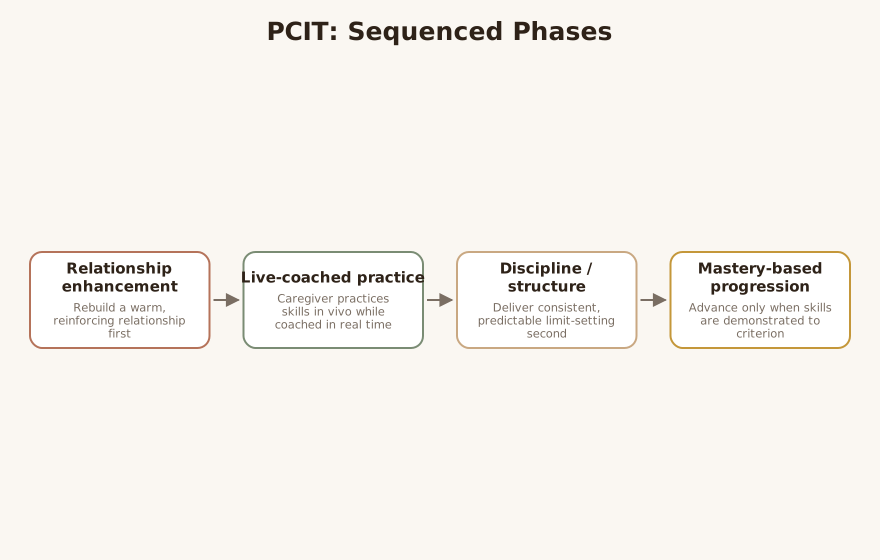
PCIT rests on the premise that coercive, escalating parent-child cycles maintain disruptive behavior, and that interrupting those cycles requires the caregiver to first rebuild a warm, reinforcing relationship before imposing structure 7. A foundational principle is sequencing: relationship enhancement comes first, discipline second, because consistent limit-setting only works once the child experiences the parent as a source of positive attention LLM. A second principle is in-vivo skill acquisition — caregivers do not merely discuss techniques, they practice them live while being coached, which is thought to drive transfer to the home far more reliably than didactic instruction 7. A third is mastery-based progression: families advance through phases only when the caregiver demonstrates the skills to criterion, so dose is individualized rather than fixed 1. Finally, PCIT is data-driven, with standardized behavioral observation and parent-report measures collected at most sessions to track progress and guide phase transitions 7.
Interventions & Techniques
PCIT is delivered in two sequential phases. The first, Child-Directed Interaction (CDI), teaches caregivers play-based skills that reinforce positive behavior and strengthen the relationship 1. CDI is organized around the PRIDE skills: Praise (ideally labeled), Reflection of the child’s appropriate statements, Imitation of the child’s play, Description of the child’s behavior, and Enthusiasm/Encouragement — while caregivers learn to avoid commands, questions, and criticism during play 7. The second phase, Parent-Directed Interaction (PDI), teaches specific discipline techniques so the child can listen to instructions and follow directions, using clear direct commands, labeled praise for compliance, and a structured time-out sequence for noncompliance 17.
Two technical features define the method. The clinician coaches in real time through a “bug-in-the-ear” wireless device, giving immediate, specific feedback as interactions unfold 7. Progress is measured with the Dyadic Parent-Child Interaction Coding System (DPICS), which codes observed parent and child behaviors, and the Eyberg Child Behavior Inventory (ECBI), a 36-item parent-report measure of disruptive behavior 7. Caregivers must reach defined mastery criteria on these skills before phases advance, and treatment continues until mastery is achieved — averaging about 14 sessions but ranging from roughly 10 to 20 1.
LLM-generated illustrative example (not a guideline): During a CDI session, a parent narrates “You’re stacking the blue blocks so carefully” while the clinician, watching from behind the mirror, says through the earpiece “Nice labeled praise — now reflect what he just said.” The parent repeats the child’s words, the child leans in, and the clinician quietly names the moment of connection so the parent notices it too LLM.
Evidence Base
The maturity of PCIT’s evidence base is best described as established. The California Evidence-Based Clearinghouse for Child Welfare assigns PCIT its highest Scientific Rating of 1 (“Well-Supported by Research Evidence”) for both disruptive behavior treatment and parent training 1. A 2017 meta-analysis concluded that PCIT is an efficacious intervention for improving externalizing behavior in children with disruptive behavior disorders 4. A Norwegian randomized controlled trial of 81 families with children aged 2-7 who scored in the clinical range on the ECBI found PCIT superior to treatment-as-usual, with medium effect sizes on mother-reported child behavior (ECBI d ≈ .64; CBCL d ≈ .61) and very large effects on observed parenting skills (Do Skills d ≈ 2.58; Don’t Skills d ≈ 1.46) 5. Bagner and Eyberg’s RCT extended efficacy to disruptive behavior in children with intellectual disability, demonstrating that the protocol generalizes beyond typically developing samples 6.
Honesty about limits matters here. Attrition is a documented and persistent weakness: dropout across studies has been reported in the rough range of 18-35%, and even in the controlled Norwegian trial, attrition from pre-test to follow-up was substantial (about 28% at 6 months) 75. Many trials have modest sample sizes, the gap between tightly controlled efficacy and real-world effectiveness is real, and cultural adaptations are still maturing LLM. The strength of the rating reflects breadth and replication, not the absence of these caveats LLM.
Populations & Indications
PCIT is indicated for young children, generally ages 2 to 7, presenting with behavior and parent-child relationship problems, and is delivered to the child’s caregiver — biological parent, foster parent, adoptive parent, or other caretaker 1. It has demonstrated efficacy across oppositional defiant disorder, conduct disorder, ADHD, separation anxiety, exposure to domestic violence, and child maltreatment prevention contexts 7. It is widely used with families affected by child physical abuse and maltreatment risk, where the relationship-enhancement phase directly targets harsh, coercive parenting 1. Foster and adoptive families are a natural fit because the protocol explicitly accommodates non-biological caregivers and supports building attachment in newly formed dyads 1LLM. The Bagner and Eyberg trial supports use with children who have developmental concerns, including intellectual disability, when the protocol is applied with appropriate pacing 6.
Problems-for-Work
PCIT directly targets the disruptive behavior cluster — noncompliance, aggression, and tantrums — by replacing coercive cycles with predictable contingencies 7.
- Oppositional defiant disorder / conduct disorder: the PDI phase installs consistent, calm consequences for defiance while CDI rebuilds the relational reservoir that makes limits tolerable 17.
- Noncompliance: caregivers learn to give single, direct, developmentally appropriate commands and to follow through, increasing compliance rates 7.
- Aggression and tantrums: the structured time-out sequence interrupts escalation, while differential attention reduces the payoff for explosive behavior 7LLM.
- Parent-child relational problems and maltreatment risk: CDI’s warmth-building skills are the primary lever, reducing harsh parenting that drives abuse risk 1.
- ADHD and separation anxiety: PCIT improves behavioral regulation and has been applied as a platform for anxiety-focused adaptations 7.
LLM-generated illustrative example (not a guideline): A 4-year-old in foster care hits and screams at bedtime. In CDI the foster parent first accrues weeks of warm, child-led play; in PDI she practices a calm, scripted command-and-consequence routine. Over sessions the bedtime aggression decreases as the child experiences both consistent attention and predictable limits LLM.
Contraindications, Cautions & Cultural Humility
PCIT is not a fit for every dyad. The time-out procedure in PDI requires careful judgment with children who have trauma histories of confinement or with families where any physical management could re-traumatize, and clinicians should follow the protocol’s safety guidance rather than improvising LLM. Active, unaddressed safety threats — ongoing severe abuse, untreated caregiver psychosis, or a caregiver who cannot tolerate the coaching format — warrant stabilization first LLM. Because the protocol asks caregivers to attend many sessions and practice daily, the documented attrition problem means access and burden are real clinical concerns, especially for under-resourced families 57.
Cultural humility is essential. Norms around praise, autonomy-granting, and discipline vary across cultures, and the authoritative-parenting target embedded in PCIT reflects a particular cultural frame 7LLM. Clinicians should collaborate with families on how PRIDE skills and limit-setting fit their values, recognize that cultural adaptations of the protocol are still developing, and avoid framing a family’s existing practices as deficient LLM.
Treatment-Plan Suggestions & SMART Objectives
| Goal | SMART objective (example) | Mechanism |
|---|---|---|
| Increase caregiver warmth | Caregiver demonstrates 10 labeled praises, 10 reflections, and 10 behavior descriptions in a 5-minute coded CDI observation within 8 sessions | PRIDE skills / positive reinforcement 7 |
| Reduce coercive parenting | Caregiver reduces commands, questions, and criticism to ≤3 each in a 5-minute CDI observation within 6 sessions | Differential attention; coercion-cycle interruption 7 |
| Improve child compliance | Child complies with ≥75% of direct commands during a coded PDI observation by mastery | Clear commands + labeled praise for compliance 17 |
| Reduce disruptive behavior | Parent-reported ECBI Intensity score drops below the clinical cutoff and is sustained at discharge | Consistent contingency management 57 |
| Establish consistent discipline | Caregiver completes the time-out sequence with correct steps in 100% of observed trials before phase exit | Operant consequences for noncompliance 7 |
| Strengthen the dyadic relationship | Caregiver completes ≥5 minutes of daily “special time” play logged 6 of 7 days for 3 consecutive weeks | Relationship enhancement / attachment 17 |
| Support generalization to home | Caregiver reports applying PDI commands consistently across two home settings by mastery | In-vivo skill transfer LLM |
Common Misconceptions
A frequent misconception is that PCIT is parenting-advice or psychoeducation; in fact its defining feature is live, in-the-moment coaching of practiced skills, not didactic instruction 7LLM. Another is that PCIT “treats the child” through play therapy — the child is present and central, but the intervention works by changing caregiver behavior 1. Some assume PCIT is a fixed-length program; in reality it is mastery-based, ending when the caregiver reaches skill criteria, so duration varies from roughly 10 to 20 sessions 1. A further misconception is that the time-out component is punitive in the colloquial sense; within the protocol it is a structured, non-escalating consequence embedded in a relationship already enriched by CDI 7LLM. Finally, clinicians sometimes assume PCIT only suits typically developing children, when RCT evidence supports its use with developmental disabilities as well 6.
Training & Certification
PCIT delivery is governed by structured training and certification overseen by PCIT International, the field’s official organization 2. Becoming a certified PCIT therapist typically requires a qualifying clinical background plus completion of an approved training sequence and demonstration of competency, with certification standards maintained by PCIT International 2LLM. Because fidelity to the two-phase, mastery-based protocol and competence with live coaching and the DPICS/ECBI measurement tools are central to outcomes, supervised practice is a core training component 7LLM. Clinicians seeking to add PCIT should consult PCIT International for current training requirements and trainer rosters, and general orientation materials are available through PCIT explainer resources 23.
Key Terms
- CDI (Child-Directed Interaction): the first, relationship-enhancement phase, structured around the PRIDE skills 17.
- PDI (Parent-Directed Interaction): the second, discipline phase using clear commands, labeled praise, and a structured time-out sequence 17.
- PRIDE skills: Praise, Reflection, Imitation, Description, Enthusiasm/Encouragement — the positive-attention skills of CDI 7.
- Bug-in-the-ear: the wireless earpiece through which the clinician coaches the caregiver live 7.
- DPICS: Dyadic Parent-Child Interaction Coding System, the observational coding tool used to assess skills 7.
- ECBI: Eyberg Child Behavior Inventory, a 36-item parent-report measure of disruptive behavior 7.
- Mastery criteria: the defined skill thresholds a caregiver must reach to advance phases or complete treatment 1.
Resources & Further Reading
▶ Watch — a video introduction to this concept:
- Parent-Child Interaction Therapy — California Evidence-Based Clearinghouse for Child Welfare (CEBC)
- PCIT International — official organization
- What is PCIT? — ParentChildInteractionTherapy.com
- Parent-Child Interaction Therapy: A Meta-analysis (Thomas et al., 2017)
- Effectiveness of PCIT in the Treatment of Young Children’s Behavior Problems: A Randomized Controlled Study — PLOS One
- PCIT for disruptive behavior in children with intellectual disability: a RCT (Bagner & Eyberg, 2007) — PubMed
- Parent-child interaction therapy — Wikipedia
Reflective / Supervision Questions
- How do I judge when a caregiver has truly reached CDI mastery versus when I am tempted to advance to PDI prematurely because of caseload pressure?
- Given PCIT’s documented attrition, what concrete steps am I taking to reduce session burden and keep this particular family engaged?
- How do this family’s cultural values around praise, autonomy, and discipline interact with the authoritative-parenting frame, and where might I need to adapt or collaborate rather than correct?
- When a child’s trauma history or developmental profile complicates the time-out procedure, how am I consulting the protocol and my supervisor rather than improvising?
- Am I using the DPICS and ECBI data to drive clinical decisions, or am I collecting them and relying on impression instead?
- How do I hold the dual focus — coaching the caregiver while staying attuned to the child’s experience in the room?