
Type & Discipline
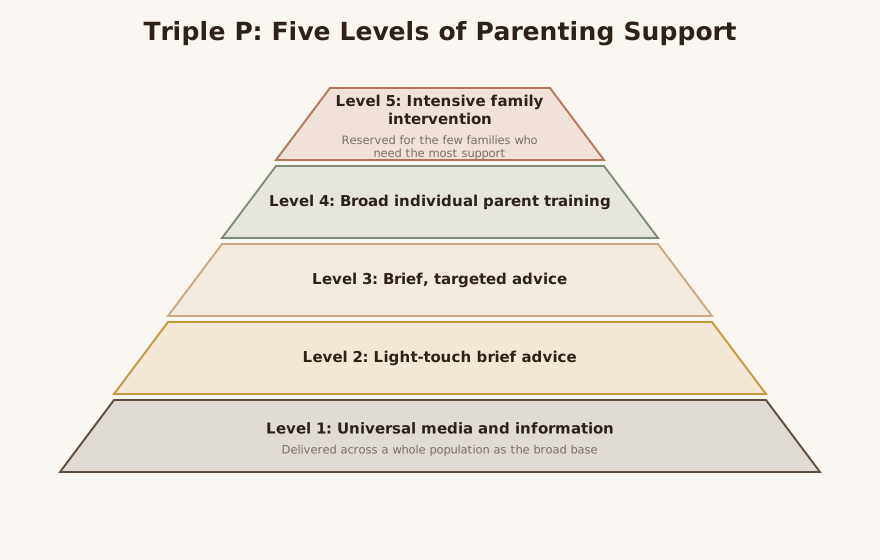
Triple P (the Positive Parenting Program) is not a single therapy but a multilevel system of parenting and family support, developed within child clinical psychology and behavioral family intervention 1. Its defining feature is that it is organized as a public-health intervention: rather than offering one fixed dose of treatment, it provides a graduated tier of interventions of increasing intensity and narrowing reach, so that a whole population of parents can be offered “the minimally sufficient” level of support each family needs 1. The system spans five levels, from a universal media and communication strategy at one end to intensive, individually tailored family intervention at the other 2.
For a practicing clinician, the practical implication is that “doing Triple P” can mean very different things depending on the level — a brief seminar, a few sessions of focused advice, or a full course of behavioral family intervention with a high-risk family 2. The unifying core across all levels is a self-regulation framework drawn from social learning theory and behavioral family intervention, in which parents are equipped with knowledge and skills to manage their child’s behavior and their own responses 2. Triple P therefore sits squarely in the parenting-and-child-intervention family alongside other behavioral parent-training programs, but is distinguished by its explicit population-level, tiered architecture 1.
Creators & Lineage
Triple P was developed by Matthew (Matt) Sanders and colleagues at the University of Queensland in Australia, where it originated and was progressively elaborated into the multilevel system known today 6. Sanders has remained the principal architect and scientific voice of the program, and the foundational rationale for the multilevel strategy was set out in his early account of moving “towards an empirically validated multilevel parenting and family support strategy” for preventing behavioral and emotional problems in children 2. Carol Markie-Dadds and Karen Turner were among the close collaborators in developing and disseminating the program’s materials and practitioner resources 6.
The intellectual lineage runs directly through social learning theory and the behavioral parent-training tradition: the premise that child behavior is shaped and maintained by patterns of reinforcement within the family, and that coercive parent-child interaction cycles can be interrupted by teaching parents specific, positive parenting skills 2. Onto this behavioral foundation Sanders grafted a self-regulation model — the idea that the goal is not merely to give parents techniques but to build parental self-sufficiency, self-efficacy, and the capacity to generalize skills to new problems without ongoing professional support 2. The genuinely novel contribution was to embed these well-established change principles inside a population-health delivery model, on the logic that small improvements in parenting spread across an entire community can shift population-level rates of child problems and maltreatment 3.
Core Principles
The organizing principle of Triple P is minimal sufficiency: families should be offered the least intensive, least intrusive level of intervention likely to be effective for them, with more intensive levels reserved for those who need them 1. This is what makes the system a population strategy rather than a clinic protocol — it is designed so that resources match need across a whole community 1.
A second principle is parental self-regulation and self-sufficiency 2. The program explicitly aims to make parents independent problem-solvers rather than dependent on the practitioner, building self-efficacy, personal agency, and the ability to apply principles to future, as-yet-unseen problems 2. Self-regulation here applies both to the parent’s management of the child and to the parent’s management of their own emotions and expectations 2.
A third principle is the use of a defined set of positive parenting principles, taught consistently across levels: ensuring a safe and engaging environment, creating a positive learning environment, using assertive discipline, having realistic expectations, and taking care of oneself as a parent 6. A fourth is flexible, tailored delivery within fidelity — the content is structured and evidence-based, but practitioners adapt the selection and emphasis of strategies to the individual family’s presenting concerns 2. Together these principles position Triple P as a behavioral, skills-based, and deliberately scalable approach 1.
Interventions & Techniques
The system is delivered across five levels of increasing intensity 2. Level 1 (Universal Triple P) is a media and communication strategy that provides parenting information to the whole population and normalizes the use of parenting support 2. Level 2 (Selected Triple P) offers brief, low-intensity advice — for example one or two sessions, or seminars — for parents with specific, relatively minor concerns about their child’s behavior or development 2. Level 3 (Primary Care Triple P) provides brief, focused intervention combining advice with active skills training for parents of children with mild to moderate behavioral difficulties 2. Level 4 (Standard/Group/Self-directed Triple P) is intensive, broad-focus parenting skills training for children with more severe behavioral problems, delivered individually, in groups, or in self-directed formats 2. Level 5 (Enhanced Triple P) adds intervention modules for families where parenting difficulties are complicated by other problems such as parental stress, depression, or partner conflict 2.
Within these levels, the active ingredients are the concrete parenting strategies taught through behavioral family intervention. These include skills for promoting children’s development and competence (descriptive praise, quality time, attending to desirable behavior) and skills for managing misbehavior (clear ground rules, directed discussion, planned ignoring, logical consequences, quiet time and time-out) 6. Delivery typically uses active skills-training methods — modeling, rehearsal, feedback, behavioral homework, and self-monitoring — rather than information-giving alone, which is what distinguishes Levels 3 and above from purely informational support 2.
LLM-generated illustrative example (not a guideline): A parent worried mainly about supermarket tantrums might be matched to a Level 3 primary-care contact: a few focused sessions building one planned-activities routine (preparing the child, setting two clear rules, praising cooperation, applying a pre-agreed consequence), with the parent self-monitoring outcomes between sessions — rather than being enrolled in a full Level 4 course they do not need LLM.
Evidence Base
Triple P’s maturity label is established, and this is warranted by the size of its evidence base: it is supported by one of the largest meta-analytic literatures in the parenting field, with the 2014 systematic review and meta-analysis synthesizing a large number of studies across the multilevel system 1. That meta-analysis reported significant short-term and longer-term effects on children’s social, emotional, and behavioral outcomes, on parenting practices, and on parental adjustment, with effects generally maintained at follow-up 1. A separately conducted quality-assessed (DARE) systematic review likewise concluded that the program is associated with positive outcomes, while noting methodological limitations in the underlying studies 5. At the population level, the U.S. Triple P System Population Trial — a randomized design across counties — found effects on indicators of child maltreatment, including substantiated cases, out-of-home placements, and maltreatment-related injuries, supporting the public-health rationale 3.
Honesty about the limits is essential, however. A recurring concern in the literature is the heavy involvement of the program developers in the evaluations: much of the strongest evidence has been generated by or with the originating team, and independent evaluations and the program’s own meta-analyses have at times reported smaller effect sizes than developer-led trials 16. Quality-assessed reviews have flagged variability in study quality, risk of bias, and questions about publication and allegiance effects 5. The defensible clinical summary is that Triple P is genuinely well-evidenced and population-validated for improving child behavior and parenting, that the magnitude of benefit is real but typically modest and smaller than early studies suggested, and that effects are most robust at the more intensive (Level 4) end of the system 16.
Populations & Indications
Triple P is indicated, in its core sense, for any parent or caregiver of a child or adolescent who wants support with parenting — by design it targets the whole population, not only clinical referrals 2. The most direct clinical indication is children with conduct, oppositional, and other behavioral and emotional problems, where the intensive levels (3-5) are matched to the severity of the presenting difficulty 2. Because the program is calibrated by need, milder concerns are addressed at lower levels and more entrenched or complex difficulties at higher ones 2.
Beyond general behavior problems, the system has been applied and indicated for families at elevated risk of child maltreatment, which is the explicit target of the population-prevention strand of the program 3. Variants have also been developed for parents of children with developmental disabilities (Stepping Stones Triple P), for separating and divorcing families, and for other specific populations, reflecting the program’s strategy of tailoring the core model to defined groups 6. Indications therefore extend from universal prevention through to selective and indicated prevention and treatment, consistent with the public-health logic of the system 1.
Problems-for-Work
- Child conduct and oppositional problems. The prototypical target; intensive levels teach parents to interrupt coercive cycles by combining positive attention for desirable behavior with consistent, non-harsh consequences for misbehavior 2. Application: a Level 4 group course for parents of a 6-year-old with frequent defiance and aggression 2.
- Coercive and dysfunctional parenting. The program directly retrains the parenting practices — inconsistent discipline, over-reactivity, low warmth — that maintain child problems, with parenting-practice change being a measured outcome in the meta-analysis 1.
- Child maltreatment risk. At population scale, increasing positive parenting and reducing coercive discipline is associated with reductions in substantiated maltreatment and related injuries 3. Application: a county- or clinic-wide rollout offering tiered support to at-risk families 3.
- Parental stress, anxiety, and depression. Enhanced (Level 5) modules address parental adjustment problems that complicate parenting, and parental wellbeing improves as a secondary outcome in trials 12.
- Low parenting self-efficacy. Building parental self-sufficiency, confidence, and a sense of agency is an explicit aim, not merely a by-product, of the self-regulation framework 2.
LLM-generated illustrative example (not a guideline): A depressed single parent of a defiant 8-year-old might be matched to Enhanced Triple P, where standard behavioral parenting modules are paired with mood-management and coping modules, on the formulation that parental depression is both worsening and being worsened by the coercive parent-child dynamic LLM.
Contraindications, Cautions & Cultural Humility
Triple P is a parenting intervention, not a substitute for child mental-health treatment or for safeguarding action where a child is at acute risk; behavioral parent training assumes a caregiver who can engage in and apply skills, and where there is active, ongoing abuse, safety and statutory response take precedence over a skills curriculum LLM. The minimal-sufficiency logic also carries a caution in reverse: matching a complex, high-risk family to a low-intensity level because it is cheaper or more available risks under-treating, and severity should genuinely drive the level selected 1.
A central evidentiary caution, which clinicians should be transparent about with families, is that the program’s benefits — while real — are on average modest, and that the most impressive early figures came disproportionately from developer-led research, so the program should not be presented as a guaranteed or transformative fix 16. On cultural humility: parenting norms around discipline, autonomy, emotional expression, and the very acceptability of “expert” parenting advice vary widely across cultures, and a structured Western behavioral curriculum can land as intrusive or value-laden if applied without adaptation LLM. The program’s own logic of flexible, tailored delivery should be used to honor a family’s cultural framework — co-creating which strategies fit their values — rather than imposing a single template of “correct” parenting 2LLM.
Treatment-Plan Suggestions & SMART Objectives
| Goal | SMART objective (example) | Mechanism |
|---|---|---|
| Reduce frequency of child oppositional/defiant episodes | Over 10 weeks, caregiver-logged defiance episodes will decrease by 30% from baseline | Skills training interrupts coercive cycles; consistent consequences 2 |
| Increase use of positive parenting strategies | Within 6 weeks, caregiver will use descriptive praise at least 5 times daily, recorded on a self-monitoring log, in 4 of 7 days | Positive-attention skills strengthen desirable behavior 6 |
| Replace harsh/over-reactive discipline | Within 8 weeks, caregiver will implement a planned, non-harsh consequence (e.g., quiet time) in at least 80% of target episodes | Retrains dysfunctional discipline practices 1 |
| Build parenting self-efficacy | Over 12 weeks, caregiver self-rated confidence in managing misbehavior will rise from 3/10 to 7/10 | Self-regulation framework builds self-sufficiency 2 |
| Establish predictable routines | Within 4 weeks, family will implement one consistent morning and one bedtime routine on at least 5 days/week | Safe, engaging, positive learning environment 6 |
| Address parental adjustment complicating parenting | Over 12 weeks, caregiver will practice one mood- or stress-management strategy daily and report reduced reactivity in 3 of 4 weekly reviews | Enhanced (Level 5) modules target parental adjustment 2 |
| Generalize skills to new problems | By program end, caregiver will independently devise and apply a behavior plan for one new, untrained problem behavior | Self-sufficiency / generalization goal of self-regulation model 2 |
Common Misconceptions
- “Triple P is one therapy with a fixed protocol.” It is a five-level system, and what is delivered ranges from a media message to intensive individual family intervention depending on the level matched to the family 2.
- “More intensive is always better.” The program’s core logic is minimal sufficiency — offering the least intensive effective level — so routinely defaulting to the most intensive level misunderstands the design 1.
- “It’s just giving parents information.” From Level 3 upward the active ingredient is skills training with modeling, rehearsal, and feedback, not information-giving alone 2.
- “It only treats the child’s behavior.” Improving parenting practices and parental adjustment (stress, mood, self-efficacy) are explicit, measured targets, not incidental 12.
- “The huge evidence base means huge effects.” The literature is large and the effects are genuine but generally modest, and are typically smaller in independent evaluations than in developer-led studies 16.
Training & Certification
Triple P is delivered by accredited practitioners, and the program operates a structured commercial training-and-dissemination infrastructure: clinicians complete level-specific training courses and an accreditation process before delivering a given level of the program 6. Because each level (and each population variant, such as Stepping Stones) has its own materials and competencies, practitioners are typically trained and accredited for the specific level and format they intend to deliver rather than for “Triple P” in the abstract 6. The program is owned and disseminated through Triple P International, the entity that licenses materials and provider training internationally 6.
For clinicians, the practical implication is that fidelity to the trained model — using the program’s resources and following its accreditation pathway — is part of how the evidence base translates into practice, and ad-hoc borrowing of a few strategies without training is not the same as delivering Triple P 2LLM. Practitioners should pursue training at the level and for the population they actually serve, and maintain the program’s quality-assurance and peer-support processes where available 6LLM.
Key Terms
- Multilevel system. The defining architecture of Triple P: five levels of intervention of increasing intensity and narrowing population reach 2.
- Minimal sufficiency. The principle of offering each family the least intensive level of support likely to be effective for them 1.
- Self-regulation / self-sufficiency. The aim of building parents’ independent capacity, confidence, and skills so they can solve current and future problems without ongoing professional dependence 2.
- Behavioral family intervention. The social-learning-based skills-training core common to all levels of the program 2.
- Positive parenting principles. The taught set: safe engaging environment, positive learning environment, assertive discipline, realistic expectations, and parental self-care 6.
- Population (public-health) approach. The strategy of intervening across a whole population to shift community-level rates of child problems and maltreatment 3.
- Stepping Stones Triple P. The program variant adapted for parents of children with developmental disabilities 6.
Resources & Further Reading
▶ Watch — a video introduction to this concept:
- Sanders et al. (2014) — The Triple P system: a systematic review and meta-analysis (PDF)
- Sanders — Towards an Empirically Validated Multilevel Parenting and Family Support Strategy (Springer)
- Prinz et al. — Population-Based Prevention of Child Maltreatment: The U.S. Triple P System Population Trial (PMC)
- Review of Evidence — Triple P (EUCPN)
- The Triple P-Positive Parenting Program: systematic review (DARE quality-assessed review, NCBI Bookshelf)
- Triple P (parenting program) — Wikipedia
Reflective / Supervision Questions
- Am I matching this family to the minimally sufficient level based on genuine severity and need, or am I defaulting to the level that is most convenient or most familiar to me? LLM
- How am I representing Triple P’s evidence to this family — accurately as well-evidenced but modest in average effect, or overstating it on the strength of the headline trial base? LLM
- Which positive parenting strategies actually fit this family’s cultural values around discipline and autonomy, and where am I imposing my own template of “good parenting”? LLM
- Is parental adjustment (stress, mood, conflict) a driver here that warrants an Enhanced-level focus rather than child-behavior strategies alone? LLM
- Am I delivering the level I am actually trained and accredited for, with fidelity to the model, or borrowing fragments in a way the evidence does not underwrite? 2LLM
- For higher-risk families, where is the line at which a parenting program is not enough and safeguarding or child mental-health treatment must take precedence? LLM