
Type & Discipline
Crip theory is a critical-theoretical framework located at the intersection of disability studies and queer studies, not a clinical treatment model 1. It functions as “a strand of critical cultural analysis” deployed alongside queer perspectives to interrogate and resist “able-bodied heteronormativity” 6. The word “crip” is a deliberate reclamation of the slur “cripple,” paralleling the activist reclamation of “queer,” and signals a politicized, identity-affirming stance rather than a diagnostic category 5. For clinicians, the relevant frame is that crip theory belongs to critical and humanities scholarship — it offers a lens for understanding how social systems shape distress, not a manualized intervention or an evidence-based therapy 3. Its disciplinary home is disability and queer studies, with close ties to feminist and critical theory 6.
Creators & Lineage
The framework is most closely associated with Robert McRuer (b. 1966), Professor of English at George Washington University, who developed it across his foundational essay and his 2006 monograph Crip Theory: Cultural Signs of Queerness and Disability, published by New York University Press with a foreword by Michael Bérubé 4. McRuer coined the concept of “compulsory able-bodiedness,” a formulation that has circulated widely across multiple academic fields 4. The field has since been substantially shaped by Alison Kafer (Feminist, Queer, Crip, 2013), who challenges compulsory able-bodiedness and imagines alternative “crip futures,” and by Jasbir Puar (The Right to Maim), who links disability to biopolitics and state power 56. The lineage draws on queer theory, the social model of disability, feminist scholarship, and critical theory, with “queer” and “crip” each functioning as politicized identity reclamations 5. McRuer’s later work, Crip Times (2018), extends the analysis into political economy 5. The intellectual debt to Adrienne Rich’s “compulsory heterosexuality” is the explicit hinge of McRuer’s original argument LLM.
Core Principles
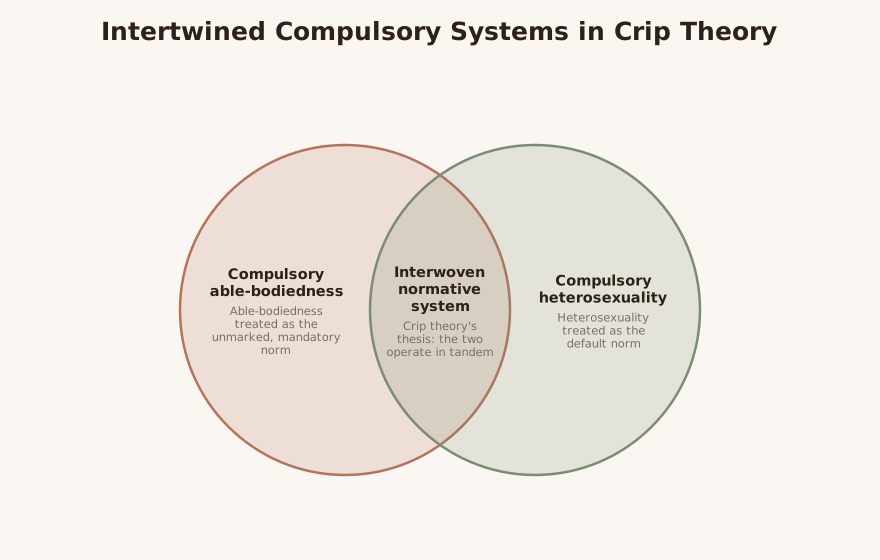
The central thesis is that “compulsory able-bodiedness” is intertwined with compulsory heterosexuality — the social system that treats able-bodiedness as the unmarked, mandatory norm operates in tandem with the system that treats heterosexuality as default 2. Crip theory rejects viewing disability as predetermined limitation; instead it recognizes disability as generating “alternative modes of living” that challenge productivity norms and produce new forms of embodied knowledge 6. It builds on the social model of disability, which locates disablement in inaccessible environments and exclusionary social arrangements rather than solely in the body 3. A further principle is intersectionality: queer crip analysis emphasizes coalitional, intersecting oppressions and centers the leadership and experience of those most affected 5. The orienting commitment is that “another, more accessible world is possible,” grounding critique in lived, personalized narrative 6. For clinicians, the takeaway principle is that what presents as individual pathology is often the internalized residue of normative pressure LLM.
Interventions & Techniques
Crip theory does not supply a protocol or a set of named techniques; it supplies a stance that can inform how a clinician listens, formulates, and frames LLM. In practice, clinicians borrow the lens to externalize distress — separating the client from norms of “compulsory able-bodiedness” so that shame is reattributed to systems rather than to the self LLM. Techniques compatible with this lens include narrative externalization, values clarification, psychoeducation about minority stress and the social model, and validation of identity reclamation LLM. The reclamation of “crip” as an affirming term models a clinical move: helping clients metabolize stigmatized language and identity into something authored and owned 5. Affirming care that does not pathologize neurodivergence, disability, or queerness operationalizes the framework’s anti-normative commitment LLM. Crucially, these moves must be housed within a recognized, billable modality — cognitive-behavioral, acceptance-based, narrative, or psychodynamic — because crip theory itself is a lens, not a treatment LLM.
Evidence Base
Honesty about maturity matters here. Crip theory is established as an academic theory within disability and queer studies — it is widely cited, has generated a substantial scholarly literature, and McRuer’s monograph received the Alan Bray Memorial Book Award from the Modern Language Association’s GL/Q Caucus 4. It is also actively used as an analytic tool in contemporary feminist and gender-studies scholarship 3. However, its scholarly standing is not a clinical evidence base LLM. There are no randomized controlled trials, no manualized “crip-theory therapy,” and no efficacy or effectiveness studies of crip theory as a treatment LLM. What exists is a robust theoretical and humanities literature, not psychotherapy outcome research 3. Clinicians should therefore present it to clients and supervisors as an orienting framework that complements evidence-based modalities, never as a validated standalone intervention LLM. Its value is conceptual — sharpening case formulation around oppression and embodiment — rather than empirically demonstrated in trials LLM.
Populations & Indications
The lens is most apt for people whose distress is entangled with bodily and identity-based norms: people with disabilities, people with chronic illness, neurodivergent individuals, and LGBTQ+ individuals clients 1. It is especially relevant for disabled queer people, whose experience sits precisely at the intersection the theory describes — where able-bodiedness and heterosexuality are both enforced as defaults 2. More broadly, it can inform work with any marginalized identity group facing intersecting forms of exclusion 5. Indications are not diagnostic; the framework is indicated when a clinician notices that a client’s self-blame, shame, or “failure” narratives track closely with normative social expectations about bodies, productivity, or sexuality LLM. It is well-suited to clients already engaged in identity exploration or political consciousness, and to those seeking to make meaning of discrimination LLM. It is not a substitute for symptom-targeted treatment when acute symptoms are present LLM.
Problems-for-Work
The framework speaks directly to several presenting concerns. Internalized ableism and internalized stigma can be reframed as the absorption of compulsory able-bodiedness rather than as personal deficits 2. Minority stress and discrimination distress are clarified by the social model’s insistence that disablement and exclusion arise from environments and systems, not from the individual 3. Body image and embodiment distress is addressed by the theory’s revaluation of disability as a generative “alternative mode of living” rather than a lack 6. Heteronormative and ableist pressure, social exclusion, and intersectional oppression are precisely the systemic forces the theory names 5. Identity-based marginalization is met with the affirming reclamation of “crip” and “queer” as owned identities 5.
LLM-generated illustrative example (not a guideline): A neurodivergent, queer client describes chronic exhaustion from “passing” at work and a pervasive sense of being “too much.” Using the lens within ACT, the clinician helps the client see the exhaustion as the cost of compulsory norms rather than a personal failing, then does values work toward an authored, less-masked life LLM.
Contraindications, Cautions & Cultural Humility
Crip theory is not contraindicated as a stance, but it can be misapplied LLM. It should never override a client’s own framing — imposing a political or activist identity on someone who does not hold it is coercive and anti-therapeutic LLM. It is not a crisis intervention and should not displace evidence-based, symptom-focused care when acute risk, psychosis, or severe symptoms are present LLM. Clinicians must avoid romanticizing disability or chronic illness; the theory revalues disabled life but does not deny real suffering, pain, or the desire for symptom relief 6. The reclaimed term “crip” is community-owned language; a clinician should follow the client’s lead on terminology and never assign the label 5. Cultural humility requires recognizing intersecting identities — race, class, gender, sexuality, and disability interact, and the framework’s own coalitional ethic insists on centering the most affected rather than a clinician’s assumptions 5. The clinician’s role is to offer the lens as one possible meaning-making tool, held lightly LLM.
Treatment-Plan Suggestions & SMART Objectives
| Goal | SMART objective (example) | Mechanism |
|---|---|---|
| Reduce internalized ableism | Within 8 sessions, client will identify and verbally reattribute 3 self-critical “able-bodiedness” beliefs to social/systemic sources, rated weekly | Externalization; cognitive reframing of norm as systemic, not personal 2 |
| Decrease minority-stress distress | Over 6 weeks, client will log discrimination-linked stressors and distinguish environmental from intrapersonal causes in 80% of entries | Social-model psychoeducation reduces self-blame 3 |
| Improve embodiment and body image | Within 10 sessions, client will articulate 2 valued capacities or “alternative modes of living” tied to their body, in their own words | Revaluation of disability as generative rather than deficient 6 |
| Strengthen identity affirmation | By session 12, client will describe their disabled/queer identity using self-chosen, affirming language in 3 consecutive sessions | Supported reclamation of stigmatized identity 5 |
| Counter social exclusion | Within 90 days, client will identify and engage 1 affirming/coalitional community or peer connection | Coalitional, intersectional support reduces isolation 5 |
| Reduce shame from heteronormative/ableist pressure | Over 8 sessions, client will report a 50% drop on a self-rated shame scale tied to “passing” behaviors | Values clarification + de-shaming reattribution LLM |
| Build resilience to discrimination distress | Within 6 sessions, client will rehearse and use 2 grounding/assertion strategies after discriminatory encounters | Skills-based coping paired with systemic framing LLM |
Common Misconceptions
A frequent misconception is that crip theory denies the reality of suffering or wants disability to be uniformly celebrated; in fact it revalues disabled existence while still grounding critique in lived experience and access needs 6. Another is that “crip” is a slur a clinician should avoid or correct — it is a community-reclaimed term, and the error is assuming rather than following the client’s usage 5. Some assume crip theory is interchangeable with the medical or even the basic social model; rather, it pushes beyond rights-based framings toward intersectional, coalitional liberation 5. A clinically important misconception is that it is an “evidence-based therapy” — it is an established academic theory without a clinical trial base 3. Finally, some treat it as solely about disability; its defining move is yoking disability to queerness and to compulsory heterosexuality 2.
Training & Certification
There is no certification, credential, or licensure pathway in “crip theory,” and clinicians should be wary of any program implying otherwise LLM. The knowledge base is academic: McRuer’s foundational essay and monograph, Kafer’s Feminist, Queer, Crip, and Puar’s The Right to Maim are the canonical primary texts 56. University library research guides curate accessible reading lists for clinicians new to the field 6. Practical clinical competence comes from pairing this reading with training in an actual billable modality (CBT, ACT, narrative, psychodynamic) and with disability-affirming and LGBTQ-affirming care frameworks LLM. Consultation with disabled and queer communities, and supervision attentive to intersectionality, build the cultural humility the framework requires 5. In short: read the theory, train in a modality, and stay accountable to the communities the theory centers LLM.
Key Terms
Compulsory able-bodiedness — McRuer’s concept that society enforces able-bodiedness as a mandatory, unmarked norm, paralleling compulsory heterosexuality 24. Crip — a reclaimed form of “cripple,” signaling affirming, politicized disabled (often queer) identity 5. Compulsory heterosexuality — the systemic treatment of heterosexuality as default, theorized as interwoven with able-bodiedness 2. Social model of disability — locates disablement in inaccessible environments and social arrangements rather than the individual body 3. Able-bodied heteronormativity — the joined norm that crip theory analyzes and resists 6. Crip futures — Kafer’s notion of imagining alternative, accessible futures for disabled life 5. Intersectionality / coalition — attention to overlapping oppressions and centering the most affected 5.
Resources & Further Reading
▶ Watch — a video introduction to this concept:
- Crip Theory: Cultural Signs of Queerness and Disability — Robert McRuer (2006)
- Compulsory Able-Bodiedness and Queer/Disabled Existence — Robert McRuer (PhilPapers record)
- Crip Theory: A Useful Tool for Social Analysis — NORA (2023)
- Robert McRuer — Wikipedia
- Disability Justice and Queer Crip Theory — Elon University LibGuide
- Disability Studies & Crip Theory — Columbia University Libraries guide
Reflective / Supervision Questions
- When a client voices self-blame, can I distinguish what belongs to systemic norms of compulsory able-bodiedness from what is intrapersonal — and am I reattributing accurately rather than reflexively? LLM
- Whose language am I using for the client’s identity, and have I followed their lead on terms like “crip,” “disabled,” or “queer”? 5
- Am I holding the crip-theory lens lightly, or am I imposing a political framing the client has not chosen? LLM
- How do I name the difference, with clients and in documentation, between an established academic theory and an evidence-based clinical intervention? 3
- Where does this lens risk romanticizing disability and minimizing the client’s real pain or desire for symptom relief? 6
- Which intersecting identities — race, class, gender, sexuality, disability — am I at risk of flattening, and how am I staying accountable to the communities this framework centers? 5