
Type & Discipline
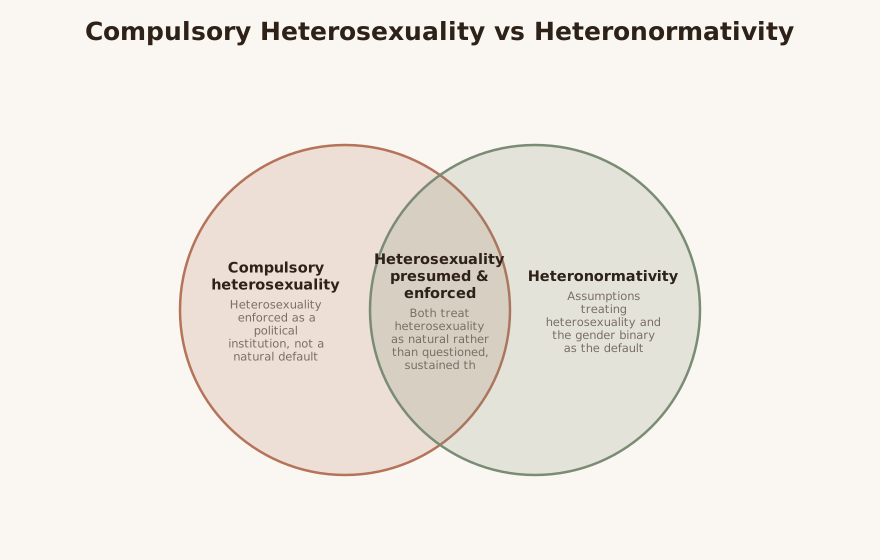
Compulsory heterosexuality and heteronormativity are theoretical constructs, not psychotherapies. LLM They originate in feminist theory and queer theory rather than in clinical psychology, and they describe how social structures organize sexuality and gender. LLM Compulsory heterosexuality is “the theory that heterosexuality is assumed and enforced upon people by a patriarchal, allonormative, and heteronormative society.” 2 Heteronormativity, the broader sibling concept, names the deeply embedded societal assumptions that treat heterosexuality as the standard and render non-heterosexual orientations as deviations deserving marginalization. 3
For the practicing therapist, the clinical relevance is interpretive: these lenses help explain the origin of distress that LGBTQ+ individuals clients bring to the room, locating shame, vigilance, and identity confusion in an external social field rather than in individual pathology. LLM The constructs themselves do not prescribe interventions; they shape case conceptualization, which is then delivered through recognized modalities. LLM
Creators & Lineage
Adrienne Rich popularized compulsory heterosexuality in her 1980 essay “Compulsory Heterosexuality and Lesbian Existence,” published in Signs: Journal of Women in Culture and Society (Summer 1980). 1 Rich argued that women’s orientation toward men results from societal conditioning rather than from an innate, freely chosen preference. 2 She framed heterosexuality not as a personal inclination but as “an institution imposed upon many cultures and societies that render women in a subordinate situation,” functioning as a “violent political institution.” 1
The heteronormativity branch of the lineage was named by social critic Michael Warner in 1991. 3 Warner has been credited with treating Rich’s essay as foundational to heteronormativity theory, and the two concepts differ in emphasis: compulsory heterosexuality stresses the individual regulation of sexual expression, while heteronormativity addresses broader societal assumptions. 2 Rich herself drew the essay’s structural scaffolding from anthropologist Kathleen Gough, adapting Gough’s characteristics of male power into a list of mechanisms that enforce heterosexuality on women. 1
The broader intellectual family is queer theory and feminist theory, with the clinical-side cousins being the minority stress model and affirmative therapy. LLM Therapists usually encounter these ideas not through the primary texts but through affirmative-care training that borrows their core insight: that distress can be socially produced. LLM
Core Principles
Several principles recur across both constructs. First, heterosexuality is presumed and enforced rather than simply observed; Rich’s central move was to “complicate” heterosexuality by questioning its assumed naturalness. 1 Second, the enforcement operates through identifiable social mechanisms. Rich, adapting Gough, named eight: forced male sexuality, labor exploitation, control of children, physical confinement, use of women in male transactions, restrictions on creativity, the withholding of knowledge, and the denial of women’s own sexuality. 1
Third, the norm sustains itself through invisibility. Heterosexual norms permeate institutions so thoroughly that members of the dominant culture rarely recognize their own privileged status. 3 Fourth, the system enforces conformity through tangible sanctions: those who deviate may be “subject to street violence, discrimination in employment, and withdrawal of social acceptance,” pressuring people to either comply or conceal. 3
Rich also offered two reframing concepts. The “lesbian continuum” encompasses the range, throughout each woman’s life and throughout history, of woman-identified experience, extending beyond sexual identity to emotionally intimate female relationships. 1 “Lesbian existence” names the conscious living outside patriarchal structures and the emotional and sexual independence from men. 2 Clinically, the value of these reframes is that they move identity from a private defect to a meaningful position within a social field. LLM
Interventions & Techniques
Because this is a lens and not a manualized treatment, there are no “comphet techniques” to deliver. LLM Instead, the constructs inform technique selection within an established modality. LLM The following are clinical applications synthesized for affirmative practice; none derive from the theoretical sources themselves. LLM
- Externalizing the norm. Naming compulsory heterosexuality and heteronormativity explicitly can relocate a client’s distress from “something wrong with me” to “a norm I absorbed.” This maps cleanly onto cognitive restructuring and narrative externalization. LLM
- Psychoeducation on minority stress. Explaining that vigilance, concealment, and rejection sensitivity are predictable responses to a hostile social field can reduce self-blame. LLM
- Distinguishing felt preference from conditioned default. Helping a client examine whether an assumed heterosexual life script was chosen or inherited, without steering the conclusion, supports authentic self-definition. LLM
- Working with concealment costs. Since heteronormativity pressures people to comply or hide, exploring the energetic and relational cost of concealment is a concrete therapeutic target. LLM
- Couples and family reframing. Locating conflict partly in internalized norms rather than solely in partner deficits can de-escalate blame in queer couples and families. LLM
Evidence Base
The honest label here is established as an influential theoretical and scholarly construct, not as an outcome-tested treatment. LLM There are no randomized trials, effect sizes, or efficacy studies of “compulsory heterosexuality therapy,” because no such therapy exists; the concept is a critical-theory framework. LLM Its scholarly standing is durable: it has shaped feminist and queer scholarship for over four decades, has been extended intersectionally (for example, to “compulsory white heterosexuality,” healthcare disparities for non-heterosexual women, and media representation), and remains a reference point in contemporary discourse. 2
The construct also has well-documented criticisms, which clinicians should hold in mind. Critics argue it can oversimplify gender binaries, underweight individual agency, and reduce the politics of sexual orientation to the politics of gender alone; some also contend that increased social visibility has diminished the institutional power the framework describes. 2 Where empirical clinical weight exists, it sits in adjacent frameworks the clinician is more likely to bill and document, namely the minority stress model and LGBTQ-affirmative therapy, which operationalize the same core insight into measurable distress pathways. LLM
Populations & Indications
The constructs are most clinically useful with sexual-minority and gender-diverse clients, including LGBTQ+ individuals individuals navigating identity, queer couples, and gender-diverse clients negotiating the gender-binary assumptions embedded in heteronormativity. LLM Rich’s original argument centered specifically on women and the erasure of lesbian existence, which makes the lens especially apt with women questioning whether a heterosexual life script was authored or inherited. 1 2
Adolescents are a particularly relevant population, since identity development and the social pressure to “comply or conceal” intensify during these years. 3 LLM The lens is indicated whenever a client’s presenting distress appears entangled with the felt pressure of a default norm: it is a conceptual tool, so the “indication” is interpretive rather than diagnostic. LLM
Problems-for-Work
The framework reframes a familiar cluster of presenting problems as partly socially produced, which can change how each is approached. LLM
- Minority stress. The constructs supply the theoretical “why” behind chronic stress: a social field that enforces a norm and sanctions deviation. 3 LLM
- Internalized homophobia and shame. When a client has absorbed the framing of their orientation as deviation, externalizing the norm can loosen the shame’s grip. 3 LLM
- Identity development and coming-out distress. Naming compulsory heterosexuality can validate the confusion of a client who long assumed a heterosexual script was simply “how things are.” 2 LLM
- Anxiety and depression. Concealment, hypervigilance, and anticipated rejection are framed as understandable responses rather than personal failings, which supports standard CBT or ACT work. LLM
- Low self-esteem. Relocating the source of “wrongness” from self to norm directly targets the self-evaluative core. LLM
- Relationship conflict and social isolation. With queer couples, distinguishing internalized norms from genuine incompatibilities can reduce blame; with isolated clients, the lesbian-continuum reframe can normalize connection-seeking. 1 LLM
LLM-generated illustrative example (not a guideline): A 24-year-old woman presents with low mood and a vague sense that her long-term relationship with a man feels “performed.” Rather than steering her toward any identity label, the therapist introduces the idea that a heterosexual life path is often assumed rather than examined, and invites her to notice which parts of her relationship feel chosen versus inherited. The work stays exploratory; the client, not the lens, reaches any conclusions. LLM
Contraindications, Cautions & Cultural Humility
The sharpest caution is the clinician imposing the lens. LLM Because the framework asserts that an apparently heterosexual orientation may be socially conditioned, an overzealous therapist can slide into suggesting a client “must really be” queer, which overrides client self-identification and replaces one prescriptive script with another. LLM The constructs are meant to open questions, not to deliver verdicts about a client’s orientation; using them to diagnose identity is a misuse. LLM
A related risk comes from contemporary self-application: clients sometimes arrive having already used “comphet” online as a self-diagnostic tool and may want the therapist to confirm a conclusion. LLM The clinician’s job is to hold the exploration open rather than to ratify or reject the client’s framing prematurely. LLM
The framework’s own published criticisms are relevant to humility: it can flatten gender into a binary and underplay agency, so it should not be applied as if it explained every client’s experience. 2 Cultural humility also requires attention to intersectionality, since the construct has been extended to show that heterosexuality’s enforcement is racialized and not uniform across communities. 2 Finally, the heteronormative pressure to “comply or conceal” means safety is a precondition: pushing disclosure on a client whose environment carries real risk of violence or discrimination can cause harm. 3 LLM
Treatment-Plan Suggestions & SMART Objectives
The goals and objectives below are illustrative examples of how the lens can inform an affirmative treatment plan; the specific wording is synthesized, not drawn from the sources. LLM
| Goal | SMART objective (example) | Mechanism |
|---|---|---|
| Reduce internalized shame | Within 8 sessions, client will identify and verbally challenge 3 internalized heteronormative beliefs, rated weekly on a 0-10 shame scale | Externalizing the norm; cognitive restructuring LLM |
| Decrease minority-stress symptoms | Over 10 weeks, client will reduce GAD-7/PHQ-9 scores by a clinically meaningful margin while practicing 2 coping skills for anticipated rejection | Psychoeducation on minority stress; skills coaching LLM |
| Clarify authentic self-definition | By session 6, client will articulate which life choices feel chosen versus inherited, without therapist-supplied conclusions | Distinguishing felt preference from conditioned default LLM |
| Lower concealment burden | Within 12 weeks, client will identify the contexts where concealment is and is not safe, and select one lower-risk context to express identity | Working with concealment costs; safety-led pacing LLM |
| Improve couple communication | Over 8 sessions, the couple will distinguish 3 conflicts rooted in internalized norms from genuine differences, using a shared worksheet | Couples reframing; de-blaming LLM |
| Reduce social isolation | Within 10 weeks, client will initiate 2 supportive connections, framed through the lesbian-continuum idea of woman-identified community | Reframing connection as legitimate, not deviant LLM |
| Build self-esteem | By session 9, client will generate a 5-item list of self-evaluations relocated from “self-defect” to “absorbed norm” | Source-relocation of self-worth LLM |
Common Misconceptions
A frequent misconception is that compulsory heterosexuality claims no one is genuinely heterosexual. LLM Rich’s stated intent, clarified in her 2004 “Reflections,” was to complicate heterosexuality and question its assumed naturalness, not to advocate a revolution or deny authentic heterosexual experience. 1 A second misconception conflates the two terms; in fact compulsory heterosexuality emphasizes individual regulation of sexual expression while heteronormativity describes broader societal assumptions. 2
A third error treats the “lesbian continuum” as purely sexual, when Rich defined it to include the full range of woman-identified experience beyond sexual identity. 1 A fourth, common in clinical settings, treats the framework as settled fact; it carries substantive academic criticism, including charges that it oversimplifies gender and underweights agency. 2 Finally, some assume the concept is dated, but it has been actively extended and remains in contemporary use, including under the abbreviation “comphet.” 2
Training & Certification
There is no certification in compulsory heterosexuality or heteronormativity, because they are theoretical constructs rather than treatment models. LLM Clinicians who want to apply the insight competently should instead pursue LGBTQ-affirmative therapy training and continuing education in the minority stress model, which translate the same social-determinants-of-distress logic into clinical practice. LLM Foundational reading in the primary and reference literature, listed below, supports conceptual fluency; supervision with an affirmative-care-experienced clinician is the most reliable route to applying the lens without imposing it. LLM
Key Terms
- Compulsory heterosexuality. The theory that heterosexuality is assumed and enforced by a patriarchal, allonormative, and heteronormative society. 2
- Heteronormativity. Embedded societal assumptions treating heterosexuality as the standard and other orientations as deviations deserving marginalization; named by Michael Warner in 1991. 3
- Lesbian continuum. The range, across each woman’s life and history, of woman-identified experience, extending beyond sexual identity. 1
- Lesbian existence. Living consciously outside patriarchal structures, with emotional and sexual independence from men. 2
- The “Great Silence.” Rich’s term for the erasure of lesbian existence from feminist scholarly literature. 1
- Comphet. The contemporary abbreviation for compulsory heterosexuality in current usage. 2
Resources & Further Reading
▶ Watch — a video introduction to this concept:
- Compulsory Heterosexuality and Lesbian Existence (Adrienne Rich, 1980, Signs vol. 5 no. 4) — full-text PDF
- Compulsory Heterosexuality and Lesbian Existence — Wikipedia
- Compulsory heterosexuality — Wikipedia
- Heteronormativity — Encyclopedia.com (social sciences reference)
- Queer Theory and Heteronormativity — Oxford Research Encyclopedia of Education
- Compulsory Heterosexuality, Past and Present: Adrienne Rich and the Lesbian Masterdoc — Post45
Reflective / Supervision Questions
- When a client’s distress involves sexuality or gender, do I reach for an intrapsychic explanation before considering a social-field one, and what does my default reveal? LLM
- Am I holding the lens as a question-opener, or am I subtly steering clients toward an identity conclusion I find more interesting or affirming? LLM
- How do I respond when a client arrives having already self-diagnosed with “comphet” online and wants me to confirm it? LLM
- Where in my own life have I left a heteronormative assumption unexamined, and how might that shape what I notice or miss in session? 3 LLM
- Have I assessed real-world safety before exploring disclosure, given that the social field can sanction deviation with violence or discrimination? 3 LLM
- When does this framework risk flattening a client’s experience into a binary it cannot hold, and how would I notice? 2 LLM