
Type & Discipline
Complexity and chaos theory is not a treatment model but a metatheory: a way of describing how change happens in systems whose components interact nonlinearly over time LLM. It belongs to the broader family of systems theory and cybernetics, and in its mathematical form it is a branch of dynamical systems theory concerned with how deterministic systems can nonetheless behave unpredictably 4. Applied to psychotherapy, it treats the therapeutic process — and the client, the dyad, the family, or the treatment milieu — as a complex, self-organizing system rather than a machine in which a given input reliably produces a proportional output 1.
The clinical relevance is that human change is rarely linear LLM. Clients improve in fits and starts, plateau for weeks, then shift suddenly; symptoms oscillate; gains made in one domain ripple unpredictably into others 2. Complexity theory offers a vocabulary — attractors, order transitions, critical instabilities, sensitive dependence — for these familiar but undertheorized phenomena 1. It does not replace cognitive, behavioral, psychodynamic, or systemic models; it sits underneath them as a framework for understanding how and when their interventions take hold LLM.
Creators & Lineage
Chaos theory as a scientific field emerged in the 1960s and 1970s from meteorology, mathematics, and physics, and was popularized for general audiences by James Gleick’s 1987 book Chaos: Making a New Science, published by Viking and a finalist for both the National Book Award and the Pulitzer Prize 46. Gleick’s account profiles Edward Lorenz, whose simplified weather model revealed that minute differences in starting conditions produce wildly divergent outcomes — the “butterfly effect” — and Mitchell Feigenbaum, who found universal constants in the route from order to chaos 6. The book’s central themes are sensitive dependence on initial conditions, self-similarity, universality, and nonlinearity 6. Benoit Mandelbrot’s work on fractals and self-similar geometry is part of the same intellectual moment 6.
The lineage flows from general systems theory and cybernetics through dynamical systems theory and into the study of complex adaptive systems LLM. The bridge into psychotherapy runs largely through Hermann Haken’s synergetics — the physics of self-organization in open systems far from equilibrium — and its clinical translation by Günter Schiepek and colleagues, whose synergetic model of change processes is the most developed empirical program in this space 1. Schiepek’s group draws explicitly on Haken’s synergetics and J. A. Scott Kelso’s work on coordination dynamics 1.
Core Principles
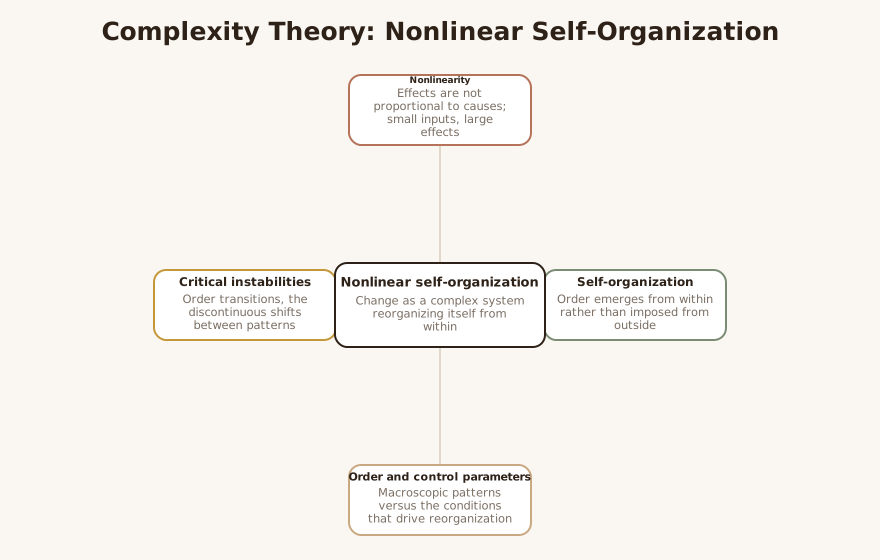
Nonlinearity. In a complex system, effects are not proportional to causes. As the synergetic model puts it, “small interventions can result in large effects on further system trajectories, or big interventions can be counterbalanced by the system dynamics” 1. This directly contradicts a simple dose-response model of therapy LLM.
Self-organization. Order emerges from within the system rather than being imposed from outside 1. Therapeutic change is understood as a “spontaneous process from within a non-linear system” — the therapist does not install the new pattern so much as create conditions under which the system reorganizes itself 1.
Order parameters and control parameters. Borrowing from synergetics, the model distinguishes the macroscopic patterns that capture a system’s state (order parameters) from the slowly changing conditions that drive reorganization (control parameters) 1. In Schiepek’s framework, intrinsic motivation for change functions as a control-parameter equivalent — the internal driving force that enables the system to shift 1.
Critical instabilities and order transitions. Discontinuous change is typically preceded by a period of heightened instability — increased dynamic complexity and fluctuation — rather than by steady accumulation 1. These “critical instabilities” are theorized as necessary precursors to therapeutic shifts, after which the system settles into a new configuration 1.
Boundary conditions. Reorganization requires stability around the edges. Schiepek’s group holds that “stable boundary conditions as experienced by clients are necessary for self-organizing dynamics” — a positive alliance and a containing milieu allow productive destabilization without collapse 1.
Sensitive dependence and deterministic chaos. A fully deterministic system can still be effectively unpredictable over the long run because tiny differences in starting state amplify 2. Schiepek’s computational work shows two trajectories beginning at nearly identical values (for example, a success variable starting at −0.3200 versus −0.3201) diverging completely while remaining within the same attractor 2. The authors conclude that “restricted predictability and spontaneous changes challenge the usefulness of prescriptive treatment manuals” 2.
Interventions & Techniques
Complexity theory is a lens, not a manualized protocol, so its “techniques” are mostly stances and monitoring practices rather than scripted procedures LLM.
Real-time process monitoring. The signature applied tool is high-frequency, often daily, self-assessment. Schiepek’s group built a Synergetic Navigation System (SNS) that collected daily internet-based self-ratings on a Therapy Process Questionnaire, allowing nonlinear time-series analysis of the unfolding process 1. Chaos-informed practice “demands technologies capable of real-time monitoring” rather than relying on predetermined intervention schedules 2.
Tracking dynamic complexity to time interventions. Rather than delivering a fixed technique on a fixed week, the clinician watches for windows of instability — periods when the system is most reorganizable — and works with them 1. In the OCD sample, complexity peaks preceded the steepest symptom change, and in many patients the steepest gradient of change occurred before the formal onset of exposure work 1.
Holding boundary conditions. Deliberately maintaining a stable alliance and predictable frame so the client can tolerate destabilization is itself an intervention in this model 1.
Catalyzing rather than controlling. Because small inputs can have large effects, the therapist acts as a catalyst for self-organization rather than an engineer of a predetermined outcome LLM.
LLM-generated illustrative example (not a guideline): A clinician using brief daily mood and urge ratings notices a client’s scores becoming noticeably more erratic over two weeks — wider swings, less predictability. Rather than reading this as deterioration, the clinician treats the rising instability as a possible pre-transition window, reinforces the frame, and introduces a values-clarification exercise during this period. A “sudden gain” follows the following session. LLM
Evidence Base
The honest summary: complexity and chaos theory is theoretically rich and empirically emerging, not established as a stand-alone efficacious treatment LLM. There are no randomized controlled trials of “chaos therapy,” because it is a framework, not a discrete intervention LLM.
The strongest empirical support comes from Schiepek’s synergetic-model program. In a study of 23 patients with OCD using daily process self-assessment, dynamic complexity peaked roughly 3–7 days before the steepest symptom change, and in 13 of 18 analyzable patients the steepest gradient of change occurred before exposure-and-response-prevention onset — consistent with discontinuous, self-organized change rather than smooth technique-driven improvement 1. Patients showing both high critical instability and a positive ward atmosphere had the best outcomes 1. (Note that the PubMed record and the open-access article describe the same study, not two independent replications 13.)
On the formal side, Schiepek’s 2017 computational paper modeled therapy as five interacting variables — emotions, problem intensity, motivation, insight, and therapeutic success — governed by four parameters, and demonstrated genuinely chaotic dynamics: positive Lyapunov exponents across iterations, bifurcation diagrams, and phase-transition-like phenomena 2. This establishes the plausibility and internal consistency of the chaos account but is a simulation, not outcome evidence LLM. Secondary and explanatory treatments echo these themes in psychology more broadly 56.
The appropriate evidentiary claim is therefore: complexity theory provides a well-formalized, partially validated description of process, with promising real-time-monitoring methods, but it should be presented to clients and supervisees as an organizing model rather than as an evidence-based therapy in the regulatory sense LLM.
Populations & Indications
The framework is process-general and so applies, in principle, across populations rather than to a single diagnosis LLM. It has been studied most directly in clients in psychotherapy as a process — the unfolding dyadic system — and in inpatient treatment systems where milieu and alliance serve as boundary conditions 1. It extends naturally to families and couples, which are paradigmatic complex systems with feedback loops and emergent patterns LLM.
It is especially illuminating for people with affective disorders and others whose course is marked by mood instability and symptom fluctuation, where nonlinear oscillation is the clinical norm rather than the exception LLM. Recovery populations, in which relapse and discontinuous change are central, are a natural fit for an attractor-based account LLM. Finally, it is a framework for therapists and researchers themselves — a way to interpret messy process data and to set realistic expectations about predictability 2.
Problems-for-Work
Sudden gains and discontinuous change. Complexity theory reframes abrupt between-session improvement not as anomaly but as an expected order transition following a critical instability, which can normalize and even anticipate such shifts 1.
Therapeutic plateaus and behavioral change resistance. A system resting in a stable attractor will resist perturbation; plateaus are reinterpreted as the system holding its current configuration until sufficient instability accumulates LLM.
Symptom fluctuation and mood instability. Day-to-day variability becomes informative signal rather than noise — rising complexity may flag an approaching window for change 1.
Emotional dysregulation. Dysregulation can be modeled as a system oscillating between or losing access to stable attractor states, reframing the goal as widening the basin of a regulated state LLM.
Relapse and treatment-resistant patterns. Relapse is understood as the system falling back into a deep, well-worn attractor; resistance reflects strong attractor stability, suggesting that timing interventions to instability windows may matter as much as their content 2.
LLM-generated illustrative example (not a guideline): A couple stuck in a repetitive pursue-withdraw cycle is described to them as a “deep groove” the relationship rolls into under stress. The therapist frames the goal not as never feeling the pull of the groove but as building enough new, competing patterns that the system has somewhere else to settle. LLM
Contraindications, Cautions & Cultural Humility
The first caution is conceptual overreach: complexity language can be used loosely and become a rhetorical gloss that explains everything and predicts nothing LLM. Because the theory emphasizes unpredictability, it must not become an excuse for therapeutic passivity or for abandoning evidence-based interventions that have demonstrated efficacy LLM. Sensitive dependence describes long-range unpredictability, not the impossibility of helpful action in the present 2.
A second caution concerns communicating uncertainty to clients. Telling a distressed client that their trajectory is fundamentally unpredictable can be destabilizing if delivered without warmth and a countervailing message of agency and hope LLM. The model’s own insistence on stable boundary conditions argues for emphasizing safety and the alliance before introducing destabilization 1.
Cultural humility matters because what counts as a “stable” or “regulated” attractor state is shaped by cultural context, family norms, and lived experience; the clinician should not impose an idiosyncratic or majority-culture definition of the desired pattern LLM. Real-time daily monitoring also assumes access to technology, literacy, and a tolerance for surveillance-like measurement that not all clients share, and consent and burden should be weighed carefully LLM. Complexity theory should augment, not displace, the client’s own account of what change looks like for them LLM.
Treatment-Plan Suggestions & SMART Objectives
| Goal | SMART objective (example) | Mechanism |
|---|---|---|
| Detect change windows | Client completes a brief daily self-rating for 4 weeks with ≥80% adherence so the dyad can review weekly | Real-time process monitoring of dynamic complexity 1 |
| Stabilize boundary conditions | Within 3 sessions, client and clinician agree on a written session frame and rate alliance ≥4/5 for 3 consecutive weeks | Stable boundary conditions enabling self-organization 1 |
| Normalize nonlinear change | Within 2 sessions, client can describe in their own words why progress may be uneven, rated by clinician | Psychoeducation on discontinuous change/order transitions 2 |
| Widen the regulated state | Over 6 weeks, client increases days with at least one self-regulation skill used from 2 to 5 per week | Strengthening an adaptive attractor basin LLM |
| Reduce relapse depth | Over 8 weeks, client identifies 3 early-instability cues and a paired response, reviewed monthly | Timing response to critical-instability windows 2 |
| Track sudden gains | Client and clinician flag and review any between-session score shift ≥1 SD within the next session for 8 weeks | Recognizing order transitions rather than dismissing them 1 |
| Support intrinsic motivation | Within 4 sessions, client articulates 2 self-generated reasons for change, revisited every 4 weeks | Strengthening the motivational control parameter 1 |
Common Misconceptions
“Chaos means randomness.” Chaotic systems are deterministic; their unpredictability comes from sensitive dependence on initial conditions, not from randomness 2. “Chaos theory is a type of therapy.” It is a metatheory of process; it has no manual and no efficacy trials of its own LLM. “Unpredictable means uncontrollable, so why intervene?” The model’s whole point is that small, well-timed inputs can have large effects, which makes skilled intervention more consequential, not less 1. “Complexity replaces evidence-based models.” It sits beneath established modalities as a framework for timing and interpretation, not as a competitor LLM. “More measurement always helps.” Daily monitoring carries burden and consent considerations and is a tool to be used judiciously LLM.
Training & Certification
There is no certification in “complexity therapy,” and clinicians should be wary of anyone offering one, because the framework is a theory rather than a credentialed modality LLM. The relevant applied apparatus — high-frequency process monitoring and the Synergetic Navigation System used in Schiepek’s research — is a research and feedback tooling tradition rather than a licensing pathway 1. Practitioners typically encounter these ideas through systems-theory and dynamical-systems coursework, continuing education, and the primary literature LLM. A reasonable entry point is reading Gleick’s Chaos for intuition and Schiepek’s synergetic-model papers for the clinical translation 41.
Key Terms
Attractor — a state or pattern toward which a system tends to settle LLM. Order transition — a qualitative shift from one stable pattern to another 1. Critical instability — a period of heightened fluctuation that typically precedes reorganization 1. Order parameter — a macroscopic variable capturing the system’s overall pattern 1. Control parameter — a slowly changing condition (e.g., intrinsic motivation) that drives reorganization 1. Sensitive dependence on initial conditions / butterfly effect — tiny differences in starting state amplifying into large divergences 26. Self-organization — emergence of order from within a system rather than by external imposition 1. Dynamic complexity — a time-series measure of fluctuation and structure used to detect instability 1.
Resources & Further Reading
▶ Watch — a video introduction to this concept:
- Schiepek et al., Self-organization in psychotherapy: testing the synergetic model of change processes (PMC)
- Psychotherapy Is Chaotic—(Not Only) in a Computational World (Frontiers in Psychology, 2017)
- Self-organization in psychotherapy — PubMed record (PMID 25324801)
- Gleick, Chaos: Making a New Science (Penguin Random House)
- Chaos Theory in Psychology (Neurolaunch explainer)
- Chaos: Making a New Science (Wikipedia)
Reflective / Supervision Questions
- When a client improves suddenly, do I treat it as a fluke, or do I look back for the period of instability that may have preceded it? LLM
- Where in my caseload am I delivering interventions on a fixed schedule rather than watching for the system’s own readiness to change? 2
- What are the boundary conditions in this case — alliance, frame, milieu — and are they stable enough to support productive destabilization? 1
- Am I using “everything is unpredictable” as genuine epistemic humility, or as a rationale for passivity? LLM
- How would I describe nonlinear change to this particular client in a way that builds hope rather than fatalism? LLM
- Whose definition of the “regulated” or desired pattern am I working toward — the client’s, or mine? LLM