
Type & Discipline
Complex adaptive systems (CAS) is a framework from complexity science, not a school of psychotherapy 2. It describes systems composed of many interacting agents whose local behavior produces emergent, system-level order that cannot be predicted from the components alone 2. The “adaptive” qualifier is load-bearing: CAS distinguishes itself from generic complex systems by emphasizing agents that gather information, learn, and modify their own rules in response to feedback 2. Britannica frames a CAS as a population of intelligent agents that “make decisions on the basis of rules and that they are ready to modify the rules on the basis of new information,” each acting on local information rather than a global view 3. For clinicians, the relevant move is metaphorical and structural: families, treatment teams, and even symptom-maintenance loops behave like adaptive systems, and that reframing changes how a therapist intervenes LLM. This article treats CAS as a lens for case conceptualization and systemic intervention, delivered inside recognized therapies — not as a billable modality in itself LLM.
Creators & Lineage
CAS crystallized at the Santa Fe Institute (founded 1984), the interdisciplinary hub where complexity science took organized form 7. John Holland, a pioneer of genetic algorithms and adaptation theory, is the figure most associated with CAS; his book Hidden Order articulated how large numbers of interacting agents adapt and learn 7. Murray Gell-Mann, the Nobel physicist, explored how simple underlying rules give rise to complex behavior, and Stuart Kauffman contributed work on self-organization operating alongside natural selection 7. The lineage runs through general systems theory and cybernetics — earlier attempts to describe systems by feedback, regulation, and wholes rather than parts — and connects directly to family systems theory, which had already reframed the individual symptom as a property of the relational system LLM. In health care, Paul Plsek and Trisha Greenhalgh translated CAS into clinical and organizational terms, arguing that health systems are themselves complex and adaptive rather than mechanical 45.
Core Principles
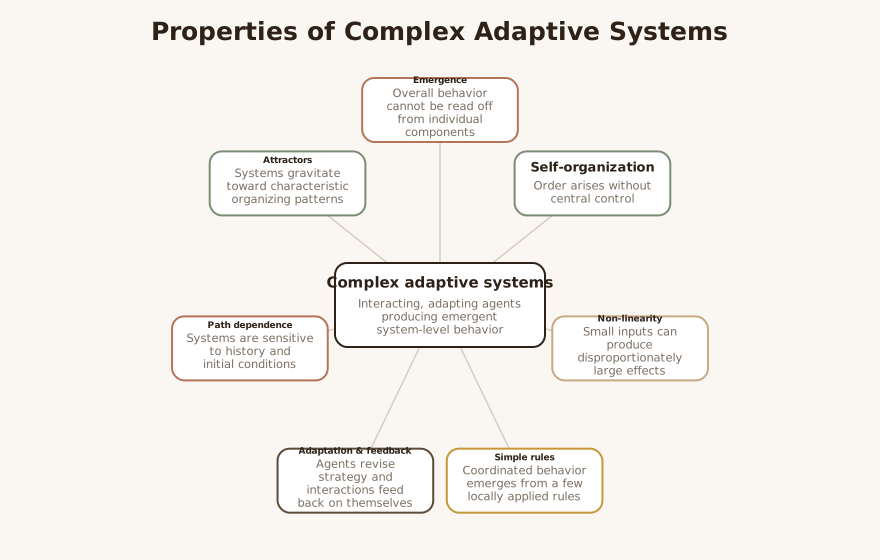
Several properties recur across the literature and travel well into clinical thinking. Emergence: overall behavior cannot be read off from individual components 2. Self-organization: order arises without central control — Plsek’s image is that “termites build the largest structures on earth…yet there is no CEO termite” 5. Non-linearity: small inputs can produce disproportionately large effects, and large interventions can produce little 56. Simple rules: complex coordinated behavior can emerge from a few locally applied rules, as in Reynolds’ flocking model where each agent only avoids collisions, matches neighbors’ speed, and moves toward the local center of mass 5. Adaptation and feedback: agents modify strategy based on outcomes, and interactions feed back on themselves 2. Path dependence: systems are sensitive to history and initial conditions 2. Attractors: systems gravitate toward characteristic patterns that organize behavior more powerfully than explicit rules 6. Co-evolution and context: healthy systems hold productive tension rather than eliminating it, and they are embedded within larger systems 5.
Interventions & Techniques
CAS does not prescribe techniques; it reshapes the therapist’s strategy LLM. Plsek’s central recommendation is the “farmer’s approach”: rather than engineer detailed specifications, “create the conditions under which a good crop is possible” 5. Translated to therapy, this means seeding minimum specifications — a few simple rules — and letting workable patterns self-organize, rather than dictating every behavior 5. A second technique is evolutionary design: generate diverse small experiments, prune what fails, and amplify what works 5. A third is attractor identification: locate the patterns a system already gravitates toward and reinforce the adaptive ones rather than only attacking barriers 6. The teams study found that naming three attractors — quality of care, interprofessional relationships, and wellbeing — guided behavior better than rules alone 6. Practically, a clinician leverages non-linearity by looking for high-leverage small changes, attends to feedback loops that maintain symptoms, and works with the system’s history rather than against it 6.
LLM-generated illustrative example (not a guideline): In family work, instead of assigning a detailed behavioral contract, a therapist might negotiate two simple rules (“we pause when voices rise” and “repair within 24 hours”) and let the family’s interactions self-organize around them — a minimum-specification, farmer’s-approach move LLM.
Evidence Base
Honesty about maturity matters here. CAS is an established framework within complexity and systems science, with decades of cross-disciplinary development centered at the Santa Fe Institute 17. Its application to health care is also well established as a descriptive and theoretical literature: Plsek and Greenhalgh’s BMJ paper and Plsek’s chapter in the Institute of Medicine’s Crossing the Quality Chasm are foundational 45. Empirical qualitative work — for example, analyzing 59 palliative-care interviews through seven CAS principles — shows the framework usefully accounts for how teams actually behave 6. What does not exist is a body of randomized controlled trials of “CAS therapy,” because CAS is not a treatment LLM. It is a conceptual lens that informs case formulation and systemic intervention, and any efficacy claim must rest on the established therapy through which it is delivered — not on CAS as a standalone intervention LLM. Britannica notes the field still lacks an adequate mathematical formalism, underscoring that CAS remains stronger as explanation than as predictive engineering 3.
Populations & Indications
CAS is most indicated where the unit of concern is genuinely a system of interacting, adapting agents LLM. Families and family systems are the clearest fit, given the direct lineage from family systems theory LLM. Organizations and teams — including healthcare and treatment teams — are well documented; the teams literature shows member interactions, not individual traits, generate team behavior 6. Healthcare and treatment systems as a whole are explicitly modeled as CAS 45. Communities and broader social networks are canonical CAS examples 2. The therapist-client dyad can itself be read as a small adaptive system co-evolving over time LLM. Finally, clinical phenomena within an individual — interacting cognitive, emotional, and physiological subsystems — can be approached with CAS as a metaphor, though this is the loosest application and should be held lightly LLM.
Problems-for-Work
CAS reframes several stubborn clinical problems. Family system dysfunction and relationship conflict become emergent products of interaction patterns rather than the fault of one “identified patient” 6. Symptom-maintenance cycles are read as feedback loops that stabilize a problem; intervention targets the loop, not just the symptom 6. Treatment-resistant or entrenched patterns are understood as strong attractors — the system keeps returning to them — so the work becomes shifting the attractor landscape 6. Resistance to change is reframed: non-linearity means the right small perturbation may shift a system that bulk effort could not 5. Sudden gains — rapid, discontinuous improvement — are exactly what non-linear systems do at tipping points, normalizing their unpredictability LLM5. Emotional dysregulation patterns can be viewed as a system oscillating without a stabilizing attractor LLM.
LLM-generated illustrative example (not a guideline): A couple’s escalating-conflict cycle is mapped as a feedback loop: one partner’s withdrawal cues the other’s pursuit, which deepens withdrawal. Rather than coaching “communication skills” broadly, the therapist targets one leverage point in the loop, expecting a possibly disproportionate downstream effect LLM.
Contraindications, Cautions & Cultural Humility
The framework’s main risk is conceptual overreach LLM. Because CAS can describe almost anything, it can become an unfalsifiable metaphor that explains everything and predicts nothing — Britannica’s note on the absence of an adequate formalism is a caution against treating CAS language as scientific precision 3. A second caution: emphasizing emergence and self-organization can be misused to minimize accountability, framing harmful patterns as “the system” in ways that obscure power, abuse, or individual responsibility LLM. Clinically, CAS must never displace risk assessment, evidence-based protocols, or duty-of-care obligations LLM. With cultural humility, the therapist should remember that what counts as a healthy “attractor” or “simple rule” is value-laden and culturally situated; the agents in a family system carry their own internal models, and imposing the clinician’s preferred order violates the framework’s own premise that order should emerge locally rather than be dictated 35.
Treatment-Plan Suggestions & SMART Objectives
| Goal | SMART objective (example) | Mechanism |
|---|---|---|
| Interrupt a symptom-maintenance loop | Within 6 sessions, family identifies one recurring trigger-response loop and reduces its weekly frequency from 5 to ≤2, by self-report log | Targets a feedback loop sustaining the symptom 6 |
| Establish minimum specifications | Within 3 sessions, couple agrees on 2 simple shared rules and applies them in ≥80% of logged conflicts over 4 weeks | “Simple rules” enabling self-organization 5 |
| Strengthen an adaptive attractor | Over 8 weeks, team/family names one shared positive attractor (e.g., repair) and references it in ≥3 conflicts/month | Reinforces existing attractor vs. only removing barriers 6 |
| Leverage non-linear change points | Within 4 sessions, client identifies one small, high-leverage behavior change and sustains it for 2 weeks | Small input → disproportionate effect 5 |
| Map system interdependencies | By session 2, client completes a genogram/feedback-loop map of the relevant system | Makes emergent, interactional structure explicit 6 |
| Normalize discontinuous progress | Within 3 sessions, client articulates that gains may be uneven/sudden and rates reduced distress about setbacks | Non-linearity and tipping-point dynamics 5 |
| Build adaptive capacity | Over 6 weeks, family runs ≥2 small “experiments,” keeps what works, drops what fails | Evolutionary design / pruning 5 |
Common Misconceptions
“CAS is a therapy.” It is a framework borrowed from complexity science; there is no CAS treatment protocol or efficacy trial 2LLM. “Complex means complicated.” A complicated system is fully decomposable and predictable; a complex adaptive system produces emergent behavior that cannot be predicted from its parts 2. “Self-organization means leave it alone.” Self-organization describes how order arises without central control, but Plsek’s farmer metaphor still involves active shaping of conditions and rules 5. “Bigger interventions yield bigger results.” Non-linearity means the opposite can hold — small changes can cascade while large efforts stall 5. “More rules give more control.” Complex coordinated behavior emerges from a few simple rules, not exhaustive specification 5.
Training & Certification
There is no certification in “CAS therapy,” and clinicians should be wary of any program implying otherwise LLM. The substantive grounding comes from two directions: complexity-science education (Santa Fe Institute materials and the broader CAS literature) and the systemic-therapy traditions that already operationalize these ideas — principally family and couples therapy training, which carry their own recognized credentials 1LLM. For clinicians wanting the conceptual base, Holland’s Hidden Order, the Santa Fe Institute body of work, and Plsek and Greenhalgh’s health-care translations are the canonical entry points 457. Competence is demonstrated not by a CAS credential but by skillful systemic formulation and intervention within a modality the clinician is licensed and trained to deliver LLM.
Key Terms
Agent — an interacting entity that gathers information, acts, and can adapt its rules 23. Emergence — system-level behavior not predictable from components 2. Self-organization — order arising without central control 5. Non-linearity — disproportion between input size and effect 5. Attractor — a pattern a system tends toward, organizing behavior more strongly than rules 6. Feedback loop — interactions that feed back on themselves, stabilizing or amplifying patterns 2. Simple rules / minimum specification — few local rules from which complex order emerges 5. Path dependence — sensitivity to history and initial conditions 2. Co-evolution — mutual adaptation among interdependent agents and their environment 5. Edge of chaos — the balance between rigid order and disorder where adaptive systems are most generative 7.
Resources & Further Reading
▶ Watch — a video introduction to this concept:
- Complex Adaptive Systems — Santa Fe Institute (research overview)
- Complex adaptive system — Wikipedia
- Complexity — Emergence, Networks, Systems — Encyclopaedia Britannica
- Plsek PE, Greenhalgh T. The challenge of complexity in health care. BMJ 2001;323:625-628
- Plsek P. Redesigning Health Care with Insights from the Science of Complex Adaptive Systems (Crossing the Quality Chasm, NAP)
- Healthcare teams as complex adaptive systems (PMC6053823)
- Complex Adaptive Systems and Complexity Theory — MIT complexity notebook (overview of Holland’s Hidden Order)
Reflective / Supervision Questions
- When I describe a case as a “system,” am I gaining explanatory leverage, or am I using CAS language to avoid naming individual responsibility, power, or risk? LLM
- What attractors is this family or team actually gravitating toward, and which are adaptive enough to reinforce rather than dismantle? 6
- Where is the single highest-leverage small change in this system, given that non-linearity means effort and effect rarely match? 5
- What are the two or three simple rules that could let healthier patterns self-organize here, rather than a detailed plan I impose? 5
- Whose values define the “healthy” order I am steering toward, and have I checked that against the client’s cultural context? 35
- Which recognized, billable modality am I actually delivering this work inside, and is my documentation grounded there rather than in CAS jargon? LLM