
Type & Discipline
Self-organized criticality (SOC) is a theory from statistical physics, not a psychotherapy 7. It describes how certain complex systems with many interacting parts spontaneously evolve toward a “critical” point — a knife’s edge between ordered and disordered behavior — without any external agent tuning them there 7. At that point the system produces scale-free “avalanches”: cascades of activity whose sizes follow a power-law distribution, meaning small events are common and large events rare but possible, with no characteristic scale 1. The brain-criticality hypothesis imports this framework into neuroscience, proposing that cortical networks operate at or near such a critical point 6.
For a practicing clinician, the honest framing is this: SOC is a model of dynamics, borrowed from physics and applied to neural recordings, that offers a vivid vocabulary for thinking about flexibility, rigidity, and dysregulation LLM. It is a discipline-crossing idea — statistical physics meeting dynamical-systems and network neuroscience — and its clinical translation remains metaphorical rather than evidence-based LLM.
Creators & Lineage
The theory was introduced in 1987 by Danish theoretical physicist Per Bak together with postdoctoral collaborators Chao Tang and Kurt Wiesenfeld, in a Physical Review Letters paper titled “Self-organized criticality: an explanation of 1/f noise” 5. Their formal treatment appeared the following year in Physical Review A 7. The canonical illustration is the Bak-Tang-Wiesenfeld “sandpile” model: grains of sand are added one at a time to a pile, which builds up until its slope reaches a critical angle, after which avalanches of every size occur to maintain that slope 5. The system tunes itself to criticality — hence “self-organized” 7.
Bak (1948-2002) worked at Brookhaven National Laboratory, the Santa Fe Institute, and Imperial College London, and popularized the idea in his 1996 book How Nature Works, which argued that self-organized criticality appears across earthquakes, evolution, and many natural systems 5. The lineage feeding the brain application runs from this statistical-physics and complexity-theory root, through dynamical-systems neuroscience, into network neuroscience, where the related notion of self-organization describes order emerging from local interactions rather than central control 6.
Core Principles
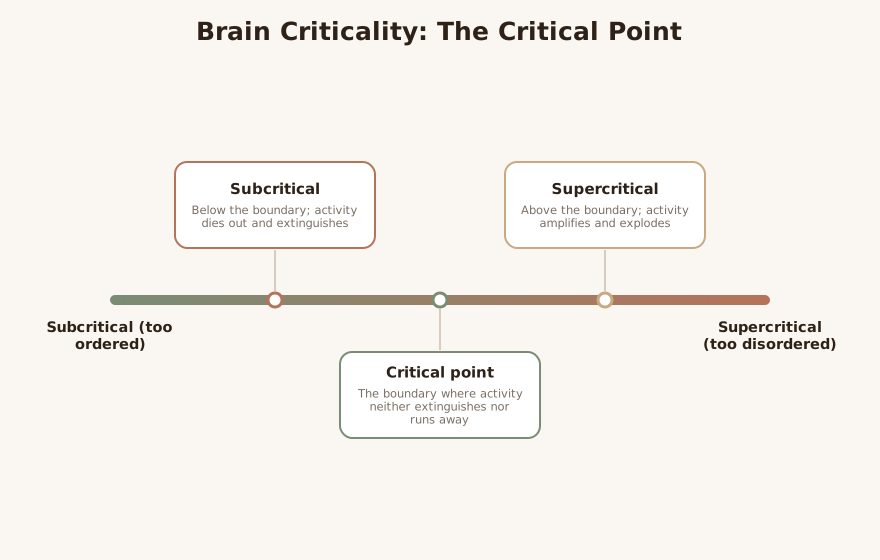
The central claim is that a system poised at criticality sits at a phase transition between two regimes — one too ordered (subcritical, activity dies out) and one too disordered (supercritical, activity explodes) 2. At the boundary, activity neither reliably extinguishes nor runs away 2.
A useful formalization is the branching parameter m, which describes how many downstream units one active unit activates on average 4. When m is below 1 the system is subcritical and activity fades; above 1 it is supercritical and activity amplifies uncontrollably; at exactly m = 1 the system is critical and sustains activity indefinitely 4. Criticality, in this branching-process view, is precisely the m = 1 boundary 4.
Three signatures mark criticality in neural data. First, neuronal avalanches — bursts of activity spreading through the network whose size distributions follow a power law with an exponent near −1.5 (−3/2), matching branching-process theory 26. Second, long separation of timescales with homeostatic recovery — power-law scaling persists despite slow external driving, and networks can recover critical dynamics within about 24 hours after perturbation 6. Third, scale invariance more broadly, where no single event size dominates 1.
The functional argument for why a brain would want to live here rests on three computational advantages identified in the literature: criticality is believed to maximize dynamic range (the span of inputs the system can distinguish), to support memory via “critical slowing down” that retains dynamical patterns, and to maximize the variability of neuronal responses 2. Systems at criticality are thought to have optimal memory and information-processing capabilities 2.
Interventions & Techniques
SOC is a theory, not an intervention, and there are no SOC-branded clinical techniques LLM. What exists are measurement and modeling methods used in research. Investigators record spontaneous network activity — classically from in vitro cortical cultures grown on multi-electrode arrays — and identify neuronal avalanches as sequences of consecutive active time bins bracketed by silent periods, then test whether avalanche sizes follow a power law 3. In intact cortex, local field potential negative peaks are tracked across electrode arrays and linked, via two-photon imaging, to pyramidal-neuron firing 6.
The control “knobs” that move a network between subcritical, critical, and supercritical regimes are themselves instructive LLM. Excitation/inhibition (E/I) balance is central: disrupting it shifts dynamics away from critical power laws toward bimodal supercritical distributions, and critical dynamics in culture appear to require an intermediate fraction of inhibitory neurons (roughly 20-30%) 63. External input strength matters too — networks become subcritical under high input and approach criticality under moderate input, consistent with cortex appearing “slightly subcritical” in awake animals 4. Neuromodulation participates: dopamine shows an inverted-U relationship with avalanche emergence in prefrontal cortex, paralleling the pharmacology of working memory 6.
For the clinician, the translational move — entirely conceptual at present — is to read therapeutic work as nudging a person’s self-regulatory dynamics away from over-rigidity or runaway instability toward a more flexible middle LLM. This is an analogy, not a measured mechanism LLM.
Evidence Base
Be candid with yourself and supervisees: for clinical purposes the evidence base is immature and largely metaphorical LLM. The strongest empirical support is at the level of neural-recording dynamics, not patient outcomes 2.
Even within neuroscience the hypothesis is contested. One review states plainly that “the criticality hypothesis has remained a controversial proposition” 2. Power laws — the headline signature — can be produced by non-critical mechanisms, including filtered neural activity, noise, and feed-forward structure, and are statistically hard to distinguish from other heavy-tailed distributions 2. Evidence for clean power-law avalanches comes largely from reduced preparations (cell cultures, slices, anesthetized animals) with low input; in awake animals power-law-distributed avalanches were often not observed, though some data suggest the critical state deteriorates during wakefulness and recovers during sleep 2. Most spike-based recordings do not support power-law fitting 2.
Other honest caveats from the field: dissociated cultures tend to show bimodal, supercritical-looking distributions rather than criticality; power-law avalanches are absent in deep cortical layers for reasons not yet explained; and arbitrary thresholds for detecting field-potential peaks could in principle manufacture power laws 6. There is also a theoretical wrinkle — perfect criticality may not be optimal, since complex tasks seem to benefit from critical dynamics while simple tasks perform better in subcritical regimes, so the brain may exploit the neighborhood of criticality rather than sitting exactly on it 4.
A balancing point: a 2021 review argues that, in superficial cortical layers specifically, the convergence of avalanches, nested oscillations, coherence potentials, and homeostatic recovery constitutes “compelling evidence” for SOC 6. So the picture is neither dismissible nor settled LLM.
Populations & Indications
No population has an indication for an SOC-based treatment, because none exists LLM. The populations below are where the theory has been invoked or studied, with sharply varying support LLM.
The best-substantiated clinical link is epilepsy: hallmarks of criticality are apparently destroyed during epileptic seizures, with epileptic dynamics showing the signatures of supercritical states and the loss of the power laws seen in healthy brains 2. This makes seizure activity a clean illustration of a network pushed past the critical edge into runaway amplification 2.
For depression, schizophrenia, disorders of consciousness, altered states (psychedelic or anesthetic), and neurodevelopmental conditions, the sources reviewed here do not provide comprehensive disease evidence; these remain areas of conceptual interest and active investigation rather than established findings 26. The most appropriate population for the model right now is arguably researchers and clinicians themselves, who use it as a conceptual lens LLM. Developmentally, it is worth noting that avalanche dynamics emerge alongside superficial-layer maturation in early postnatal life, which gives the framework a foothold for thinking about neurodevelopment 6.
Problems-for-Work
Translated as a metaphor for case formulation, the recurring clinical problem the model speaks to is the tension between rigidity and instability — being stuck in over-ordered patterns versus being flung into chaotic dysregulation LLM. The “critical” middle maps onto the flexibility clinicians prize LLM.
-
Rigidity (subcritical analogy): depressive rumination, cognitive inflexibility, and behavioral constriction resemble an over-ordered system where novel activity dies out LLM. The model frames the goal as restoring responsiveness and range 2.
-
Instability (supercritical analogy): panic escalation, dissociative flooding, and — at the literal neural level — seizure dynamics resemble runaway amplification 2. Here the framing is containment and re-balancing LLM.
-
Neural dysregulation / E/I imbalance: because excitation/inhibition balance is the key control parameter for criticality, problems framed as “too much activation, too little braking” have a natural place in the metaphor 6.
LLM-generated illustrative example (not a guideline): A clinician describes a client’s chronic avoidance as a “subcritical” pattern — safe, predictable, but unable to generate new responses — and frames graded exposure as gently increasing the network’s reactivity toward a more flexible range. This is a teaching analogy for the client, not a claim about that client’s neural avalanches LLM.
Contraindications, Cautions & Cultural Humility
The principal caution is reification LLM. Because SOC sounds rigorously physical, there is a real risk of dressing ordinary clinical impressions in borrowed scientific authority and implying a measured brain state that has not been measured 2. Power laws are easy to misattribute and hard to confirm, so a therapist should never tell a client their brain is “at criticality” or “subcritical” as if it were a finding 2.
A second caution: even where neural criticality is supported, it lives in recording data, not symptom checklists, so leaping from avalanche statistics to a treatment plan is unwarranted 6. Use the idea to enrich formulation, not to diagnose or prognosticate LLM.
Culturally, “flexibility,” “order,” and “balance” are not neutral — what reads as adaptive criticality in one cultural context may be valued differently in another, and the metaphor should not be used to pathologize culturally normative stability or expressiveness LLM. The model carries an implicit Western complexity-science framing that clinicians should hold lightly and transparently LLM.
Treatment-Plan Suggestions & SMART Objectives
The table below uses SOC only as a conceptual scaffold; mechanisms are framed analogically, and any actual treatment runs through established, evidence-based modalities LLM.
| Goal | SMART objective (example) | Mechanism |
|---|---|---|
| Reduce depressive rigidity (“subcritical” pattern) | Over 8 weeks, client will initiate 3 novel pleasurable or mastery activities per week, logged daily, increasing behavioral range LLM | Re-introducing variability/responsiveness, by analogy to restoring dynamic range away from an over-ordered state 2 |
| Improve emotional flexibility | Within 6 weeks, client will identify and shift between 2 distinct coping responses in 80% of distress episodes, tracked in a log LLM | Cultivating a flexible middle between over-control and dysregulation LLM |
| Contain escalation (“supercritical” pattern) | Over 4 weeks, client will apply a paced-breathing skill within 2 minutes of panic onset in 4 of 5 episodes LLM | Strengthening inhibitory “braking,” by analogy to restoring excitation/inhibition balance 6 |
| Build distress tolerance | Within 10 sessions, client will tolerate a graded distressing image for 5 minutes without avoidance, rated weekly LLM | Widening tolerable input range without tipping into runaway activation 4 |
| Stabilize sleep as a regulatory base | Over 4 weeks, client will maintain a consistent sleep window 6 of 7 nights, tracked by diary LLM | Supporting homeostatic recovery of flexible regulation, by analogy to sleep-associated recovery of critical dynamics 2 |
| Increase cognitive flexibility | Within 8 weeks, client will generate ≥2 alternative appraisals for a triggering situation in 75% of thought records LLM | Counteracting over-ordered, scale-collapsed thinking LLM |
| Reduce avoidance range constriction | Over 12 weeks, client will complete a graded exposure hierarchy of 8 items, one per week LLM | Nudging an over-rigid pattern toward greater responsiveness 2 |
Common Misconceptions
-
“The brain is proven to operate at criticality.” No — the hypothesis is supported in some preparations and contested in others, and one review explicitly calls it a “controversial proposition” 2. The most balanced reading is that cortex appears near criticality, often slightly subcritical, with the exact status unresolved 4.
-
“A power law proves criticality.” Power laws can arise from non-critical mechanisms (noise, filtering, feed-forward structure) and are statistically slippery, so they are suggestive, not conclusive 2.
-
“Criticality is always optimal, so more is better.” Evidence suggests simple tasks can be handled better in subcritical regimes, so the brain may exploit the region around criticality rather than perfect criticality 4.
-
“Self-organized criticality is a therapy.” It is a physics theory about avalanches and phase transitions; clinical use is analogical 71.
-
“Self-organized means someone tunes it.” The opposite — the system reaches criticality on its own, like the sandpile maintaining its slope without intervention 75.
Training & Certification
There is no certification in self-organized criticality as a clinical practice, because it is not a clinical practice LLM. The relevant “training” is conceptual literacy: understanding branching processes, power-law fitting and its pitfalls, excitation/inhibition balance, and the role of synaptic and homeostatic plasticity in tuning networks toward criticality 42. The primary literature — Bak, Tang, and Wiesenfeld’s original papers, Bak’s How Nature Works, and the neuroscience reviews cited here — constitutes the entry path 716. Clinicians should treat this as background theory that sharpens formulation, while keeping their certified competencies in established, evidence-based modalities LLM.
Key Terms
- Self-organized criticality (SOC): the tendency of some complex systems to evolve, without external tuning, to a critical point producing scale-free avalanches 7.
- Criticality / critical point: the phase-transition boundary between ordered (subcritical) and disordered (supercritical) dynamics 2.
- Neuronal avalanche: a cascade of network activity bracketed by silence, whose sizes follow a power law near −3/2 at criticality 63.
- Branching parameter (m): average number of units activated by one active unit; m = 1 defines criticality 4.
- Power law / scale-free: a distribution with no characteristic scale, where small events are common and large ones rare but possible 1.
- Subcritical / supercritical: regimes where activity dies out (m < 1) or amplifies uncontrollably (m > 1); seizures resemble supercritical dynamics 42.
- Excitation/inhibition (E/I) balance: the relative drive of excitatory and inhibitory neurons, a key control parameter for criticality 6.
- Small-world / scale-free network: topologies combining local clustering with long-range links that support critical avalanches across all sizes 3.
Resources & Further Reading
▶ Watch — a video introduction to this concept:
- How Nature Works: The Science of Self-Organized Criticality (1996) — Per Bak
- Self-organized criticality as a fundamental property of neural systems (Hesse & Gross)
- Self-organized criticality in cortical assemblies occurs in concurrent scale-free and small-world networks (Massobrio et al.)
- Self-Organization Toward Criticality by Synaptic Plasticity (Zeraati, Priesemann & Levina)
- Self-Organized Criticality in the Brain (Plenz et al.)
- Self-organized criticality — original formal paper (Bak, Tang & Wiesenfeld, Phys. Rev. A)
- Per Bak — biography
Reflective / Supervision Questions
- When I describe a client as “rigid” or “dysregulated,” am I using brain-criticality language as an honest metaphor, or am I smuggling in unearned scientific authority about a brain state I have not measured? LLM
- How might the cultural meanings of “flexibility,” “order,” and “balance” shape whether I read a client’s stability as healthy or pathological? LLM
- The evidence suggests the brain may sit near, not at, criticality — where in my own clinical thinking do I over-claim precision the data do not support? 4
- If excitation/inhibition balance is the key control parameter in the model, what are the concrete “braking” and “activating” resources in this client’s life, and how do I support both? 6
- Epileptic dynamics illustrate a system pushed into supercriticality — what does that teach me, carefully and humbly, about containment in states of emotional flooding? 2