
Type & Discipline
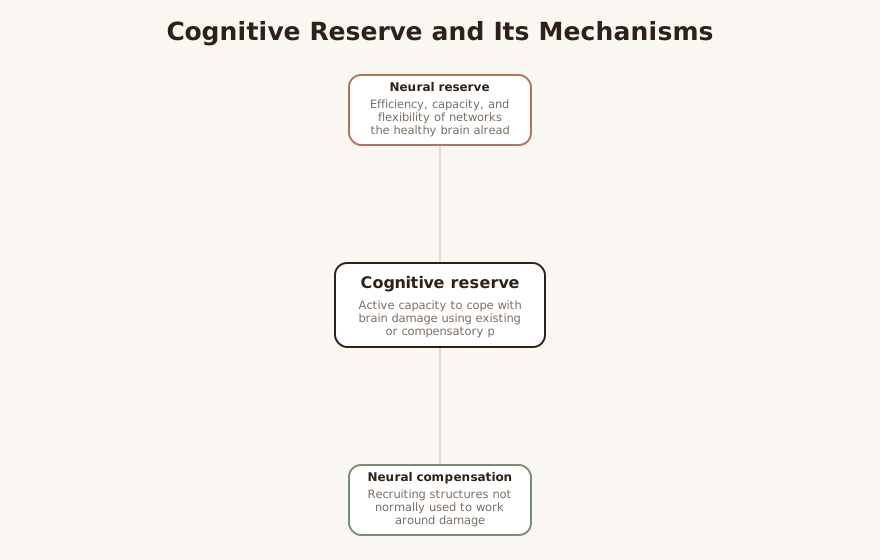
Cognitive reserve is a construct from cognitive neuroscience and neuropsychology, not a treatment modality or a clinical technique 2. It names the brain’s active capacity to cope with neurological damage or pathology by using pre-existing cognitive processing resources or by recruiting compensatory ones, such that two people with the same amount of brain pathology can show very different levels of clinical impairment 2. The construct belongs to the broader family of brain reserve and plasticity, sitting at the intersection of aging research, dementia neuropathology, neuroimaging, and the psychology of lifelong learning and engagement 1. Its defining claim is about resilience: individual differences in how people process tasks let some tolerate a larger lesion or a heavier pathological burden than others before clinical symptoms appear 2. For the practicing clinician its value is explanatory and integrative rather than procedural — it gives a biologically grounded account of why education, complex work, and an engaged life track with later resistance to cognitive decline, and why two clients with similar scans or similar diagnoses can function so differently 4. It is best held as a conceptual and prognostic lens layered onto established assessment, psychoeducation, and psychotherapeutic work, not as a stand-alone therapy LLM.
Creators & Lineage
The empirical seed of cognitive reserve is usually traced to the neurologist Robert Katzman, whose late-1980s autopsy work documented older adults who carried substantial Alzheimer pathology at death yet had shown little or no clinical dementia in life, and who tended to have larger brains and more neurons than matched controls 6. That discrepancy — pathology present, clinical expression absent — is the observation the whole field exists to explain 6. Yaakov Stern then developed and formalized the construct over the following decades, drawing the now-standard distinction between a passive model and an active one 2. In the passive “brain reserve” account, resilience derives simply from the quantity of neural substrate: a larger brain or a higher neuronal count can sustain more damage before a fixed threshold of impairment is crossed 2. Stern’s cognitive reserve is an active model in which the brain attempts to cope with damage by using pre-existing cognitive processes more efficiently or by enlisting compensatory networks 2. A frequently used shorthand contrasts brain reserve as “hardware” with cognitive reserve as “software” 6. The lineage thus runs from Katzman’s neuropathological puzzle, through Stern’s active-model synthesis and its two proposed neural mechanisms, into a contemporary research program that culminated in a 2020 consensus whitepaper distinguishing reserve, brain reserve, and brain maintenance as separable concepts 1.
Core Principles
The first principle is the dissociation between pathology and its clinical expression: the relationship between the amount of brain damage and the resulting impairment is not fixed but moderated by reserve 2. A person with higher reserve tolerates a larger lesion than another before clinical impairment becomes apparent, which means, paradoxically, that high-reserve individuals are typically diagnosed at a more advanced pathological stage and may then decline more steeply once a threshold is finally crossed 2.
The second principle is that cognitive reserve is active and functional, not merely structural 2. Stern proposed two implementing mechanisms 2. Neural reserve is inter-individual variability in the efficiency, capacity, and flexibility of the brain networks that the healthy brain already uses for a task, so that more efficient or flexible networks are more robust to disruption 2. Neural compensation is the ability to recruit brain structures or networks not normally used by people with intact brains in order to work around damage to the standard processing networks 2. Together these distinguish cognitive reserve from the passive, hardware-quantity logic of brain reserve 2.
The third principle is that reserve is built across the lifespan and is not fixed 2. At any point in life, a person’s reserve reflects a combination of exposures — education, the cognitive complexity of their occupation, premorbid intelligence, and engagement in intellectually, socially, and physically stimulating leisure — and life experiences appear to confer reserve over and above innate intelligence 2. A related and increasingly emphasized principle is that cognitive reserve is conceptually distinct from brain maintenance: reserve is about coping with pathology once it is present, whereas brain maintenance refers to the relative absence or slower accumulation of age- and disease-related brain changes in the first place 1. The two are separable explanations for preserved late-life cognition and should not be collapsed into one another 1.
Interventions & Techniques
Cognitive reserve does not arrive with proprietary techniques; it is a construct that informs assessment, prognosis, formulation, and the rationale for established interventions LLM. Its most immediate clinical translation is psychoeducational: explaining to an older client or a worried family that an engaged, learning-rich life appears to buffer the brain against the expression of decline can validate effort, instill realistic hope, and reframe “brain health” from a fixed inheritance into something life experience shapes 4. The same framing supplies a coherent “why” for behavior-change targets around learning, social connection, and activity LLM.
From there the construct points toward activities associated, in observational research, with higher reserve — continued education and learning, cognitively complex and novel activities, rich social engagement, and physical activity 4. Reserve-informed neuropsychological assessment is a second application: because the same test score can mean very different things in a high- versus low-reserve person, clinicians interpret cognitive findings against an estimate of premorbid ability and educational and occupational history, rather than reading raw scores in isolation 2. A third use is prognostic framing for rehabilitation, since reserve helps explain why two clients with similar injuries or similar diagnoses follow different recovery and decline trajectories 3. These applications are delivered inside recognized clinical activities — psychoeducation, neuropsychological assessment, rehabilitation, and psychotherapy for adjustment — not as a freestanding “cognitive reserve therapy” LLM.
LLM-generated illustrative example (not a guideline): A 68-year-old retired teacher, frightened after a friend’s dementia diagnosis, asks her therapist whether decline is simply fate. The clinician uses the reserve frame to explain that a lifetime of teaching, reading, and connection appears to help the brain keep functioning even as changes accumulate, and that staying socially and intellectually engaged is one of the few levers she can still pull — turning diffuse dread into a concrete, hopeful set of weekly commitments rather than a verdict. LLM
Evidence Base
The maturity of cognitive reserve is best described as established — as a well-validated, widely used research construct, not as an evidence-based treatment 1. The construct has a large empirical literature: across many cohorts, proxies for reserve such as education, occupational attainment, premorbid intelligence, and leisure engagement predict later resistance to clinical cognitive impairment, and reserve consistently moderates the relationship between measured brain pathology and observed cognitive performance 2. The field has matured to the point of a formal consensus effort to define and operationally separate cognitive reserve, brain reserve, and brain maintenance, which signals an active, self-correcting research program rather than a loose metaphor 1. Neuroimaging work continues to seek the functional signatures of neural reserve and neural compensation that would give the active model a mechanistic basis 3.
Honesty requires several caveats for clinical use LLM. First, “established” describes the standing of the construct, not the outcomes of any therapy derived from it; there is no manualized “cognitive reserve treatment” with its own trial base, and the clinical applications here are reasoned extensions rather than direct findings from reserve research LLM. Second, the bulk of the evidence is observational and correlational: it shows that education, complex work, and engagement associate with delayed clinical expression of pathology, but association is vulnerable to confounding — healthier, wealthier, and already higher-functioning people both engage more and decline later LLM. Third, and most important for managing client expectations, the evidence that any specific intervention reliably builds reserve and thereby prevents or delays dementia in an individual is weak and contested; reviews have concluded there was insufficient evidence to recommend a particular way to increase cognitive reserve to prevent dementia, and transfer from trained tasks to real-world cognition is limited 6. Fourth, the construct is operationalized indirectly through proxies rather than measured directly, so studies vary in which proxies they use, and a proxy such as years of education is a coarse and culturally loaded stand-in for the underlying capacity 3. The honest summary is that cognitive reserve is a robust, biologically grounded construct with real explanatory and prognostic value at the population level, best held by the clinician as a formulation and psychoeducation aid rather than as a promise that “brain training” will protect a given client LLM.
Populations & Indications
The construct is most clinically illuminating wherever the gap between brain status and functional status matters 2. Older adults are the paradigm population, since the construct exists to explain why aging brains with similar pathology function so differently, and it informs both reassurance and realistic counseling about decline 4. People with mild cognitive impairment or dementia can be understood through reserve, which helps explain a slow, long-stable course in some and a steep drop in others, and which contextualizes the at-times counterintuitive observation that highly educated patients may present with relatively advanced pathology once symptoms finally surface 2. Adults worried about cognitive decline — the “worried well,” often anxious after a relative’s diagnosis — are well served by a frame that names a real, engageable buffer rather than fate LLM.
Beyond these, traumatic brain injury and stroke survivors sit squarely within the construct, since reserve and neural compensation help account for differing recovery trajectories after comparable injuries 3. Adults with low formal education or limited lifelong cognitive engagement are a population in which lower estimated reserve has prognostic relevance, and in which the construct must be handled with particular care to avoid blame, given how strongly reserve proxies track social advantage 4. People with late-life depression, whose disengagement and inactivity can erode the very engagement the construct prizes, are a group where reserve-informed psychoeducation can motivate behavioral re-engagement LLM. Across all of these the construct is an adjunct formulation and prognostic lens, not a diagnosis-specific protocol LLM.
Problems-for-Work
Anxiety about cognitive decline. The construct gives client and clinician a shared, non-fatalistic account of brain aging, replacing “decline is inevitable and out of my hands” with “an engaged life appears to buffer how soon changes show up,” and channeling diffuse dread into concrete engagement targets 4.
Adjustment to a mild cognitive impairment or dementia diagnosis. Reserve contextualizes a confusing course — long plateaus, then steeper drops in high-reserve individuals — and supports adjustment work that holds both realism and meaning rather than collapsing into hopelessness 2.
Post-injury cognitive and identity adjustment. For TBI and stroke survivors, neural compensation and reserve help explain why recovery differs across people with similar injuries, supporting rehabilitation engagement and a non-blaming account of uneven progress 3.
Health-behavior change for brain health. The construct supplies a motivating rationale for continued learning, social connection, and physical activity, framed honestly as plausible buffers rather than guaranteed prevention 4.
Late-life depression and disengagement. Because withdrawal erodes the engagement associated with reserve, the construct supports behavioral activation toward cognitively and socially stimulating activity as both mood and brain-health work LLM.
LLM-generated illustrative example (not a guideline): A 74-year-old man recently diagnosed with mild cognitive impairment has stopped attending his chess club and woodworking group, convinced “there’s no point now.” His clinician uses the reserve frame to reframe re-engagement not as denial but as one of the few evidence-aligned things within his control, and they build a graded plan to return to two activities he values — pairing adjustment work with behavioral re-engagement rather than letting withdrawal accelerate his disengagement. LLM
Contraindications, Cautions & Cultural Humility
Because cognitive reserve is a construct rather than a treatment, it carries no direct contraindications, but its misuse does LLM. The most damaging error is overselling it — promising that puzzles, classes, or “brain games” will prevent dementia, when the evidence that any specific intervention reliably builds reserve in an individual is weak and transfer to real-world function is limited 6. A second caution is the inverse: using the construct fatalistically, telling a low-education or disengaged client that their “low reserve” dooms them, when reserve is dynamic, multiply determined, and not a verdict 2. A third caution is interpretive — reserve must inform neuropsychological assessment without becoming an excuse to dismiss a genuine deficit in a high-reserve person whose still-“normal” scores mask real decline from their personal baseline 2.
Cultural humility matters acutely here, because the standard proxies for cognitive reserve — years of formal education, occupational complexity, literacy-loaded IQ measures — are saturated with social advantage and are culturally and linguistically biased LLM. Lower estimated reserve in a marginalized client often reflects unequal access to schooling and complex work, discrimination, and material constraint rather than any individual deficiency, so framing it as a personal failing would be both inaccurate and unjust 4. Educational-attainment proxies also travel poorly across cultures and cohorts, and bilingualism and rich informal or communal learning may confer reserve that years-of-schooling measures miss entirely 6. The construct is most honestly used to validate that life circumstances shape brain resilience — naming a real, partly social phenomenon — while locating responsibility in conditions as well as in the individual, and advocating for access to enriching opportunity rather than prescribing self-improvement alone LLM.
Treatment-Plan Suggestions & SMART Objectives
| Goal | SMART objective (example) | Mechanism |
|---|---|---|
| Reduce catastrophic beliefs about decline | Client articulates the reserve model in their own words and names 2 personal, modifiable engagement levers by session 3 | Reframes decline as moderated by lifelong engagement, lowering fatalistic anxiety 4 |
| Increase cognitively stimulating engagement | Client adds 1 novel, cognitively complex activity (e.g., a class or new skill) and sustains it weekly for 8 weeks | Targets the engagement associated with higher reserve across the lifespan 4 |
| Rebuild social engagement | Client attends 1 valued social or group activity per week for 6 weeks | Social engagement is among the leisure activities associated with reserve 2 |
| Re-engage after withdrawal in late-life depression | Client completes 3 graded behavioral-activation tasks per week toward stimulating activity for 6 weeks | Counters disengagement that erodes the activity linked to reserve LLM |
| Support post-injury rehabilitation engagement | Client attends scheduled rehabilitation sessions and completes between-session practice 5 of 7 days for 4 weeks | Engages compensatory processing relevant to neural compensation and recovery 3 |
| Improve assessment accuracy via reserve context | Clinician gathers premorbid education and occupational history before interpreting cognitive scores by the second assessment session | Interprets the same score against estimated reserve rather than in isolation 2 |
| Set realistic, hopeful expectations | Client and clinician agree on a written, non-fatalistic and non-overpromising statement of what engagement can and cannot do by session 4 | Aligns hope with honest, observational evidence about reserve 6 |
| Maintain physical activity for brain health | Client completes 3 sessions of moderate physical activity per week for 8 weeks | Physical activity is among the engaged-lifestyle factors associated with reserve 4 |
Common Misconceptions
The single most common error is conflating cognitive reserve with brain reserve — treating reserve as merely a bigger brain or more neurons, when the cognitive reserve construct is specifically an active model about how efficiently and flexibly the brain processes and how it recruits compensatory networks, distinct from the passive structural-quantity account 2. A second misconception is that reserve is fixed at birth or set by innate intelligence; in fact reserve accrues across the lifespan from education, occupation, and engagement, with life experience contributing over and above innate ability 2. A third is that cognitive reserve and brain maintenance are the same thing, when they are separable: reserve is coping with pathology once present, while maintenance is the slower accumulation of pathology in the first place 1.
A fourth, clinically important misconception is that “brain games” or puzzles reliably build reserve and prevent dementia; the evidence for any specific intervention durably increasing reserve in an individual is weak and contested, and gains often fail to transfer beyond the trained task 6. A fifth is that higher reserve means slower decline throughout — whereas high-reserve individuals often appear stable longer but then decline more steeply once a pathological threshold is finally crossed, because symptoms emerged only at a more advanced disease stage 2. Finally, clinicians sometimes treat the construct as a validated therapy in its own right, when its standing concerns the explanation and prediction of cognitive resilience, not the outcomes of any branded treatment LLM.
Training & Certification
There is no certification, credential, or formal training pathway specific to cognitive reserve, because it is a scientific construct rather than a practice modality LLM. Clinicians typically encounter it within graduate and postgraduate coursework in neuropsychology, cognitive aging, and behavioral neurology, and through the primary literature — most usefully Stern’s foundational reviews and the 2020 consensus whitepaper that operationalizes reserve, brain reserve, and brain maintenance 12. Accessible overviews from dementia research organizations and clinically oriented interviews and explainers are sufficient for most conceptual and psychoeducational use 45.
For applied competence, the relevant skills live in adjacent credentialed domains: neuropsychological assessment for reserve-informed interpretation of test data, rehabilitation for post-injury work, and the established psychotherapies — cognitive behavioral therapy, behavioral activation, and adjustment-focused approaches — for the anxiety, depression, and adjustment problems the construct helps frame LLM. Where formal cognitive testing or differential diagnosis is involved, that interpretation belongs to neuropsychologists and physicians, and interdisciplinary collaboration rather than solo assessment is the appropriate stance LLM. The most useful preparation is therefore to learn the construct well enough to use it for psychoeducation, prognosis, and case formulation, while building credentialed skill in the assessment and treatments it complements LLM.
Key Terms
Cognitive reserve: the brain’s active capacity to cope with pathology by using pre-existing cognitive processing more efficiently or by recruiting compensatory networks, so that more pathology can be tolerated before clinical impairment appears 2.
Brain reserve: the passive, structural model in which resilience derives from the quantity of neural substrate — brain size or neuronal count — allowing more damage before a fixed threshold of impairment is crossed 2.
Brain maintenance: the relative absence or slower accumulation of age- and disease-related brain changes over time, a concept distinct from reserve because it concerns avoiding pathology rather than coping with it 1.
Neural reserve: inter-individual variability in the efficiency, capacity, and flexibility of the brain networks the healthy brain already uses, one of the two mechanisms Stern proposed for cognitive reserve 2.
Neural compensation: the recruitment of brain structures or networks not normally used by people with intact brains, in order to work around pathology-disrupted standard networks 2.
Reserve proxies: indirect indicators used to estimate reserve, such as years of education, occupational complexity, premorbid IQ, and leisure engagement, since reserve is not measured directly 3.
Pathology–expression dissociation: the core observation that the same amount of brain pathology can produce very different degrees of clinical impairment across individuals, depending on reserve 2.
Resources & Further Reading
▶ Watch — a video introduction to this concept:
- Stern et al. (2020), Whitepaper: Defining and investigating cognitive reserve, brain reserve, and brain maintenance — Alzheimer’s & Dementia
- Stern (2009), Cognitive Reserve — Neuropsychologia (PMC2739591)
- Stern et al. (2019), Brain Reserve, Cognitive Reserve, Compensation, and Maintenance: Operationalization, Validity, and Mechanisms (PMC6859943)
- Cognitive reserve and dementia risk — Alzheimer’s Research UK
- Episode 80: Cognitive Reserve – A Conversation With Dr. Yaakov Stern — NavNeuro podcast
- Cognitive reserve — Wikipedia
Reflective / Supervision Questions
- When you introduce the cognitive reserve frame, how do you keep it motivating and hopeful without overpromising that engagement or “brain training” will prevent decline? 6
- For a client with low formal education or a disengaged history, how do you use the construct to inform prognosis without implying a personal deficiency, given how strongly reserve proxies track social advantage? 4
- How do you let reserve sharpen your interpretation of cognitive test data while still catching genuine decline in a high-reserve client whose scores remain in the “normal” range? 2
- Where in your practice does conflating cognitive reserve with brain reserve, or with brain maintenance, risk muddying how you explain a client’s course? 1
- For a client decompensating with late-life depression and withdrawal, how do you frame re-engagement as both mood work and brain-health work without overstating the evidence? LLM
- In which of your cases would naming a real, partly social buffer give a client a more workable and less fatalistic account of brain aging than a purely biological-decline narrative? 4