
Type & Discipline
Cognitive Stimulation Therapy (CST) is a short-term, manualized, group (or individual) intervention for people with mild-to-moderate dementia or Alzheimer’s disease, sitting within geriatric psychology and old-age psychiatry 6. It is best understood as a structured psychosocial treatment rather than a pharmacological or purely cognitive-training one: across a fixed course of themed sessions it actively stimulates and engages people with dementia while providing an optimal learning environment and the social benefits of a group 4. The defining feature is that it works on general cognitive and social functioning through enjoyable, multi-sensory activity rather than by drilling any single isolated cognitive skill 3.
What distinguishes CST as a discipline-specific modality is its dual target LLM. It is designed to produce measurable cognitive benefit and, simultaneously, to improve quality of life and social connection — the two outcomes its originators chose to test together because either alone would be an incomplete account of living well with dementia 1. That pairing of cognition and quality of life as co-equal goals is unusual among dementia interventions and shapes how the programme is delivered and evaluated LLM.
Operationally, CST occupies the space between care and therapy LLM. It is structured enough to be manualized, replicated, and trialled, yet flexible and humane enough to be delivered by a wide range of front-line staff in care homes, day centres, and memory clinics 4. This accessibility is part of its identity: it was built to be deliverable at scale by the people already around the person with dementia, not only by specialist clinicians 5.
Creators & Lineage
CST was developed at University College London from 1998 by Professor Martin Orrell and Dr Aimee Spector, working with Professor Bob Woods at the University of Bangor 5. The programme grew out of a systematic effort to identify what actually helped people with dementia cognitively and then to package those ingredients into a single, testable, evidence-based protocol 5. The International CST Centre, which now coordinates training, manuals, and global dissemination, is directed by Professor Aimee Spector at UCL 4.
The intellectual lineage of CST draws on the older psychosocial traditions of dementia care — reality orientation and reminiscence work — which contributed elements such as the use of a reality-orientation board and themed reminiscence-style discussion of childhood, food, and the past LLM. The UCL team’s distinctive contribution was to extract the active components from that scattered prior work and assemble them into one standardized, manual-driven programme that could be subjected to randomized controlled evaluation rather than delivered idiosyncratically 5. The visible inheritance from reality orientation survives in the session structure: each group typically opens with a reality-orientation board carrying the date, place, and time alongside information about the group 6.
What Spector, Orrell, and Woods added was the discipline of evidence LLM. Earlier psychosocial approaches were often promising but inconsistently delivered and weakly evaluated; CST reorganized them around a fixed protocol, an explicit set of guiding principles, and pre-registered cognitive and quality-of-life outcomes, transforming a tradition of practice into an intervention the field could test and recommend 13. That move is precisely why CST, rather than its precursors, became the non-pharmacological intervention endorsed in national guidelines 5.
Core Principles
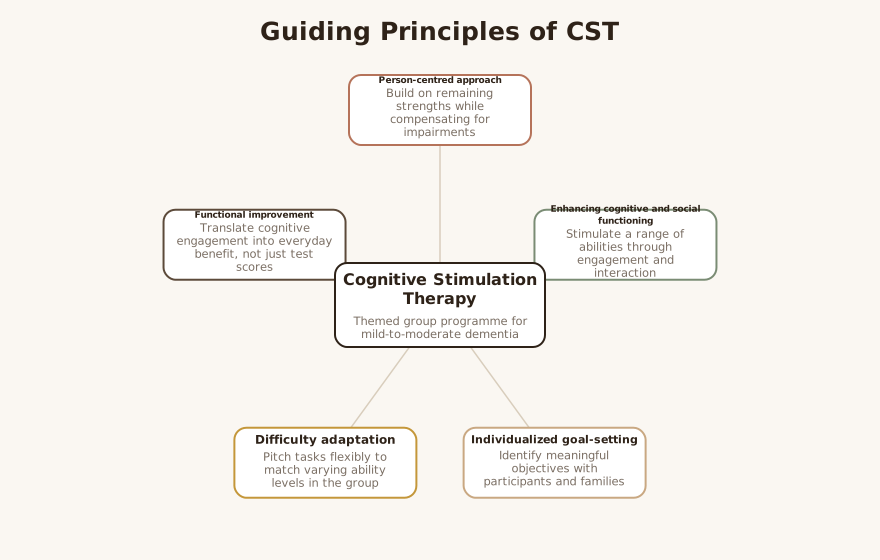
CST is governed by an explicit set of guiding principles that distinguish it from generic group activity 3. The first is a person-centred approach that builds on each individual’s remaining strengths while compensating for impairments, so that activities meet people where they are rather than exposing deficits 3. The second is a focus on the general enhancement of cognitive and social functioning — CST deliberately stimulates a range of abilities through engagement and social interaction rather than training one function in isolation 3.
A third principle is individualized goal-setting, in which facilitators work with participants and, where appropriate, families to identify meaningful objectives for the person 3. A fourth is difficulty adaptation: the standard tasks are designed to be flexibly pitched to match varying ability levels within the group, so that the same themed activity can be made easier or harder without anyone being left behind or unchallenged 3. A fifth principle is functional improvement — the aim is to translate cognitive engagement into meaningful benefits in everyday life, not merely to raise a test score 3.
Underlying these is a consistent therapeutic ethos: that people with dementia retain the capacity to learn, connect, and enjoy, and that an optimal learning environment plus the social benefits of a group can mobilize that capacity 4. The sessions are constructed to be implicit rather than effortful — engaging memory, language, and reasoning through pleasurable activity such as word games, discussion, music, and multi-sensory experience rather than through anxiety-provoking testing 6. This combination of structure and warmth is what allows CST to be both standardized and humane LLM.
Interventions & Techniques
The core programme is a fixed, manualized course of 14 sessions delivered twice weekly, each lasting 45 minutes, over seven weeks 1. Each session follows a general theme — potential themes include childhood, food, or current events — and within that theme the group moves through a sequence of activities such as puzzles, word games, money exercises, famous-faces tasks, instrument playing, and discussion 6. Sessions characteristically open with a warm-up and a reality-orientation board, and groups commonly adopt a group name and a signature song to build continuity and belonging across meetings 6.
The recommended format is a small group of fewer than ten participants, although an individual version (individual CST, or iCST) can be delivered one-to-one when a group is not feasible; group delivery is generally considered more effective 6. The manual prescribes the themes and activity types while leaving facilitators room to adapt difficulty and content to the group in front of them, honouring the difficulty-adaptation and person-centred principles 3. Multi-sensory material is used throughout to keep participants active and engaged across the cognitive and social domains 6.
Beyond the core seven-week course, Maintenance CST (MCST) extends the work through ongoing weekly sessions to sustain benefit over time 4. The maintenance format keeps the same principled, themed structure but reduces frequency to weekly and runs over a substantially longer period, with trials extending maintenance for up to 24 weeks following the initial programme 2.
LLM-generated illustrative example (not a guideline): In a care-home group of seven residents with mild-to-moderate dementia, the facilitator opens each session at the reality-orientation board reviewing the day and date, then the group — which has named itself “The Sunshine Club” — sings its chosen song before moving into the day’s theme of “food.” Residents handle and smell herbs, debate favourite childhood meals, and play a word game generating dishes by first letter. The clinician pitches the word game up or down so the most and least able members are both engaged, never tested into failure LLM.
Evidence Base
CST has a genuinely established evidence base for a psychosocial dementia intervention, anchored by randomized controlled trials and reflected in national guideline endorsement 15. The foundational trial randomized 201 older people with dementia and found that, compared with usual activities, the 14-session CST programme produced significantly greater improvement on cognition — on both the Mini-Mental State Examination (P=0.044) and the Alzheimer’s Disease Assessment Scale–Cognition (P=0.014) — and on quality of life as measured by the QoL-AD scale (P=0.028) 1. Using a criterion of a four-point-or-greater improvement on the ADAS-Cog, the number needed to treat was six — six people treated for one to benefit at that threshold 1.
A key honest framing is that these effects, while real, are modest in absolute terms and are described by the authors as comparing favourably with drug trials rather than dwarfing them 1. For the larger four-point improvements, CST performed as well as galantamine or tacrine and substantially better than rivastigmine — which is why CST is routinely summarized as having effects of a size comparable to the available anti-dementia medications 14. That parity with pharmacotherapy, achieved by a non-drug intervention deliverable by ordinary care staff, is the central reason CST is taken seriously 5.
The maintenance evidence is more nuanced and must not be collapsed into the core finding LLM. The single-blind, multicentre, pragmatic MCST trial randomized 236 people with dementia and found that continuing CST weekly improved self-rated quality of life at six months (QoL-AD, P=0.03) for the group as a whole 2. Crucially, however, the cognitive benefit of maintenance was confined to a subgroup: participants who were also taking acetylcholinesterase inhibitors showed cognitive gains on the MMSE at three and six months, whereas continuing CST improved quality of life broadly but cognition only for those on medication 2. The fair summary is therefore that CST reliably improves quality of life and that its cognitive payoff, especially in maintenance, is real but bounded and partly dependent on concurrent pharmacotherapy 2LLM.
Populations & Indications
CST’s primary indication is mild-to-moderate dementia or Alzheimer’s disease, the population for whom the programme was designed and in whom it has been trialled 6. It is delivered across the settings where such people are found — care homes, day services, and post-diagnostic memory clinics — and is intended to be accessible to the large number of people living with dementia rather than reserved for a specialist few 4. In the UK it is positioned as a mandatory post-diagnostic treatment in accredited NHS memory clinics, reflecting how mainstream its indication has become 4.
Within that broad indication, group CST is the default, with individual iCST reserved for those who cannot join a group, since group delivery is generally considered more effective 6. The trials recruited older people with dementia from both residential care and community services, supporting use across the spectrum from care-home residents to community-dwelling older adults 12. CST is generally not indicated for severe dementia, where the cognitive and conversational demands of the activities exceed the person’s capacity, and the evidence base does not extend there LLM.
The practical indication is a person with mild-to-moderate cognitive impairment who can participate in a small, themed group, whose care team wants to support cognition, quality of life, and social engagement together, and who can be offered a fixed course followed, where resources allow, by maintenance sessions 4LLM.
Problems-for-Work
For cognitive decline in mild-to-moderate dementia, CST is the natural application: the programme directly and measurably slows or modestly reverses decline on standard cognitive measures over its seven-week course 1. For memory and language difficulties specifically, the benefits are documented, with the most pronounced impact reported on language skills alongside gains in memory and executive functioning 5.
For reduced quality of life — a problem-for-work in its own right in dementia care — CST is one of the few interventions with randomized evidence of improvement, both in the core programme and, for quality of life specifically, in maintenance 12. For social isolation, the group format is itself the active ingredient, supplying the social benefits of a group to people who are frequently withdrawn or under-stimulated 4.
LLM-generated illustrative example (not a guideline): A community-dwelling client with mild Alzheimer’s disease has become increasingly withdrawn, rarely speaking at home and losing words mid-sentence. Enrolled in a twice-weekly CST group, she re-engages through the famous-faces and word-association activities, and over seven weeks her family notices she initiates conversation more readily and seems brighter in mood. The clinician frames the work as targeting both her language difficulties and her social isolation, not a single test score LLM.
For disorientation, the reality-orientation board and the consistent group rituals — name, song, date review — provide gentle, repeated anchoring without confrontation 6. Across these problems, CST’s appeal is that one accessible programme addresses cognition, well-being, and connection together rather than requiring separate interventions for each LLM.
Contraindications, Cautions & Cultural Humility
CST is not indicated for severe dementia, where participants cannot meaningfully engage with the themed activities, and the evidence base does not support its use there LLM. It is also not a substitute for pharmacological treatment where that is indicated; indeed, the maintenance evidence suggests the cognitive benefit of continued CST may be strongest when combined with acetylcholinesterase inhibitors rather than offered in their place 2. Clinicians should present CST as a complementary, evidence-based component of dementia care, not as a stand-alone cure or a reason to withhold medication LLM.
A second caution concerns effect size and expectation-setting LLM. The benefits are genuine and comparable to anti-dementia drugs, but they are modest, with a number needed to treat of six for the larger cognitive improvements; families should be helped to hold realistic hopes for a quality-of-life and engagement benefit rather than a dramatic cognitive recovery 1LLM. Fidelity also matters: CST’s results depend on delivering the manualized programme as designed, so under-trained or improvised “CST-flavoured” activity should not be expected to reproduce the trial outcomes 3LLM.
Cultural humility is a specific, named limitation rather than a generic disclaimer LLM. CST was developed primarily for a Western, English-speaking population, and further research is likely needed to establish its effectiveness across cultures, even though the manual has been translated into many languages and implemented internationally 65. The themed content — childhood, food, famous faces, current events — is culturally loaded, and material that evokes recognition and pleasure in one population may be alien or even distressing in another, so facilitators should adapt themes to the lived history and cultural context of the people in the group 6LLM.
Treatment-Plan Suggestions & SMART Objectives
| Goal | SMART objective (example) | Mechanism |
|---|---|---|
| Support cognition in mild-to-moderate dementia | Client attends ≥12 of 14 CST sessions over seven weeks and shows a stable or improved MMSE score at programme end | Themed, manualized stimulation produces measurable cognitive benefit 1 |
| Improve quality of life | Client’s self-rated QoL-AD score improves by programme end and is maintained at three-month review | CST and maintenance CST improve self-rated quality of life 12 |
| Strengthen language and verbal engagement | Family reports increased conversation initiation at home across four consecutive weeks of CST | CST shows its most pronounced impact on language skills 5 |
| Reduce social isolation | Client participates verbally in group activities in ≥10 of 14 sessions | The small-group format supplies the social benefits of a group 4 |
| Sustain gains over time | Client transitions to weekly Maintenance CST and attends ≥80% of sessions over 24 weeks | Maintenance CST extends quality-of-life benefit beyond the core course 2 |
| Optimize cognitive benefit of maintenance | Care team reviews and documents concurrent AChEI status before starting maintenance | Maintenance cognitive benefit was found mainly in those taking AChEIs 2 |
| Tailor difficulty to ability | Facilitator records, each session, how at least one activity was pitched up or down for group members | Difficulty adaptation keeps each member engaged without failure 3 |
| Deliver with fidelity | Facilitator completes accredited CST training before leading a group | Training and manual adherence underpin replicable outcomes 3 |
Common Misconceptions
The first misconception is that CST is interchangeable with general “brain games” or any pleasant group activity; in fact it is a manualized, principle-governed programme whose trial-level results depend on delivering the specified themes, structure, and difficulty adaptation as designed 3. A second is that CST is the same as cognitive training (repeatedly drilling a specific function such as working memory) or cognitive rehabilitation (working toward individualized functional goals through compensatory strategies); CST is distinct from both, targeting general cognitive and social functioning through implicit, enjoyable stimulation rather than focused drill or goal-specific rehabilitation LLM.
A third misconception is that CST works only on cognition; its originators deliberately built and tested it to improve quality of life and social engagement alongside cognition, and the quality-of-life benefit is among its most robust findings 12. A fourth is that its effects are large; they are genuine and comparable to anti-dementia drugs but modest, with a number needed to treat of six for the larger cognitive improvements 1. A fifth is that maintenance simply prolongs the cognitive gains for everyone; in the maintenance trial the broad benefit was to quality of life, with cognitive gains concentrated in those also taking acetylcholinesterase inhibitors 2. A sixth is that CST requires a specialist psychologist to run; it is designed to be delivered by a range of trained care workers, nurses, occupational therapists, and others 6.
Training & Certification
CST is intended to be deliverable by a broad workforce — social workers, psychologists, occupational therapists, nurses, and other care workers — provided they are appropriately trained and supervised 6. This is by design: national endorsement specifies that CST be commissioned and provided by a range of health and social care workers with training and supervision, which is part of what makes it scalable 5. The International CST Centre coordinates manuals, training, and certified trainers across many countries to support this dissemination 4.
Training itself is interactive rather than purely didactic, typically combining group discussion, structured exercises, video observation, and role-play alongside teaching, and is often led by experienced clinical psychologists 3. Fidelity is supported by a detailed manual specifying the protocols, formalized training courses available at moderate cost, online support such as slide sets, and ongoing supervision and specialist consultation 3. For clinicians and services adopting CST, the practical path is to obtain the manual, complete accredited training, and run the core seven-week programme with supervision before extending into maintenance 34.
Key Terms
Cognitive Stimulation Therapy (CST) — a manualized, short-term group (or individual) programme of 14 twice-weekly 45-minute themed sessions over seven weeks for people with mild-to-moderate dementia, designed to improve cognition and quality of life 16. Maintenance CST (MCST) — weekly continuation sessions following the core programme, extending quality-of-life benefit over a longer period such as 24 weeks 2. Individual CST (iCST) — a one-to-one version for people who cannot join a group, generally considered less effective than group delivery 6. Reality-orientation board — a session feature displaying the date, place, time, and group information used to gently anchor orientation 6. Guiding principles — the explicit person-centred, strengths-based, individualized, difficulty-adapted, and function-focused commitments that define CST delivery 3. Number needed to treat (NNT) — the count of people who must receive CST for one to achieve a defined benefit; reported as six for a four-point ADAS-Cog improvement 1. Acetylcholinesterase inhibitors (AChEIs) — anti-dementia medications whose presence was associated with the cognitive benefit of maintenance CST 2.
Resources & Further Reading
▶ Watch — a video introduction to this concept:
- Spector et al. (2003). Efficacy of an evidence-based cognitive stimulation therapy programme for people with dementia: a randomised controlled trial — British Journal of Psychiatry
- Orrell et al. (2014). Maintenance cognitive stimulation therapy for dementia: single-blind, multicentre, pragmatic RCT — PubMed
- Aguirre, Spector & Orrell. Cognitive stimulation therapy: training, maintenance and implementation in clinical trials — PMC
- International Cognitive Stimulation Therapy (CST) Centre — UCL
- Cognitive Stimulation Therapy — a new therapy for dementia (Research Impact case study) — UCL
- Cognitive Stimulation Therapy — Psychology Today (therapy types)
Reflective / Supervision Questions
- When you offer CST to a client and their family, how will you frame the realistic size of the benefit — a meaningful quality-of-life and engagement gain comparable to medication, not a dramatic cognitive recovery — without either overselling or discouraging? LLM
- Given that the maintenance cognitive benefit appeared mainly in those on acetylcholinesterase inhibitors, how does your service coordinate CST with prescribing so the two are complementary rather than treated as alternatives? LLM
- How would you adapt the themed content — childhood, food, famous faces, current events — for a client whose cultural and linguistic background differs from the Western, English-speaking population CST was developed for? LLM
- Where, in your setting, is the line between faithfully delivered CST and well-intentioned “CST-flavoured” group activity that lacks the training, manual adherence, and difficulty adaptation the evidence depends on? LLM
- For a client who cannot tolerate a group, how do you weigh the convenience of individual iCST against the evidence that group delivery is more effective? LLM
- How will you measure whether CST is actually improving this person’s cognition and quality of life over the seven-week course, rather than assuming benefit because the programme was delivered? LLM