
Type & Discipline
Cognitive Remediation Therapy (CRT) is a behavioral training modality within the broader discipline of neurocognitive rehabilitation, sitting at the intersection of clinical psychology and neuropsychology 3. It targets the neurocognitive functions — attention, memory, processing speed, and executive function — that underlie a disorder rather than its symptoms or its content 3. An expert working group has defined CRT as a behavioural training intervention aiming to improve cognitive processes (attention, memory, executive function, social cognition, or metacognition) with the goal of durability and generalisation 3. In practice this means CRT is not talk therapy about thoughts; it is supervised, repeated cognitive exercise plus explicit coaching in how to think more effectively 5. LLM
The modality is delivered by clinicians, but its conceptual roots are rehabilitative: the working assumption is that cognition is trainable and that improved cognition is a means to improved everyday functioning, not an end in itself 3. CRT therefore lives alongside — and is frequently combined with — psychiatric rehabilitation, supported employment, and skills training, where the cognitive gains are meant to be cashed out in real-world goals 1. LLM
Creators & Lineage
CRT’s modern form draws on several lineages: neuropsychological rehabilitation (the tradition of retraining cognition after brain injury), cognitive psychology’s models of attention, memory and executive control, cognitive-behavioural principles of structured practice and strategy use, and neuroplasticity-based training that assumes repeated, scaffolded practice can reshape function 3. The field coalesced around schizophrenia, where neurocognitive impairment is a core, relatively treatment-resistant feature 1. LLM
Til Wykes is the figure most associated with establishing CRT’s evidence base in psychosis; her group’s 2011 meta-analysis in the American Journal of Psychiatry set the methodological and effect-size benchmarks the field still cites 1. The subsequent push to define the field’s active ingredients was led by an international expert working group, whose 2020 white paper named the core techniques that distinguish bona fide CRT from generic computer drills 3. That same network maintains the field’s professional home and training infrastructure at cognitiveremediation.info 5. The CIRCuiTS programme — a computerised, metacognitively-oriented CRT developed and trialled by the same UK research tradition — represents a “new generation” implementation that operationalises those principles 4. LLM
Core Principles
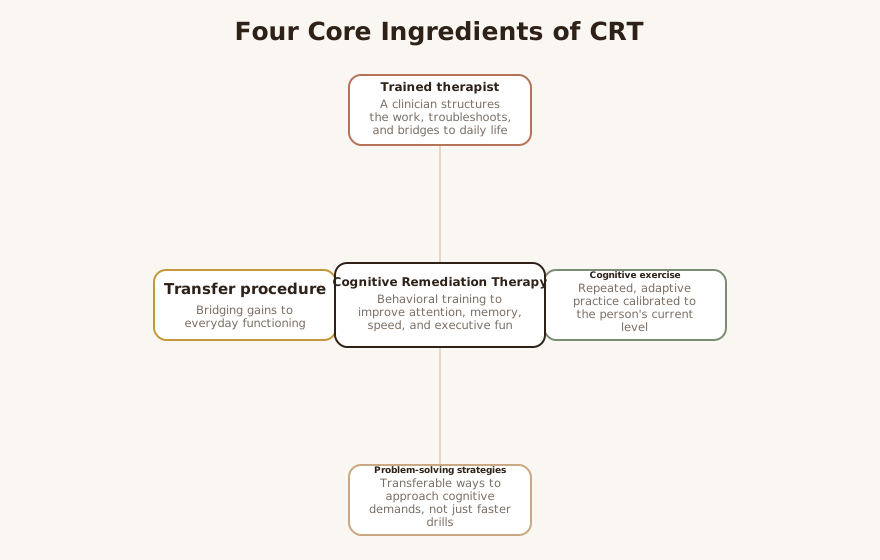
The 2020 expert consensus identifies four core ingredients that define CRT and predict its effects 3. First is the involvement of a trained therapist, not merely software: a clinician structures the work, troubleshoots, and bridges to daily life 3. Second is cognitive exercise — repeated, adaptive practice of cognitive tasks calibrated to the individual’s current level 3. Third is the development of problem-solving strategies, so the client learns transferable ways to approach cognitive demands rather than just getting faster at a single drill 3. Fourth is a procedure to facilitate transfer of gains to everyday functioning, the bridging that prevents CRT from becoming an end in itself 3. LLM
Two further principles run through the modality. CRT is increasingly metacognitive: rather than drilling capacities in isolation, newer programmes explicitly teach clients to monitor, plan, and regulate their own thinking — to know which strategy to deploy and when 4. And CRT is adaptive and errorless-leaning: tasks are pitched to keep the client largely successful, building mastery and motivation rather than reinforcing failure 5. LLM
LLM-generated illustrative example (not a guideline): A clinician notices a client can complete a sequencing task in session but cannot apply the same “break it into steps and check as you go” approach when planning a grocery trip. The clinician’s job is not to push for a faster in-session score but to make that strategy explicit and rehearse it against the client’s own real-world goal LLM.
Interventions & Techniques
Concrete CRT techniques include adaptive computerised exercises that scale difficulty to performance, paper-and-pencil tasks, and therapist-led “bridging” discussions that connect a just-practised skill to a named everyday task 3. Strategy coaching is central: the therapist helps the client articulate and generalise approaches such as chunking, self-talk, verbal mediation, rehearsal, and self-monitoring 3. scaffolding and gradual fading of support, massed and distributed practice, and explicit goal-setting are standard procedural elements 5. LLM
Computerised programmes operationalise these techniques at scale. CIRCuiTS, for example, embeds metacognitive prompts directly into the software so that clients are cued to plan before a task, monitor during it, and reflect afterward, with the therapist using session content to drive transfer to personally meaningful activities 46. The platform is designed as a therapist-supported tool rather than a standalone game, consistent with the principle that the clinician is an active ingredient 6. LLM
LLM-generated illustrative example (not a guideline): A client working on working memory practices a span task on the computer, then the therapist asks, “Where this week did you lose track of something mid-task?” The client names forgetting steps while cooking; together they design a written checklist and a self-cue (“pause and name the next step”), then review how it went the following session LLM.
Evidence Base
CRT’s evidence is established in schizophrenia and should be described honestly as strongest there 1. Wykes and colleagues’ 2011 meta-analysis of 40 studies found durable, significant effects of CRT on global cognition and on functioning, with effect sizes in the small-to-moderate range 1. Critically, that analysis showed effects on functioning were significantly larger when CRT was combined with other psychiatric rehabilitation rather than delivered alone, and that the presence of a strategic (versus purely drill-and-practice) approach influenced outcomes 12. This is the empirical basis for the “bridging is essential” principle 2. LLM
The meta-analysis also clarified what CRT does and does not do: cognitive gains were robust and durable, but symptom change was minimal — CRT is a cognition-and-functioning intervention, not an antipsychotic substitute 1. The CIRCuiTS RCT extended the evidence to a modern computerised, metacognitive format, supporting cognitive and functioning benefits in a contemporary delivery model 4. The expert working group’s white paper represents field-level consensus that the four core ingredients, not the software brand, drive these effects 3. LLM
Outside schizophrenia, CRT has been adapted and studied for other conditions — anorexia nervosa, bipolar disorder, traumatic brain injury, ADHD, and major depressive disorder — but clinicians should treat that evidence as less mature and more heterogeneous than the psychosis literature, and should not assume the schizophrenia effect sizes transfer directly 3. LLM
Populations & Indications
CRT is indicated when neurocognitive impairment is a meaningful barrier to functioning and recovery 3. The best-supported population is people with schizophrenia, for whom CRT addresses the cognitive impairment in psychosis that limits work, study, and independent living 1. The modality has also been applied to individuals with anorexia nervosa (targeting cognitive rigidity and set-shifting), people with bipolar disorder and individuals with major depressive disorder (targeting neurocognitive impairment in mood disorders), adults with traumatic brain injury (within neuropsychological rehabilitation), and people with ADHD (targeting attention and executive function) 3. LLM
The common indication across these groups is not a diagnosis but a profile: demonstrable deficits in attention, working memory, processing speed, or cognitive flexibility that interfere with the person’s own goals 3. CRT is most appropriate when the client is reasonably stable, motivated to work on functioning, and has concrete goals the cognitive gains can be bridged toward 1. LLM
Problems-for-Work
CRT maps cleanly onto cognitively-framed problems-for-work. Cognitive impairment in psychosis is the flagship target: practice plus strategy plus bridging aimed at the deficits that constrain a client’s vocational or educational goals 1. Executive dysfunction — difficulty planning, organising, and self-monitoring — is addressed through strategy coaching and metacognitive prompting 4. Attention deficits and processing speed deficits are worked through adaptive, calibrated practice that keeps the client near the edge of competence 5. LLM
Working memory impairment is targeted with span and updating tasks paired with externalising strategies (lists, self-cues) the client can carry into daily life 3. Cognitive flexibility deficits — set-shifting and rigidity — are a particular focus in adaptations for anorexia nervosa 3. Neurocognitive impairment in mood disorders and the resulting functional impairment are increasingly recognised residual problems in bipolar disorder and major depressive disorder for which CRT is being explored 3. LLM
LLM-generated illustrative example (not a guideline): For a client whose problem-for-work is “executive dysfunction interfering with returning to part-time study,” sessions pair adaptive planning tasks with a transfer plan: each week the client applies a “plan-do-review” routine to one real coursework task and reports back LLM.
Contraindications, Cautions & Cultural Humility
CRT has no dramatic contraindications, but several cautions matter. It is not a symptom treatment and should not displace pharmacological or psychotherapeutic care for acute psychosis, severe depression, or eating-disorder medical instability 1. Delivering drill-and-practice software without a trained therapist, strategy work, or a transfer procedure is not CRT and should not be expected to produce its functional effects 3. Effects on functioning are most reliable when CRT is embedded in broader rehabilitation, so isolated CRT with no real-world bridging risks producing in-session score gains that do not generalise 12. LLM
Cultural humility is essential because “cognition” is measured and trained through culturally loaded tasks. Norms, task content, and assumptions about what counts as a meaningful functional goal may not fit a given client’s language, education, or life context, and clinicians should co-define goals from the client’s own valued activities rather than imposing a generic functioning template 3. Adaptive difficulty and an errorless, mastery-oriented stance help protect engagement, but clinicians should remain alert to demoralisation and to the risk of framing cognitive difference as deficit 5. LLM
Treatment-Plan Suggestions & SMART Objectives
| Goal | SMART objective (example) | Mechanism |
|---|---|---|
| Improve sustained attention | Within 12 weeks, client completes a 20-minute adaptive attention task with <2 lapses, 3x/week | Adaptive, calibrated cognitive exercise 3 |
| Strengthen working memory for daily tasks | Within 8 weeks, client uses a self-generated checklist strategy in 4/5 monitored real-world tasks | Strategy coaching + transfer procedure 3 |
| Build executive planning | Within 10 weeks, client applies a plan-do-review routine to one weekly study/work task, self-rated success ≥7/10 | Metacognitive strategy + bridging 4 |
| Increase cognitive flexibility | Within 12 weeks, client generates ≥2 alternative approaches on set-shifting tasks in 4/5 sessions | Adaptive practice + strategy development 3 |
| Translate cognitive gains to functioning | Within 16 weeks, client completes one personally-chosen functional goal (e.g., enrol in a class) | Combination with rehabilitation + bridging 1 |
| Improve processing speed | Within 8 weeks, client reduces timed-task latency by 15% while maintaining accuracy | Errorless, adaptive massed practice 5 |
| Generalise metacognitive monitoring | Within 12 weeks, client independently initiates “pause-and-check” in 3/5 observed tasks | Metacognitive self-regulation training 4 |
Common Misconceptions
A frequent misconception is that CRT is “brain-training games” — that downloading a cognitive app is equivalent to the modality 3. The expert consensus is explicit that a trained therapist, strategy development, and a transfer procedure are core ingredients; software alone is not CRT 3. A second misconception is that CRT primarily reduces psychiatric symptoms; the meta-analytic evidence shows its reliable effects are on cognition and functioning, not symptom severity 1. LLM
A third misconception is that cognitive gains automatically translate into better functioning; they do not, which is why bridging and combination with rehabilitation are emphasised, and why CRT’s functional effects are larger when it is not delivered in isolation 12. Finally, some assume CRT is only for schizophrenia; while that is its most established indication, the techniques have been extended to other cognitively-impairing conditions, albeit with a less mature evidence base 3. LLM
Training & Certification
CRT competence is more than running software; it requires the clinical skills to structure practice, coach strategies, and drive transfer 3. The international experts’ network at cognitiveremediation.info serves as the field’s hub, offering information, resources, and links to training for clinicians and services seeking to deliver CRT to standard 5. Clinicians should seek training that explicitly covers the four core ingredients rather than tool-specific instruction alone 3. LLM
For computerised delivery, programme-specific training and materials exist; CIRCuiTS, for example, provides therapy information and implementation support through its dedicated site, intended to support therapist-delivered use rather than unsupervised self-administration 6. Engaging with the experts’ network and accessing peer support and supervision is advisable for clinicians building CRT into a service 5. LLM
Key Terms
Cognitive exercise — repeated, adaptive practice of cognitive tasks calibrated to current ability, one of the four core ingredients 3. Strategy development / strategy coaching — teaching transferable problem-solving approaches (chunking, self-talk, self-monitoring) rather than task-specific speed 3. Transfer / bridging procedure — explicit therapist-led work connecting trained cognition to the client’s everyday functioning 3. Metacognition — thinking about and regulating one’s own thinking; a focus of newer programmes such as CIRCuiTS 4. Adaptive difficulty — automatic scaling of task challenge to keep practice productive and mastery-oriented 5. Combination with rehabilitation — pairing CRT with other psychiatric rehabilitation, associated with larger functional effects 1. LLM
Resources & Further Reading
▶ Watch — a video introduction to this concept:
- Wykes et al. (2011), A Meta-Analysis of Cognitive Remediation for Schizophrenia (Am J Psychiatry)
- Wykes et al. (2011), meta-analysis full text (PMC)
- Bowie et al. (2020), Expert working group white paper on core techniques (PubMed)
- CIRCuiTS randomised controlled trial (Psychological Medicine)
- Cognitive Remediation experts network — About Us
- CIRCuiTS Therapy Information
Reflective / Supervision Questions
- For this client, can I name the concrete everyday goal that each cognitive exercise is meant to serve, or am I drilling cognition for its own sake? 3 LLM
- Am I delivering all four core ingredients — therapist involvement, cognitive exercise, strategy development, and a transfer procedure — or have I drifted into software-only practice? 3 LLM
- Is this CRT embedded in broader rehabilitation, given that functional effects are larger in combination? 1 LLM
- How am I checking that strategies are generalising beyond the session, and what evidence would tell me they are not? 2 LLM
- Whose definition of “better functioning” is guiding the plan — mine or the client’s — and have I co-defined goals from their valued activities? 3 LLM
- Am I keeping difficulty adaptive enough to protect mastery and motivation, and am I watching for demoralisation? 5 LLM