
Type & Discipline
Brief psychodynamic psychotherapy (BPP), also called short-term psychodynamic psychotherapy (STPP) or short-term dynamic therapy, is a time-limited individual psychotherapy modality rooted in psychoanalysis and clinical psychology 1. It is best understood not as a single protocol but as a family of related dynamic therapies that share a common engine: working with emotions, defenses, and relationship patterns within a deliberately compressed timeframe 1. In practice these treatments are delivered as standard-length individual sessions of 45 to 60 minutes, with a typical course of about 15 sessions and an upper bound near 40 hours of treatment in total 1. The defining structural feature is focus — the therapy is organized around a central conflict or focal theme rather than open-ended exploration 1. LLM That focus is what makes “brief” possible: by agreeing early on what the work is about, therapist and patient avoid the diffusion that lengthens treatment. LLM
Creators & Lineage
Brief dynamic therapy descends from psychoanalysis and its later branches — object relations theory, attachment theory, and interpersonal traditions — but it was shaped by clinicians who deliberately accelerated and focused the analytic method 1. David Malan, working in the British tradition, articulated two organizing schemas that remain central to the field: the triangle of conflict and the triangle of person 6. Habib Davanloo, a Montreal psychiatrist, built on Malan’s frameworks through video-recorded research to develop Intensive Short-Term Dynamic Psychotherapy (ISTDP), an active variant designed to overcome resistance more directly 6. Davanloo’s lineage explicitly draws on earlier short-term pioneers including Peter Sifneos, alongside Sándor Ferenczi and Franz Alexander 6. Sifneos contributed the anxiety-provoking short-term approach that helped establish brief dynamic work as a distinct method 6. Contemporary writers such as Jonathan Shedler argue that this whole tradition has evolved far beyond its Freudian origins and now represents a diverse collection of theories rather than a single doctrine 7.
Core Principles
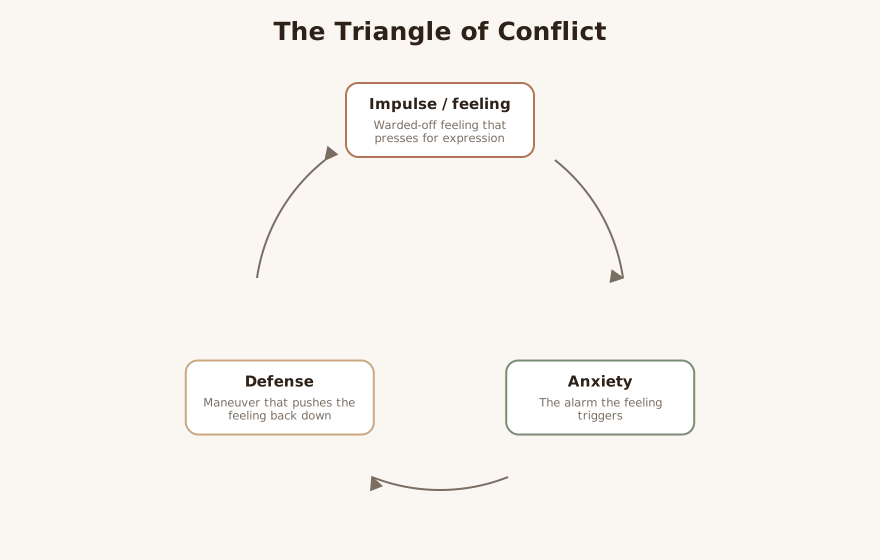
The clinical heart of brief dynamic work is the triangle of conflict — the link between impulse-laden feelings, the anxiety those feelings trigger, and the defenses the patient uses to push them back down 16. Paired with it is the triangle of person — the recognition that emotions originating in past relationships with attachment figures become reactivated in current relationships and in the relationship with the therapist 16. LLM The therapist’s job is to map a patient’s presenting symptom onto these two triangles, showing how an old pattern is being re-enacted in present life and in the room. LLM A foundational premise is that symptoms often function as compromises — defensive solutions to feelings that feel too dangerous to experience fully 1. Brief dynamic therapy therefore treats emotional avoidance, not only the surface complaint, as the target of change 1. Shedler frames the goal as helping people experience “what is” rather than continuing to react to “what was,” moving beyond patterns rooted in the past 7. The corrective experience offered by the therapy relationship — an interpersonally different encounter — is considered a mechanism of change in its own right 1.
Interventions & Techniques
The interventions follow from the triangles. The therapist works to facilitate a therapeutic alliance, build the patient’s capacity to tolerate emotion, increase self-awareness, do the emotional work of healing past wounds, and provide an interpersonally corrective experience 1. Practically, this means identifying defenses as they appear, clarifying how they operate, and helping the patient relinquish them so warded-off feelings can be experienced and named 1. The more active variants are explicit about this. In Davanloo’s ISTDP, three signature interventions structure the work: pressure toward authentic feeling, challenge to clarify and interrupt defenses once identified, and the head-on collision that confronts the entire defensive structure while appealing to the patient’s motivation to change 6. ISTDP also describes a central dynamic sequence that tends to emerge as resistance is overcome — moving through rage, guilt about that rage toward loved ones, grief about emotional disconnection, and finally yearning for closeness 6. LLM Not every brief dynamic therapist works this confrontationally; gentler focal and supportive-expressive models pursue the same triangles with more interpretation and less pressure, matching intensity to the patient’s fragility. LLM
LLM-generated illustrative example (not a guideline): A young adult presents with low mood and the chronic sense that “everyone eventually leaves.” The therapist hears him minimize anger at a partner who cancelled plans, then notices he does the same with the therapist after a missed session. Rather than reassure, the therapist gently names the pattern — anger felt, then quickly buried under “it’s fine” — and links it to a childhood of placating an unpredictable parent. Over twelve sessions the focal theme becomes his fear that anger destroys attachment. LLM
Evidence Base
The evidence for brief psychodynamic psychotherapy is established, and honest appraisal means holding both its strength and its limits. Shedler’s influential 2010 review reported an overall effect size of d = 0.97 for short-term psychodynamic therapy (treatments of 40 or fewer hours) on general symptom improvement — a large effect comparable to those claimed for other evidence-based therapies 5. Notably, that effect size increased to d = 1.51 at long-term follow-up of nine months or more, indicating that patients tended to maintain and even extend their gains after treatment ended 5. For depression specifically, Driessen and colleagues’ 2010 meta-analysis of 23 studies (1,365 subjects) found large pre- to post-treatment change (d = 1.34), maintained to one-year follow-up, and significant superiority over control conditions at post-treatment (d = 0.69) 2. That same analysis found a small effect favoring other psychotherapies immediately post-treatment (d = −0.30), but no significant difference at follow-up — the gap closed over time 2. Across common mental disorders, the broader literature finds STPP useful where emotional regulation problems are thought to play a causal role 1. The caveats are real: study quality is variable, many trials lacked treatment manuals or adherence measures, and heterogeneity between studies means findings should be interpreted with caution 1. LLM The fair summary is that brief dynamic therapy is efficacious and durable, with a still-maturing evidence base that warrants larger, higher-quality, diagnosis-specific trials. LLM
Populations & Indications
Brief dynamic therapy is principally an outpatient treatment for adults and young adults 1. It is indicated across a range of common mental disorders — depression, anxiety disorders, somatoform and somatic symptom presentations, eating disorders, and mixed presentations — particularly where difficulties with emotional regulation are central 1. It is also applied to personality difficulties and personality disorders, including in the more intensive variants developed for resistant cases 6. LLM Patients with relational difficulties are natural candidates, because the modality’s two triangles are built to surface and rework interpersonal patterns. LLM The approach suits people who can tolerate a focus and engage emotionally within a bounded number of sessions, including bereaved individuals working through grief and clients whose presenting problem clearly maps onto a recurring relational theme 1. LLM Good fit is less about diagnosis than about whether a coherent focal conflict can be identified and the patient can bear feeling it. LLM
Problems-for-Work
The modality’s structure makes it well suited to problems that recur in relationships and resist insight alone 1. Major depressive disorder and generalized anxiety disorder are core targets, with meta-analytic support for depression in particular 2. Interpersonal conflict and relationship conflict map directly onto the triangle of person, letting the therapist trace how a current rupture echoes an old one 16. Grief and unresolved conflict lend themselves to focal work on warded-off feeling toward a lost or ambivalent figure 1. Somatic symptom disorder is addressed by linking bodily complaints to avoided emotion, consistent with the model’s view of symptoms as defensive compromises 1. Low self-esteem, adjustment disorder, and personality disorders can each be framed as a recurring pattern of self-protection that the therapy aims to loosen 16.
LLM-generated illustrative example (not a guideline): A bereaved client cannot cry over a parent who was both abusive and beloved, and instead reports headaches and irritability. The focal formulation names the conflict — grief blocked by guilt over relief at the death — and sessions work to make both the love and the anger experienceable, after which the somatic complaints recede. LLM
Contraindications, Cautions & Cultural Humility
LLM The chief caution is the same feature that gives brief dynamic therapy its power: it asks patients to experience avoided feeling, which can destabilize people who lack the affect-tolerance or external support to bear it. LLM The active, confrontational variants in particular concentrate emotional intensity, so pressure and challenge should be titrated carefully and are poorly suited to acutely fragile, floridly psychotic, or imminently suicidal patients without first establishing safety and stabilization 6. LLM Because the model is explicitly built around past attachment relationships, therapists must avoid imposing a culturally narrow template of family, emotion, or “health” onto patients whose norms differ — what looks like defense in one cultural frame may be appropriate restraint in another. LLM The honest evidentiary caution also bears repeating clinically: heterogeneous and variable-quality trials mean a therapist should monitor each patient’s response rather than assume the average result applies 1. LLM Cultural humility here means co-constructing the focal theme with the patient rather than handing them a formulation, and remaining willing to revise it. LLM
Treatment-Plan Suggestions & SMART Objectives
| Goal | SMART objective (example) | Mechanism |
|---|---|---|
| Identify a focal conflict | Within 3 sessions, collaboratively name one recurring relational pattern the patient agrees to work on | Focus on a central conflict/theme 1 |
| Increase affect tolerance | Over 8 weeks, patient describes a previously avoided feeling in session without immediately deflecting, on 3 occasions | Building emotional capacities 1 |
| Recognize defenses | By session 6, patient can name one habitual defense (e.g., minimizing anger) when it occurs in session | Clarifying and interrupting defenses 16 |
| Link past to present | Within 10 sessions, patient articulates how a current conflict echoes a past attachment relationship, twice | Triangle of person 16 |
| Reduce target symptom | Over 12 weeks, reduce depression score by a clinically meaningful margin on a standardized measure | STPP efficacy for depression 2 |
| Improve a current relationship | By termination, patient reports one changed interaction with a key figure attributable to the focal work | Interpersonally corrective experience 1 |
| Consolidate and sustain gains | At a 3-month review, patient maintains symptom gains and reports continued self-directed insight | Durable, growing post-treatment gains 5 |
Common Misconceptions
A persistent misconception is that psychodynamic therapy means the couch, multiple sessions per week, and a silent analyst — Shedler argues these stereotypes belong to a “horse and buggy era” and that contemporary practice has evolved radically since Freud 7. Another is that it lacks scientific support; the meta-analytic record on symptom change and durability contradicts that 52. LLM A third is that “brief” means shallow — in fact the time limit is what concentrates the work onto a single live conflict. LLM It is also wrong to equate “psychoanalytic” with “Freudian,” since the tradition is now a diverse collection of theories drawing on object relations, attachment, and interpersonal thinking 7. LLM Finally, clinicians sometimes assume brief dynamic therapy only relieves symptoms; the literature frames it as also building self-awareness and reworking relational patterns, with benefits that continue after the last session 15.
Training & Certification
LLM There is no single credential that confers competence in brief psychodynamic psychotherapy; clinicians typically build skill through graduate clinical training, supervised dynamic casework, and study of the foundational texts. LLM Malan’s Individual Psychotherapy and the Science of Psychodynamics is a standard reference for the triangles and the core method 4. The more codified variants — Davanloo’s ISTDP in particular — have their own training communities and a substantial outcome literature, including numerous randomized trials, that supports structured supervision in the method 6. LLM Practically, video-recorded supervision is well matched to this work, because the active techniques and moment-to-moment defense identification are difficult to convey from process notes alone — Davanloo himself developed the method through video review. LLM6
Key Terms
- Triangle of conflict — the relationship between feeling, anxiety, and defense that the therapy continually maps 16.
- Triangle of person — the link between past attachment figures, current relationships, and the therapist 16.
- Focal theme / central conflict — the single organizing problem around which a brief treatment is structured 1.
- Defense — a habitual maneuver that pushes warded-off feeling out of awareness, and a primary target of intervention 16.
- Central dynamic sequence — in ISTDP, the predictable emotional progression (rage, guilt, grief, yearning) that emerges as resistance lifts 6.
- Head-on collision — Davanloo’s confrontation of the whole defensive structure while appealing to the patient’s motivation 6.
- Corrective experience — the new, healthier interpersonal encounter the therapy relationship provides 1.
Resources & Further Reading
▶ Watch — a video introduction to this concept:
- Short-term psychodynamic psychotherapies for common mental disorders (review)
- Driessen et al. — The efficacy of short-term psychodynamic psychotherapy for depression: A meta-analysis
- Brief dynamic psychotherapy (Advances in Psychiatric Treatment, 1994)
- Malan — Individual Psychotherapy and the Science of Psychodynamics (2nd ed.)
- Shedler (2010) — The Efficacy of Psychodynamic Psychotherapy (American Psychologist)
- Intensive short-term dynamic psychotherapy (ISTDP)
- Shedler — That Was Then, This Is Now: An Introduction to Contemporary Psychodynamic Psychotherapy
Reflective / Supervision Questions
- For your current brief-therapy patient, can you state the focal conflict in one sentence — and would the patient agree with how you have framed it? LLM
- Where in recent sessions did you see the triangle of conflict operating, and did you address the defense or only the surface content? LLM
- How is the patient’s central pattern showing up in the relationship with you, and what are you doing with that data? LLM
- If you tend toward a gentle or toward a confrontational style, is that intensity calibrated to this patient’s affect tolerance or to your own comfort? LLM
- Are you imposing a culturally specific template of “healthy” emotion or family, and have you checked the formulation against the patient’s own norms? LLM
- Given that gains may grow after termination, how will you plan an ending that supports continued self-directed work rather than abrupt loss? LLM5