
Type & Discipline
Behavioral Momentum is a theory within behavioral psychology, specifically the operant / behavior-analytic tradition 4. It is not a freestanding therapy but an explanatory framework describing how behavior persists, and it has been operationalized into applied procedures such as the high-probability request sequence 1. The theory’s home discipline is applied behavior analysis, and almost all of its clinical literature concerns behavior-analytic service delivery 1. For a general psychotherapist, its primary value is conceptual: it explains why densely reinforced behaviors resist change and why “easy wins before hard asks” can build compliance 5. It belongs to the first-wave behaviorist lineage rather than to cognitive or third-wave models LLM.
Creators & Lineage
The foundational operant concepts trace to B.F. Skinner’s 1938 work, but the behavioral momentum framework itself was developed by John A. Nevin across the 1970s through 1990s 4. Nevin and John Grace’s comprehensive review in 2000 consolidated the theory and its quantitative structure 4. The model sits within the lineage of operant conditioning, reinforcement schedules, the matching law, and applied behavior analysis 1. Subsequent work by Timothy Shahan and colleagues extended the theory to relapse phenomena and supplied the equations now used to model persistence and resurgence 1. The lineage is therefore continuous with first-wave behavior therapy LLM.
Core Principles
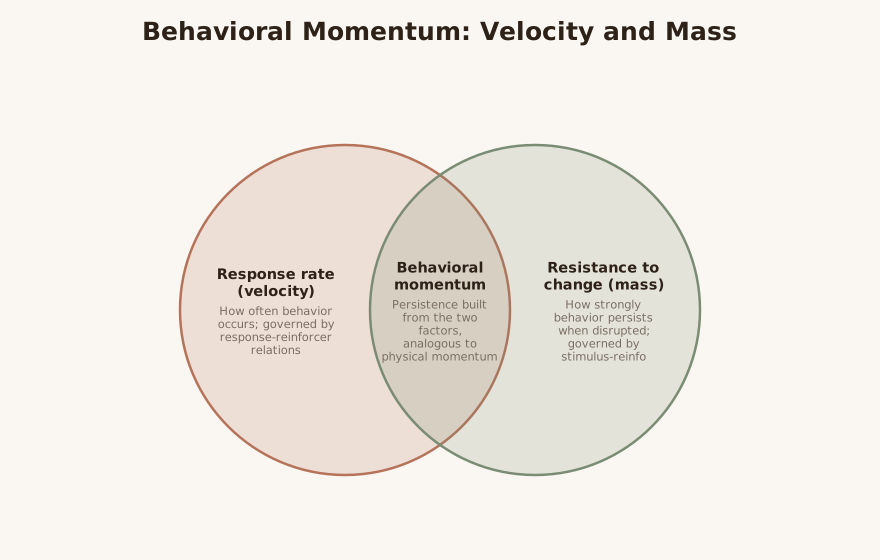
The central metaphor borrows Newton’s second law: physical momentum is mass times velocity, and behavioral persistence has an analogous two-factor structure 4. Response rate maps onto velocity (how often behavior occurs), while resistance to change maps onto mass (how strongly behavior persists when disrupted) 4. Crucially, Nevin defined behavioral “strength” as resistance to change rather than response rate alone 1. The two factors are governed independently: response-reinforcer relations (shaped by the matching law) control response rate, while stimulus-reinforcer relations (Pavlovian context effects) control persistence 4.
The most consequential principle is that all reinforcers obtained in the presence of a discriminative stimulus increase resistance to change, regardless of whether they are contingent on the target behavior 1. Noncontingent reinforcers and reinforcers for alternative behaviors all strengthen the stimulus context and thereby the persistence of whatever behavior occurs there 1. Behavioral change is inversely related to the reinforcement rate in the context and directly related to the magnitude of the disrupter 1. Higher baseline reinforcement yields greater resistance to disruption 1.
Interventions & Techniques
The signature applied procedure is the high-probability (high-p) request sequence: a clinician presents a short series of requests the person almost always completes, then immediately delivers a low-probability (low-p) request while compliance “momentum” is high 5. Implementation involves identifying high-p tasks the learner completes independently near 100% of the time, presenting two to five of them in quick succession, then introducing the low-p request 5. Differential reinforcement is layered in: minimal praise for high-p responses, and a powerful reinforcer immediately following the low-p response 5. Pace matters, because breaks can disrupt the momentum, so requests are delivered rapidly and without interruption 5.
A second application area is relapse prevention. The theory informs how alternative reinforcement (such as differential reinforcement of alternative behavior, or DRA, and noncontingent reinforcement) is faded, because the same procedures that suppress problem behavior also increase its persistence 1.
LLM-generated illustrative example (not a guideline): A school behavior team working with a student who refuses written work opens each session with three quick “high-p” requests the student reliably completes (clap your hands, give me a high-five, point to the door), then presents the writing task, reinforcing engagement immediately. LLM
Evidence Base
Honesty requires separating three tiers of maturity. The underlying phenomenon — that resistance to change tracks reinforcement rate and history in a stimulus context — is robust and established across species and decades of operant research 1. The high-p request sequence as an applied technique is supported but variable; its parameters are loosely specified and outcomes differ across studies and learners 5. The formal quantitative model is actively contested 3.
Craig and Shahan demonstrated that Behavioral Momentum Theory failed to predict the effects of reinforcement rate on resurgence: higher baseline reinforcement did not produce greater persistence, and resurgence appeared only for high-rate alternative-reinforcement groups, contradicting the model 3. Fitting the theory to those data required parameter values differing from typical ones by several orders of magnitude, signaling a fundamental rather than a measurement problem 3. Behavioral momentum also predicts the relapse of extinguished operant responding, a relationship documented in the relapse literature 2. So the takeaway is “established phenomenon, mature applied heuristic, contested mathematics” LLM.
Populations & Indications
The empirical base is concentrated in applied behavior analysis with children with autism and developmental disabilities, students in educational settings, and people with intellectual disability 5. Within those groups, the high-p sequence targets escape-related behavior, tantrums, and task refusal 5. It is used in behavioral skill training and instructional programming where compliance with low-probability demands is the goal 5. General psychotherapists should treat applicability as a conceptual bridge rather than a validated adult-psychotherapy protocol, because the controlled evidence does not extend there LLM. The theory’s relapse predictions are relevant wherever a densely reinforced maladaptive behavior is being extinguished 1.
Problems-for-Work
Noncompliance and task refusal. The high-p sequence is designed to lift compliance with demands the person typically escapes, by building momentum on easy requests first 5.
Oppositional behavior. Pre-empting refusal before challenging behavior occurs — rather than after — keeps the sequence from inadvertently reinforcing escape 5.
Behavioral persistence and relapse. The theory explains why a suppressed problem behavior re-emerges (resurgence) when alternative reinforcement is withdrawn, and frames how to fade reinforcement to limit relapse 1.
Skill acquisition deficits and adherence. Momentum can be used to embed novel or effortful demands within a stream of mastered ones, supporting acquisition and follow-through 5.
LLM-generated illustrative example (not a guideline): A clinician fading a noncontingent-reinforcement plan for a client’s attention-maintained behavior tapers reinforcement gradually over weeks rather than stopping abruptly, anticipating a temporary resurgence and planning support around the transition. LLM
Contraindications, Cautions & Cultural Humility
The central caution is paradoxical and well documented: alternative reinforcement (DRA, NCR) that reduces problem behavior during treatment also increases that behavior’s resistance to subsequent extinction 1. When that reinforcement is later withheld, problem behavior can resurge precisely because the suppressing source was removed while the context retains its heightened value 1. Higher reinforcement rates buy greater suppression during treatment but risk larger resurgence on discontinuation 1. Mitigation involves extended treatment duration and gradual rather than abrupt termination of alternative reinforcement, since longer exposure produces lower response rates and less resurgence 1.
Timing is a further caution: if a learner is already engaging in problem behavior, the high-p sequence should be held off, or it may reinforce escape 5. The evidence base is also culturally and developmentally narrow — predominantly children with disabilities in structured ABA and educational settings — so clinicians should not assume generalization to adults, to other presentations, or across cultural contexts where directive request-stacking may be experienced as coercive LLM.
Treatment-Plan Suggestions & SMART Objectives
| Goal | SMART objective (example) | Mechanism |
|---|---|---|
| Increase compliance with demands | Complete the low-probability task within 10 seconds in 80% of opportunities across 3 consecutive sessions | High-p sequence builds momentum into the low-p request 5 |
| Reduce escape-maintained refusal | Reduce task-refusal episodes from baseline by 50% over 4 weeks | Pre-emptive high-p delivery before problem behavior occurs 5 |
| Support skill acquisition | Independently complete 2 new instructional targets per session for 2 weeks | Effortful demands embedded among mastered high-p requests 5 |
| Prevent relapse during fading | Tolerate stepwise reduction of reinforcement with under 1 resurgence episode per step | Gradual fading limits resurgence from context devaluation 1 |
| Maintain gains over time | Sustain target behavior at 90% across a 1-month maintenance check | Extended exposure lowers response rate and resurgence risk 1 |
| Improve adherence to routines | Complete the full morning routine in 4 of 5 weekday opportunities | Momentum carries engagement across sequenced demands 5 |
Common Misconceptions
“Adding reinforcement always helps.” The opposite can hold: reinforcement delivered in a context increases the persistence of whatever behavior occurs there, including problem behavior, so generous alternative reinforcement can make problem behavior harder to extinguish later 1.
“Behavioral momentum is the same as response rate.” It is not; momentum (resistance to change) and response rate are independent factors, and a fast behavior is not necessarily a persistent one 1.
“The metaphor is just rhetorical.” Nevin grounded it in a quantitative model with explicit equations relating disruption to reinforcement rate, though that model is now contested 3.
“High-p sequencing is a validated adult psychotherapy technique.” Its controlled evidence is concentrated in ABA with children and developmental disabilities, not general adult therapy 5.
Training & Certification
There is no certification specific to “behavioral momentum”; competence in it is acquired as part of broader applied-behavior-analysis training and credentialing, where the high-p procedure is taught as one antecedent intervention among many 5. Clinicians learn it through ABA coursework, supervised fieldwork, and the experimental-analysis-of-behavior literature 4. The procedural parameters (number of high-p requests, pacing, reinforcement layering) are taught as practice guidance rather than fixed rules, and practitioners are expected to individualize them 5. Familiarity with the relapse literature is advisable before fading reinforcement plans 1.
Key Terms
Resistance to change. The persistence of behavior when a disrupter (such as extinction or distraction) is introduced; the theory’s measure of behavioral “strength” LLM.
Discriminative stimulus context. The stimulus situation in which reinforcement has occurred; its accumulated reinforcement history governs persistence LLM.
Resurgence. The re-emergence of a previously reinforced, then suppressed, behavior when the alternative reinforcement maintaining its replacement is reduced or removed LLM.
High-probability (high-p) request. A demand the person completes reliably, used to build momentum before a harder low-probability request LLM.
Disrupter. Any operation (extinction, satiation, competing reinforcement) that challenges ongoing behavior and reveals its resistance to change LLM.
Resources & Further Reading
▶ Watch — a video introduction to this concept:
- Behavioral Momentum Theory: Equations and Applications (Nevin & Shahan, 2011)
- Behavioral Momentum and Relapse of Extinguished Operant Responding
- Behavioral Momentum Theory Fails to Account for the Effects of Reinforcement Rate on Resurgence (Craig & Shahan)
- Behavioral momentum — overview (Wikipedia)
- High-Probability Request Sequences & Behavioral Momentum: A Deep Dive for ABA Professionals
Reflective / Supervision Questions
- When a client’s maladaptive behavior resists change, what reinforcement history in that specific context might be sustaining it, and which non-target reinforcers am I overlooking? LLM
- Before I fade an alternative-reinforcement plan, have I planned for a temporary resurgence, and is my fading gradual enough to limit it? LLM
- Am I treating high-p sequencing as a conceptual heuristic appropriate to my population, or am I overextending an ABA procedure beyond its evidence? LLM
- Could request-stacking be experienced as coercive by this client or family, and how does cultural context shape that? LLM
- Where in my caseload am I confusing a fast behavior (high rate) with a persistent one (high resistance to change)? LLM