
Type & Discipline
“Attractor states” and “basins of attraction” are constructs from nonlinear dynamical systems theory, the branch of applied mathematics and physics that studies how systems evolve over time under feedback. 1 An attractor is a set of states toward which a system tends to evolve from a wide variety of starting conditions; it is the long-term behavior the system gravitates toward regardless of where it began. 6 A basin of attraction is the set of all initial conditions in the system’s state space that eventually converge to a given attractor. 6 These are not therapeutic techniques but a descriptive vocabulary—a way of formalizing why some patterns are stable, why they resist perturbation, and what it takes to change them. LLM
For clinicians, the constructs arrive by analogy. They are well established as mathematics and physics, and have a long history in affective neuroscience and family systems thinking, but their application to individual psychopathology is a younger, actively developing research program rather than a validated clinical protocol. 3 The honest framing is: this is a rigorous theoretical lens that is becoming testable in psychiatry, not a manualized treatment. LLM
Creators & Lineage
The underlying mathematics belongs to the tradition of nonlinear dynamics and chaos, synthesized for a broad scientific audience in Steven Strogatz’s widely used textbook, which made fixed points, limit cycles, bifurcations, and basins accessible across physics, biology, and engineering. 1 The formal treatment of multistability—systems with several coexisting attractors—and of how one might deliberately push a system from one stable state to another was consolidated by Pisarchik and Feudel in their review on the control of multistability. 2
The bridge into mind and brain runs through several streams. In affective neuroscience, Walter Freeman modeled brain activity as movement across an attractor landscape, arguing that emotion and intention shape which neural patterns become stable and how the system transitions between them. 4 In family and complexity theory, recurrent relational patterns were long described as self-stabilizing systems that resist change—language that maps naturally onto basins. LLM Most recently, a dynamical-systems view of psychiatric disorders has proposed treating psychological health and illness as alternative attractors of one underlying system, drawing explicitly on the same tipping-point and resilience mathematics used in ecology and climate science. 3
Core Principles
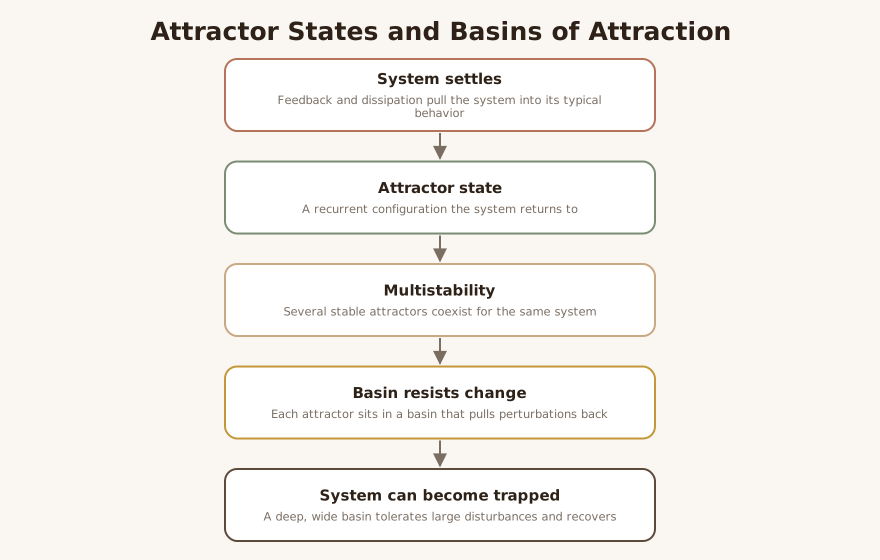
A system settles. Through feedback and dissipation, transient fluctuations die off and the system settles into its typical behavior—its attractor. 6 Attractors come in types: a fixed point (a single equilibrium, like a damped pendulum coming to rest), a limit cycle (an isolated periodic orbit, like a steady oscillation), and a strange or chaotic attractor (a fractal set on which nearby trajectories diverge yet stay confined). 6 Clinically, a fixed point resembles a flat, stuck mood; a limit cycle resembles a repeating relational or mood loop. LLM
Multistability. The same system, with the same parameters, can possess more than one stable attractor; which one it occupies depends on its history and starting point. 2 This is the crux of the clinical metaphor: the same person can have both a healthy organization and a pathological one available as stable states. 3
Basins create resistance to change. Each attractor sits at the bottom of a basin. Basin stability quantifies how likely a perturbation is to return the system to its attractor—larger basins mean the system tolerates bigger disturbances and still recovers. 5 A deep, wide basin is the formal picture of an entrenched pattern: small nudges get absorbed and the system slides back. LLM
Boundaries and tipping points. Basins are separated by boundaries (separatrices). These can be smooth and predictable, or fractal, or even Wada-type, where every boundary point is shared by three or more basins, producing extreme sensitivity to where exactly the system sits. 5 Crossing a boundary is a critical transition: the system leaves one basin and falls into another. 3
Hysteresis. Transitions are often asymmetric. The push required to tip a system out of a basin is not the mirror image of what restores it; the path in and the path out differ, so removing the original cause does not automatically reverse the state. 3 This is why “just stop the stressor” frequently fails to undo a settled depression. LLM
Interventions & Techniques
Attractor theory is not itself an intervention; it reframes what an intervention is trying to do. LLM In dynamical terms there are three levers, all of which have clinical analogues.
1. Move the system across a boundary (state change). Control-of-multistability work shows a system can be driven from one coexisting attractor to another through perturbation, feedback, or noise. 2 The psychiatric review captures the clinical hope precisely: short interventions may produce lasting success when they flip the system into an alternative basin of attraction. 3 A well-timed behavioral activation, a single corrective relational experience, or a successful exposure can act as the perturbation that tips a person out of a stuck basin. LLM
2. Reshape the landscape (change basin geometry). Rather than push the marble, change the bowl. Therapy that builds new skills, beliefs, or supports effectively deepens the basin around a healthy state and shallows the pathological one, so the system is more likely to settle in the adaptive attractor and less likely to relapse into the old one. 4 Freeman’s framing—emotion and learning continually reshaping the attractor landscape—is the neuroscience version of this. 4
3. Monitor stability and time the intervention. Because resilience is a dynamical property, generic indicators (rising variance, slower recovery from small upsets—“critical slowing down”) can flag when a system is approaching a boundary. 3 Densely sampled self-report or passive data can, in principle, be analyzed to estimate how close someone is to a transition and to time support accordingly. 3
LLM-generated illustrative example (not a guideline): A clinician tracks a client’s daily mood ratings and notices the swings are getting wider and each dip takes longer to recover from—even though the average is unchanged. Reading this as critical slowing, the clinician front-loads support before a feared anniversary rather than waiting for a crisis. LLM
Evidence Base
The maturity here is layered and must be stated honestly. LLM As mathematics and physics, attractors, basins, and multistability are established: rigorously defined, extensively validated, and standard across the sciences. 16 The control of multistability—the demonstrable ability to switch a real system between coexisting stable states—is likewise a mature physics literature. 2
The clinical application is emerging, not established. The dynamical-systems view of psychiatric disorders is presented as theory and review: it proposes that monitoring time-series data can infer causality, quantify resilience, and predict relapse, and that disorders behave like alternative attractors. 3 These are promising, internally coherent, and increasingly testable hypotheses—not a body of randomized-trial evidence that an “attractor-based therapy” outperforms standard care. 3 No outcome studies in the provided sources show that intervening on basins, as such, improves clinical outcomes. LLM Use the framework as a conceptual map and a research direction, and avoid presenting it to clients as proven mechanism. LLM
Populations & Indications
The lens is population-agnostic because it describes how patterns stabilize, not a diagnosis. LLM It is most clarifying with adults caught in entrenched, self-maintaining patterns, and it scales naturally to couples and families, where the “system” is the relationship and the attractor is a recurrent interactional cycle. 3 It is equally a tool for therapists and researchers as a meta-model for thinking about change, relapse, and timing across clinical populations and individuals in therapy. 3 It is indicated wherever the central puzzle is stability of a maladaptive state—why something persists despite the person’s wish and effort to change it. LLM
Problems-for-Work
- Entrenched maladaptive patterns / rigid behavioral patterns. Reframed as deep, wide basins that absorb perturbation; the work is to shrink that basin and build a competing one. 5
- Chronic depression. Modeled as a stable low-mood attractor the system is trapped in, with hysteresis explaining why removing triggers does not flip it back. 3
- Rumination. A limit-cycle-like loop—an isolated, self-sustaining periodic pattern the system returns to. 6
- Emotional dysregulation / mood instability. Read through basin stability and proximity to boundaries; widening variance and slow recovery signal a fragile, near-tipping state. 3
- Relationship conflict. The couple’s recurring fight as a shared attractor with a robust basin; small repair attempts get reabsorbed until the landscape itself changes. 3
- Relapse. The persistence of the old basin even after improvement—the healthy state was reached but its basin stayed shallow, so a perturbation tips the system back. 3
- Resistance to change / stuck therapeutic process. Not (only) motivation, but a structurally stable system doing what stable systems do—resisting small perturbations. 5
LLM-generated illustrative example (not a guideline): A couple presents the same Sunday-evening argument for the hundredth time. Framing it as an attractor, the therapist stops trying to “win” the content and instead engineers a different entry into the cycle and a new repair ritual—reshaping the basin rather than pushing harder on the marble. LLM
Contraindications, Cautions & Cultural Humility
The framework is a metaphor with mathematical bones, and its risks are mostly interpretive. LLM Do not let it become deterministic or fatalistic. Describing a client’s depression as a “deep attractor” can be heard as “you are stuck forever”; the same theory holds that short, well-placed interventions can flip a system, so the message must carry that hope. 3 Do not overclaim mechanism. Because the clinical evidence is emerging, presenting attractor dynamics as the proven cause of a disorder oversteps the sources. 3
Cultural humility: what counts as the “healthy attractor” is not value-neutral. LLM A clinician’s model of the desirable stable state can encode cultural assumptions about emotion, family roles, autonomy, and relational patterns; a stable configuration that looks “stuck” from outside may be adaptive within the client’s context. LLM The construct should describe the client’s own system and goals, not impose a normative endpoint. LLM Finally, time-series monitoring raises real privacy and surveillance concerns that require explicit consent. 3
Treatment-Plan Suggestions & SMART Objectives
| Goal | SMART objective (example) | Mechanism |
|---|---|---|
| Reduce the “depth” of a stuck low-mood basin | Over 8 weeks, complete 3 scheduled pleasant/mastery activities weekly, logged daily, achieving ≥80% adherence | Repeated perturbations plus competing reinforcement reshape the landscape away from the low-mood attractor 3 |
| Interrupt a ruminative loop | Within 4 weeks, apply a rehearsed attention-shift technique within 5 minutes of noticing rumination on ≥5 days/week | Breaks the limit-cycle before it self-sustains 6 |
| Detect approach to a tipping point | For 6 weeks, complete a daily 1-minute mood/energy rating to build a personal baseline and recovery-time trend | Generates time-series data to read critical slowing / rising variance 3 |
| Widen tolerance to perturbation (resilience) | Over 10 weeks, practice a paced-breathing skill twice daily and rate distress before/after, targeting a ≥2-point drop | Increases basin stability so disturbances are absorbed without a state change 5 |
| Change a couple’s recurring conflict attractor | For 4 weeks, use a 20-minute structured weekly check-in with a defined repair step, completed ≥3 of 4 weeks | Alters the relational landscape rather than the fight’s content 3 |
| Reduce relapse risk after improvement | Build and rehearse a written early-warning + response plan within 3 sessions and review monthly for 6 months | Deepens the new healthy basin and pre-plans counter-perturbations to old triggers 3 |
| Increase agency over the “switch” | Within 6 weeks, identify 3 personal perturbations that reliably shift state and use ≥1 during a low period, logged | Operationalizes deliberate movement between coexisting states 2 |
Common Misconceptions
- “It’s a type of therapy you can deliver.” It is a descriptive framework, not a protocol; there is no validated “attractor therapy” in the sources. 3LLM
- “A deep attractor means change is impossible.” Multistability theory says the opposite—coexisting states mean a healthier attractor is already available, and short interventions can flip the system into it. 23
- “Remove the cause and the state reverses.” Hysteresis means the exit path differs from the entry path; clearing the original trigger need not restore the prior state. 3
- “Attractor equals a fixed, frozen state.” Attractors include oscillating limit cycles and even chaotic-but-bounded behavior, not just static equilibria. 6
- “Bigger perturbation is always better.” Timing near a boundary matters as much as force; a small, well-placed nudge near a tipping point can do what a large mistimed one cannot. 3
- “It’s pure metaphor with no rigor.” The mathematics is exact and measurable (basin volume, basin stability, separatrix geometry); what is emerging is the clinical validation, not the math. 51
Training & Certification
There is no certification in “attractor-based psychotherapy,” and none is implied by the sources. LLM Clinicians gain competence by (1) grounding in the conceptual vocabulary—attractors, basins, multistability, bifurcations—via a standard nonlinear-dynamics text such as Strogatz, 1 (2) reading the multistability-control literature for how switching between stable states is actually achieved, 2 and (3) following the dynamical-systems-in-psychiatry literature to track what is established versus hypothesized. 3 The applied clinical skills themselves come from training in whichever evidence-based modality you use to deliver the work (CBT, behavioral activation, systemic couples therapy, mindfulness-based approaches). LLM
Key Terms
- Attractor. A set of states the system tends to evolve toward from many starting conditions. 6
- Basin of attraction. All initial conditions that converge to a given attractor. 6
- Fixed point / limit cycle / strange attractor. A single equilibrium; an isolated periodic orbit; a fractal, sensitively chaotic but bounded set. 6
- Multistability. Coexistence of more than one stable attractor for the same system parameters. 2
- Basin stability. A probabilistic measure of how likely a perturbation returns the system to its attractor; larger basins are more robust. 5
- Separatrix / basin boundary. The surface dividing basins; may be smooth, fractal, or Wada-type. 5
- Critical transition / tipping point. Crossing a basin boundary into a different attractor. 3
- Hysteresis. Asymmetry between the path into a state and the path out of it. 3
- Critical slowing down. Rising variance and slower recovery from perturbation as a system nears a tipping point—an early-warning signal. 3
Resources & Further Reading
▶ Watch — a video introduction to this concept:
- Strogatz, Nonlinear Dynamics and Chaos (3rd ed.) — author page 1
- Pisarchik & Feudel, “Control of multistability,” Physics Reports (2014) 2
- A Dynamical Systems View of Psychiatric Disorders—Theory: A Review (2024) 3
- Freeman, “Emotion Is Essential to All Intentional Behaviors” 4
- Basin-of-Attraction Analysis — EmergentMind 5
- Attractor — Wikipedia 6
Reflective / Supervision Questions
- For a “stuck” client, can I describe the maladaptive pattern as an attractor—what keeps absorbing the perturbations I introduce, and is the basin shallow or deep? LLM
- Am I trying to push the marble (force a state change) when I should be reshaping the bowl (building competing structure), or vice versa? 2
- What would count as an early-warning signal of a tipping point for this client, and am I measuring anything that could reveal it? 3
- Where might hysteresis be operating—am I expecting a state to reverse simply because I removed its trigger? 3
- Whose definition of the “healthy attractor” am I using, and does it impose cultural assumptions on this client’s system? LLM
- Am I holding the framework honestly with the client—as a hopeful, hypothesis-level map rather than proven mechanism? 3