
Type & Discipline
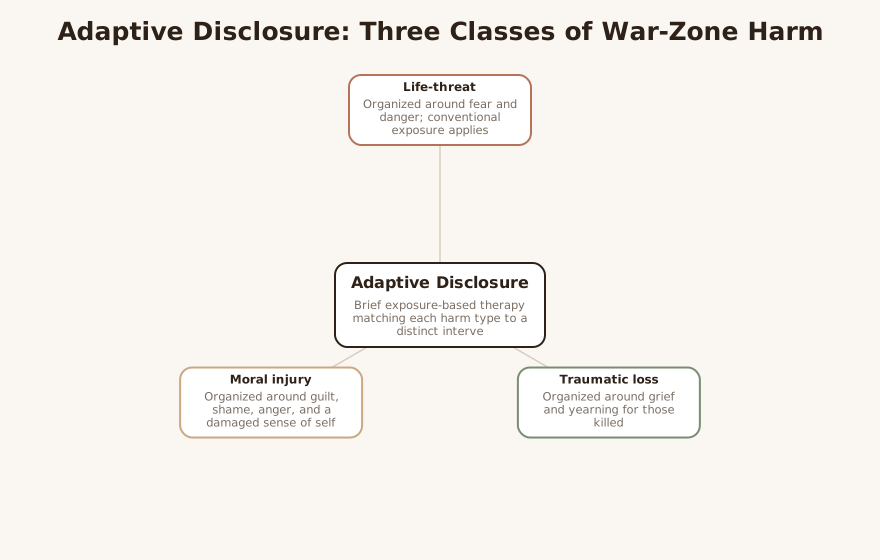
Adaptive Disclosure (AD) is a brief, manualized, exposure-based individual psychotherapy developed specifically for military service members and veterans exposed to war-zone trauma. 4 It sits within military and trauma psychology and belongs to the family of combat-focused treatments for posttraumatic stress disorder, but it is distinguished from generic PTSD protocols by its premise that not all war-zone experiences are the same and therefore should not be treated the same way. 4 Where many trauma treatments assume a single underlying mechanism — typically fear conditioning around a life-threatening event — AD organizes the work around three functionally distinct classes of experience: life-threat, traumatic loss, and moral injury. 4 Each class is matched to a different therapeutic strategy rather than being forced through one uniform procedure. LLM
AD is a standalone modality, not a technique bolted onto another therapy, and it was designed for delivery in a relatively short course of roughly six to twelve sessions. 4 Its identity as a military-tailored treatment is central: the language, pacing, and case conceptualization are built around the realities of deployment, unit cohesion, and the warrior ethos rather than civilian trauma narratives. 4 Understanding AD therefore means understanding both its exposure-therapy roots and its deliberate departure from a one-size-fits-all model of war trauma. LLM
Creators & Lineage
Adaptive Disclosure was developed by Brett Litz and colleagues and is presented in full in the 2016 Guilford Press treatment manual Adaptive Disclosure: A New Treatment for Military Trauma, Loss, and Moral Injury, authored by Brett Litz, Leslie Lebowitz, Matt Gray, and William Nash. 4 Litz, a clinical psychologist and prominent military-trauma researcher, is the principal architect; Lebowitz brought expertise in trauma and emotion; Gray contributed to the treatment’s clinical and empirical development; and Nash, a psychiatrist with deep U.S. Marine Corps experience, grounded the work in operational military culture. 4 The collaboration of academic trauma researchers with clinicians embedded in the military shaped a treatment intended to be credible to service members themselves. LLM
The lineage is explicitly exposure-based. 4 AD draws on the imaginal exposure tradition central to Prolonged Exposure for the life-threat component, while incorporating emotion-focused and experiential methods for loss and moral injury that go beyond habituation. 4 Its intellectual lineage also runs through the emerging construct of moral injury, which Litz and colleagues helped define as the lasting psychological, social, and spiritual harm that can follow perpetrating, failing to prevent, or witnessing acts that transgress deeply held moral beliefs. 3 The U.S. Department of Veterans Affairs’ National Center for PTSD recognizes moral injury as a distinct source of distress that may not respond to fear-focused treatment alone, situating AD within a broader movement to expand trauma care beyond the fear paradigm. 3
Core Principles
The foundational principle of AD is functional differentiation: war-zone experiences differ in their psychological structure, and treatment must be matched to the type of harm. 4 Life-threat experiences are organized around fear and danger; traumatic losses are organized around grief and yearning; and morally injurious events are organized around guilt, shame, anger, and a damaged sense of self. 4 Treating a moral injury as if it were a fear memory — by simply repeating the story until anxiety habituates — misses the point, because the problem is not that the memory is frightening but that the person believes they did, or failed to do, something unforgivable. LLM
A second principle is that disclosure itself is therapeutic but insufficient on its own. 4 AD uses imaginal exposure to break the avoidance that keeps painful experiences walled off, but it pairs disclosure with active meaning-making and corrective emotional experiences tailored to the type of event. 4 The “adaptive” in Adaptive Disclosure refers to helping the service member arrive at a more accurate, compassionate, and livable understanding of what happened, rather than merely tolerating the memory. LLM
A third principle is cultural fidelity to military identity. 4 AD is built to honor the values, bonds, and moral codes of military service rather than to pathologize them, working within the warrior ethos rather than against it. 4 This stance is intended to lower the shame and stigma that often keep service members from disclosing the events that trouble them most. LLM
Interventions & Techniques
AD opens, like most trauma therapies, with assessment, psychoeducation, and rapport-building, including a clear rationale for why avoidance maintains suffering and why approaching the experience is necessary. 4 The clinician and service member then identify the index experience and determine which of the three categories it primarily represents, recognizing that a single deployment can contain more than one. 4 This case conceptualization step drives everything that follows. LLM
For life-threat experiences, AD uses imaginal exposure in the manner familiar from exposure-based PTSD treatment: the service member recounts the event in detail, in the present tense, with eyes closed, repeatedly, to reduce avoidance and emotional reactivity. 4 For traumatic loss, AD shifts toward grief-focused experiential work, often including an imaginal dialogue with the deceased — a “deceased-benefactor” or breakup-letter–style conversation — in which the service member says what was left unsaid and processes the relationship and the loss. 4 For moral injury, AD employs an imaginal dialogue with a compassionate, moral authority figure — a benevolent mentor whom the service member respects — to whom they disclose what they did or failed to do, and from whom they imaginatively receive an honest, accountable, yet compassionate response. 4
The compassionate-mentor dialogue is the signature moral-injury intervention. 4 Its purpose is not absolution by the therapist but a corrective experience that interrupts the globalized self-condemnation (“I am irredeemable”) and opens space for accountability, repair, and reconnection. 3 A case study of war-related moral injury and loss illustrates how these differentiated dialogues are sequenced within a single course of treatment when a service member carries both a grievous loss and a moral transgression. 5 Across all three tracks, between-session work, processing of beliefs and meaning, and attention to forward-looking values and repair are woven in. 4
LLM-generated illustrative example (not a guideline): A Marine haunted by a split-second decision at a checkpoint that he believes cost a civilian’s life might be guided, after disclosure, to imagine recounting the event to a respected former drill instructor — and then to imagine that mentor responding with neither denial nor condemnation, but with the hard, humane acknowledgment that he acted under impossible conditions and remains capable of living a moral life. LLM
Evidence Base
The evidence base for Adaptive Disclosure is best described as emerging rather than established. LLM The most substantial controlled test to date is a randomized controlled non-inferiority trial comparing AD with Cognitive Processing Therapy in active-duty Marines and sailors. 1 In that trial, AD was examined as a combat-specific alternative to an established first-line treatment, and the non-inferiority framing itself signals that the goal was to show AD performs comparably rather than superiorly to CPT. 1 Results of this kind support AD as a viable option for combat-related PTSD without establishing it as the superior treatment, and a single non-inferiority trial is not sufficient to elevate a protocol to first-line status. LLM
A second line of evidence comes from a controlled trial of an enhanced version, Adaptive Disclosure–Enhanced, designed to improve functioning as well as reduce PTSD symptoms. 2 This work reflects ongoing development of the protocol toward broader functional outcomes rather than symptom reduction alone, which is clinically meaningful given that many veterans retain significant impairment even after symptom-focused treatment. LLM Alongside the controlled trials, the published case-study literature documents how AD is delivered in practice for moral injury and loss, offering proof of concept and clinical detail but not the controlled comparison needed to establish efficacy. 5
Honesty about maturity requires three caveats. LLM First, the controlled evidence base is small relative to that of Prolonged Exposure or Cognitive Processing Therapy, which have many trials and are recommended as first-line by major guidelines. LLM Second, the strongest claim the data currently support is non-inferiority to an established treatment in a military sample, not superiority or broad generalizability. 1 Third, the moral-injury components in particular rest more on theory, clinical rationale, and the recognition that fear-based treatments may not address guilt and shame than on a deep randomized evidence base. 3 Clinicians should present AD to clients as a promising, theoretically coherent, military-specific option under active study, not as a settled standard of care. LLM
Populations & Indications
AD was designed for and tested with military populations: active-duty service members and veterans exposed to war-zone trauma, including the deployed Marines and sailors studied in the central randomized trial. 1 It is indicated for combat-related PTSD, and especially for presentations dominated by guilt, shame, grief, and moral conflict rather than by fear alone. 4 Service members carrying moral injury — distress stemming from acts of perpetration, failure to prevent harm, or betrayal by leaders — are a particularly apt population, because this is precisely the territory AD was built to address and that fear-focused protocols may leave untouched. 3
The treatment is also indicated for service members whose primary wound is traumatic loss: the death of a close comrade, often sudden and violent, that has left grief frozen by avoidance. 4 In practice, many deployment histories contain a mixture of life-threat, loss, and moral injury, and AD’s differentiated structure is meant to accommodate that complexity within a single course of treatment. 5 While developed for the military, the underlying logic — matching intervention to the type of trauma, and addressing moral injury distinctly — has drawn interest for adaptation to other morally exposed populations such as first responders and healthcare workers, though the formal evidence remains military-centered. LLM
Problems-for-Work
The core problems-for-work in AD map onto its three categories of experience. 4 For combat-related PTSD driven by life-threat, the clinician uses imaginal exposure to reduce the avoidance and reactivity surrounding a specific terrifying event, such as an ambush or IED blast. 4 For moral injury, the work targets pervasive guilt and shame, self-condemnation, and the belief that one is irredeemable following a transgressive act, using the compassionate-mentor dialogue to open a path toward accountability and repair. 3 For traumatic loss and grief, the work addresses frozen mourning and unfinished business with a fallen comrade through imaginal dialogue with the deceased. 4
Related problems-for-work that frequently accompany these include demoralization, anger, social withdrawal and disconnection from unit or family, spiritual or existential crisis, and functional impairment in work and relationships. 3 The Adaptive Disclosure–Enhanced trial’s explicit focus on functioning reflects that symptom reduction alone may not restore a service member’s capacity to work, parent, and reconnect, making functional impairment a legitimate target in its own right. 2 In each case the intervention is selected to fit the specific problem rather than applying a uniform exposure procedure to every presentation. LLM
Contraindications, Cautions & Cultural Humility
As an exposure-based and emotionally evocative treatment, AD carries the standard cautions of trauma-focused work: it requires sufficient stability to tolerate intense affect, and clinicians should attend to acute suicidality, active substance dependence, ongoing danger, or severe dissociation before or alongside the imaginal work. LLM Because moral-injury interventions can intensify guilt and shame before they resolve, careful pacing and a strong alliance are essential, and the compassionate-mentor dialogue should never be rushed into before the service member feels safe enough to disclose. LLM AD is also a developing treatment, so clinicians should obtain informed consent that frames it as a promising but not first-line option and should consider established treatments such as Cognitive Processing Therapy or Prolonged Exposure where guideline-level evidence is a priority. 1
Cultural humility in AD runs in two directions. LLM First, the treatment depends on respecting military culture, moral codes, and identity rather than imposing a civilian or clinician-centered moral framework onto the service member’s experience; the clinician’s role in the moral-injury dialogue is to facilitate the client’s own meaning-making, not to pronounce judgment or grant forgiveness. 4 Second, moral injury is itself shaped by the client’s spiritual, religious, and cultural value systems, so what counts as a transgression and what counts as repair will vary, and clinicians should let those meanings be defined by the client. 3 Imposing a single template of redemption risks reproducing the very condemnation the treatment aims to interrupt. LLM
Treatment-Plan Suggestions & SMART Objectives
| Goal | SMART objective (example) | Mechanism |
|---|---|---|
| Reduce avoidance of a life-threat memory | Within 6 sessions, client will complete 3 imaginal exposures to the index combat event with a measurable drop in peak distress rating | Imaginal exposure reducing avoidance and reactivity |
| Differentiate the primary type of war-zone harm | By session 2, client and clinician will collaboratively identify whether the index experience is primarily life-threat, loss, or moral injury | Functional case conceptualization guiding treatment selection |
| Interrupt globalized self-condemnation after a transgression | Within 8 sessions, client will verbalize a more accountable yet self-compassionate appraisal of the morally injurious event on at least 2 occasions | Compassionate-mentor imaginal dialogue producing a corrective experience |
| Process frozen grief over a fallen comrade | Within 6 sessions, client will complete an imaginal dialogue with the deceased and report saying what was left unsaid | Grief-focused experiential disclosure addressing unfinished business |
| Reduce guilt- and shame-driven distress | Over 8 weeks, client will report a measurable reduction in guilt/shame intensity on a standardized self-report | Meaning-making and corrective emotional experience for moral injury |
| Restore valued functioning and connection | Within 10 sessions, client will re-engage 1 valued role or relationship (unit, family, or work) per week | Forward-looking values and repair work (AD-Enhanced functional focus) |
| Build a coherent, livable account of the event | Within 10 sessions, client will articulate an integrated narrative that holds both accountability and self-worth | Adaptive disclosure and meaning reconstruction |
Common Misconceptions
The most common misconception is that Adaptive Disclosure is simply Prolonged Exposure for veterans. LLM While AD uses imaginal exposure for life-threat memories, its defining feature is that it routes loss and moral injury through different interventions — grief dialogue and compassionate-mentor dialogue — rather than treating every event as a fear memory to be habituated. 4 A second misconception is that the moral-injury dialogue is about the therapist absolving the client; in fact the corrective experience is generated through the client’s own imagined dialogue with a respected moral figure, with the clinician facilitating rather than forgiving. 3
A third misconception is that AD is an established, guideline-recommended first-line treatment on par with Cognitive Processing Therapy or Prolonged Exposure; the current evidence supports it as a promising, military-specific option with non-inferiority data, not as a settled standard. 1 A fourth is that moral injury is just a synonym for PTSD; the National Center for PTSD frames moral injury as a distinct form of harm, centered on guilt, shame, and violated values, that can occur with or without a PTSD diagnosis and may not respond to fear-focused treatment alone. 3 Finally, some assume AD is only about disclosing the past, when in practice it deliberately incorporates meaning-making, repair, and forward-looking reconnection. 4
Training & Certification
Adaptive Disclosure does not have a single mandatory licensure or certification body in the way that some branded therapies do; the primary entry point is the published treatment manual. LLM The 2016 Guilford Press text Adaptive Disclosure: A New Treatment for Military Trauma, Loss, and Moral Injury by Litz, Lebowitz, Gray, and Nash is the foundational clinical reference and provides the protocol, rationale, and session structure. 4 Clinicians typically come to AD with prior grounding in exposure-based trauma treatment, since competent delivery of the life-threat component assumes familiarity with imaginal exposure. LLM
Because AD addresses moral injury and traumatic loss, training also benefits from familiarity with the moral-injury literature and clinical resources such as those maintained by the VA’s National Center for PTSD for professionals. 3 The case-study literature offers worked clinical examples that complement the manual and help clinicians see how the differentiated dialogues are sequenced in practice. 5 As with any evolving trauma treatment, supervision and consultation during early cases are advisable, particularly for the emotionally evocative moral-injury and grief dialogues. LLM
Key Terms
Adaptive Disclosure (AD): a brief, military-specific, exposure-based psychotherapy that matches three classes of war-zone experience — life-threat, loss, and moral injury — to differentiated imaginal interventions. 4
Moral injury: the lasting psychological, social, and spiritual harm that can follow perpetrating, failing to prevent, or witnessing acts that transgress deeply held moral beliefs, centered on guilt, shame, and violated values. 3
Life-threat experience: a war-zone event organized around fear and danger, treated in AD primarily through imaginal exposure. 4
Traumatic loss: the death of a close comrade or other significant loss, treated in AD through grief-focused experiential work including imaginal dialogue with the deceased. 4
Compassionate-mentor dialogue: the signature moral-injury intervention, in which the service member discloses a transgression to an imagined respected moral figure and receives a corrective, accountable, yet compassionate response. 4
Adaptive Disclosure–Enhanced: a developed version of the protocol studied in a controlled trial with an added emphasis on improving functioning alongside reducing PTSD symptoms. 2
Non-inferiority trial: a study design used in the central AD randomized trial to test whether AD performs comparably to — rather than better than — an established treatment such as Cognitive Processing Therapy. 1
Resources & Further Reading
▶ Watch — a video introduction to this concept:
- Adaptive disclosure vs. cognitive-processing therapy: a randomized controlled non-inferiority trial (Psychiatry Research)
- A controlled trial of Adaptive Disclosure–Enhanced to improve functioning and treat PTSD (PubMed)
- Moral Injury — VA National Center for PTSD (for professionals)
- Adaptive Disclosure: A New Treatment for Military Trauma, Loss, and Moral Injury (Guilford excerpt PDF)
- Treating War-Related Moral Injury and Loss with Adaptive Disclosure: A Case Study (Springer)
- Adaptive Disclosure (Litz, Lebowitz, Gray, Nash — book listing)
Reflective / Supervision Questions
- When I formulate a veteran’s trauma, am I defaulting to a fear/life-threat model, or am I genuinely distinguishing loss and moral injury that may call for different interventions? LLM
- In the compassionate-mentor dialogue, how do I facilitate the client’s own moral reckoning without slipping into the role of the one who forgives or judges? LLM
- How do I present AD’s evidence honestly — as promising and military-specific but not yet first-line — while still conveying genuine hope? LLM
- Whose moral and spiritual framework is defining “transgression” and “repair” in the room, and am I respecting the client’s value system rather than importing my own? LLM
- For a service member carrying both grief and moral injury, how do I sequence the differentiated dialogues so that one does not overwhelm the other? LLM
- Am I adequately attending to stability, safety, and pacing before opening emotionally evocative disclosure work? LLM