
Type & Discipline
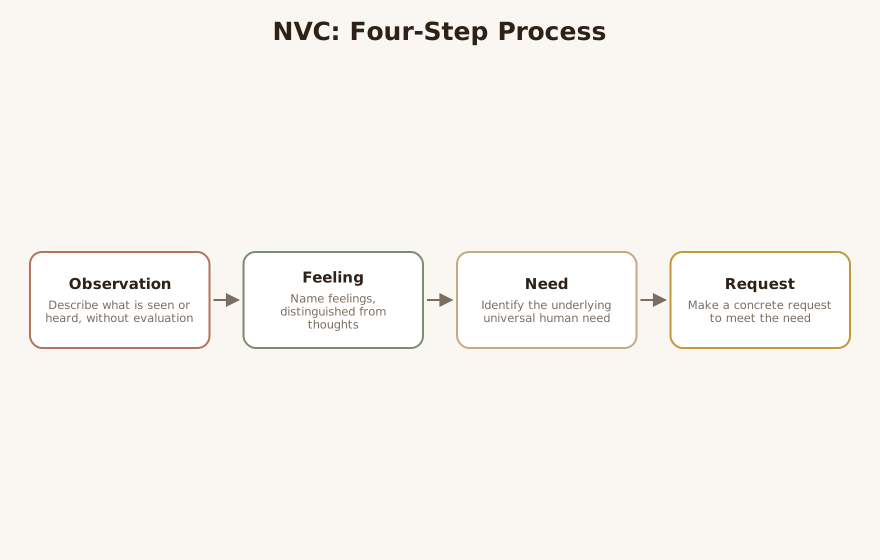
Nonviolent Communication (NVC) is a structured communication framework rather than a school of psychotherapy or a manualized clinical treatment 1. It is sometimes referred to as Compassionate Communication or Collaborative Communication, and it sits within the humanistic tradition, emphasizing empathy, authenticity, and the universal needs that underlie human behavior 4. Its core is a learnable four-component process — observation, feeling, need, and request — used both to express oneself honestly and to receive others empathically 5. For clinicians, NVC is best understood as a communication-skills framework that can be integrated into psychotherapy, coaching, mediation, and education, rather than as a standalone modality delivered as primary treatment for a diagnosable condition LLM. It was developed as a general-purpose approach to human connection and conflict, and was disseminated widely outside of clinical settings — in schools, prisons, organizations, and international peacebuilding — before and alongside any therapeutic application 2. The practical promise of the framework is that the way people speak and listen, especially under conflict, can be changed deliberately to reduce defensiveness and increase mutual understanding 3.
Creators & Lineage
NVC was created by Marshall B. Rosenberg, an American clinical psychologist, in the 1960s and 1970s 4. Rosenberg earned a doctorate in clinical psychology and studied under, and was influenced by, the humanistic psychologist Carl Rogers, whose person-centered emphasis on empathy and unconditional positive regard is visible throughout the NVC framework 4. He developed the approach in part through his work in civil-rights-era mediation and school desegregation, where he needed a practical method for de-escalating conflict and building understanding between parties in opposition 4. In 1984 he founded the Center for Nonviolent Communication (CNVC), the international nonprofit that trains and certifies practitioners and continues to steward the framework after his death in 2015 2.
The intellectual lineage of NVC is explicitly humanistic and is also informed by the philosophy of nonviolence 4. Rosenberg drew the word “nonviolent” from Gandhi’s concept of ahimsa, the principle of acting without harm, and applied it to language and interpersonal exchange rather than only to political action 4. The Rogerian heritage supplies the framework’s faith in empathy and in people’s capacity to respond constructively when their experience is genuinely heard 4. In contemporary clinical terms, NVC shares territory with person-centered therapy’s relational stance, with emotionally focused work’s attention to underlying emotional needs, and with structured couples approaches such as the Gottman Method that teach concrete communication skills, though NVC developed independently of these as a general communication system LLM.
Core Principles
The foundational premise of NVC is that all human beings share the same universal needs, and that nearly all behavior — including hostile, aggressive, or withdrawing behavior — is an attempt, however unskillful, to meet one of those needs 5. Conflict, in this view, is rarely a conflict of needs themselves but of the strategies people use to meet them, which means that connecting at the level of needs opens space for solutions that competing demands obscure 5. A second principle is that empathy — present, judgment-free attention to what another person is experiencing — is the precondition for cooperation, and that people are far more willing to consider others’ needs once their own have been heard 3.
A third, clinically important principle is the sharp distinction NVC draws between observation and evaluation 5. The framework asks speakers to describe what they actually see or hear, concretely and specifically, without mixing in interpretation, judgment, or generalization such as “always” and “never,” because evaluative language tends to provoke defensiveness and dispute 5. A fourth principle distinguishes feelings from thoughts, encouraging people to name genuine emotions (“I feel discouraged”) rather than disguised judgments or accusations (“I feel ignored,” which attributes blame) 3. Underlying all of these is the stance that NVC describes as moving away from “jackal” language — the habitual language of blame, demand, criticism, and labeling — toward “giraffe” language oriented to needs and connection, metaphors Rosenberg used to make the distinction memorable 3.
Interventions & Techniques
The central technique is the four-component model, applied in sequence 5. First, the speaker states an observation: a specific, non-evaluative description of what happened (“When I see the dishes in the sink from last night”) 5. Second, they name the feeling that the observation evokes (“I feel frustrated”) 5. Third, they connect that feeling to an underlying need or value (“because I need order and shared responsibility”) 5. Fourth, they make a concrete, positive, doable request rather than a demand (“Would you be willing to wash them before dinner?”) 5. The same four components also organize receiving: empathic listening involves silently or aloud sensing the observation, feeling, need, and possible request behind another person’s words, even when those words arrive as criticism or attack 5.
NVC distinguishes a request from a demand by the speaker’s response to “no”: a genuine request leaves room for refusal and continued dialogue, whereas a demand carries an implied threat or punishment, which the framework treats as a return to coercive, “jackal” communication 3. The practice also includes self-empathy, turning the same four-step attention inward to identify one’s own observations, feelings, and needs before speaking, and honest self-expression, owning one’s feelings and needs without blaming the other 3. In applied settings, NVC is taught through role-play, structured practice, worksheets, and the deliberate rehearsal of phrasing, since the shift from habitual evaluative speech to needs-based language is a skill built through repetition 3.
LLM-generated illustrative example (not a guideline): A partner who would habitually say “You never listen to me, you’re so selfish” is coached to reframe: “When I was talking about my day and you looked at your phone (observation), I felt lonely (feeling), because I really need to feel connected to you (need). Would you be willing to put the phone down while we talk for ten minutes (request)?” The reframing names the same hurt without the labeling that typically triggers a defensive counterattack LLM.
Evidence Base
The honest label for NVC is established but not strongly trial-validated: it is a widely disseminated, institutionalized framework with decades of practice, a foundational text, and an international training organization, rather than an intervention with a robust controlled-trial evidence base 2. NVC is described as effective by its proponents and is taught in over sixty countries, but the published empirical literature evaluating it is limited and of variable methodological quality, consisting largely of small studies rather than large randomized controlled trials 4. The five sources available here — Rosenberg’s foundational book, the CNVC and BayNVC organizational sites, a practitioner-oriented explainer, and an encyclopedic reference — are descriptive and theoretical rather than empirical outcome data, so the framework should not be presented to clients as a first-line, trial-validated treatment for a specific disorder LLM.
What can be said defensibly is that NVC operationalizes mechanisms that are themselves well supported in the broader clinical literature: empathic attunement, reduction of blaming and globalizing language, distinguishing observation from interpretation, and translating reactive affect into identifiable needs and concrete requests LLM. These overlap substantially with communication-skills components found in evidence-based couples and family interventions, which lends face validity to NVC’s targets even where direct outcome evidence for the branded framework remains thin LLM. A recurring critique is that the model’s claim that all conflict reduces to needs-versus-strategies can be over-applied, and that some of its terminology and the strong claims made for it outrun the available data 4. The pragmatic clinical stance is to use NVC as a structured, teachable communication scaffold within a treatment that has stronger empirical support, rather than as a substitute for one LLM.
Populations & Indications
NVC is most naturally indicated for couples and families, where recurring conflict is driven by blaming, demanding, and globalizing communication patterns that the framework is specifically designed to interrupt 3. It is widely used with co-parents in conflict, who must continue to coordinate despite relational rupture and who benefit from a shared, neutral structure for raising grievances without escalation LLM. The framework is applied with adolescents, both in family work and in school settings, because the needs-based reframing can defuse the power struggles characteristic of parent-teen conflict and gives young people a vocabulary for being heard rather than acting out LLM. It is used in workplace teams and organizational settings, where NVC has a substantial non-clinical training presence aimed at conflict resolution, feedback, and collaboration 2. It is also relevant for caregivers, who often suppress their own needs to the point of resentment or burnout and who can use self-empathy and honest request-making to voice needs without guilt LLM. Beyond therapy, the framework has been deployed in mediation, education, and even prison and peacebuilding programs, reflecting its broad, non-pathology-specific design 2.
Problems-for-Work
The clearest indications are communication difficulties, interpersonal conflict, and relationship conflict, where NVC directly targets the evaluative, blaming speech patterns that drive escalation and replaces them with observation, feeling, need, and request 5. Marital distress is well matched, since couples in distress frequently communicate through criticism and counter-criticism, and the framework offers a concrete alternative grammar for raising complaints 3. Anger and irritability are addressed by helping the person trace the reactive feeling to an unmet need and to express it as a request rather than an attack, which can interrupt the escalation cycle 3. Difficulty expressing needs and assertiveness deficits are a natural fit, because the model gives an explicit, low-aggression template for stating what one feels and wants 5.
LLM-generated illustrative example (not a guideline): A client who swings between silent compliance and sudden outbursts is taught self-empathy and the request form, so that instead of resentfully agreeing to extra work and then exploding a week later, she can say in the moment, “When I’m asked to take on a third project (observation), I feel overwhelmed (feeling), because I need to protect time for my health (need); could we look at the priorities together (request)?” — converting a pattern of suppression-then-rupture into a single clear ask LLM.
Resentment is worked by surfacing the chronically unmet needs that accumulate behind it and giving them voice before they harden, while parent-child conflict is addressed by replacing demands and labels with needs-based requests that lower the adolescent’s defensiveness LLM. For emotional dysregulation, the framework’s insistence on pausing to name the genuine feeling and underlying need can function as a between-stimulus-and-response regulation strategy, though for clients with significant dysregulation it works best alongside dedicated emotion-regulation skills rather than as a replacement for them LLM.
Contraindications, Cautions & Cultural Humility
NVC is a communication-skills framework, not a crisis intervention or a treatment for severe psychopathology, and it is poorly suited as a sole response to acute suicidality, active psychosis, or significant instability, where containment, safety planning, and evidence-based stabilization take priority LLM. The most serious caution concerns relationships involving abuse or coercive control: teaching a person to express needs gently and to empathize with an abuser’s “needs” can be harmful if it implies that better communication will resolve the situation or that the targeted partner is responsible for managing the abuser’s feelings, and clinicians must not use NVC in ways that obscure power and safety LLM. The framework’s emphasis on owning one’s feelings and softening complaints should never be allowed to slide into victim self-blame LLM.
Two further cautions deserve naming LLM. First, NVC can be misused as a manipulative script — the surface form (“when you… I feel… I need…”) deployed to pressure or guilt another person while abandoning the genuine empathy that is its point; clinicians should teach the stance, not just the formula 3. Second, the scripted phrasing can feel stilted, formulaic, or culturally foreign, and some clients experience it as inauthentic, which can itself become an obstacle LLM. Cultural humility is essential because the framework’s premises — direct verbal expression of feelings and needs, individual ownership of emotion, and explicit request-making — carry assumptions rooted in Western, individualist, low-context communication norms LLM. In cultures and families where indirectness, deference, or restraint in naming feelings are valued, the standard NVC idiom may read as intrusive or improper, and the clinician should adapt the underlying principles to the client’s communicative world rather than imposing the script wholesale LLM.
Treatment-Plan Suggestions & SMART Objectives
| Goal | SMART objective (example) | Mechanism |
|---|---|---|
| Reduce blaming, evaluative communication in conflict | Within 8 weeks, client will reframe 3 recurring complaints into observation-only language and use them in session and at home, logging each attempt | Distinguishing observation from evaluation 5 |
| Express needs directly rather than through resentment or outburst | Over 6 weeks, client will make 2 explicit needs-based requests per week instead of hinting, withdrawing, or demanding | Honest self-expression via the request form 5 |
| Build empathic listening to de-escalate partner conflict | Within 10 sessions, partners will each reflect the other’s feeling and need before responding in 4 of 5 rehearsed conflict conversations | Empathic receiving / reflecting needs 5 |
| Convert anger into an identifiable unmet need | For 6 weeks, client will pause at 70% of anger spikes to name the feeling and underlying need before responding | Linking feelings to needs; self-empathy 3 |
| Replace demands with genuine requests in parenting | Within 8 weeks, parent will phrase 3 routine expectations as doable requests that leave room for “no” and dialogue | Request-versus-demand distinction 3 |
| Increase assertiveness without aggression | Over 6 weeks, client will use the four-component model to voice 1 previously avoided need per week | Structured, low-aggression self-expression 5 |
| Strengthen self-empathy to reduce burnout-driven resentment | For 4 weeks, caregiver will complete a brief self-empathy check (observation, feeling, need) on 5 of 7 days | Self-empathy preceding expression 3 |
Common Misconceptions
The most common misconception is that NVC is about being nice, soft, or conflict-avoidant; in fact it is a method for engaging conflict more directly and honestly, naming feelings and needs that polite avoidance usually buries 3. A second is that it is a rigid verbal formula — that one must always recite “when you… I feel… I need… would you be willing to” — when the four components are a structure for a stance of empathy and honesty, not a mandatory script, and fluent practitioners internalize them rather than reciting them 3. A third, clinically important, is that NVC means suppressing or never expressing anger; the framework treats anger as a valuable signal pointing to an unmet need and asks the person to express what is underneath it, not to swallow it 3. A fourth is conflating the model’s “no demands” principle with having no boundaries or never saying no; requests can be firm and boundaries can be clear, and a “no” is itself legitimate information about a need 5. A fifth is the assumption that, because all behavior is framed as an attempt to meet a need, NVC excuses harmful behavior; understanding the need behind an action is not the same as endorsing the action, and the framework is compatible with protecting oneself LLM. Finally, some treat NVC as a fully evidence-based clinical treatment, when it is more accurately an established communication framework whose controlled-trial support is limited 4.
Training & Certification
Training in NVC is offered primarily through the Center for Nonviolent Communication (CNVC), the nonprofit Rosenberg founded, which maintains a formal pathway to becoming a CNVC Certified Trainer along with workshops, intensive programs, and an international network of certified trainers 2. Regional organizations such as Bay Area Nonviolent Communication (BayNVC) provide foundational courses, leadership programs, and practice groups that teach the framework to the public and to professionals 5. NVC is deliberately not gated behind a clinical license — it is taught to educators, mediators, managers, parents, and the general public as well as to therapists, reflecting its origin as a general communication system rather than a psychotherapy 2. For practicing clinicians, two distinct paths exist: pursuing CNVC-affiliated training to teach or facilitate NVC formally, or integrating its principles and techniques into one’s existing psychotherapy practice within one’s scope and competence LLM. Rosenberg’s book Nonviolent Communication: A Language of Life is the standard foundational text and a common low-barrier entry point before any formal training 1.
Key Terms
Observation — a specific, concrete description of what one sees or hears, stated without evaluation, judgment, or generalization 5. Evaluation — interpretive or judging language (blame, labels, “always/never”) that NVC asks speakers to separate out from observation because it provokes defensiveness 5. Feeling — a genuine emotion named as one’s own, distinguished from disguised judgments or accusations 3. Need — a universal human requirement or value (connection, safety, autonomy, respect) that underlies feelings and motivates behavior 5. Request — a concrete, positive, doable ask that leaves room for “no,” as opposed to a demand 5. Demand — a request backed by an implied threat or punishment, which NVC treats as coercive communication 3. Self-empathy — turning the four-component attention inward to identify one’s own observations, feelings, and needs before speaking 3. Empathic listening — sensing the observation, feeling, need, and request behind another’s words, even when delivered as criticism 5. “Giraffe” and “jackal” language — Rosenberg’s metaphors contrasting needs-and-connection-oriented speech (giraffe) with blame-and-demand speech (jackal) 3.
Resources & Further Reading
▶ Watch — a video introduction to this concept:
- Nonviolent Communication: A Language of Life (3rd ed., Marshall B. Rosenberg) — PuddleDancer Press
- The Center for Nonviolent Communication (CNVC)
- Your Complete Nonviolent Communication Guide — PositivePsychology.com
- Nonviolent Communication — Wikipedia
- Basics of Nonviolent Communication — BayNVC
Reflective / Supervision Questions
- When I teach a client the NVC request form, am I helping them express a genuine need, or am I inadvertently handing them a more sophisticated way to pressure or guilt the other person LLM?
- In a couple where power is unequal — or where coercive control may be present — how do I avoid using “express your needs gently” in a way that places responsibility for safety on the wrong person LLM?
- When a client experiences the NVC phrasing as stilted, foreign, or inauthentic to their cultural communication style, how do I adapt the underlying principles rather than imposing the script LLM?
- Am I representing NVC’s evidence status honestly — as an established communication framework integrated within a better-supported treatment, rather than as a trial-validated therapy for the client’s presenting problem LLM?
- For a client with significant emotional dysregulation, when does needs-based reframing genuinely help, and when does it need to be paired with dedicated emotion-regulation skills first LLM?