
Type & Discipline
Yin-yang is a foundational theory in Chinese cosmology and Taoist philosophy, not a psychotherapy, and the clinically honest starting point is to treat it as a conceptual frame rather than a manualized treatment 1. In its native setting, yin-yang names the way the ancient Chinese understood reality as composed of two complementary, interdependent forces or aspects whose dynamic interplay generates and sustains all phenomena 1. Yin originally referred to the shady side of a hill and yang to the sunlit side, and from this concrete imagery the pair came to denote a vast family of paired qualities such as dark and light, rest and motion, receptivity and activity, contraction and expansion 5. For the practicing therapist, the useful translation is that yin-yang is a relational, process-oriented way of thinking about apparent opposites that can be folded into recognized therapies, not billed as a therapy of its own LLM.
The theory is better described as correlative thinking than as a doctrine about two substances 2. Rather than dividing the world into fixed categories that exclude one another, yin-yang sorts phenomena into resonant pairs that imply, balance, and transform into one another, so the emphasis falls on relationship, proportion, and change rather than on essence 2. This is precisely why the construct is attractive to clinicians working with rigid, either-or cognition: at its core it is a model in which opposites are not enemies but partners in a single process LLM.
Creators & Lineage
Yin-yang has no single author; it emerged gradually within early Chinese thought and was systematized over centuries rather than founded by one figure 1. Its earliest fully developed expression is bound up with the Yijing, the Book of Changes, a divination and wisdom text whose system of broken and unbroken lines encodes the alternation of yin and yang as the engine of all transformation 4. The Yijing treats change itself as the fundamental reality and uses yin-yang as the basic grammar for describing how situations arise, ripen, and turn into their opposites 4.
The concept was elaborated by several streams of classical Chinese philosophy 1. The so-called Yin-Yang School, associated with the cosmologist Zou Yan, paired yin-yang with the five phases or five agents to build a comprehensive account of natural and political cycles 1. Taoist texts gave the pair its most influential philosophical voice, framing the Tao as the source from which the complementary opposites emerge and into which they resolve, and prizing a life lived in accord with their natural rhythm 5. Over time yin-yang became a shared substrate of Chinese cosmology rather than the property of any one school, informing ethics, statecraft, the calendar, and especially medicine 3.
For clinicians, the most relevant downstream lineage is twofold and largely Western LLM. First, the dialectical strand of Western philosophy and its descendant, the dialectical synthesis at the heart of Dialectical Behavior Therapy, rhymes strongly with yin-yang: both insist that a thesis and its apparent opposite can both be true and can be held together rather than resolved by elimination LLM. Second, Jungian psychology made the reconciliation of psychic opposites a central therapeutic aim, with Jung explicitly drawing on Chinese thought and the Yijing and naming the tendency of any extreme to convert into its opposite as enantiodromia LLM. Yin-yang is therefore best understood by the therapist as an ancient cosmological theory whose clinical usefulness is realized through these later, established frameworks LLM.
Core Principles
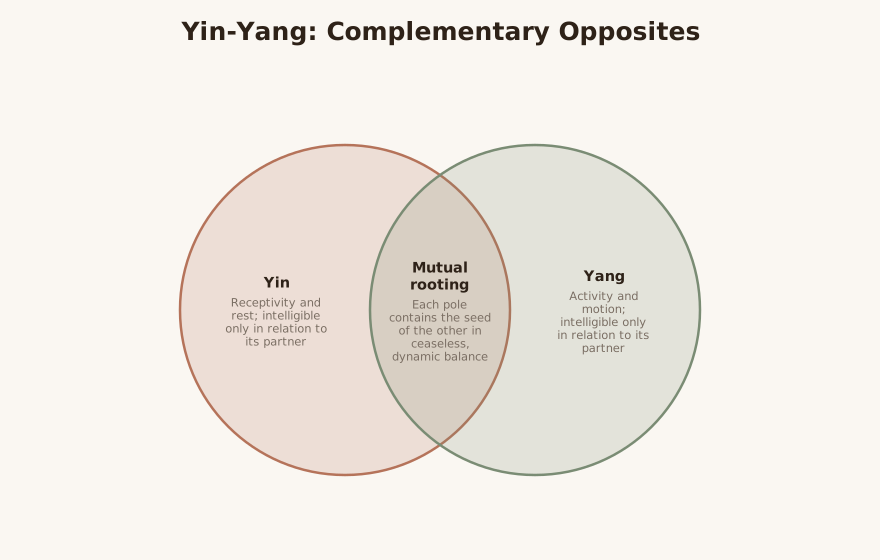
The first principle is complementarity: yin and yang are opposites that define and require one another rather than opposites that negate one another 1. There is no light without dark, no rest without motion, no activity without the receptivity it acts upon, so each pole is intelligible only in relation to its partner 5. Clinically, this reframes “opposite” states such as effort and rest, or closeness and autonomy, as partners in a single system rather than as a choice between good and bad LLM.
The second principle is interdependence and mutual rooting: each pole contains the seed of the other, an idea captured by the familiar symbol in which a dot of yin sits inside the yang field and a dot of yang inside the yin 5. Nothing is purely one thing; the maximum of one already harbors the beginning of the other 5. This is the conceptual antidote to all-or-nothing thinking, because it denies the possibility of a state that is wholly and permanently one quality LLM.
The third principle is dynamic balance and ceaseless transformation: yin and yang are not a static equilibrium but a continuous waxing and waning, so that as one waxes to its peak it gives way to the other 4. The Yijing makes this principle of change primary, treating reversal at the extreme as the normal course of events 4. For the clinician this offers a model of states as transient and self-correcting rather than fixed, which directly counters the catastrophic belief that a painful state is permanent LLM.
A fourth principle is relativity and proportion: nothing is absolutely yin or absolutely yang, and the same thing is yin relative to one referent and yang relative to another 2. Yin-yang is a relational measure, not an absolute classification, which is why the tradition speaks in degrees and ratios rather than in fixed kinds 2. This relational quality maps onto a dimensional, rather than categorical, view of experience that many therapies endorse LLM.
Interventions & Techniques
Because yin-yang is a theory rather than a protocol, its clinical use takes the form of a cognitive and attitudinal lens layered onto established techniques, most naturally the dialectical methods of Dialectical Behavior Therapy and the opposite-integrating work of Jungian and other depth therapies LLM. The foundational move is dialectical reframing: helping a client who is locked in an either-or position discover the “kernel of truth” in both poles and hold them together, which mirrors yin-yang’s insistence that opposites coexist and imply one another 1. The clinician models that two seemingly contradictory statements, such as “I am doing my best” and “I need to do better,” can both be true at once LLM.
A second technique uses the seed-of-the-other image directly to soften absolutist appraisals: when a client declares a situation, a person, or themselves to be wholly bad, the clinician explores where the dot of the opposite quality already sits within it, reflecting the principle that no pole is ever pure 5. A third technique draws on the principle of transformation to address the belief that a distressing state is permanent: the clinician frames moods, urges, and crises as waxing-and-waning processes that, like everything in the yin-yang model, tend to turn toward their opposite when they reach an extreme 4.
A fourth application is balance-oriented self-monitoring, in which the client tracks ratios of activity and rest, doing and being, or connection and solitude, and adjusts toward dynamic balance rather than toward a fixed ideal, echoing the medical use of yin-yang as a logic of restoring proportion 3.
LLM-generated illustrative example (not a guideline): A client insists, “Either I am completely in control or I am a total failure.” Within a dialectical frame informed by yin-yang, the clinician helps her notice that her week contained both controlled and out-of-control moments, that each contained a seed of the other, and that “in control” and “struggling” are points on a moving spectrum rather than two sealed boxes. They rehearse the statement, “I can be struggling and still be coping,” and she practices catching the moment her mind collapses the spectrum into a binary LLM.
In practice these techniques are delivered through the surrounding modality, for example as dialectical reframing and “walking the middle path” within Dialectical Behavior Therapy, as holding-the-tension-of-opposites within Jungian analysis, or as cognitive flexibility work within cognitive behavioral therapy LLM.
Evidence Base
Yin-yang is an established theory within Chinese cosmology, philosophy, and traditional medicine, and that established status is exactly what must be stated precisely to avoid overclaiming LLM. It is established as a venerable, internally coherent, and historically influential cosmological and philosophical framework, documented and analyzed in mainstream academic philosophy reference works 1. It is also an organizing principle of traditional Chinese medicine, where health is conceived as a dynamic balance of yin and yang and illness as their disharmony 3. What it is not is an empirically validated psychotherapy with its own outcome trials, and the therapist should never present it as one LLM.
The honest evidentiary position is therefore that yin-yang’s standing rests on scholarly and historical grounds rather than on randomized controlled clinical research 1. Where its core intuitions have measurable clinical traction, that traction belongs to the modern therapies that independently embody the same logic, principally the dialectical model of Dialectical Behavior Therapy and the broader literature on cognitive flexibility and reduced dichotomous thinking, not to yin-yang as a freestanding intervention LLM. It is also worth noting that academic work in Chinese philosophy of science cautions against reading yin-yang as a proto-scientific empirical theory; it is a correlative and cosmological system whose claims are not framed in the falsifiable terms of experimental science 2. The defensible clinical stance is to use yin-yang as an explanatory metaphor and a cognitive lens within an evidence-based modality, while reserving outcome claims for the validated therapy actually delivered LLM.
Populations & Indications
As a clinical lens, yin-yang is best suited to adults whose suffering is amplified by rigid, polarized ways of construing experience LLM. People with black-and-white or dichotomous thinking are the most natural fit, because the theory’s whole architecture refuses pure opposites and insists that each pole contains the other 5. Adults with cognitive rigidity and perfectionism are indicated where an all-or-nothing standard drives distress, since the model offers a vocabulary of degrees, proportions, and dynamic balance in place of fixed ideals 2.
People facing life transitions may be served by the theory’s emphasis on ceaseless change and on the reversal of states at their extremes, which can normalize the instability of a transitional period as a natural turning rather than a failure 4. Those under chronic stress and people seeking better life balance can use the explicit balance logic, including its medical articulation as the restoration of harmony, to reorganize the ratios of activity and rest in their lives 3. Meditators and clients already drawn to contemplative frameworks often find the imagery resonant and integrative LLM. Couples and clients with relationship conflict can use complementarity to reframe a partner’s opposite tendencies as a potentially balancing counterpart rather than a defect, provided this is done without excusing genuinely harmful behavior LLM.
Problems-for-Work
The construct speaks most directly to polarization-driven distress across several presentations LLM. For black-and-white thinking, the clinician uses the seed-of-the-other principle to demonstrate that no situation, person, or self is wholly one quality, training the client to locate the embedded opposite 5.
LLM-generated illustrative example (not a guideline): A client describes a colleague as “completely toxic.” Rather than debating the label, the clinician asks where the small dot of the opposite sits, eliciting two recent moments when the colleague was helpful, which loosens the totalizing appraisal without denying the real conflict LLM.
For cognitive rigidity and perfectionism, the work uses relativity and proportion to replace absolute standards with adjustable ratios, so that “perfect or worthless” becomes “more or less balanced today” 2. For emotional dysregulation, the principle of transformation reframes intense affect as a waxing-and-waning process that crests and reverses, supporting the client’s tolerance of a feeling they assume will last forever 4. For chronic stress and imbalance, the medical logic of restoring dynamic balance guides concrete adjustments to the proportion of exertion and recovery in daily life 3. For difficulty tolerating ambivalence, complementarity offers permission to hold two opposed truths at once rather than forcing premature resolution 1. For relationship conflict, complementarity reframes opposed temperaments as potentially balancing rather than simply incompatible, again only where the relationship is fundamentally safe LLM.
Contraindications, Cautions & Cultural Humility
The central caution is misuse of “balance” and “complementarity” to rationalize harm: a client should never be guided to see an abusive partner’s cruelty as the necessary yin to their own yang, and any framing that pressures someone to accept mistreatment in the name of balance is contraindicated LLM. Because the theory can be stretched to make any opposition look natural and harmonious, the clinician must guard against using it to minimize genuine injustice, danger, or the need for change LLM. Yin-yang language is also poorly matched to acute crisis, active psychosis, acute suicidality, and severe instability, where structure, safety planning, and stabilization take priority over philosophical reframing LLM.
A second caution is the appeal-to-nature error: yin-yang describes how a tradition understands the cosmos, and the fact that something is framed as a natural polarity does not make it good, fair, or unchangeable LLM. Clinicians should also avoid presenting yin-yang as if it were a validated medical or psychological treatment, since its standing is cosmological and historical rather than experimentally established, and traditional medical applications in particular should not be offered as substitutes for indicated care 3.
Cultural humility is essential because yin-yang is a sacred and deeply rooted element of Chinese cosmology, Taoism, and Chinese medicine, not a free-floating wellness motif 1. Clinicians should resist the common Western tendency to flatten it into a simple “balance” slogan or a decorative symbol, and should represent its origins and complexity accurately 5. For clients of Chinese or East Asian heritage the concept may carry layered cultural and spiritual meaning that the clinician should follow rather than define, while for clients from other backgrounds it should be offered as one optional lens among many, never imposed as a universal truth LLM.
Treatment-Plan Suggestions & SMART Objectives
| Goal | SMART objective (example) | Mechanism |
|---|---|---|
| Reduce black-and-white thinking | Within 8 sessions, client will identify 3 situations per week labeled in all-or-nothing terms and locate the “seed of the opposite” in each | Complementarity and the seed-of-the-other principle 5 |
| Increase cognitive flexibility | Over 6 weeks, client will reframe 2 absolute judgments per week into statements of degree or proportion | Relativity and proportion over absolute kinds 2 |
| Improve distress tolerance | Within 10 sessions, client will track 5 intense emotions and note when each crested and began to subside | Transformation and reversal of states at the extreme 4 |
| Loosen perfectionistic standards | Over 8 weeks, client will complete 2 tasks weekly to a “balanced enough” standard and record the result without all-or-nothing judgment | Dynamic balance replacing fixed ideals 2 |
| Restore activity-rest balance under stress | Within 6 sessions, client will monitor daily ratios of exertion and recovery and make one weekly adjustment toward balance | Restoring dynamic balance (medical analogy) 3 |
| Tolerate ambivalence | Over 6 weeks, client will hold and write down 1 “both-and” statement per week that affirms two opposed truths at once | Coexistence of complementary opposites 1 |
| Normalize a life transition | Within 8 sessions, client will reframe 3 features of their transition as natural turning rather than failure | Change as the fundamental reality (Yijing) 4 |
| Reframe relationship complementarity | Over 6 weeks, client will identify 2 partner traits previously seen as defects and describe how each could be balancing, where the relationship is safe | Complementarity of opposites 1 |
Common Misconceptions
The most consequential misconception is that yin-yang means a static fifty-fifty balance to be achieved and maintained; in the tradition it is a ceaseless dynamic alternation, a waxing and waning rather than a fixed equilibrium 4. A second is that yin is bad and yang is good, or that the pair maps onto a simple moral hierarchy; in fact the poles are valued as complementary and interdependent, and neither is intrinsically superior 1. A third, especially common in Western pop culture, is that yin-yang divides the world into two separate, mutually exclusive substances; correlative thinking instead sorts phenomena into relational pairs that contain and convert into one another, so the relationship, not the separation, is the point 2. A fourth is treating the symbol as a free-floating decoration detached from its philosophical and cosmological roots, which strips it of the precise meaning the tradition gives it 5. A fifth is mistaking the theory for an empirically tested scientific or clinical claim, when its standing is cosmological, philosophical, and historical rather than experimental 1.
Training & Certification
There is no license or certification in yin-yang as a therapy; it is a philosophical theory that licensed clinicians may draw on within their existing scope and modalities LLM. The most direct routes to clinically responsible use are training in the modern frameworks that operationalize its core logic, principally Dialectical Behavior Therapy with its dialectical and middle-path methods, and Jungian or depth-oriented psychotherapy with its work on the reconciliation of opposites, each of which has its own established training pathway LLM. Clinicians who wish to invoke yin-yang directly benefit from grounding in its source traditions through reputable academic treatments of Chinese cosmology, Taoism, the Yijing, and Chinese medicine, so that they represent the concept accurately rather than as a decontextualized slogan 1. Familiarity with the Yijing’s account of change and with the medical conception of health as balance helps a clinician use the metaphor precisely 4. As with any cross-cultural integration, clinicians should represent their competence and scope honestly and avoid implying spiritual or cultural authority they do not hold LLM.
Key Terms
Yin-yang – the principle that reality is composed of complementary, interdependent opposites in dynamic balance, each containing the seed of the other 1. Yin – the receptive, dark, yielding, cooling pole of the pair, originally the shady side of a hill 5. Yang – the active, bright, assertive, warming pole, originally the sunlit side of a hill 5. Correlative thinking – the mode of reasoning that sorts phenomena into resonant, mutually implicating pairs rather than into mutually exclusive categories 2. Complementarity – the relationship in which each pole defines, requires, and balances the other rather than negating it 1. Enantiodromia / transformation – the principle that a pole pushed to its extreme converts into its opposite, central to the Yijing’s account of change 4. Dynamic balance – a moving, self-adjusting proportion of the two poles rather than a fixed equilibrium 4. Tao – in Taoist thought, the source and underlying unity from which the complementary opposites emerge and to which they return 5. Yijing (Book of Changes) – the classical text whose system of yin and yang lines encodes the patterns of transformation 4.
Resources & Further Reading
▶ Watch — a video introduction to this concept:
- Yinyang (Yin-yang) | Internet Encyclopedia of Philosophy
- Science and Chinese Philosophy (Stanford Encyclopedia of Philosophy)
- Chinese Philosophy and Chinese Medicine (Stanford Encyclopedia of Philosophy)
- Chinese Philosophy of Change (Yijing) (Stanford Encyclopedia of Philosophy)
- Yin and yang (Wikipedia)
Reflective / Supervision Questions
- When I introduce yin-yang to a client, am I representing it as the rich cosmological theory it is, or am I flattening it into a “balance” slogan or a decorative symbol LLM?
- Am I alert to the risk that complementarity and balance language could be used to rationalize harm, injustice, or an abusive dynamic the client should leave rather than accept LLM?
- Am I clear with myself and the client that this is an explanatory metaphor and cognitive lens layered onto an evidence-based therapy, not a validated treatment in its own right LLM?
- For a client of Chinese or East Asian heritage, am I following the meaning the concept holds for them rather than imposing my own reading of it LLM?
- With a client in acute crisis, am I prioritizing safety and stabilization over philosophical reframing LLM?
- Where in my own clinical thinking am I stuck in an either-or, and how might holding the tension of opposites change how I see this client LLM?