
Type & Discipline
Virtual Reality Exposure Therapy (VRET) is a technique within clinical psychology, not a freestanding school of therapy LLM. It belongs to the family of technology-mediated exposure modalities: it takes the well-validated principles of behavioral exposure and delivers them through immersive, computer-generated environments rather than through real-world (in vivo) or imagined (imaginal) confrontation with feared stimuli 6. The patient typically wears a head-mounted display or sits inside an immersive screen room that reproduces the sights, sounds, and sometimes the smells and vibrations associated with the feared situation, while a clinician observes and titrates the scene in real time 45.
Mechanistically, VRET is a delivery format for exposure therapy and systematic desensitization, progressively habituating the patient to anxiety-triggering stimuli within a safe, controllable virtual setting 6. Because the clinical engine is the same as in standard exposure-based cognitive behavioral therapy (CBT), VRET is best understood as a method of administering an existing evidence-based treatment rather than as a novel intervention with its own theory of change LLM.
Creators & Lineage
VRET descends directly from behavioral exposure traditions: Joseph Wolpe’s systematic desensitization, broader exposure therapy, and, for trauma, prolonged exposure (PE) and CBT LLM. The conceptual debt is explicit in the literature, which frames VR therapy as a controlled, immersive instantiation of exposure and systematic desensitization 6.
The modality’s empirical foundations were laid in the early-to-mid 1990s. Max North published early work in 1994, and Ralph Lamson at Kaiser Permanente reported high success rates treating phobias around the same period 6. The figure most associated with establishing VRET as a credible clinical approach is Barbara Rothbaum, who, with computer scientist Larry Hodges at Georgia Tech and Emory University, conducted the first controlled studies beginning in 1994–1995 6. Their 1995 randomized trial in acrophobia is widely cited as the first controlled demonstration that virtual graded exposure could reduce a clinical fear 1.
For trauma applications, Albert “Skip” Rizzo’s Virtual Iraq system (2005) and its successor BRAVEMIND were pivotal, placing combat veterans in reconstructed conflict environments under therapist guidance and catalyzing the use of VRET for combat-related PTSD 6. Much of this work was sustained by U.S. Department of Defense funding, which is one reason the PTSD evidence base skews heavily military 63.
Core Principles
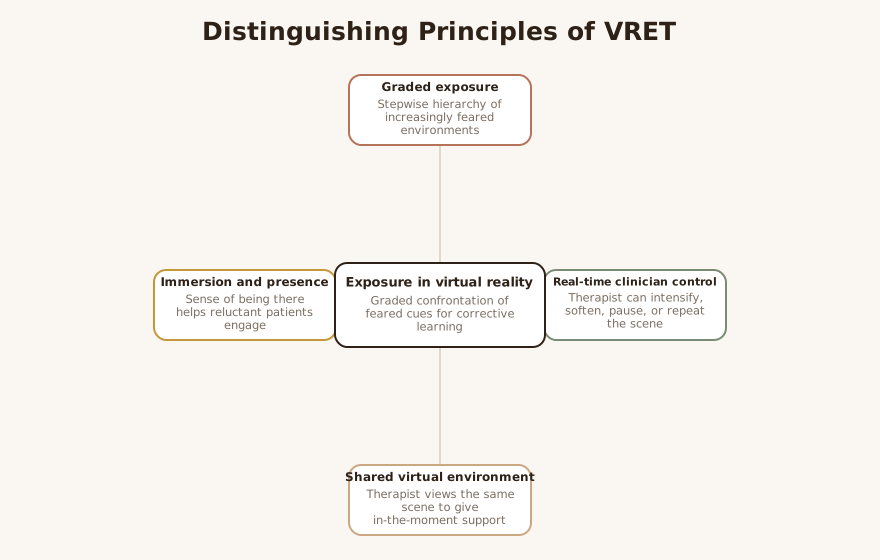
The therapeutic logic of VRET is the therapeutic logic of exposure. By confronting feared cues in a safe setting, the patient’s conditioned stress response is reduced and new, corrective learning is acquired 4. Several principles distinguish how this plays out in VR.
First, exposure is graded. The technology allows the clinician to move the patient through increasingly feared environments in a stepwise hierarchy, carefully monitored and tailored to the individual 5. Both graded-exposure and flooding approaches exist, but graded progression is the dominant clinical model 6.
Second, the clinician retains real-time control of the stimulus. Because the scene is software, the therapist can intensify, soften, pause, or repeat elements precisely, and the therapist views the same virtual environment, effectively sharing the patient’s experience and providing in-the-moment support 5. This degree of standardization and control is difficult to achieve with in vivo exposure LLM.
Third, immersion and presence matter. A sensory-rich, evocative environment helps reluctant patients engage with feared memories and situations they might otherwise avoid, and the sense of “being there” is thought to contribute meaningfully to outcome 5. Patients are often more willing to attempt VR exposure than other forms of exposure, partly because the virtual world does not carry the real risks of returning to the feared environment 5.
Fourth, VRET is therapist-delivered, not self-administered. A licensed clinician with exposure (typically prolonged exposure) experience discusses the trauma or fear, builds the virtual scenario, guides the in-session confrontation, and processes the experience afterward 4.
Interventions & Techniques
In practice, a VRET course resembles a standard exposure protocol with a VR-delivered exposure component LLM. Early sessions emphasize rapport, psychoeducation about anxiety and avoidance, and construction of a fear hierarchy before any headset is used 4. Patients spend time building the alliance with the therapist before VR exposure begins 4.
During exposure sessions, the patient enters the virtual scenario and confronts fear-inducing scenes within the virtual space, after which the therapist leads discussion and processing 4. The clinician adjusts intensity in real time, monitoring reactions and tailoring the scene to keep the patient within a productive window of activation 56. In trauma work, the therapist progressively reconstructs the environment to approximate the index event, then processes the meaning and emotion that surface 4. Coping-skills training and, where indicated, medication may supplement the protocol 4.
A consistent clinical observation is dose-responsiveness: effectiveness tends to increase with more sessions, and outcomes are often strongest when VR exposure is combined with traditional treatment approaches rather than used in isolation 4.
LLM-generated illustrative example (not a guideline): A clinician treating a veteran with combat-related PTSD might begin with two sessions of psychoeducation and breathing retraining, then introduce a neutral virtual convoy scene at low intensity, gradually adding engine noise, then radio chatter, then a simulated roadside event over subsequent sessions, pausing the scene to process spikes in distress and consolidate the new learning that the memory can be tolerated LLM.
Evidence Base
The maturity of VRET’s evidence is best described as established for phobias and promising but less mature for PTSD LLM.
For specific phobias and related anxiety disorders, a 2019 systematic review and meta-analysis directly compared VR exposure to gold-standard in vivo exposure across nine randomized controlled trials (371 participants), restricting inclusion to studies that equated the amount of exposure in both conditions 2. Both modalities produced substantial within-condition improvement, with VR effect sizes ranging from Hedges’ g = 0.35 to 2.76 2. The direct comparison showed only a small, non-significant advantage for in vivo overall (g = −0.20); for specific phobia (g = −0.15) and agoraphobia (g = −0.01) there was no evidence that VR was significantly less efficacious, though social phobia showed a significant advantage for in vivo (g = −0.50) 2. The authors concluded that VR exposure is broadly non-inferior for specific phobia and agoraphobia and advocated for wider dissemination given its practical advantages 2. This builds on the foundational acrophobia RCT, in which a virtual graded-exposure group improved significantly over eight weeks while a waiting-list comparison group did not 1.
For PTSD, the picture is more cautious. A meta-analysis of nine controlled trials (296 participants) found VRET superior to waitlist for PTSD symptoms (g = 0.62) and depression (g = 0.50), but anxiety effects were non-significant, and against active comparators the differences were small and non-significant (PTSD g = 0.25) 3. The authors concluded VRET “may be as effective as active comparators” but stressed caution: trials were few and small, samples were 88–100% male and predominantly military, heterogeneity among active comparisons was high (I² = 67%), and traditional exposure therapy has shown larger effect sizes (d ≈ 1.16–1.79) in other literatures 3. No long-term follow-up data were reported in that synthesis 3.
In short, the technique is real and clinically useful, but clinicians should not overstate it: for social anxiety and for PTSD against active treatments, VRET has not clearly outperformed established approaches LLM.
Populations & Indications
VRET has the strongest support in specific phobias, including acrophobia, fear of flying, and fear of spiders, and in agoraphobia 21. It is also applied to social anxiety disorder, panic disorder, and anxiety disorders more broadly, though the social-anxiety evidence is weaker 256.
The other major indication is PTSD, where VRET has been most heavily studied in veterans and combat-exposed service members for combat-related trauma 36. Civilian trauma populations studied include crime victims, 9/11 survivors, and firefighters, though these represent a small minority of the trial evidence 35. VRET is particularly attractive when the feared or traumatic situation is difficult or impossible to recreate safely in reality, such as military combat or severe accidents 4.
Beyond anxiety and trauma, the broader VR-therapy literature describes applications in chronic pain, stroke and neurorehabilitation, and other domains, but these fall outside the exposure-therapy core of VRET 6.
Problems-for-Work
VRET targets the avoidance and conditioned fear at the heart of anxiety and trauma disorders LLM. Representative problems and applications include:
- Acrophobia / heights: graded virtual ascent through floors, balconies, or glass elevators to reduce height-related anxiety and avoidance 1.
- Fear of flying: virtual boarding, taxi, takeoff, turbulence, and landing sequences for patients who avoid air travel 26.
- Agoraphobia / panic disorder: virtual crowded or enclosed settings to confront interoceptive and situational cues 26.
- Specific phobia (e.g., spiders): controlled, escalating encounters with feared stimuli at a pace the clinician sets 26.
- Combat-related PTSD: reconstructed deployment environments that allow processing of trauma memories otherwise hard to access 43.
- Avoidance behavior generally: any clinically significant avoidance pattern amenable to graded confrontation can be a target, since avoidance is the maintaining mechanism exposure addresses 4LLM.
Contraindications, Cautions & Cultural Humility
The most common adverse effect is cybersickness: prolonged VR exposure can produce nausea, dizziness, headache, and eye strain, which may limit session length or tolerability for some patients 6. Clinicians should screen for susceptibility, keep early immersions brief, and monitor for these symptoms LLM.
A second caution is reality transfer: success inside the virtual environment does not guarantee generalization to real-world situations, so clinicians should plan for in vivo consolidation or homework where feasible 6. Personalization is also imperfect; anxiety is highly individual and the available virtual scenarios may not match a given patient’s specific fear, limiting how closely the stimulus can be tailored 6.
Cost and access are real barriers: hardware and content development remain expensive, which can limit availability for underserved populations 6. Training standardization is another gap, as the field lacks robust, uniform certification protocols for VRET practitioners 6.
From a cultural-humility standpoint, the PTSD evidence base was built overwhelmingly on male, military samples, so its generalizability to women, civilians, and non-combat trauma is not established and should not be assumed 3LLM. Virtual scenarios designed for one cultural or occupational context may not represent another patient’s lived experience, and clinicians should treat scenario fit, not just symptom category, as part of appropriate matching LLM. As with all exposure work, VRET requires informed consent, a stable therapeutic alliance, and attention to whether immersive re-exposure is appropriate for a given patient’s current stability LLM.
Treatment-Plan Suggestions & SMART Objectives
| Goal | SMART objective (example) | Mechanism |
|---|---|---|
| Reduce height-related avoidance | Patient will complete a graded virtual height hierarchy through at least 6 levels with peak SUDS dropping by ≥40% within 8 weeks | Habituation and corrective learning via graded exposure 1 |
| Re-enable air travel | Patient will tolerate a full virtual flight sequence (boarding to landing) with SUDS ≤4/10 across 3 consecutive sessions within 8 sessions | In vivo-equivalent exposure to flight cues 2 |
| Decrease agoraphobic avoidance | Patient will remain in a virtual crowded enclosed environment for 15 minutes without escape behavior by session 6 | Extinction of situational/interoceptive fear 26 |
| Process combat trauma memory | Patient will narrate the index event within the reconstructed virtual scene across 3 sessions with declining peak distress | Emotional processing and habituation of trauma cues 43 |
| Reduce PTSD symptom severity | Patient will achieve a clinically meaningful reduction on a standardized PTSD measure over a 10-session VRET course | Exposure-based symptom reduction 3 |
| Build distress tolerance for exposure | Patient will apply a taught coping/breathing skill to keep within-session SUDS below 7/10 in 4 of 5 exposures | Self-efficacy and affect regulation supporting exposure 45 |
| Increase engagement in avoided activity | Patient will complete one real-world in vivo step matched to each mastered virtual scenario weekly | Generalization from virtual to real-world contexts 6 |
Common Misconceptions
“VRET is automated or self-guided.” It is therapist-delivered; a licensed clinician constructs the scenario, guides the exposure, and processes it afterward 4. The technology is a tool the clinician controls, not a replacement for the clinician 5.
“VR is gimmicky and less effective than real exposure.” For specific phobia and agoraphobia, the controlled evidence shows no significant inferiority to gold-standard in vivo exposure when exposure dose is equated 2.
“VRET cures PTSD better than standard therapy.” Against active comparators, VRET has not shown a significant advantage for PTSD, and traditional exposure has larger reported effect sizes; VRET is best framed as a comparably effective option, not a superior one 3.
“Results in VR automatically transfer to real life.” Generalization is not guaranteed, which is why real-world consolidation is often planned 6.
Training & Certification
VRET should be delivered by a licensed psychologist or qualified therapist with experience in exposure therapy, and specifically prolonged exposure for trauma applications 4. The clinical skill set is that of exposure-based CBT/PE; the VR system adds a technical layer for stimulus delivery and real-time scene control 45. Notably, the field currently lacks robust standardized certification protocols specific to VRET, so competence rests primarily on the clinician’s underlying exposure-therapy training plus familiarity with the particular VR platform in use 6LLM.
Key Terms
- Exposure therapy: confronting feared stimuli to reduce conditioned fear and avoidance; the clinical engine of VRET 4.
- Graded exposure: stepwise progression through a fear hierarchy from less to more distressing cues 5.
- In vivo exposure: real-world confrontation with feared situations; the comparison standard for VRET in phobia trials 2.
- Imaginal exposure: confrontation with feared content through imagination/narrative, often used in prolonged exposure LLM.
- Presence/immersion: the subjective sense of “being there” in the virtual environment, thought to support engagement and outcome 5.
- Cybersickness: motion-sickness-like symptoms (nausea, dizziness, eye strain) from VR exposure 6.
- SUDS: Subjective Units of Distress Scale, a 0–10 self-rating used to titrate exposure intensity LLM.
- BRAVEMIND / Virtual Iraq: military-specific VR systems for combat-related PTSD exposure 6.
Resources & Further Reading
▶ Watch — a video introduction to this concept:
- Rothbaum et al. (1995): Computer-generated (virtual reality) graded exposure for acrophobia
- Wechsler et al. (2019): VRET in phobias — systematic review and meta-analysis vs. in vivo exposure (Frontiers in Psychology)
- VRET for PTSD: systematic review and meta-analysis (PMC)
- BrainLine: Virtual Reality Exposure Therapy (VRET) overview
- Weill Cornell PATSS: Why Virtual Reality Exposure Therapy?
- Wikipedia: Virtual reality therapy
Reflective / Supervision Questions
- For this patient, what does VRET offer over in vivo or imaginal exposure, and is that advantage clinical (e.g., access to an unrecreatable situation) or merely logistical? LLM
- Given the male, military-dominated PTSD evidence base, how confident am I that the findings generalize to this particular patient, and how does that shape my consent conversation? 3LLM
- Have I planned for generalization to real-world settings rather than assuming virtual gains will transfer? 6
- How will I screen for and respond to cybersickness, and what is my threshold for shortening or stopping a session? 6
- Am I treating VRET as a technique within my exposure/PE competency, or am I leaning on the technology to compensate for gaps in exposure-therapy skill? 4LLM
- Is the virtual scenario a good cultural and contextual match for this patient’s actual fear or trauma, or only a category match? LLM