
Type & Discipline
The Behaviour Change Wheel (BCW) is an intervention-design framework rather than a therapy modality in its own right 1. It sits within health psychology and behavioral science, and it is widely used in public health and implementation science to characterize, select, and structure behavior-change interventions 2. The framework was published in the journal Implementation Science in 2011 and elaborated into a practitioner manual in 2014 23. For a clinician, the most useful way to think about the BCW is as a structured “diagnose-then-design” map: first work out why a target behavior is or is not happening, then decide what to do about it LLM.
Crucially, the BCW is content-agnostic. It does not prescribe a particular treatment; instead it organizes the universe of intervention options so that whatever modality you deliver — psychoeducation, skills training, environmental cueing, contingency management — is chosen deliberately rather than by habit 5LLM.
Creators & Lineage
The BCW was developed by Susan Michie, Maartje van Stralen, and Robert West, with Susan Michie as the lead figure most associated with it 1. The 2014 design guide, which turned the model into a step-by-step method, was authored by Michie, Lou Atkins, and Robert West 3.
The framework did not appear in a vacuum. The authors systematically reviewed 19 existing behavior-change frameworks and found three recurring shortcomings: they were not comprehensive (no single framework covered all the intervention types in use), they were incoherent (categories mixed different conceptual levels), and most lacked any link to an overarching model of behavior 2. The BCW was their synthesis intended to repair those gaps 2. Its conceptual lineage runs directly into the COM-B model (which forms its hub) and downstream into the Behaviour Change Technique Taxonomy v1 (BCTTv1), a companion catalogue of specific active ingredients used to operationalize the broad intervention functions LLM. Michie has continued to articulate the model and its empirical rationale in public lectures 67.
Core Principles
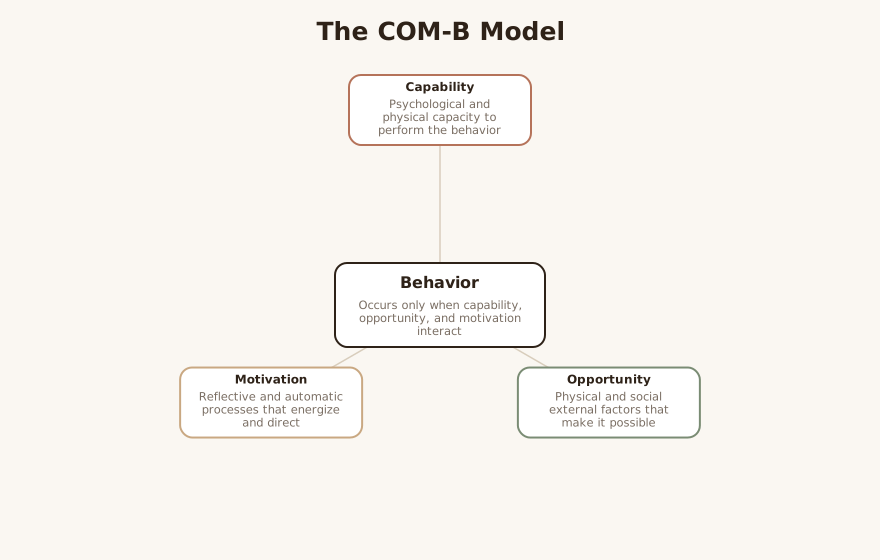
At the center of the wheel sits the COM-B model, which holds that any behavior (B) occurs only when three conditions are sufficiently present and interacting 24. Capability (C) is the individual’s psychological and physical capacity to perform the behavior — psychological capability covers knowledge, skills, and the capacity to engage in the necessary thought processes; physical capability covers the bodily functions and motor skills required 24. Opportunity (O) comprises the external factors that make the behavior possible — physical opportunity (the environment, resources, time) and social opportunity (culture, language, social norms, and the cues of those around us) 24. Motivation (M) is the internal process that energizes and directs behavior — reflective motivation (conscious plans, evaluations, intentions, beliefs about consequences) and automatic motivation (emotions, impulses, habits, and associative learning) 24.
The components are not independent; they interact bidirectionally with behavior in a dynamic system, so improving one (for example, building skill) can shift another (confidence, then motivation) 2. The first principle of practice, therefore, is that you cannot choose an effective intervention until you have specified the target behavior and diagnosed which COM-B component is the binding constraint 4LLM.
Wrapped around the COM-B hub are two outer rings. The middle ring holds nine intervention functions — broad ways an intervention can change behavior — and the outer ring holds seven policy categories — the means by which those functions are delivered and sustained at a system level 25. The logic of the wheel is concentric and directional: diagnosis (COM-B) drives the choice of intervention functions, which in turn drive the choice of policy or delivery mechanisms 5.
Interventions & Techniques
The nine intervention functions are: education (increasing knowledge or understanding); persuasion (using communication to induce positive or negative feelings); incentivisation (creating an expectation of reward); coercion (creating an expectation of punishment or cost); training (imparting skills); restriction (using rules to reduce the opportunity to engage in the behavior); environmental restructuring (changing the physical or social context); modelling (providing an example to aspire to or imitate); and enablement (increasing means or reducing barriers to capability or opportunity beyond the other functions) 2.
These functions map onto COM-B in a structured way — for instance, capability deficits are typically addressed by education, training, and enablement; opportunity deficits by restriction, environmental restructuring, and enablement; and motivation deficits by persuasion, incentivisation, coercion, modelling, and education 2LLM. The seven policy categories that can deliver these functions are communication/marketing, guidelines, fiscal measures, regulation, legislation, environmental/social planning, and service provision 2.
In practice, the broad intervention functions are made concrete using specific behavior change techniques (the smallest active ingredients), such as goal-setting, self-monitoring, prompts/cues, or social comparison LLM. The Social Change explainer also frames the policy ring along a “stealth-to-force” continuum, from subtle nudges to directive mandates, which helps practitioners weigh intrusiveness against likely durability 5.
LLM-generated illustrative example (not a guideline): A clinician working with a client who repeatedly skips an evening inhaler diagnoses the behavior with COM-B. Knowledge is intact (capability fine), but the inhaler lives in a bathroom cabinet the client never opens at night (physical opportunity) and the client “doesn’t feel sick at night” (automatic motivation). The plan pairs environmental restructuring (move the inhaler to the bedside, link to toothbrushing) with enablement (a phone reminder) — not more education LLM.
Evidence Base
Honest appraisal: the BCW is an established and very widely adopted framework, but “established” describes its conceptual maturity and uptake, not proof that interventions designed with it outperform those designed without it 12. The original authors were explicit that, while the wheel is “usefully characterised,” further research was needed to demonstrate whether it actually improves intervention effectiveness 2. That caveat still matters: the BCW organizes choice and improves the transparency and reproducibility of intervention design, but the efficacy of any given program ultimately rests on the specific techniques chosen and how well they are delivered 2LLM.
The framework’s strongest validated claim is structural: it was derived from a systematic review of 19 prior frameworks and demonstrated to be more comprehensive and coherent than its predecessors, and it was applied to worked examples in tobacco control and obesity to show it could characterize real interventions 2. The COM-B hub itself is best understood as a parsimonious, theory-linked model of behavior rather than a tested causal mechanism for any single condition 4LLM. Clinicians should therefore treat the BCW as a planning scaffold that complements, rather than replaces, the evidence base for whatever specific treatment they ultimately deliver LLM.
Populations & Indications
The BCW was designed for population- and service-level intervention design, and its core audiences are public health teams, intervention designers, and healthcare service planners 15. At the individual level, it is well suited to adults seeking lifestyle change, people with chronic illness, patients with adherence challenges, and any population targeted by health policy 15.
Indications are broad because the framework is behavior-specific rather than diagnosis-specific: it applies wherever a clearly definable behavior needs to start, stop, increase, or decrease 4LLM. For a frontline clinician, the practical indication is a case where simple “tell the patient what to do” advice has failed and you need to understand which part of the capability-opportunity-motivation system is actually blocking the behavior 4LLM.
Problems-for-Work
The BCW has been used across a wide span of health behaviors, including medication and treatment nonadherence, smoking cessation, physical inactivity, unhealthy diet and obesity, substance use, and poor chronic-illness self-management 12. It is equally relevant to the more generic problems of low motivation and capability barriers that cut across diagnoses 4.
The common application pattern is the same across these problems: specify the behavior, run a COM-B diagnosis, select intervention functions that target the deficit, then choose delivery methods 5. For nonadherence, the question is whether the barrier is forgetting (capability/opportunity) versus ambivalence about the medication (reflective motivation), because the two demand different functions LLM. For physical inactivity, opportunity barriers (no safe space, no time) call for environmental restructuring and enablement rather than another motivational pep talk 2LLM.
LLM-generated illustrative example (not a guideline): A therapist’s client wants to cut alcohol use. COM-B reveals strong reflective motivation (“I want to stop”) but powerful automatic motivation toward drinking when stressed, plus a social opportunity problem (every friend gathering centers on a bar). The plan combines training (urge-surfing and refusal skills), enablement (a coping plan), and a deliberate social-opportunity shift (proposing non-bar meetups) — addressing automatic motivation and opportunity, not just restating the goal LLM.
Contraindications, Cautions & Cultural Humility
The BCW has no clinical contraindications in the pharmacological sense, but it carries real cautions LLM. Two of the nine intervention functions — coercion (expectation of punishment) and restriction — and several policy levers can be paternalistic or coercive, so they require explicit ethical scrutiny before use with vulnerable individuals 2LLM. The “stealth-to-force” framing of the policy ring is a useful prompt to ask how intrusive an approach is and whether the person has genuinely consented to it 5LLM.
Cultural humility is essential because opportunity in COM-B is explicitly social and cultural — norms, language, and context shape what is possible and acceptable 2. A COM-B diagnosis that ignores the client’s cultural and structural context (poverty, discrimination, caregiving load) risks misattributing a structural-opportunity barrier to a personal “motivation” deficit, which is both inaccurate and stigmatizing 2LLM. The framework is descriptive, not value-neutral: it tells you what could change behavior but not whether you should change it, so the clinician retains responsibility for autonomy, equity, and informed consent LLM.
Treatment-Plan Suggestions & SMART Objectives
| Goal | SMART objective (example) | Mechanism (COM-B / function) |
|---|---|---|
| Improve medication adherence | Client will take the prescribed evening dose >=6 of 7 nights/week for 4 consecutive weeks, verified by a self-monitoring log | Physical opportunity + automatic motivation; enablement, environmental restructuring 2 |
| Increase physical activity | Client will complete two 20-minute walks per week for 6 weeks, recorded in a shared tracker | Physical opportunity + reflective motivation; enablement, goal-setting 2 |
| Reduce alcohol use | Client will identify 3 high-risk social situations and rehearse a refusal/coping plan for each within 3 sessions | Automatic motivation + social opportunity; training, modelling 2 |
| Build self-management capability | Client will demonstrate correct blood-glucose checking technique unaided by session 4 | Physical + psychological capability; training, education 2 |
| Strengthen quit motivation (smoking) | Client will complete a personalized pros/cons decisional balance and set a quit date within 2 sessions | Reflective motivation; persuasion, education 2 |
| Reduce environmental triggers | Client will remove identified cues (e.g., visible snacks, ashtrays) from the home within 1 week | Physical opportunity; environmental restructuring, restriction 2 |
| Increase social support | Client will recruit one accountability partner and schedule a weekly check-in for 4 weeks | Social opportunity; enablement, modelling 2 |
Common Misconceptions
“The BCW is a therapy.” It is a framework for choosing and structuring interventions; the therapy is whatever modality you use to deliver the selected functions 1LLM. “COM-B is just a fancy way of saying motivation.” It deliberately separates motivation from capability and opportunity precisely because so many failures are not motivational — people often want to change but lack the skill, the resources, or the environment 42. “More education will fix it.” Education is only one of nine functions and is the right lever only when a knowledge gap is the diagnosed barrier 2LLM. “Using the wheel guarantees an effective intervention.” The authors themselves cautioned that the framework’s value lies in comprehensiveness and coherence, while effectiveness still depends on the specific content delivered 2.
Training & Certification
There is no licensure or required certification to use the BCW; it is an open, published framework 1LLM. The foundational training resources are the 2011 Implementation Science paper, which defines the model, and the 2014 guide The Behaviour Change Wheel: A Guide to Designing Interventions, which lays out the step-by-step design method for practitioners 23. Susan Michie’s recorded lectures provide an accessible orientation to the model and its rationale 67. Practitioners typically build competence by reading the guide and pairing the framework with the Behaviour Change Technique Taxonomy to operationalize intervention functions into specific techniques 3LLM.
Key Terms
- COM-B model: The hub of the wheel; behavior (B) results from the interaction of capability, opportunity, and motivation 2.
- Capability: Psychological and physical capacity to enact the behavior 24.
- Opportunity: Physical and social external factors that make the behavior possible 24.
- Motivation: Reflective (conscious) and automatic (emotional/habitual) processes that energize behavior 24.
- Intervention function: One of nine broad ways an intervention changes behavior (e.g., education, training, enablement) 2.
- Policy category: One of seven system-level means of delivering intervention functions (e.g., guidelines, service provision) 2.
- Behavior change technique: The smallest active ingredient used to operationalize an intervention function (e.g., self-monitoring) LLM.
Resources & Further Reading
▶ Watch — a video introduction to this concept:
- Michie, van Stralen & West (2011) — The behaviour change wheel (PubMed listing) 1
- The behaviour change wheel — full text (PMC3096582) 2
- Michie, Atkins & West (2014) — The Behaviour Change Wheel: A Guide to Designing Interventions 3
- The COM-B Model for Behavior Change — The Decision Lab 4
- The Behaviour Change Wheel — Social Change 5
- Dr. Susan Michie — The Behaviour Change Wheel (YouTube) 6
- What really changes behaviour? — Professor Susan Michie (YouTube) 7
Reflective / Supervision Questions
- For my current case, have I specified the target behavior concretely enough to diagnose it, or am I working with a vague goal like “be healthier”? LLM
- When this client’s behavior change has stalled, which COM-B component is actually the binding constraint — and have I tested that assumption or just defaulted to “low motivation”? 4LLM
- Am I reaching for education or persuasion out of habit when the real barrier is opportunity or skill? 2LLM
- Where does my chosen approach sit on the stealth-to-force continuum, and have I weighed its intrusiveness against the client’s autonomy and consent? 5LLM
- Have I checked whether what looks like a personal “motivation deficit” is actually a structural or cultural opportunity barrier outside the client’s control? 2LLM
- Within which billable modality am I delivering this plan, and does my documentation reflect the specific technique rather than the planning framework? LLM