
Type & Discipline
Transactional Analysis (TA) is a theory of personality and a method of psychotherapy that sits within clinical psychology and counseling, and is most often classified as a neo-psychoanalytic, humanistic approach. 4 It was conceived simultaneously as a model of the structure of the mind, a model of communication, and a system of intervention, and Eric Berne deliberately phrased its concepts in plain, everyday language so that clients could understand and use them. 1 Although its roots are psychoanalytic, TA departs from classical analysis by emphasizing observable here-and-now communication, a collaborative therapist-client relationship, and the conviction that people can change. 3
TA is unusual among therapeutic traditions in that it migrated rapidly out of the consulting room into organizational, educational, and coaching settings, where its accessible vocabulary travels well. 2 For clinicians, the most useful framing is that TA offers a shared, non-pathologizing language for talking about how a person relates to themselves and others, which can be layered onto the relational and self-concept work that already happens inside recognized therapeutic modalities. LLM
Creators & Lineage
TA was created by Eric Berne (1910-1970), a Canadian-born psychiatrist trained in psychoanalysis who developed the framework in the 1950s and popularized it through bestselling books, most famously Games People Play (1964) and Transactional Analysis in Psychotherapy. 4 Berne trained within the psychoanalytic tradition and his work is a direct descendant of Freudian theory, with the Parent-Adult-Child ego states often read as an accessible reworking of the superego-ego-id structure. 3
The lineage of TA therefore draws on psychoanalysis and ego psychology, but Berne’s clinical sensibility and his trust in the client’s capacity for autonomy align it equally with humanistic psychology, and its experiential, here-and-now techniques overlap with Gestalt therapy. 3 After Berne’s death the approach was carried forward and formalized by a professional community, principally through the International Transactional Analysis Association (ITAA), which maintains training standards, examinations, and a body of literature across psychotherapy, counseling, education, and organizational fields. 2 TA concepts also entered popular and managerial culture through accessible explainers, which helped spread the model but also diluted the distinction between casual self-help use and rigorous clinical practice. 6
Core Principles
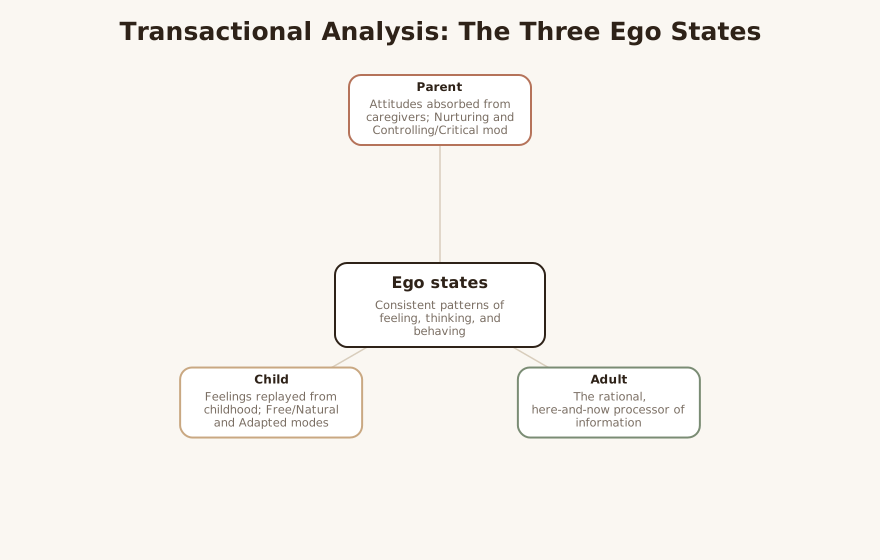
The central structural model of TA is that each person has three ego states — consistent patterns of feeling, thinking, and behaving — labeled Parent, Adult, and Child. 5 The Parent ego state contains attitudes and behaviors absorbed from caregivers and authority figures; the Adult is the rational, here-and-now processor of information; and the Child holds feelings, impulses, and reactions replayed from childhood. 5 Each state can be observed in a person’s tone, vocabulary, posture, and behavior, and Berne treated these as real, observable phenomena rather than abstract metaphors. 1
The Parent and Child are commonly subdivided in clinical teaching: the Parent into a Nurturing and a Controlling/Critical mode, and the Child into a Free/Natural and an Adapted mode. 6 A transaction is a unit of social exchange — one person’s communication (the stimulus) and the other’s reply (the response) — and TA analyzes which ego state is sending and which is being addressed. 3 Transactions are described as complementary (the response comes from the ego state that was addressed, so communication flows smoothly), crossed (the response comes from an unexpected ego state, producing friction or breakdown), or ulterior (a covert message runs beneath the social one). 6
Beyond single transactions, TA describes larger recurring patterns. Strokes are units of recognition, and Berne held that people are driven to seek them, accepting negative strokes when positive ones are unavailable. 6 Games are series of ulterior transactions that proceed to a predictable, often uncomfortable payoff and reinforce a person’s existing relational stance. 1 The life script is an unconscious life plan formed in childhood out of early decisions and parental messages, which the person then lives out, sometimes self-defeatingly, into adulthood. 4 An overarching humanistic premise — that people are fundamentally “OK” and capable of autonomous change — underlies the model and distinguishes its tone from deterministic readings of psychoanalysis. 3
Interventions & Techniques
The foundational technique is structural analysis: helping the client recognize which ego state they are operating from in a given moment, and noticing shifts between Parent, Adult, and Child. 5 Transactional analysis proper then examines the back-and-forth between people, mapping complementary, crossed, and ulterior transactions so that the client can see how predictable conflicts are generated. 3 A common therapeutic aim is to strengthen the client’s access to the Adult ego state so they can respond to present reality rather than replaying old patterns. 5
Game analysis identifies the repetitive, payoff-driven sequences a client gets drawn into — in relationships, at work, or with the therapist — and brings the hidden agenda and the predictable bad feeling at the end into awareness. 1 Script analysis explores the early decisions and parental messages that shaped the client’s life plan, with the goal of revising self-limiting scripts in favor of autonomy. 4 Contemporary TA practice typically frames the work around an explicit, collaboratively negotiated contract that names the change the client wants, reflecting the model’s egalitarian, non-pathologizing stance. 3
LLM-generated illustrative example (not a guideline): A client repeatedly reports the same argument with their partner. The therapist helps them notice that they open from a Critical Parent (“You never help”), the partner answers from a wounded Child, and the exchange resolves in the familiar payoff of mutual resentment. Naming the pattern lets the client experiment with opening from Adult instead. LLM
Evidence Base
TA is best described as an established approach in the sense that it has a long clinical history, a formal professional community, standardized training, and continued worldwide use across psychotherapy, counseling, education, and organizational settings. 2 Its concepts have been influential and durable, and its accessible language has given it unusual reach beyond clinical psychology. 6
However, clinicians should be honest that “established” here means long-standing and widely taught, not strongly evidenced by the standards of contemporary outcome research. LLM TA originated from psychoanalytic clinical observation rather than controlled trials, and much of its literature is theoretical, case-based, or applied rather than experimental. 4 The available explainer and reference material emphasizes TA’s conceptual contributions and its influence far more than a robust randomized-controlled-trial base, and practitioners should treat the model as a clinically useful heuristic and relational language rather than an empirically validated, manualized treatment for any specific disorder. 3 When working with conditions that have strong first-line evidence-based treatments, TA is most defensibly used as a complementary framework within a recognized modality rather than as a stand-alone substitute. LLM
Populations & Indications
TA was developed and refined substantially in group settings, and Berne’s work has a strong group-therapy heritage; it is also applied with individual adults, couples, and families. 4 Because its vocabulary is concrete and non-shaming, it is often used with adolescents and in organizations and teams, where the ego-state and transaction language helps people examine communication without heavy clinical jargon. 2
The model is indicated wherever the clinical focus is on patterns of relating — to others or to oneself — rather than on a discrete symptom alone. LLM Its concepts map naturally onto relationship conflict, communication problems, and maladaptive relational patterns, and the script and stroke concepts speak to low self-esteem, identity issues, and longer-standing personality difficulties. 6 TA is also applied to mood and anxiety presentations and to self-defeating behavior, though here it functions best as a relational and self-concept lens layered onto a primary evidence-based treatment. LLM
Problems-for-Work
- Relationship conflict and communication problems. Mapping crossed and ulterior transactions gives partners or colleagues a shared, blame-reducing way to see how a familiar argument is built and where it could be interrupted. 6
- Maladaptive relational patterns and self-defeating behavior. Game analysis surfaces the repetitive sequences and their hidden payoffs, helping a client recognize the role they play and choose out of it. 1
- Low self-esteem and identity issues. Script analysis links present self-limiting beliefs to early decisions and parental messages, opening the possibility of revising the script toward autonomy. 4
- Depression and anxiety. The Adult-strengthening and stroke-economy work can be used to interrupt internalized Critical Parent messaging and to build healthier recognition-seeking, within a broader treatment plan. LLM
- Personality difficulties and interpersonal difficulties. The ego-state framework offers a structured, observable language for chronic relational stances that clients and clinicians can track over time. 5
LLM-generated illustrative example (not a guideline): An adolescent in a family session describes constant clashes with a parent. Using TA, the family notices the parent reliably speaks from Controlling Parent and the teen answers from Rebellious Adapted Child. Practicing Adult-to-Adult requests at home becomes a concrete between-session task. LLM
Contraindications, Cautions & Cultural Humility
TA is not a manualized, disorder-specific treatment, so the principal caution is against using it as a stand-alone intervention where a condition has strong first-line evidence-based therapies; in those cases it should support, not replace, the indicated treatment. LLM The accessibility that makes TA appealing can also lead to oversimplification — labeling someone as “in Child” or “playing a game” can become reductive or even subtly shaming if used carelessly, which contradicts the model’s own “I’m OK, you’re OK” premise. 3
Because TA concepts are widely available in popular self-help form, clinicians should distinguish casual lay use from disciplined clinical application and avoid importing pop-psychology assumptions uncritically. 6 Cultural humility is essential: the Parent ego state encodes culturally transmitted norms, and what counts as a “healthy” stroke, a respectful transaction, or an autonomous script is shaped by cultural, family, and community values. LLM The therapist should hold the ego-state and script models as collaborative hypotheses to be checked against the client’s own meaning rather than as universal truths, and should be alert to how labeling a client’s culturally normative behavior as “Adapted Child” or “script-bound” could pathologize difference. LLM
Treatment-Plan Suggestions & SMART Objectives
| Goal | SMART objective (example) | Mechanism |
|---|---|---|
| Increase Adult-state awareness | Within 6 sessions, client will identify in session which ego state (Parent/Adult/Child) they are speaking from in at least 3 recent interactions. | Structural analysis builds metacognitive self-observation 5 |
| Reduce a recurring relational “game” | Over 8 weeks, client will name one repetitive conflict pattern, its hidden payoff, and one alternative response, demonstrated in a role-play. | Game analysis surfaces ulterior transactions and payoffs 1 |
| Improve communication in a couple | By session 10, partners will identify 2 crossed transactions from the prior week and rehearse a complementary Adult-to-Adult alternative. | Transaction mapping reframes conflict as patterned, not personal 6 |
| Revise a self-limiting belief | Within 12 sessions, client will articulate one early “script” message and a chosen counter-statement, and report applying it twice. | Script analysis links early decisions to present self-concept 4 |
| Build healthier recognition-seeking | Over 6 weeks, client will log situations where they sought negative strokes and substitute one positive stroke-seeking behavior weekly. | Stroke economy reframes recognition needs 6 |
| Reduce Critical-Parent self-talk | By session 8, client will identify 3 internal Critical Parent messages and reframe each from a Nurturing Parent or Adult stance. | Ego-state dialogue work targets internalized criticism 5 |
| Increase relational autonomy | Within treatment, client will set and keep one boundary that interrupts a habitual game, reported in 2 consecutive sessions. | Translating insight into autonomous behavioral choice 1 |
Common Misconceptions
A frequent misconception is that the Parent-Adult-Child ego states are literal “inner people” or fixed personality types; they are observable, shifting states of functioning, and a healthy person moves flexibly among all three. 5 Another is that “Adult” is good while “Parent” and “Child” are bad — in fact the Nurturing Parent and Free Child are valuable, and the therapeutic aim is flexibility and appropriate access, not permanent residence in the Adult. 6
The word “game” is also misread. In TA a game is not playful or deliberate; it is a repetitive, largely out-of-awareness sequence of ulterior transactions ending in a predictable bad feeling, so calling someone’s pattern a “game” is a clinical description, not an accusation of manipulation. 1 Finally, TA’s mass-market popularity leads some to assume it is merely self-help; while its language is accessible by design, structural, transactional, game, and script analysis constitute a genuine clinical method when applied with rigor. 3
Training & Certification
Formal training and credentialing in TA are organized internationally through the International Transactional Analysis Association (ITAA) and affiliated regional bodies, which maintain training pathways and recognized qualifications across psychotherapy, counseling, education, and organizational fields. 2 The professional structure typically involves supervised training, accumulated practice hours, and formal examination, reflecting TA’s status as a defined modality with its own standards rather than an informally transmitted technique. 2
For clinicians already licensed in a primary discipline, TA can be incorporated as a framework within existing scope of practice, with deeper formal certification pursued through ITAA-affiliated training if a clinician wants to practice and represent themselves specifically as a TA practitioner. LLM Authoritative conceptual grounding is available through the official Eric Berne estate materials, while introductory and applied overviews are widely available through general explainer resources. 1
Key Terms
- Ego state: A consistent pattern of feeling, thinking, and behaving — Parent, Adult, or Child. 5
- Parent (P): Attitudes and behaviors copied from parents and authority figures; subdivided into Nurturing and Controlling/Critical. 6
- Adult (A): The rational, here-and-now ego state that processes current reality. 5
- Child (C): Feelings and reactions replayed from childhood; subdivided into Free/Natural and Adapted. 6
- Transaction: A unit of communication consisting of a stimulus and a response between ego states. 3
- Complementary / crossed / ulterior transactions: Smooth, friction-producing, or covert exchanges, respectively. 6
- Stroke: A unit of recognition; people seek strokes and will accept negative ones if positive ones are scarce. 6
- Game: A repetitive series of ulterior transactions ending in a predictable payoff. 1
- Life script: An unconscious life plan formed in childhood from early decisions and parental messages. 4
Resources & Further Reading
▶ Watch — a video introduction to this concept:
- Description of Transactional Analysis and Games — Dr. Eric Berne MD (official estate site) 1
- International Transactional Analysis Association (ITAA World) 2
- Transactional Analysis Theory & Therapy: Eric Berne — Simply Psychology 3
- Transactional Analysis — Wikipedia overview 4
- Eric Berne: The 3 Ego States of Transactional Analysis — YouTube 5
- Transactional Analysis — Eric Berne (Businessballs) 6
Reflective / Supervision Questions
- When I notice a client “in Child,” am I using the ego-state model to understand them collaboratively, or am I quietly labeling and distancing? LLM
- Where might my own Parent or Child ego states be activated in the therapeutic relationship, and how is that shaping the transactions between us? LLM
- Am I treating the script or game I have hypothesized as a tentative, client-checked formulation, or as a fixed truth about who this person is? LLM
- For this presentation, is TA the most defensible primary framework, or should it support an intervention with stronger condition-specific evidence? LLM
- How do the client’s cultural, family, and community values shape what counts as a “healthy” stroke, transaction, or autonomous script — and am I imposing my own norms? LLM