
Type & Discipline
Relational autonomy is a construct rather than a treatment modality: it is a philosophical reconception of what autonomy is, drawn primarily from feminist philosophy and bioethics 1. It does not prescribe a set of techniques the way a packaged therapy does; instead it offers a corrective lens on a value clinicians invoke constantly — client self-determination LLM. The term names a family of positions united by the conviction that “persons are socially embedded and that agents’ identities are formed within the context of social relationships and shaped by a complex of intersecting social determinants” 1. Its disciplinary home is the literature on autonomy theory, where it stands in deliberate contrast to traditional, individualist accounts 1.
For practicing therapists, the relevance is practical rather than abstract: ethics codes, informed-consent procedures, and recovery-oriented care all rest on a concept of autonomy, and relational autonomy reshapes how that concept should be applied with clients whose choices are constrained by oppression, dependency, or coercion LLM. It belongs to the same conceptual neighborhood as feminist therapy, self-determination theory, and supported decision-making, but it is upstream of all of them as a theory of the self LLM.
Creators & Lineage
The phrase “relational autonomy” was crystallized as an organizing term by Catriona Mackenzie and Natalie Stoljar in their edited 1999 Oxford University Press volume, Relational Autonomy: Feminist Perspectives on Autonomy, Agency, and the Social Self 2. That collection gathered diverse feminist critiques and reconstructions of autonomy under a single umbrella, and it remains the canonical reference point for the field 3. Mackenzie and Stoljar explicitly intended “relational autonomy” as an umbrella term rather than a single unified theory 1.
The lineage extends to several major contributors whose distinct positions the volume helped consolidate 1. Jennifer Nedelsky argued that what actually enables people to be autonomous “is not isolation, but relationships” — a foundational reframing for the whole project 1. Marilyn Friedman developed procedural accounts emphasizing reflective endorsement and a usable threshold notion of autonomy for people living in oppressive contexts 1. Diana Meyers introduced the influential idea of “autonomy competency,” a repertoire of agentic skills, and engaged the challenges intersectionality poses to demands for a coherent self 1. Marina Oshana advanced a strongly relational, “social-relational” account on which autonomy requires de facto practical control over the direction of one’s life 1. Natalie Stoljar continues to develop and curate this body of work; she is a member of the philosophy faculty at McGill University 4.
Core Principles
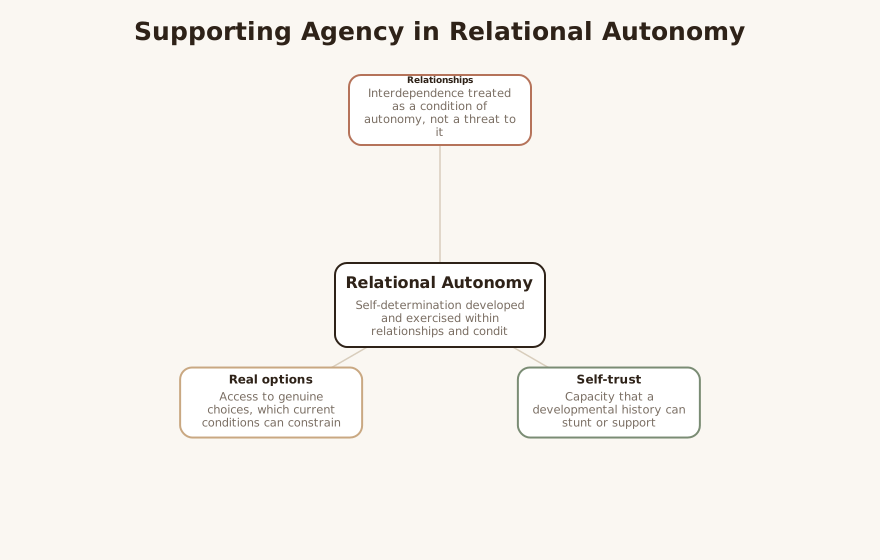
The central move is the rejection of an “atomistic” picture of the person — the idea that autonomy “presupposes a conception of the person as ‘atomistic,’ as ideally self-sufficient, as operating in a vacuum unaffected by social relationships” 1. Feminist theorists argued that this individualist picture wrongly treats relationships and interdependence as threats to autonomy rather than as its conditions 1. The clinical translation is direct: a client embedded in caregiving, family, or community is not therefore less autonomous, and pushing a client toward “independence” is not the same as supporting their agency LLM.
A key distinction is between causal and constitutive relational claims 1. Causal accounts hold that social relationships develop autonomy, so that “a lack of appropriate social relationships can also stunt its development” 1. Constitutive accounts go further, treating certain social conditions as definitionally part of what autonomy is, not merely as inputs that help it grow 1. The two are not mutually exclusive, and many clients present with both a developmental history that stunted self-trust and current conditions that constrain real choice LLM.
A second distinction is between procedural and substantive accounts 1. Procedural theories are content-neutral: autonomy is present when an agent can reflect critically on her own motivations, beliefs, and values, whatever their content 1. Substantive theories add normative constraints — “strong substantive” approaches restrict which preference contents count as autonomous, while “weak substantive” approaches require certain self-regarding attitudes without dictating preference content directly 1. The weak-substantive camp is especially useful clinically, because it ties autonomy to attitudes like self-trust and self-respect that therapy can actually address LLM.
Interventions & Techniques
Because relational autonomy is a construct, it does not supply a manualized protocol; it functions as a lens that reshapes how a clinician deploys whatever modality they already practice LLM. The most concrete operational handle is the notion of autonomy competencies — the agentic skills, such as self-discovery, self-definition, and self-direction, that Meyers argued autonomy consists in 1. Reframing autonomy as a set of skills, rather than a possession someone either has or lacks, makes it a legitimate target of intervention LLM.
Several attitudinal capacities are treated as conditions of autonomy and are workable in session. Self-trust is held to be “a necessary condition of autonomy,” and justified self-trust is described as an “attitude of optimism about our own competence and moral integrity” 1. Oppression is understood to damage these capacities directly, through shame and diminished self-worth 1. Interventions therefore aim to rebuild self-trust and self-respect, to validate the client’s own appraisals, and to widen the actual option set rather than only to process a decision in the abstract LLM.
LLM-generated illustrative example (not a guideline): A clinician working with a client who feels “selfish” for considering leaving a controlling marriage does not adjudicate the decision. Instead they help the client notice that her sense of having no right to her own preferences is itself a learned response to constraint, work to restore her trust in her own perceptions, and explore what options are genuinely available — financial, social, legal — so that any choice is made from a wider field rather than a foreclosed one LLM.
A relational-autonomy-informed stance also reorients the clinician’s posture toward the client’s relationships: rather than coaching the client toward self-sufficient independence, the work supports the relationships and supports that make agency possible, consistent with Nedelsky’s claim that relationships, not isolation, enable autonomy 1.
Evidence Base
The maturity of relational autonomy is best described as established — but as theory and ethics, not as an outcome-tested intervention LLM. It is a mature, widely cited body of philosophical work with a clear canonical literature, anchored by the Mackenzie and Stoljar volume and an extensive subsequent scholarship catalogued in standard reference databases 3. Within philosophy and bioethics its standing is secure, and it is treated as a foundational framework in the Stanford Encyclopedia of Philosophy’s coverage of autonomy 1.
Honesty requires being clear about what that establishment does and does not mean for clinicians LLM. There is no randomized-controlled-trial evidence that “applying relational autonomy” improves clinical outcomes, because it is not the kind of object that gets trialed; it is a conceptual framework, not a treatment arm LLM. Its evidentiary weight is argumentative and normative — it offers reasons to prefer certain ways of respecting clients — and clinicians should present it that way rather than overclaiming empirical support LLM. Its practical credibility comes from coherence with established clinical commitments (informed consent, trauma-informed care, cultural responsiveness), not from effect sizes LLM.
Populations & Indications
Relational autonomy was developed with attention to women and gender-diverse people, whose interdependence and caregiving roles individualist accounts tended to pathologize as autonomy-undermining 1. It is especially indicated for clients in oppressive or coercive contexts — intimate partner violence, trafficking, or high-control relationships and groups — where the central question is whether and how a constrained person can still exercise meaningful agency LLM. The framework’s analysis of how oppression shapes desire and self-worth makes it well suited to exactly these situations 1.
It also fits clients from collectivist or interdependent cultural backgrounds, for whom a Western individualist autonomy norm can feel alien or even harmful, since relational accounts explicitly deny that embeddedness diminishes agency LLM. Other apt populations include adolescents and emerging adults negotiating individuation, older adults facing capacity and guardianship questions, and clients with disabilities navigating supported decision-making — all situations in which agency is exercised through, not against, relationships and supports LLM.
Problems-for-Work
Coerced or pressured decision-making. When a client’s “choice” is shaped by threat or dependency, a relational lens directs the clinician to assess the conditions of the choice, not only its content, consistent with constitutively relational accounts that require real practical control over one’s life 1.
Adaptive preferences. Clients sometimes want only what their constraints have left them room to want; such preferences are treated as “paradigmatically nonautonomous” when they form unconsciously under oppressive conditions, though theorists disagree about how strictly to apply this 1. Clinically, the work is to gently surface whether a stated preference is genuinely the client’s or a narrowing imposed by circumstance LLM.
Impaired self-trust and self-respect. Because self-trust is a necessary condition of autonomy and oppression erodes it, rebuilding the client’s confidence in their own competence and moral integrity is itself autonomy-restoring work 1.
Over-accommodation and identity foreclosure. For clients who have organized themselves entirely around others’ needs, the autonomy-competency frame lets the clinician treat self-definition and self-direction as learnable skills rather than character traits 1.
LLM-generated illustrative example (not a guideline): A young adult who has never chosen a course of study without a parent’s approval is not framed as “enmeshed and deficient.” The clinician instead scaffolds the autonomy competencies of self-discovery and self-direction, while keeping the supportive relationship intact, so that the client practices deciding rather than being pushed into premature “independence” LLM.
Contraindications, Cautions & Cultural Humility
Relational autonomy is a lens, not a license to override clients, and its central caution is that it can be misused LLM. Because some accounts are strongly substantive — judging certain preferences as nonautonomous — a careless clinician could use the framework to discount a client’s stated wishes as “merely adaptive” and substitute their own judgment 1. That risk is real and must be named: the framework’s whole point is to expand respect for agency, not to give the clinician authority to decide which of a client’s preferences are the real ones LLM.
The procedural–substantive debate is itself a caution flag, because theorists genuinely disagree about how far normative constraints on autonomy can go without becoming paternalistic 1. Cultural humility is essential here, since the very critique that birthed relational autonomy was a critique of imposing one culture’s individualist norms; applying it well means resisting the temptation to relabel culturally interdependent choices as deficits in autonomy 1. With clients in genuinely dangerous situations, the framework informs but does not replace safety planning, mandated-reporting duties, or capacity assessment, which operate under their own legal and ethical rules LLM.
Treatment-Plan Suggestions & SMART Objectives
| Goal | SMART objective (example) | Mechanism |
|---|---|---|
| Strengthen self-trust as a basis for choice | Within 8 sessions, client will identify and verbalize 3 instances per week where she trusted her own judgment, rated on a self-report log | Justified self-trust as a necessary condition of autonomy 1 |
| Distinguish authentic preferences from adaptive ones | Over 6 sessions, client will name 2 wants previously assumed “off-limits” and evaluate whether they reflect his values or his constraints | Surfacing adaptive preferences shaped by circumstance 1 |
| Build autonomy competencies | Within 10 sessions, client will practice and report on one self-direction skill (e.g., making a low-stakes decision unaided) weekly | Autonomy as a repertoire of learnable agentic skills 1 |
| Widen the real option set | Within 4 sessions, client and clinician will map 3 concrete options (financial, social, legal) the client did not previously see as available | Constitutively relational control over life direction 1 |
| Repair self-respect eroded by oppression | Over 8 sessions, client will reduce shame-based self-statements, tracked on a weekly measure, by identifying their source in external conditions | Oppression’s damage to self-worth as autonomy-undermining 1 |
| Support, not sever, enabling relationships | Within 6 sessions, client will identify 2 relationships that expand their agency and 1 that constrains it, and set one boundary | Relationships, not isolation, enable autonomy 1 |
| Reduce coerced decision-making | Within 12 sessions, client will defer no major decision solely to another’s demand without first articulating her own position aloud in session | Practical control as a condition of relational autonomy 1 |
Common Misconceptions
A frequent error is hearing “relational autonomy” as “autonomy doesn’t matter” or “the group decides” — it is neither, since it is still an account of autonomy, not its abandonment 1. The framework reconceives autonomy as socially embedded; it does not dissolve individual agency into the collective 1. A second misconception is that it simply means “consider the client’s relationships,” when in fact it makes a stronger claim that relationships and social conditions can be constitutive of agency, not merely contextual 1.
A third is treating it as a single theory with one definition, when Mackenzie and Stoljar explicitly offered it as an umbrella term covering procedural and substantive, causal and constitutive variants that disagree with one another 1. Finally, some clinicians assume the substantive versions license overriding “inauthentic” preferences; the more defensible reading uses the adaptive-preference concept as a question to explore with the client, not a verdict to impose on them LLM.
Training & Certification
There is no certification in relational autonomy, because it is a philosophical construct rather than a credentialed modality LLM. Competence comes from reading the primary literature — beginning with the Mackenzie and Stoljar volume and the Stanford Encyclopedia of Philosophy entry — and from integrating the lens into modalities one is already trained and credentialed to deliver 2. The scholarly record of the field is well catalogued for clinicians who want to go deeper into specific debates 3.
Practically, “training” here means supervised reflection on cases where client autonomy is contested, and deliberate practice at distinguishing respect-for-agency from coaching toward independence LLM. Clinicians already trained in feminist therapy, trauma-informed care, or supported decision-making will find relational autonomy gives explicit philosophical backing to commitments they likely already hold LLM.
Key Terms
- Atomistic self: the individualist picture of the person as self-sufficient and unaffected by relationships, which relational autonomy rejects 1.
- Causal vs. constitutive: whether relationships merely develop autonomy or are part of what autonomy is 1.
- Procedural vs. substantive: whether autonomy is content-neutral critical reflection or carries normative constraints on acceptable preferences 1.
- Weak substantive account: requires self-regarding attitudes (e.g., self-respect) without dictating preference content 1.
- Autonomy competency: the repertoire of agentic skills (self-discovery, self-definition, self-direction) that autonomy consists in 1.
- Self-trust: an attitude of justified optimism about one’s own competence and moral integrity, treated as a necessary condition of autonomy 1.
- Adaptive preferences: desires unconsciously adjusted to oppressive conditions, often treated as paradigmatically nonautonomous 1.
Resources & Further Reading
▶ Watch — a video introduction to this concept:
- Feminist Perspectives on Autonomy — Stanford Encyclopedia of Philosophy
- Relational Autonomy: Feminist Perspectives on Autonomy, Agency, and the Social Self (Mackenzie & Stoljar, eds., OUP 1999)
- Relational Autonomy — PhilPapers record
- Natalie Stoljar — McGill University faculty page
- Relational Autonomy — Oxford University Press preview (PDF)
Reflective / Supervision Questions
- In a recent case where I worried a client was “not being autonomous,” was I assessing the content of their choice or the conditions under which they made it? LLM
- Where might I be coaching a client toward self-sufficient independence when the more respectful move is to support the relationships that enable their agency? 1
- When I sense a client’s preference is “adaptive,” am I holding that as a question to explore with them, or as a verdict I have already reached about them? 1
- How do shame and diminished self-worth show up in this client, and how is repairing self-trust itself autonomy-restoring work? 1
- With clients from interdependent cultural backgrounds, am I importing an individualist autonomy norm and mistaking embeddedness for a deficit? 1
- Where in my caseload is the real intervention widening the client’s actual option set rather than processing a decision in the abstract? LLM