
Traditional Chinese Medicine (TCM) is a millennia-old medical system that uses psychological and physical approaches such as acupuncture and tai chi, along with herbal products, to address health problems 1. For a practicing psychotherapist, the relevant question is rarely “should I deliver TCM” but rather “what should I understand about a system many of my clients are already using.” This article orients clinicians to TCM’s core logic, its emotion-organ mapping (the natural bridge to mental health work), what the evidence does and does not support, and the safety cautions — especially herb-drug interactions — that belong in any thorough intake LLM.
Type & Discipline
TCM is a complete classical medical system within the broader discipline of East Asian medicine, not a psychotherapy modality 2. It encompasses diagnostic methods, an explanatory theory of physiology, and a family of treatment modalities including herbal medicine, acupuncture, moxibustion, cupping, tuina (manual therapy), and qigong 2. NCCIH classifies TCM as a complementary health approach that blends psychological and physical methods with herbal products 1. For mental health clinicians, it sits alongside acupuncture, mind-body medicine, Ayurveda, and integrative medicine as a system clients may pursue concurrently with psychotherapy rather than one a therapist administers LLM.
Creators & Lineage
TCM has no single founder; it is a tradition compiled over centuries rather than authored by one figure 6. Critically for clinicians, what is marketed today as a unified “Traditional Chinese Medicine” is largely a twentieth-century construction: early Chinese modernizers initially sought to eliminate traditional practices as backward, after which practitioners selected and reorganized surviving elements into a standardized system 6. The 1950s Chinese government legalized previously banned practices and sponsored integration of Chinese and Western medicine, and during the Cultural Revolution the state promoted TCM as inexpensive and popular 6. The WHO included TCM diagnostic categories in its 2019 classification compendium but explicitly stated this was not an endorsement of scientific validity 6. Its conceptual lineage connects to acupuncture as its best-studied component, to mind-body medicine and integrative medicine as modern delivery contexts, and it is frequently compared with Ayurveda as a parallel classical system LLM.
Core Principles
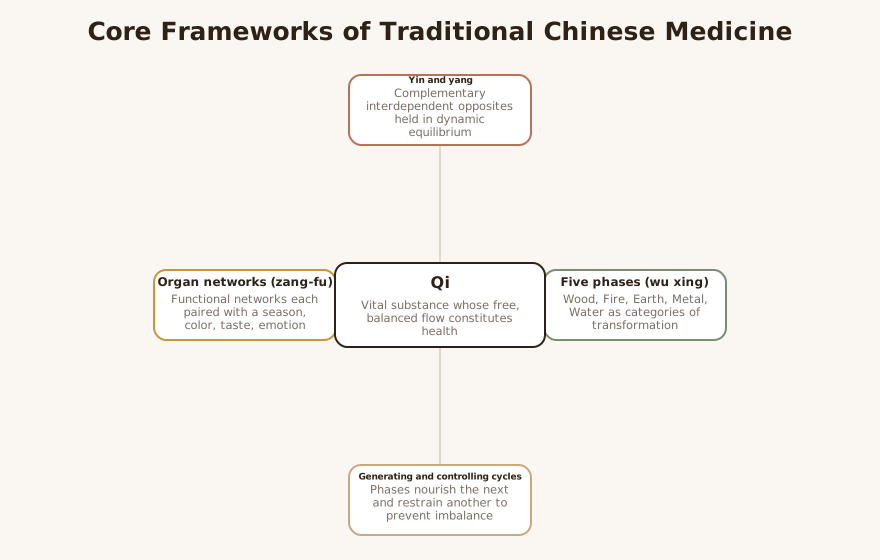
TCM rests on the premise that the body is animated by qi, a vital substance whose free and balanced flow constitutes health and whose blockage or depletion constitutes disease 2. Two organizing frameworks structure this. The first is yin and yang: complementary, interdependent opposites where yang denotes warmth, exterior, function, and repletion, and yin denotes cold, interior, structure, and depletion, with health understood as their dynamic equilibrium 2. As one teaching framing puts it, you cannot have one without the other, and equilibrium between them is essential 5.
The second framework is the five phases or elements (wu xing): Wood, Fire, Earth, Metal, and Water, understood as functional categories of transformation rather than literal substances 2. These phases are linked by two cycles — a generating (sheng) cycle in which each phase nourishes the next, and a controlling (ke) cycle in which each phase restrains another to prevent imbalance 4. Each phase maps to a paired organ network (zang-fu), a season, a color, a taste, and an emotion 4.
The organ networks (zang-fu) are conceived functionally rather than anatomically: five yin “zang” organs — heart, liver, spleen, lung, and kidney — pair with yang “fu” organs and circulate qi and blood through twelve primary meridians 2. The mental-health-relevant feature is the emotion-organ correspondence: anger maps to the Liver/Wood phase, joy to the Heart/Fire phase, worry and overthinking to the Spleen/Earth phase, grief to the Lung/Metal phase, and fear to the Kidney/Water phase 4. In this model, emotional disturbance and visceral function are treated as one continuous system, allowing practitioners to address physical and emotional states simultaneously 5.
Interventions & Techniques
TCM diagnosis precedes treatment and uses four examinations — inspection (including the tongue), auscultation and olfaction, inquiry, and palpation (notably pulse diagnosis at three radial positions and depths) 2. Rather than identifying a Western disease, the practitioner differentiates a “syndrome” or pattern (zheng) describing disturbances of organ function and yin-yang balance 2. Treatment then aims to restore that balance LLM.
The principal modalities are: Chinese herbal medicine and dietetics, in which herbs and foods are classified by thermal nature and flavor and combined to work synergistically rather than as isolated active ingredients 2; acupuncture and moxibustion, in which needling or warming of acupoints is held to regulate qi, with proposed mechanisms including enhanced parasympathetic activity, activation of the cholinergic anti-inflammatory pathway, and release of endogenous opioids 2; cupping, using sub-atmospheric pressure to mobilize blood and fluids 2; tuina, a manual therapy combining massage and acupoint stimulation 2; and qigong, integrating posture, movement, breath, and meditation as a form of traditional self-regulation training 2. Tai chi, a related movement practice, is also grouped under TCM’s physical approaches 1.
Evidence Base
TCM is an established system in the sense of being mature, codified, and widely practiced, but “established” should not be read as “mechanistically validated” — the evidence is genuinely mixed and condition-specific 1. The honest summary by modality is as follows.
For acupuncture, research suggests possible benefit for chronic pain conditions (low-back pain, neck pain, knee osteoarthritis, carpal tunnel), tension headache, and migraine prevention; however, many trials find real and sham acupuncture roughly equally effective, pointing toward a substantial placebo or nonspecific component 1. Additional reviews report effectiveness signals for nausea and vomiting and some depression and gynecological indications 2. For tai chi and qigong, studies indicate benefits for balance in older adults and in Parkinson’s disease, osteoarthritis pain, fibromyalgia coping, anxiety reduction, and mood 12.
For Chinese herbal products, the evidence is weakest: many studies are of poor quality, and no firm conclusions can be drawn about effectiveness for conditions including stroke, heart disease, mental disorders, and respiratory conditions 1. The underlying theory fares worse still under scientific scrutiny. Reviews have found no anatomical or physiological basis for qi, meridians, or acupuncture points, and the broader scientific reception describes TCM’s theoretical framework as pre-scientific and, in places, pseudoscientific 6. Five-element theory specifically is not historically supported by research as a basis for treatment decisions 3. The clinical takeaway: some TCM modalities produce real, measurable effects for specific symptoms, while the traditional explanatory theory should be treated as cultural and metaphorical rather than physiological LLM.
Populations & Indications
Clients most likely to be using TCM include adults with chronic illness, people with chronic pain, older adults (often via tai chi for balance and mood), and patients explicitly seeking complementary or integrative care 12. People with insomnia and individuals with functional somatic complaints — symptoms without a clear medical explanation — also frequently turn to TCM 2. From a mental health standpoint, clients with generalized anxiety, depression, stress-related presentations, and somatic symptom concerns may already frame their distress in TCM terms, which a culturally attuned clinician can work with rather than against LLM.
Problems-for-Work
For a psychotherapist, TCM is most useful as a shared explanatory language and a self-regulation context, not as something to administer. Representative applications:
-
Insomnia and stress-related disorders. A client practicing qigong or receiving acupuncture for sleep may be more open to mind-body framing; the clinician can integrate this with cognitive and behavioral sleep work 2.
-
Generalized anxiety and somatic symptom disorder. The emotion-organ map (worry to the Spleen, fear to the Kidney) can serve as a non-pathologizing bridge into psychoeducation about the body-mind link for clients who somaticize distress 4.
LLM-generated illustrative example (not a guideline): A client with health anxiety describes her chest tightness as “Heart fire” from her acupuncturist. Rather than correcting the model, the clinician uses it as common ground to introduce interoceptive awareness and graded exposure, validating the felt experience while building psychological flexibility LLM.
- Chronic pain and fatigue. Clients combining acupuncture with therapy for pain-related depression can benefit from coordinated, non-competing care 1.
Contraindications, Cautions & Cultural Humility
The single most important clinical caution for therapists is herb-drug interaction. Chinese herbal products have been found to contain undeclared pharmaceuticals (including warfarin and diclofenac), heavy metals such as arsenic, lead, and cadmium, and pesticides, and manufacturing errors have caused organ damage 1. Some ingredients are known to be toxic or carcinogenic 6. Because a client’s herbal regimen can interact with prescribed psychotropics, the practical rule is to ask clients directly what supplements and herbs they are taking and to coordinate with the prescribing clinician LLM. Acupuncture, while generally safe, carries rare risks of infection, organ puncture, and pneumothorax when performed with nonsterile or improper technique 1.
Cultural humility matters here. For many clients, TCM is an inherited framework tied to identity, family, and meaning; dismissing it as pseudoscience can rupture the alliance even where the clinician privately doubts the theory LLM. The stance that holds both truths — respecting the framework’s meaning while remaining honest about evidence — is the workable one 3. Clinicians should also be aware of ethical and conservation concerns: illegal wildlife trade for certain traditional ingredients drives poaching of endangered species 6.
Treatment-Plan Suggestions & SMART Objectives
The objectives below treat TCM concepts as a client-held lens to integrate into evidence-based psychotherapy, not as interventions the therapist delivers LLM.
| Goal | SMART objective (example) | Mechanism |
|---|---|---|
| Reduce insomnia severity | Within 6 weeks, client will lower Insomnia Severity Index score by 4 points while continuing qigong practice | Behavioral sleep regulation plus mind-body self-regulation 2 |
| Lower generalized anxiety | Over 8 sessions, client will use one interoceptive grounding skill daily, reframing “qi imbalance” as a body-awareness cue | Psychoeducation bridging somatic and emotional experience 4 |
| Reduce somatic preoccupation | Within 10 weeks, client will reduce health-anxiety checking to <2 times/day | Cognitive restructuring within a shared body-mind model 2 |
| Improve depressed mood | Over 12 weeks, client will attend tai chi 2x/week and log mood, targeting a 5-point PHQ-9 reduction | Behavioral activation plus movement-based mood benefit 1 |
| Improve pain coping | Within 8 weeks, client will apply two pacing strategies during pain flares | Coordinated care with acupuncture for chronic pain 1 |
| Strengthen stress regulation | Daily over 4 weeks, client will complete a 10-minute breath-and-movement practice | Autonomic self-regulation via qigong-style practice 2 |
| Build alliance around health beliefs | By session 4, clinician and client will co-create a shared formulation honoring the client’s TCM framework | Cultural humility supporting engagement 3 |
Common Misconceptions
A frequent misconception is that because acupuncture sometimes “works,” qi and meridians must be physically real; in fact, reviews find no anatomical basis for these structures, and much of acupuncture’s measured effect is nonspecific 16. A second is that TCM is an unbroken ancient monolith, when the unified “TCM” brand is largely a twentieth-century standardization 6. A third is that “natural” herbal products are inherently safe — contamination, undeclared drugs, and toxicity make this false 1. A fourth is that five-element personality typing has empirical support for guiding treatment, which research does not bear out 3. Finally, clinicians sometimes assume TCM cannot coexist with evidence-based therapy; in practice, integrative coordination is common and often beneficial 2.
Training & Certification
Therapists do not become TCM practitioners through psychotherapy training, and delivering acupuncture or prescribing herbs is outside the psychotherapy scope of practice LLM. In the United States, acupuncture practice is typically regulated at the state level, with most states requiring certification from the National Certification Commission for Acupuncture and Oriental Medicine 1. For mental health clinicians, the relevant “training” is referral literacy: knowing how to identify a licensed, certified TCM or acupuncture provider for collaborative care and how to ask informed questions about a client’s regimen LLM.
Key Terms
Qi — the vital substance whose balanced, free flow TCM equates with health; blockage or depletion is held to cause disease 2.
Yin and yang — complementary, interdependent opposites (cold/structure/interior versus warm/function/exterior) whose dynamic balance defines health 2.
Wu xing (five phases/elements) — Wood, Fire, Earth, Metal, and Water as functional categories linked by generating and controlling cycles 4.
Zang-fu — the functional organ networks (e.g., Liver, Heart, Spleen, Lung, Kidney) that pair with phases and emotions 2.
Meridians (jing luo) — the twelve channels through which qi and blood are said to circulate and connect to acupoints 2.
Zheng (pattern/syndrome) — the TCM diagnostic category describing a disturbance of organ function and yin-yang balance, differentiated instead of a Western disease 2.
Moxibustion — therapeutic burning of mugwort near acupoints to deliver warmth and stimulation 2.
Resources & Further Reading
▶ Watch — a video introduction to this concept:
- Traditional Chinese Medicine: What You Need To Know — NCCIH (NIH)
- Understanding Traditional Chinese Medicine Therapeutics: An Overview of the Basics and Clinical Applications (PMC)
- Five Element Theory in Chinese Medicine: What the Science Says — Healthline
- Wu Xing (Five Elements) — Me & Qi Knowledge Base
- A Beginner’s Guide to Yin, Yang and the Five Elements in Chinese Medicine — Ruth Hull
- Traditional Chinese Medicine — Wikipedia
Reflective / Supervision Questions
- When a client explains their distress in TCM terms, how do I hold both respect for their framework and honesty about the evidence without rupturing the alliance? LLM
- Do my intake questions reliably surface herbal and supplement use that could interact with a client’s prescribed psychotropics? LLM
- Where am I tempted to either over-endorse or dismissively pathologize a client’s complementary medicine, and what drives that reaction in me? LLM
- How would I coordinate with a licensed acupuncturist or prescriber to provide genuinely integrated, non-competing care? LLM
- Am I distinguishing clearly, for myself and the client, between TCM modalities with real symptom-level evidence and the traditional theory that lacks physiological support? LLM