
Type & Discipline
Ayurveda is the classical medical system of the Indian subcontinent, a holistic framework addressing life, health, and disease that is rooted in the philosophical foundations of the Indian Darshanas, particularly Sankhya Darshana 4. Within it sits an explicit, codified psychotherapy — sattvavajaya chikitsa (“winning” or “restraint” of the mind) — alongside a constitutional theory of personality that pairs three bodily humors (tridosha) with three mental qualities (triguna) 14. For the practicing therapist, the relevant point is that Ayurveda is not only a system of herbs and detoxification; it contains a non-pharmacological, mind-focused treatment modality that maps onto familiar psychotherapeutic territory 3. This article treats Ayurveda as a framework — a way of conceptualizing mind, constitution, and intervention — rather than as a discrete licensed psychotherapy LLM.
The discipline classifies itself as traditional Indian medicine and is recognized in India under the AYUSH systems, but Western clinicians should hold it as a complementary and integrative framework rather than a standalone evidence-based protocol LLM.
Creators & Lineage
The concept of sattvavajaya is attributed to Acharya Charaka, often called the father of Indian medicine, and is described in the classical compendia known as the Samhitas 3. The foundational texts cited across the literature include the Charaka Samhita, Sushruta Samhita, and Ashtanga Hridaya (associated with Vagbhata), together with philosophical treatises such as the Sankhya Karika and Yoga Darshana 4. The triguna doctrine itself originates in Sankhya philosophy, which explains creation as the interaction of Purusha (consciousness) and Prakriti (primordial nature) 4.
The lineage that matters for contemporary integrative work runs through traditional Indian medicine, the yoga and meditation traditions, and a constitutional or typological theory of personality 45. The literature explicitly draws the parallel to cognitive restructuring: sattvavajaya operates by withdrawing the mind from unwholesome objects and altering maladaptive thoughts, a mechanism modern authors compare directly to contemporary psychotherapy 13.
Core Principles
Ayurveda holds that body and mind are interdependent, rejecting Cartesian dualism in favor of a psychosomatic model in which physical constitution and psychological attributes shape one another 2. The tridosha — vata (ether and air, governing movement), pitta (fire and water, governing transformation), and kapha (water and earth, governing structure) — regulate physiological function, and each person is born with a unique constitution, or prakriti 24. Imbalance, or vikruti, is the basis of disease 4.
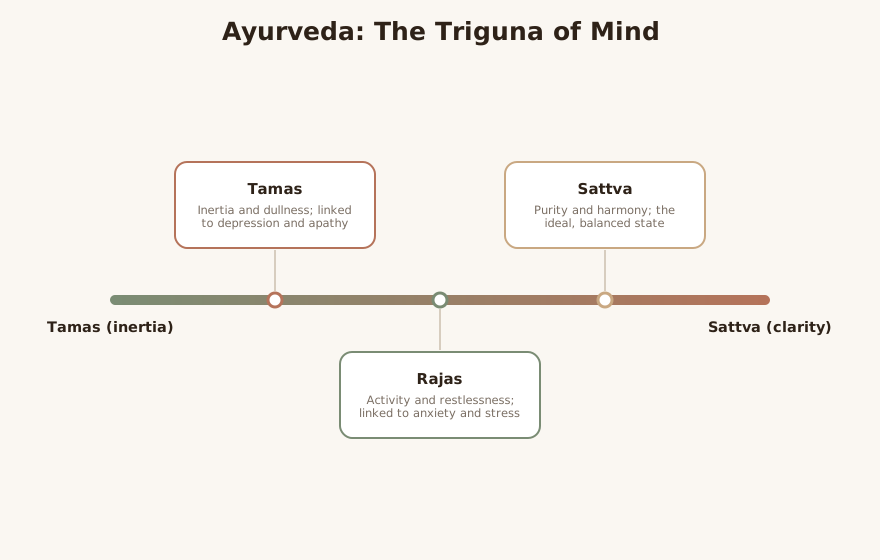
The triguna governs the mind: sattva (purity, clarity, harmony), rajas (activity, passion, restlessness), and tamas (inertia, dullness, confusion) 4. A disturbance of the mind is understood as always arising from an imbalance of the three gunas 5. Excess rajas is linked to anxiety, insomnia, and stress-related disorders; dominance of tamas is associated with depression, apathy, and delusional states 4. Sattvika mental constitution is considered the ideal, associated with calm, ethical, and balanced functioning 4. One conceptual review maps sattva onto balanced vata–pitta, rajas onto vitiated vata–pitta, and tamas onto excessive kapha — an integrated psycho-somatic lens 4. The therapeutic aim across all of this is restoration of equilibrium 4.
Interventions & Techniques
Ayurveda organizes treatment into three broad modalities: sattvavajaya chikitsa (psychotherapy / mind control), yuktivyapashraya (rational therapy using panchakarma, drugs, and diet), and daivavyapashraya (faith-based therapy using mantra, ritual, and prayer) 1. Only the psychological components fall within a psychotherapist’s scope LLM.
Sattvavajaya itself has a defined internal structure: five methods, two principles, three dimensions, three psychotherapeutic domains, and five techniques 3. The classical mechanisms include three principles — replacement of emotions, assurance therapy, and psycho-shock therapy 1. Emotional replacement substitutes pathogenic affect with its opposite: malice with love, anger with composure, greed with contentment, ignorance with knowledge, and fear with valor 1. Five methods of mind control are described — regulating thought processes (cintya), replacing ideas (vicarya), channeling presumptions (uhya), polishing objectives (dhyeya), and guiding right decisions (samkalpa) 1. The core action is withdrawal of the troubled mind from ahita artha — unwholesome or distracting objects, thoughts, and perceptions — while stimulating consciousness, memory, and discrimination of maladaptive thoughts 3.
The non-psychological interventions in the broader system include sattvic dietary recommendations, lifestyle and behavioral practices, medhya (mental-clarity) herbal formulations, meditation, prayer, and panchakarma cleansing 5. These strengthen sattva and reduce rajasic overstimulation or tamasic lethargy, but the medical components require an Ayurvedic physician 5.
Evidence Base
Honesty about maturity is essential here. Ayurveda as a system is established — millennia old, codified in the classical Samhitas, and formally recognized in India 4. The empirical evidence for sattvavajaya as a psychotherapy, however, is early-stage LLM. What the literature offers is conceptual reviews articulating the philosophy and proposed mechanisms, theoretical correlations between triguna and tridosha, and a small number of case reports 34.
A representative case study applied triguna-based psychological therapy alongside panchakarma and yoga-pranayama to a patient with bipolar disorder over a structured regimen, reporting improvements in mood stability, reduced obsessive thoughts, and enhanced self-awareness 6. The authors themselves note that larger samples are needed to confirm clinical efficacy 6. The empirical review of sattvavajaya likewise frames the modality conceptually and calls for further research 3. There are no large randomized controlled trials in the provided evidence base establishing efficacy for any specific disorder LLM. Modern psychosomatic models are described as aligning with the triguna–tridosha framework, but alignment of concepts is not the same as demonstrated outcomes 4LLM.
Populations & Indications
The framework is most naturally indicated for South Asian and Indian populations for whom these concepts are culturally resonant, and for adults seeking holistic or integrative care 14. The conditions the literature associates with guna imbalance — and therefore with sattvavajaya-style intervention — include anxiety, stress-related disorders, and insomnia (linked to excess rajas), and depression and apathy (linked to tamas) 4.
In practice for a Western therapist, the framework is best positioned as a complementary lens for patients seeking complementary medicine, those drawn to mind-body and constitutional models, and individuals with psychosomatic presentations where the mind-body interdependence is clinically salient 24. It should not be presented as a first-line treatment for severe or acute psychiatric conditions on the strength of the current evidence LLM.
Problems-for-Work
Maladaptive thoughts and cravings. Sattvavajaya’s vicarya (replacing ideas) and the discrimination of maladaptive thoughts map closely onto cognitive restructuring, making this the most transferable application 13.
LLM-generated illustrative example (not a guideline): A client describes intrusive cravings that he frames as “proof I have no willpower.” The clinician borrows the emotion-replacement and idea-substitution logic — naming the craving, then deliberately cultivating a competing intention (contentment in place of grasping) — woven into standard cognitive restructuring. LLM
Emotional dysregulation. The emotion-replacement principle (anger to composure, fear to valor) gives a structured, values-anchored vocabulary for affect regulation work 1.
Stress, anxiety, and insomnia. Framed as rajasic overactivity, these invite sattvic lifestyle counseling, breath and meditation practices, and routine regulation as adjuncts to evidence-based care 45.
Low wellbeing and psychosomatic presentations. The triguna–tridosha lens offers a coherent narrative connecting bodily and mental states for clients whose distress is somatically expressed 24.
Contraindications, Cautions & Cultural Humility
The central caution is scope of practice. A US-licensed psychotherapist may ethically draw on the psychological elements — triguna psychoeducation, emotion-replacement, the cognitive-restructuring analog, and lifestyle counseling — but cannot deliver the medical components of Ayurveda LLM. Panchakarma, virechana (therapeutic purgation), and medhya or other herbal formulations require an Ayurvedic physician and fall outside a therapist’s competence and licensure 56. Herbal products carry interaction and quality-control risks and should never be recommended by a psychotherapist LLM.
Cultural humility cuts both ways. For South Asian clients these concepts may be deeply meaningful and validating; for others they may feel foreign or appropriative if imposed LLM. The constitutional typology should be offered tentatively, not as a fixed diagnostic label, given that prakriti is described as inborn and unchanging — a framing that can feel deterministic if applied carelessly 24. Severe or acute psychiatric presentations require established mental-health care; the framework is adjunctive, not a substitute LLM.
Treatment-Plan Suggestions & SMART Objectives
| Goal | SMART objective (example) | Mechanism |
|---|---|---|
| Reduce rajasic overactivation driving anxiety | Client will practice a daily 10-minute breath/meditation routine 5 days/week for 6 weeks | Cultivating sattva; withdrawing mind from unwholesome objects 45 |
| Restructure maladaptive cravings | Client will identify and substitute one craving-linked thought per day for 4 weeks | Vicarya (idea replacement) / cognitive restructuring 13 |
| Improve emotion regulation | Client will name and deliberately pair 3 distressing emotions with chosen opposites weekly for 8 weeks | Replacement-of-emotions principle 1 |
| Stabilize sleep linked to mental restlessness | Client will follow a consistent sattvic evening routine 6 nights/week for 4 weeks | Reducing rajas; routine regulation 45 |
| Increase self-awareness of mental state | Client will log predominant guna/mood daily for 4 weeks and review patterns | Triguna self-monitoring; reflective awareness 46 |
| Reduce psychosomatic distress | Client will connect one bodily symptom to a mental state in session weekly for 6 weeks | Body-mind interdependence framing 2 |
| Build resilience and steadiness | Client will identify 2 values-anchored “valor” responses to feared situations over 6 weeks | Fear-to-valor emotion replacement 1 |
Common Misconceptions
That “established” means proven: the tradition is established, but psychotherapeutic efficacy rests on conceptual work and case reports, not large trials 36LLM. That doshas and gunas are interchangeable: doshas are bodily humors (vata, pitta, kapha), gunas are mental qualities (sattva, rajas, tamas), and the literature describes a correlation between them, not an identity 4. That sattvavajaya is exotic and unfamiliar: its core mechanisms — withdrawing attention from harmful objects, replacing thoughts, substituting emotions — closely parallel cognitive and emotion-focused techniques Western clinicians already use 13. That a therapist can “do Ayurveda”: the full system includes medical interventions outside psychotherapeutic scope 5LLM.
Training & Certification
There is no psychotherapy-specific Ayurvedic certification described in the provided sources, and full Ayurvedic practice is the domain of trained Ayurvedic physicians who study the classical texts and clinical methods 4LLM. For a Western psychotherapist, the responsible path is to integrate the psychological concepts into an existing evidence-based practice while collaborating with, or referring to, a qualified Ayurvedic practitioner for any constitutional assessment or medical intervention 5LLM. Familiarity with the classical framework — triguna, tridosha, and the structure of sattvavajaya — supports culturally informed care without claiming clinical competence in the medical system LLM.
Key Terms
Sattvavajaya (chikitsa) — Ayurvedic psychotherapy; restraint of the mind by withdrawing it from unwholesome objects 13. Tridosha — the three bodily humors: vata, pitta, kapha 4. Triguna — the three mental qualities: sattva, rajas, tamas 4. Prakriti — an individual’s inborn constitution 2. Vikruti — imbalance/deviation from constitution, the basis of disease 4. Manas — the mind 3. Yuktivyapashraya — rational therapy (diet, drugs, panchakarma) 1. Daivavyapashraya — faith/spiritual therapy 1. Medhya — herbal formulations for mental clarity 5.
Resources & Further Reading
▶ Watch — a video introduction to this concept:
- Ayurvedic concepts related to psychotherapy (Indian Journal of Psychiatry, 2013)
- Understanding personality from an Ayurvedic perspective for psychological assessment (AYU)
- An empirical understanding on the concept of Sattvavajaya (Indian Journal of Health Sciences and Biomedical Research)
- A Conceptual Study of Triguna and Tridosha (International Journal of AYUSH)
- Ayurvedic therapies for psycho-mental balance (Ayurveda Akademie)
- Application of Triguna-based Psychological Therapy in Bipolar Disorder: A Case Study
Reflective / Supervision Questions
- When I borrow emotion-replacement or thought-substitution from sattvavajaya, am I genuinely extending the client’s frame, or repackaging cognitive restructuring I would have done anyway? LLM
- How do I hold the constitutional typology tentatively, so prakriti reads as a working hypothesis rather than a fixed label? LLM
- For this client, is the Ayurvedic framing culturally resonant and chosen by them, or am I importing it? LLM
- Where is the line between the psychological elements I can ethically use and the medical components that require referral to an Ayurvedic physician? 5LLM
- Given the early-stage evidence, how do I present this as a complement to — never a replacement for — established care? 36LLM