
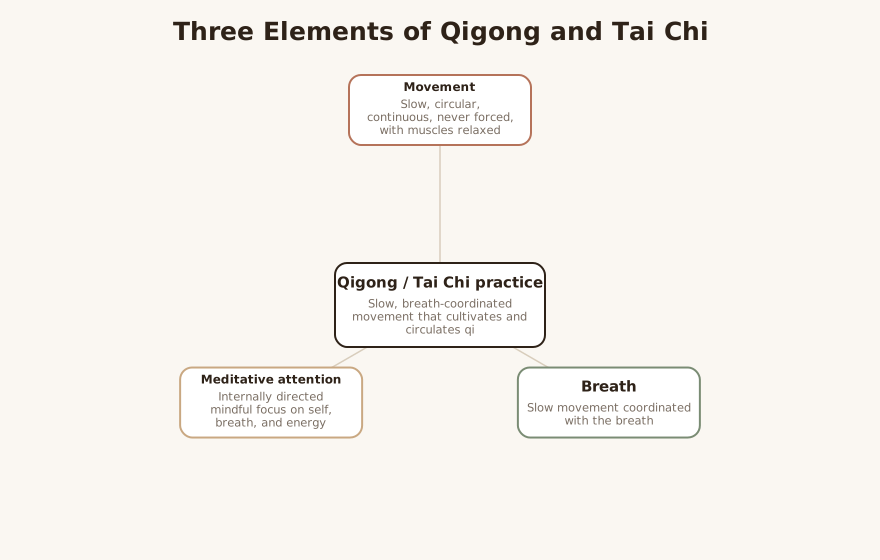
Qigong and Tai Chi are slow, self-paced movement practices that combine gentle posture and motion with diaphragmatic breathing and a meditative, internally focused quality of attention 23. Both arise from Traditional Chinese Medicine and martial-arts lineages and share the aim of cultivating and circulating qi — vital energy or life force — to balance the body and quiet the mind 3. For practicing clinicians they are best understood not as a single proprietary therapy but as a family of contemplative movement techniques that can be folded into established treatment to address arousal, pain, balance, and mood LLM. This article orients you to what they are, where the evidence is genuinely strong and where it is thin, and how to integrate them responsibly.
Type & Discipline
Qigong and Tai Chi belong to the family of contemplative movement practices — sometimes grouped with yoga under the heading of “mind-body exercise” — that integrate physical movement, breath regulation, and meditative focus into a single activity 2. Their disciplinary home is Taoist and Traditional Chinese Medicine thought, in which health reflects the smooth circulation and balance of qi and the dynamic relationship of yin and yang 3. Tai Chi (taijiquan) developed as a healing and martial art, performed as a series of graceful, continuous movements with deep, slow breathing while standing or stepping 23. Qigong is described as closely similar to Tai Chi — a series of breath practices coordinated with body movement and meditation to reach a deeply focused, relaxed state 23.
A useful framing for clinicians is that these are techniques rather than standalone licensed psychotherapies LLM. They function less like a discrete diagnosis-specific protocol and more like a structured way of moving and breathing that can be embedded inside a recognized treatment such as Mindfulness-Based Stress Reduction or a broader mind-body or rehabilitation plan LLM. The research literature increasingly treats Qigong and Tai Chi as comparable interventions that share theoretical foundations and mechanisms rather than as fundamentally distinct modalities 1.
Creators & Lineage
There is no single founder; both practices are products of centuries of Chinese cultural, philosophical, and martial tradition rather than the invention of one figure 3LLM. Their conceptual lineage runs through Traditional Chinese Medicine and Taoist practice, where qi cultivation, breath, and movement have long been used to preserve health and longevity 3. The Qigong Institute exists as an organizational hub for the scientific study and dissemination of qigong, reflecting how the field has organized itself around research and education rather than around a charismatic originator 6.
In the contemporary clinical and research world, the lineage that matters most to a Western practitioner is the translation of these practices into mind-body medicine, where they sit alongside Mindfulness-Based Stress Reduction, yoga, and somatic practices as studied contemplative interventions 2. A notable figure in that translation is Peter Wayne, a Harvard Medical School researcher whose work — collected for general and clinical audiences in The Harvard Medical School Guide to Tai Chi (2013, with Mark Fuerst) — frames Tai Chi in evidence-oriented terms, as a practice with multiple interacting components rather than a single mechanism, and as something that can be approached as a form of medicine 5. This research lineage is part of why Tai Chi and Qigong now appear in mainstream medical education materials rather than only in martial-arts schools 45.
Core Principles
The first principle is the cultivation and circulation of qi 3. In the practices’ own framework, slow movement, breath, and focused intention are understood to move and balance vital energy, harmonizing yin and yang within the body 3. Clinicians need not adopt the metaphysics to use the practice, but should understand that this is the internal logic clients and teachers will reference LLM.
A second principle is the integration of three elements at once: movement, breath, and meditative attention 2. Unlike most exercise, the movements are performed with a deep, internally directed mindful focus on the self, the breath, and the sense of energy, which is what places these practices in the mind-body category rather than the purely physical one 2. Movements are slow, circular, continuous, and never forced, with the muscles relaxed rather than tensed 4.
A third principle is accessibility and low impact. Tai Chi is self-paced and gentle enough to be adapted across a wide range of ability, from people who are quite fit to those recovering from surgery or seated in wheelchairs, and it generally does not leave the practitioner breathless 4. This makes the practices unusually suitable as a bridge for clients who cannot or will not engage with more strenuous exercise 4LLM.
A fourth, more clinical principle — emphasized in the research literature — is that the proposed pathway from practice to health runs through the nervous, endocrine, and immune systems, the idea being that mind-body exercise modulates these interacting systems while it is being performed 2. This gives a plausible, if still incompletely mapped, account of why a single practice might touch pain, mood, blood pressure, and balance at once 2LLM.
Interventions & Techniques
In clinical use, the core “intervention” is regular, guided practice of a Tai Chi or Qigong form, usually beginning in a class or supervised setting and progressing to home practice 34. A typical session includes a warm-up (gentle shoulder circles, head turns, rocking), instruction and rehearsal of the movements, and explicit breathing or “energy” work drawn from Qigong 4.
Practical elements clinicians can recognize and adapt LLM:
- Slow, continuous standing or stepping forms, performed with relaxed muscles and unforced, circular motion 4.
- Diaphragmatic, slow breathing coordinated with the movement, which is itself a recognizable arousal-regulation tool 23.
- Internally directed mindful focus on body sensation, breath, and the felt sense of energy, functioning as a moving meditation 2.
- Qigong breath-and-movement sequences that can be done seated or standing, lowering the barrier for frail or deconditioned clients 34.
- Graded progression from short, supervised sessions to longer independent practice, matched to the client’s tolerance 3LLM.
LLM-generated illustrative example (not a guideline): A clinician working with an older adult who has stopped leaving the house after a fall introduces a brief seated Qigong breathing-and-arm sequence at the start of sessions, then refers the client to a community Tai Chi class pitched to beginners. The shared goals are to rebuild balance confidence and to give the client a portable way to down-regulate anxiety; the clinician keeps tracking falls-related avoidance in the primary treatment plan LLM.
Evidence Base
The honest summary is that the literature is established in volume and consistency but uneven in trial quality LLM. The landmark comprehensive review by Jahnke and colleagues (2010) synthesized 77 randomized controlled trials of Qigong and Tai Chi and organized outcomes into nine domains: bone density, cardiopulmonary effects, physical function, falls and fall-related risk factors, quality of life, self-efficacy, patient-reported outcomes, psychological symptoms, and immune function 1. The most heavily studied domains were psychological symptoms (27 studies), falls and related risk (23 studies), and cardiopulmonary effects (19 studies), and the authors concluded that RCTs have demonstrated consistent, significant results for a number of these health benefits 1.
A second contribution of that review is conceptual: it argued for recognizing the similarity and near-equivalence of Qigong and Tai Chi, suggesting they share theoretical foundations, mechanisms, and expected benefits and can reasonably be considered together rather than as separate interventions 1. The mind-body exercise literature reinforces a plausible mechanistic story running through the nervous, endocrine, and immune systems 2.
National Center for Complementary and Integrative Health (NCCIH) summaries point in the same direction at the condition level — modest benefits for balance and fall prevention in older adults, possible improvements in fibromyalgia pain and function, osteoarthritis (especially knee) pain, hypertension, sleep, cancer-related fatigue, and psychological well-being and quality of life 3. Harvard Health similarly catalogs improvements in muscle strength, flexibility, balance, and modest aerobic conditioning, framing Tai Chi as “meditation in motion” that might equally be called “medication in motion” 4.
The crucial caveat: research quality varies considerably, with many trials limited by small samples and a lack of standardized protocols, which is why even strong-looking results warrant cautious, qualified language 3. “Established” here means a mature, large, and broadly encouraging literature — not a uniformly high-quality or definitive one 3LLM. Present these practices to clients as supported and low-risk adjuncts, not as proven cures for any specific psychiatric diagnosis LLM.
Populations & Indications
The clearest indication is older adults, where benefits to balance, physical function, and fall risk are among the best-supported outcomes 13. The low-impact, self-paced, easily adapted nature of the practice makes it suitable even for people who are not fit, who are recovering from surgery, or who use a wheelchair, and Tai Chi carries an excellent safety record 4.
People with chronic illness and chronic pain are a second natural fit, given signals for fibromyalgia, osteoarthritis, COPD, and hypertension, alongside broad gains in quality of life 3. Cardiac and rehabilitation patients are well-matched to the cardiopulmonary and physical-function literature and to a gentle modality that can be graded to tolerance 14. For anxiety and stress-related disorders, the heavily studied psychological-symptom domain and the breath-and-meditation components provide a reasonable rationale for use as an adjunct 12. Trauma survivors may benefit from a structured, predictable, body-based practice that supports arousal regulation, though this population calls for the cautions noted below LLM.
Problems-for-Work
The following are application sketches grounded in the reviewed outcomes, not efficacy guarantees for any individual LLM:
- Stress and emotion dysregulation: Slow movement plus diaphragmatic breathing and meditative focus offers a portable, repeatable way to lower arousal, consistent with the large psychological-symptom literature 12.
- Generalized anxiety and depression (as adjunct): Used inside a primary therapy, regular practice provides behavioral activation, a present-moment anchor, and mood benefits reported across studies 13.
- Balance and fall risk: Among the strongest indications; structured Tai Chi improves balance and reduces fall risk and fear of falling in older adults 134.
- Chronic pain, fibromyalgia, and arthritis: Gentle, graded movement can improve pain and function where higher-intensity exercise is intolerable 3.
- Hypertension: Consistent practice is associated with modest blood-pressure reduction, useful as a lifestyle adjunct 3.
- Insomnia and fatigue: Evidence supports improved sleep quality and reduced fatigue, including cancer-related fatigue 3.
- PTSD symptoms (as adjunct): A predictable, contained, body-based practice may support arousal regulation when integrated into trauma-informed care LLM.
LLM-generated illustrative example (not a guideline): A client with generalized anxiety and tension headaches practices a 10-minute Qigong breathing-and-movement sequence each morning. In session the clinician and client review a simple log of pre/post tension ratings, using the practice as one of several arousal-regulation tools within the broader treatment plan LLM.
Contraindications, Cautions & Cultural Humility
Although Tai Chi and Qigong are low-impact and carry an excellent overall safety record, they are not risk-free 4. NCCIH guidance flags caution for people who are pregnant, or who have an active hernia, recent or acute fractures, or significant joint problems, and recommends that clients with existing conditions consult a healthcare provider before starting 3. Movements may need modification for these clients, and a frail or deconditioned client should generally begin under supervision rather than from a video alone 3LLM.
Clinically, match intensity and stance to the client: seated forms, shorter durations, and a wall or chair for support can make the practice accessible without increasing fall risk during learning 4LLM. For trauma survivors, the meditative, eyes-open-but-internally-focused quality can occasionally surface distress or dissociation; introduce it gradually, keep it grounded and time-bounded, and pair it with stabilization rather than using it to “open” trauma material LLM.
Cultural humility is essential because these are living practices embedded in Taoist and Traditional Chinese Medicine worldviews, not neutral exercises invented for the clinic 3. The qi framework is meaningful to many clients and dismissible to others; respect both, avoid presenting the metaphysics as established physiology, and do not strip the practice of its origins while borrowing its benefits 3LLM. Offer it as an invitation, normalize declining, and adapt to each client’s beliefs, body, and comfort LLM.
Treatment-Plan Suggestions & SMART Objectives
| Goal | SMART objective (example) | Mechanism |
|---|---|---|
| Reduce stress and physiological arousal | Client will complete a 10-minute Qigong breathing-and-movement sequence on 5 of 7 days per week and report a ≥2-point drop on a 0–10 tension scale, for 6 weeks | Slow movement, diaphragmatic breathing, and meditative focus down-regulate arousal 12 |
| Improve balance and reduce fall risk | Client will attend a weekly beginner Tai Chi class and demonstrate improved single-leg stance time by week 12 | Tai Chi improves balance, physical function, and proprioception 14 |
| Decrease anxiety symptoms (adjunct) | Client will practice a chosen Qigong form 4×/week and report reduced subjective anxiety in 4 of 6 sessions over 8 weeks | Mind-body practice acts on nervous/endocrine systems and the psychological-symptom domain 12 |
| Improve chronic pain and function | Client will complete graded daily movement and report a ≥1-point reduction in average pain and improved daily function within 8 weeks | Gentle, graded movement improves pain and function in fibromyalgia/arthritis 3 |
| Lower blood pressure (lifestyle adjunct) | Client will maintain ≥3 weekly practice sessions for 12 weeks and track home blood-pressure readings | Consistent practice is associated with modest blood-pressure reduction 3 |
| Improve sleep quality | Client will perform an evening Qigong sequence nightly and report improved sleep on a standard sleep diary within 6 weeks | Practice is linked to improved sleep quality 3 |
| Build a portable emotion-regulation skill | Client will identify and use a 3-minute breath-and-movement reset during a distressing moment at least twice weekly, recorded between sessions | Coordinated breath and movement provide an accessible self-regulation tool 2LLM |
| Increase behavioral activation in depression | Client will leave the home to attend a community Tai Chi class once weekly for 8 weeks | Structured, low-barrier activity supports activation and mood 14LLM |
Common Misconceptions
- “It’s just gentle exercise.” The defining feature is the integration of movement with breath and internally directed meditative focus; remove the breath and attention and it is no longer a mind-body practice 24.
- “Qigong and Tai Chi are completely different things.” The research literature argues they share theoretical foundations, mechanisms, and benefits and can reasonably be treated as comparable interventions 1.
- “It’s an evidence-based cure for [specific diagnosis].” The literature is large and encouraging but limited by small samples and non-standardized protocols; describe it as a supported, low-risk adjunct, not a cure 13LLM.
- “You have to be fit and flexible to start.” The practice is self-paced, low-impact, and adaptable from highly fit individuals to people recovering from surgery or using a wheelchair 4.
- “The qi explanation is established physiology.” Qi is the practice’s traditional framework; the studied mechanisms run through the nervous, endocrine, and immune systems, and clinicians should not present the two as identical 23LLM.
Training & Certification
Unlike licensed psychotherapies, there is no single governing board or unified certification for clinical Tai Chi and Qigong; instruction runs through martial-arts schools, qigong lineages, and health-oriented programs of varying rigor 3LLM. NCCIH frames these as complementary health approaches and recommends that clients seek qualified instruction and consult a provider where conditions warrant, which implies clinicians should vet local teachers and programs rather than assume uniform standards 3. Organizations such as the Qigong Institute serve as research-and-education hubs for the field, reflecting its self-organization around science and dissemination 6.
For clinicians, the practical implication is that referring to or co-delivering Tai Chi/Qigong supplements but does not replace your underlying license and scope LLM. A research-grounded resource for understanding the practice in medical terms is The Harvard Medical School Guide to Tai Chi (Wayne with Fuerst, 2013), which presents Tai Chi as a multi-component practice studied as medicine and is a reasonable starting point for clinicians who want an evidence-oriented overview before integrating it 5.
Key Terms
- Qi: Vital energy or life force whose cultivation and balanced circulation is the traditional aim of both practices 3.
- Qigong: A series of breath practices coordinated with body movement and meditation to reach a deeply focused, relaxed state 23.
- Tai Chi (taijiquan): A healing/martial art performed as slow, graceful standing movements with deep, slow diaphragmatic breathing 2.
- Yin and yang: The complementary opposites whose balance, in the traditional framework, reflects health 3.
- Mind-body exercise: Movement performed with internally directed mindful focus on self, breath, and energy, distinguishing it from purely physical exercise 2.
- “Medication in motion”: Harvard Health’s framing of Tai Chi as a meditative movement practice with therapeutic value 4.
Resources & Further Reading
▶ Watch — a video introduction to this concept:
- A Comprehensive Review of Health Benefits of Qigong and Tai Chi (Jahnke et al., 2010) 1
- Tai Chi, Yoga, and Qigong as Mind-Body Exercises (PMC review) 2
- Tai Chi and Qi Gong: In Depth — NCCIH (NIH) 3
- The Health Benefits of Tai Chi — Harvard Health Publishing 4
- The Harvard Medical School Guide to Tai Chi (Wayne with Fuerst, 2013) 5
- Qigong Institute — Qigong Science 6
Reflective / Supervision Questions
- For this specific client, can I articulate why a contemplative movement practice is indicated over (or alongside) a more structured intervention, and which problem-for-work it targets? LLM
- Am I representing the evidence honestly — as a large but methodologically uneven literature supporting these as low-risk adjuncts rather than as proven cures? 13LLM
- Have I screened for the relevant cautions (pregnancy, hernia, recent fracture, joint problems, fall risk during learning) and arranged appropriately supervised or modified practice? 3
- How do this client’s beliefs about qi and their cultural relationship to these practices shape how I introduce, adapt, or decline to use them? 3LLM
- When I refer a client to a community teacher, how have I vetted the quality of instruction, and where is the boundary between my clinical role and the movement instructor’s? 3LLM