
Type & Discipline
Terror Management Theory (TMT) is a theory in existential social psychology, not a stand-alone treatment modality.5 It is an explanatory framework: a set of testable hypotheses about how the human capacity for self-awareness — and the accompanying knowledge that death is inevitable — shapes belief, self-regard, and social behavior.5 For the clinician, this distinction matters. TMT does not come with a manualized protocol, a session structure, or a fidelity checklist; it supplies a lens through which a range of presentations — death anxiety, existential distress, health anxiety, defensive rigidity, prejudice — can be reframed and worked with inside whatever evidence-based modality you already practice.LLM
The theory sits at the intersection of social psychology (it was built and tested almost entirely through controlled experiments) and the existential tradition that long predated it.5 Its empirical wing is unusually large for a humanistic-adjacent idea, with roughly 200 studies of its central prediction.5 That experimental pedigree is part of what makes TMT clinically useful: it gives existential concerns a mechanism and a measurable footprint rather than leaving them as philosophy.LLM
Creators & Lineage
The intellectual taproot is the cultural anthropologist Ernest Becker, whose 1973 book The Denial of Death argued that the idea of death “haunts the human animal like nothing else” and drives much of human striving as an effort to deny mortality’s finality.5 Becker synthesized psychoanalytic and existential thought into a claim that culture itself is, in large part, a defense against the terror of being a mortal animal who knows it will die.5
In the 1980s three social psychologists — Jeff Greenberg, Sheldon Solomon, and Tom Pyszczynski — translated Becker’s largely untestable theses into an experimental research program.4 Their first published evidence appeared in 1989, demonstrating that reminding people of death changed how harshly they judged those who violated or upheld their cultural values.1 Over the following decades the trio, with many collaborators, extended the work across health behavior, intergroup relations, leadership, and religion, eventually synthesizing it for general readers in The Worm at the Core: On the Role of Death in Life (2015).6
The broader lineage TMT draws on includes existential psychology, Becker’s denial-of-death tradition, self-esteem theory, and social identity theory — the last supplying the idea that group belonging confers identity and worth that individuals will defend.5 The combination is what gives TMT its characteristic shape: an existential problem (mortality) solved through fundamentally social means (shared worldviews and group-conferred esteem).LLM
Core Principles
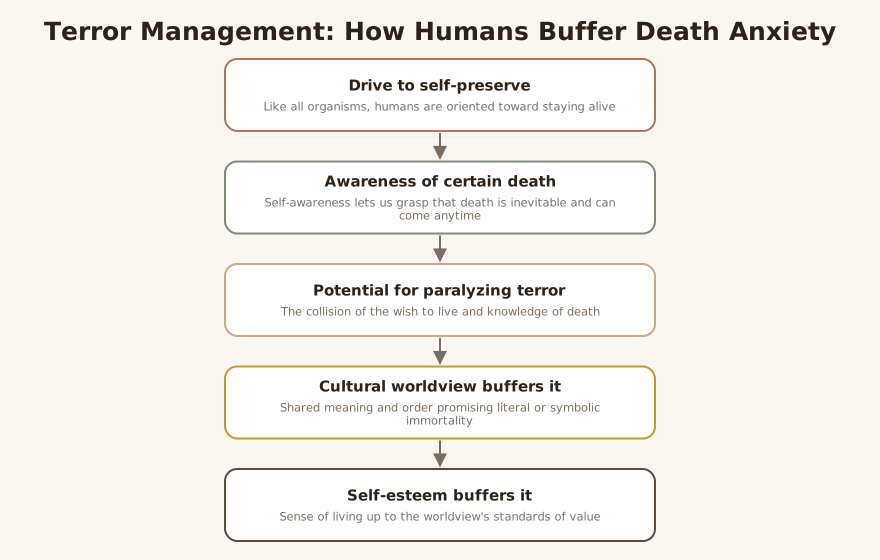
The central premise is a conflict.5 Like all organisms, humans are biologically oriented toward self-preservation; unlike other organisms, our sophisticated self-awareness lets us grasp that death is certain, can come at any moment, and is the fate of the self we are so invested in preserving.5 This collision between the wish to live and the knowledge of death creates the potential for paralyzing terror.4
Two interlocking structures buffer that terror.5 The first is the cultural worldview: a shared, humanly constructed conception of reality that imbues life with order, meaning, and permanence, and that promises some form of immortality.5 That immortality can be literal — religious afterlives — or symbolic — being part of a nation, a family line, a body of work, or any enterprise that outlasts the individual.5 The second structure is self-esteem, understood here in a specific way: not generic positive feeling but the sense that one is living up to the standards of value prescribed by one’s worldview, and is therefore a person of worth in a meaningful universe.5
From this come two hypotheses that organize the empirical work.5 The anxiety-buffer hypothesis predicts that strengthening self-esteem should reduce anxiety and defensiveness in the face of threat; people with higher self-esteem show greater resilience to death reminders.5 The mortality salience hypothesis predicts that making death psychologically prominent should intensify people’s need for their buffer — leading them to defend their worldview more vigorously and to cling harder to sources of self-worth.5 This second prediction has been tested in roughly 200 studies using inductions ranging from writing about one’s own death to being interviewed near a cemetery.5
A crucial refinement is the dual-process model of defense.5 When death is in conscious focus, people deploy proximal defenses: pragmatic, rational-seeming moves to push the threat away — distraction, denying vulnerability, or promising to exercise more.5 Once death thoughts recede from focal attention but remain accessible below awareness, distal defenses take over: the symbolic worldview-and-self-esteem bolstering that has no logical connection to death at all.5 The accessibility of those lingering death thoughts is itself measurable through word-fragment tasks, where a person primed with mortality is more likely to complete “coff__” as “coffin” than “coffee.”5 This proximal/distal distinction is clinically important because it predicts that reassurance in the moment and the defensive rigidity that surfaces later are governed by different processes.LLM
Interventions & Techniques
TMT is descriptive, so there is no canonical TMT intervention set; what follows are clinical applications of its principles, not validated TMT techniques.LLM The most direct use is case formulation: hearing a presentation — sudden prejudice after a loss, frantic health-optimizing after a diagnosis, white-knuckle worldview rigidity in a trauma survivor — as buffer activation rather than as the surface symptom alone.LLM
From there the principles map onto established techniques.LLM Because the theory locates relief in meaning and worth, it dovetails with meaning-centered and existential approaches: helping a client articulate sources of symbolic immortality (legacy, relationships, creative work, generativity) and reconnect with values that confer self-esteem in their own worldview’s terms.LLM Where a client’s buffer has narrowed to a single brittle source — one relationship, one achievement domain, one ideology — the work is to diversify and soften it, since a sole load-bearing source of worth is fragile.LLM
The dual-process model suggests timing.LLM When death is in conscious focus (a fresh diagnosis, an acute panic about dying), proximal-style work — grounding, accurate information, tolerating the affect — fits; the symbolic, meaning-making work that addresses distal concerns often lands better once the acute spike subsides.LLM Exposure-based and acceptance-based methods are natural partners: rather than helping a client more efficiently avoid death thoughts, the aim is to increase tolerance for mortality awareness so that less defensive scaffolding is required to function.LLM
LLM-generated illustrative example (not a guideline): A 58-year-old man, six weeks after a cardiac event, presents with new contempt for “people who don’t take care of themselves” and a punishing exercise regimen. Formulated through TMT, his moralizing (worldview defense) and his self-improvement drive (proximal denial of vulnerability) are buffer responses to acute mortality salience. The clinician names the fear underneath the contempt and, once the acute spike eases, shifts toward what a meaningful remaining life would contain — broadening his sources of worth beyond bodily control. LLM
Evidence Base
TMT’s evidence base is best described as established but contested.5 The mortality salience hypothesis has accumulated roughly 200 supportive experiments, and the death-thought-accessibility paradigm has added dozens more, giving the theory unusually broad and convergent experimental support for an existential framework.5 Findings span domains: religious participants derogate religious out-groups more after death reminders; mortality salience shifts leadership preferences toward charismatic, in-group figures; and self-esteem reliably moderates defensive responding.5
Honesty requires naming the limits.5 A large multi-lab replication effort (Many Labs 4), spanning 21 labs and roughly 2,200 participants, failed to replicate the foundational worldview-defense effect under the conditions tested.5 The theory’s originators contested the replication on grounds of sample composition and protocol fidelity, and the dispute remains unresolved.5 There are also live theoretical alternatives: coalitional-psychology, meaning-maintenance, and uncertainty-management accounts each argue that non-death threats produce similar effects, implying death may not be uniquely causal.5 TMT’s popularity in academic psychology peaked roughly 2004–2008 and has since declined.5
The clinical takeaway is calibrated.LLM TMT is a generative, well-elaborated framework with real experimental backing, but the magnitude and boundary conditions of some signature effects are genuinely uncertain, and it has not been validated as a treatment.5 Use it to think, formulate, and hypothesize — not to make strong causal promises to clients about why they feel as they do.LLM
Populations & Indications
TMT is most clinically resonant where mortality is not abstract but pressing.LLM People facing terminal illness and adults confronting mortality (after a serious diagnosis, a near-death event, or an age milestone) are confronting exactly the salience the theory studies, often experientially rather than experimentally.LLM Older adults navigating the foreshortening of time, finitude, and legacy concerns are a natural fit for meaning-and-legacy framing.LLM
Bereaved individuals face a double load: grief itself plus the mortality reminder that another’s death forces.LLM People with health anxiety can be understood as caught in proximal defenses gone chronic — repeated, ineffective attempts to push the threat of death out of focal awareness.LLM Trauma survivors, whose sense of a stable, meaningful world has been ruptured, may show heightened worldview defense as the damaged buffer strains to recover.2 Across all of these, TMT is an adjunctive lens within grief, anxiety, trauma, or existential work, not a primary modality.LLM
Problems-for-Work
Death anxiety and existential distress. TMT’s home territory; the work is to build tolerance for mortality awareness and to strengthen genuine, diversified sources of meaning rather than to manufacture more effective avoidance.LLM
Health anxiety. Reframing compulsive checking and reassurance-seeking as proximal defenses helps a client see the futility of the strategy and pivot toward living a valued life alongside uncertainty.LLM
Grief and bereavement. Attending to how a loss has destabilized the client’s meaning structures, and supporting reconstruction of a worldview that can hold the death.2
Anxiety and low self-esteem. Because the buffer is built from worth-in-a-meaningful-world, work that authentically rebuilds self-esteem in the client’s own value terms is, in TMT logic, anxiety-reducing at a deep level.5
Meaninglessness. Directly addressed by helping clients locate symbolic immortality — legacy, contribution, relationship, creation — that makes life feel significant and durable.5
Prejudice and out-group derogation. Naming defensive hostility toward out-groups as a death-buffer response, especially after threat or loss, can create distance from it and open a more compassionate, deliberate stance.4
LLM-generated illustrative example (not a guideline): A bereaved client, two months after her father’s death, reports uncharacteristic irritability at coworkers whose values differ from her own. Framed through TMT, the loss heightened mortality salience and her worldview defense intensified. Naming this — “when the ground feels unstable, we grip our certainties harder” — lets her treat the irritability as grief’s shadow rather than a verdict on her colleagues. LLM
Contraindications, Cautions & Cultural Humility
TMT is a theory, so the cautions concern its use, not side effects.LLM The first is interpretive overreach: not every instance of prejudice, ambition, or religiosity is death-defense, and reducing a client’s deeply held faith or cultural identity to “just a terror-management buffer” is reductive, disrespectful, and clinically corrosive.LLM Worldviews and the esteem they confer are, in TMT’s own account, what make life bearable and meaningful; the clinical stance is to honor them, not to debunk them.5
Second, the empirical caveats above mean clinicians should avoid presenting TMT mechanisms to clients as settled fact, given unresolved replication and competing theoretical accounts.5 Offer it as a way of looking, held lightly.LLM
Cultural humility is central here, because cultural worldviews are precisely what differ across people.LLM What constitutes meaning, worth, a good death, and acceptable mourning is culturally and religiously specific; literal-immortality beliefs that one clinician finds foreign may be the healthy bedrock of another person’s equanimity.5 Imposing a secular, meaning-making, “accept your finitude” frame on a client whose tradition offers a different and sustaining answer is itself a worldview imposition.LLM The work is to support the client’s buffer in their own terms, attentive to how TMT’s intergroup findings can describe the clinician’s defensiveness too.LLM
Treatment-Plan Suggestions & SMART Objectives
| Goal | SMART objective (example) | Mechanism |
|---|---|---|
| Increase tolerance of mortality awareness | Within 8 sessions, client will remain present with death-related thoughts for 10 minutes using a grounding skill without escaping into reassurance-seeking, in 3 of 4 sessions | Reduces reliance on proximal avoidance; builds capacity to face finitude 5 |
| Diversify sources of self-esteem | Within 10 weeks, client will identify and act on 3 distinct value-based sources of worth (e.g., relationship, contribution, craft), logged weekly | Broadens the anxiety buffer beyond a single brittle source 5 |
| Reduce defensive out-group reactivity after loss | Within 6 sessions, client will name 2 instances where grief-driven irritability arose and reframe each as buffer activation rather than judgment | Externalizes worldview defense; supports compassionate response 4 |
| Rebuild meaning structure after bereavement | Within 12 weeks, client will articulate a coherent narrative that integrates the loss into a continued meaningful worldview, rated as “fits my life” by client | Restores the meaning system destabilized by mortality reminder 2 |
| Interrupt health-anxiety checking cycle | Within 8 weeks, client will reduce reassurance-seeking checks from daily to ≤2/week while engaging 1 valued activity in their place | Replaces chronic proximal defense with valued living alongside uncertainty LLM |
| Strengthen symbolic-immortality sources | Within 10 sessions, client will begin one legacy-oriented project (writing, mentoring, creative work) and report on it monthly | Engages symbolic transcendence as a durable meaning source 6 |
| Support self-esteem in client’s own value terms | Within 8 weeks, client will identify their worldview’s standards of worth and rate weekly alignment, targeting an increase of 2 points on a 0–10 self-rating | Anxiety-buffer hypothesis: authentic self-worth lowers existential anxiety 5 |
Common Misconceptions
“TMT is a type of therapy you can deliver.” It is an explanatory theory from social psychology, tested in experiments; there is no TMT protocol, and any clinical use is an application of its principles within an existing modality.5
“TMT says people are always consciously afraid of death.” The theory’s force is in the non-conscious layer — distal defenses kick in precisely once death thoughts have left focal awareness but remain accessible.5 Much of the buffering is automatic and symbolic, not felt as fear.5
“Mortality salience just makes people anxious.” The signature finding is not raw anxiety but worldview defense and self-esteem striving — changes in judgment, group loyalty, and values, often without measurable spikes in conscious affect.5
“The science is fully settled.” A major multi-lab replication failed to reproduce the foundational effect, and several alternative theories compete to explain the same data; the framework is robust and generative but genuinely contested at its edges.5
“Self-esteem in TMT means feeling good about yourself.” It specifically means perceiving that you are meeting the standards of value set by your cultural worldview — worth measured against a shared yardstick, not free-floating positivity.5
Training & Certification
There is no certification in Terror Management Theory, because it is a research framework rather than a credentialed clinical method.LLM Clinicians develop fluency through the primary literature — the original experimental papers and the trade synthesis The Worm at the Core — and through recorded lectures by the originators, such as Sheldon Solomon’s public talks on the psychology of death and terror management.67 Graduate social-psychology training and the Wiley encyclopedia treatment offer concise scholarly overviews.3
For the practicing therapist, the relevant clinical training is in the modalities through which TMT concerns are actually treated — existential psychotherapy, meaning-centered psychotherapy, grief and bereavement approaches, and acceptance-based anxiety treatments — into which a TMT-informed formulation can be folded.LLM
Key Terms
Mortality salience — Heightened psychological prominence of death; the experimental induction at the center of TMT’s research, predicted to intensify worldview defense and self-esteem striving.5
Anxiety-buffer hypothesis — The prediction that bolstering the buffer (especially self-esteem) reduces anxiety and defensiveness under threat.5
Cultural worldview — A shared conception of reality conferring meaning, order, and the promise of literal or symbolic immortality.5
Self-esteem (TMT sense) — The perception that one is living up to the standards of value prescribed by one’s worldview.5
Proximal vs. distal defenses — Conscious, pragmatic responses to death-in-focus (proximal) versus symbolic worldview/self-esteem bolstering once death is out of focal awareness but still accessible (distal).5
Death-thought accessibility — The measurable degree to which death-related cognitions are cognitively available, often assessed via word-fragment completion.5
Symbolic immortality — A sense of transcending death by being part of something enduring — a nation, lineage, faith, or body of work.5
Resources & Further Reading
▶ Watch — a video introduction to this concept:
- Rosenblatt, Greenberg, Solomon, Pyszczynski & Lyon (1989). Evidence for Terror Management Theory I
- Pyszczynski, Lockett, Greenberg & Solomon (2021). Terror Management Theory and the COVID-19 Pandemic
- Pyszczynski, Solomon & Greenberg. Terror Management Theory (Wiley Encyclopedia of Personality and Individual Differences)
- Terror Management Theory (Psychology Today)
- Terror management theory (Wikipedia)
- Solomon, Greenberg & Pyszczynski (2015). The Worm at the Core: On the Role of Death in Life
- Sheldon Solomon: The Psychology of Death & Terror Management Theory (YouTube)
Reflective / Supervision Questions
- When a client’s prejudice, rigidity, or moralizing intensifies after a loss or threat, do I hear it as a death-buffer response — and does that change how I respond to it?LLM
- How do I support a client’s worldview and sources of self-esteem without subtly debunking the literal-immortality or cultural beliefs that may be sustaining them?LLM
- Where in my own practice am I helping clients avoid mortality awareness more efficiently, versus building genuine tolerance for it?LLM
- Given the unresolved replication debate, how do I hold TMT explanations lightly with clients rather than presenting mechanism as fact?5
- When a client’s anxiety buffer rests on a single brittle source of worth, how do I help diversify it without destabilizing them prematurely?LLM
- How does mortality salience show up in me — in my own defensiveness, certainty, or out-group reactivity — when I sit with dying, bereaved, or traumatized clients?2