
Type & Discipline
The sunk cost fallacy is a theoretical construct from behavioral economics and the psychology of judgment and decision making, not a treatment modality or a clinical technique 3. It names the tendency to continue an endeavor once an investment of money, effort, or time has been made, where that prior investment is irrecoverable and should be irrelevant to the decision at hand 1. A “sunk cost” is a cost that has already been incurred and cannot be recovered, and economic rationality holds that only future costs and benefits should bear on a decision; the fallacy is the systematic violation of that principle 3. The phenomenon is descriptive rather than prescriptive: it characterizes how people actually decide, not how they ought to 2. For the practicing clinician its value is explanatory and formulational LLM. It gives a precise, evidence-grounded account of why a client persists in a course of action — a relationship, a job, a project, a treatment — that they themselves judge to be failing, because they are weighing what they have already spent rather than what lies ahead LLM. It is best used as a conceptual lens layered onto established cognitive and behavioral interventions, never as a stand-alone therapy LLM.
Creators & Lineage
The construct was named and experimentally established by Hal Arkes and Catherine Blumer in their 1985 paper “The Psychology of Sunk Cost,” published in Organizational Behavior and Human Decision Processes 1. Across a series of experiments they demonstrated that people who had already paid for something were more likely to use or continue it than people who had not, even when continuing was the worse choice 1. The closely related “sunk cost effect” and its popularization in behavioral economics owe much to Richard Thaler, who in the early 1980s analyzed it as one of the anomalies that mainstream economics, with its assumption of rational actors, could not accommodate 3. The intellectual lineage runs through the heuristics-and-biases tradition of Daniel Kahneman and Amos Tversky and, in particular, through prospect theory and its central finding of loss aversion — the tendency for losses to loom larger than equivalent gains 3. Abandoning an endeavor forces a person to book the prior investment as a realized loss, and because losses are felt more acutely than gains, people throw good resources after bad to avoid that experience 3. From this behavioral-economics base the construct has been carried into clinical practice through cognitive behavioral therapy, where it functions as a specific, named instance of the broader family of cognitive distortions that drive maladaptive persistence LLM.
Core Principles
The central claim is that prior, irrecoverable investment distorts forward-looking choice 1. A decision made well considers only the marginal future costs and benefits from this point onward; the sunk cost fallacy is the intrusion of “but look how much I have already put in” into that calculation 3. Because the past spend cannot be recovered whatever one now decides, it is, strictly, information that should not move the choice — yet it reliably does 2.
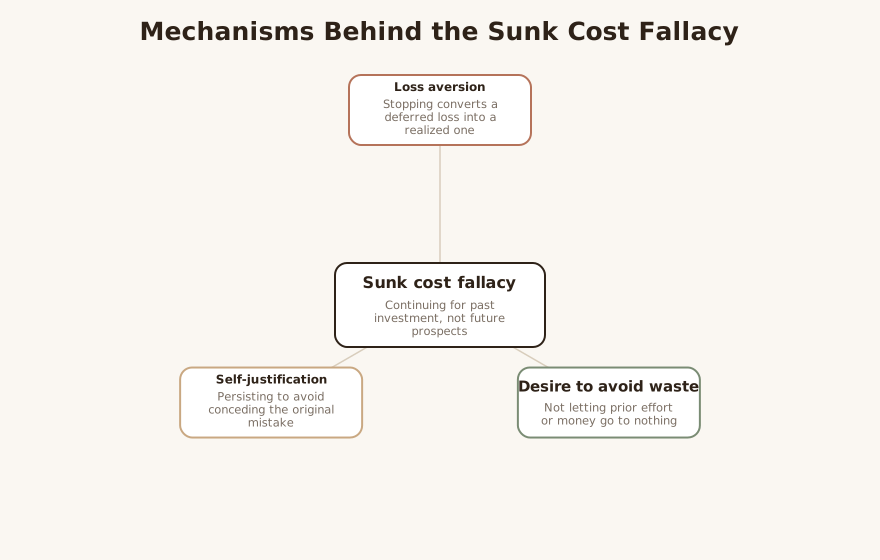
Several mechanisms are advanced to explain why 2. Loss aversion supplies the affective engine: stopping means converting a provisional, deferred loss into a definite, realized one, and the wish to avoid that realization keeps people invested 3. A second driver is the desire to avoid waste, often experienced as an almost moral injunction not to let prior effort or money “go to nothing,” so that continuing feels like the responsible choice even when it is the costlier one 2. A third is self-justification and the management of one’s self-image and reputation: abandoning a course publicly concedes that the original commitment was a mistake, and people persist partly to avoid appearing — to others and to themselves — inconsistent or wrong 2. Commitment and consistency pressures, and the related dynamic of escalation of commitment, compound this, as each further investment deepens the stake and raises the felt cost of quitting 3.
A crucial refinement is that the size and salience of the prior investment matter 1. The original experiments showed the effect grew with the magnitude of what had been spent, and that making the prior cost vivid intensified the pull to continue 1. Importantly, the fallacy concerns the misuse of past cost; a rational agent can still honor an existing commitment for genuine future reasons — reputation that will affect tomorrow, or option value — and distinguishing those forward-looking grounds from a backward-looking refusal to “waste” the past is the heart of the analysis LLM.
Interventions & Techniques
The sunk cost fallacy does not arrive packaged with proprietary techniques; it is a model that informs how a clinician conceptualizes and reframes a client’s reasoning within existing interventions LLM. Its most immediate clinical translation is psychoeducational: naming for a client that the mind treats “how much I have already put in” as a reason to continue, when only future prospects should count, externalizes the pattern and reframes a stuck decision as a recognizable, near-universal trap rather than a personal weakness LLM. This maps directly onto standard cognitive behavioral work — distinguishing a thought from a fact, examining the evidence for and against a course of action, and identifying the cognitive distortion driving a stuck appraisal LLM.
Because the fallacy is powered by the wish to avoid realizing a loss rather than by missing information, simply pointing out that the past is unrecoverable is necessary but often insufficient 3. A client can know intellectually that the years already spent are gone and still feel that leaving would betray them LLM. The construct therefore supports a forward-reframing move at the center of the work: asking the client to decide as though they were choosing freshly today, without the prior investment — the “would I start this now, knowing what I know?” question — which strips the sunk cost out of the appraisal 4. It also supports making the opportunity cost explicit, since the fallacy is in part a failure to weigh what continuing forecloses; naming the better alternatives the current course is crowding out shifts the frame from “protecting the investment” to “comparing futures” 4. Where the persistence is anchored in self-justification, the relevant work is on the meaning of being wrong — separating the decision to stop from a verdict on the person’s worth or judgment — which is squarely the territory of cognitive restructuring LLM. Commitment devices and pre-committed stopping rules, defined in advance of the emotional moment of quitting, can pre-empt escalation by deciding the abandon-criterion while the stakes are still cool LLM.
LLM-generated illustrative example (not a guideline): A clinician working with a client three years into a doctoral program the client now dreads draws out the question their mind is actually answering — not “is finishing the best use of my next two years?” but “how can I waste the three I already gave?” The clinician invites the client to imagine being offered the program fresh today, with full knowledge of how it feels, and asks whether they would enroll. The work shifts from defending the past investment toward comparing the futures each choice opens or closes. LLM
Evidence Base
The maturity of this construct is best described as established as a behavioral phenomenon, not as an evidence-based treatment 1. The sunk cost effect is one of the more durable findings in the psychology of decision making, demonstrated in the original 1985 Arkes and Blumer experiments and replicated across many subsequent laboratory and field studies and incorporated as a standard topic in behavioral economics 1. It has been documented across domains as varied as personal spending, business investment, public policy, and persistence in relationships and careers 2. Its standing as a real and reproducible departure from normative choice is not seriously in dispute 3.
Honesty requires several caveats LLM. First, recent work has complicated the picture: a 2021 evaluation of the sunk cost effect across a large set of experiments found the effect to be more fragile and context-dependent than its textbook prominence implies, with its size sensitive to how the decision is framed and measured 5. That does not overturn the construct, but it cautions against treating it as an iron law that will appear in every case 5. Second, “established” describes the standing of the behavioral phenomenon, not the outcomes of any therapy derived from it; there is no manualized “sunk cost treatment” with its own trial base, and the clinical inferences drawn here are reasoned extensions of established cognitive behavioral practice rather than direct findings LLM. Third, much of the foundational evidence comes from controlled choice tasks with relatively modest stakes, so its transfer to the affect-laden, identity-defining decisions of clinical life — leaving a marriage, abandoning a career — is plausible and useful but is itself an extrapolation LLM.
Populations & Indications
The construct is most clinically illuminating wherever a presentation turns on persisting in a failing course because of what has already been invested LLM. Adults facing major life decisions are the natural fit, since the fallacy bites hardest where the prior investment is large and meaningful 1. Clients with decision-making difficulties and pervasive indecisiveness often find that the weight of sunk costs is precisely what keeps them frozen between continuing and quitting LLM. Clients in unsatisfying relationships illustrate the pattern sharply: years together, shared history, and effort already spent are weighed as reasons to stay, independent of whether the relationship has a future worth having 2. Professionals and investors show it in escalating commitment to a failing project, role, or position, where each further outlay is justified by the ones before it 3.
The construct also reaches into more specific presentations LLM. Gamblers and clients with disordered gambling experience an intensified form, chasing losses in the belief that stopping now would waste what has already been lost, which is the sunk cost logic operating on each prior wager LLM. People with obsessive-compulsive disorder may show a related dynamic when time and effort already poured into a ritual, a checking sequence, or a reassurance-seeking loop are felt as reasons to complete or repeat it, making disengagement harder LLM. Across all of these the construct is an adjunct formulation lens, not a diagnosis-specific protocol LLM.
Problems-for-Work
Maladaptive decision-making. The construct sharpens work on stuck or self-defeating choices by showing that the client may be optimizing the past rather than the future, so treatment can target the intrusion of irrecoverable investment into a forward-looking decision 1.
Indecisiveness. Naming that the weight of “what I have already put in” is paralyzing a choice helps a client see why they oscillate, and supports the move of deciding as though choosing freshly today 4.
Relationship conflict. Persistence in an unsatisfying relationship can be reframed not as love or commitment alone but partly as reluctance to “waste” shared years, opening space to weigh the relationship’s future prospects on their own terms 2.
Behavioral inflexibility. Rigid continuation of a plan, role, or routine that no longer serves the client can be framed as escalation of commitment, where each prior step raises the felt cost of changing course 3.
Gambling-related persistence. Chasing losses can be named as the sunk cost fallacy applied to prior wagers, where the wish not to “waste” what is already lost drives the next, costlier bet LLM.
LLM-generated illustrative example (not a guideline): A client who has spent two years and considerable savings renovating a business that is steadily losing money describes feeling unable to close it “after everything I’ve put in.” The clinician helps the client separate the unrecoverable past spend from the question of what the next year would actually cost and yield, and to name what staying open is preventing them from doing instead. The work shifts from honoring the investment toward comparing realistic futures. LLM
Contraindications, Cautions & Cultural Humility
Because the sunk cost fallacy is a conceptual model rather than a treatment, it carries no direct contraindications, but its misuse does LLM. The chief caution is not to let an elegant framework substitute for assessment or evidence-based care; the construct should sit alongside established interventions, never replace them LLM. A second caution is precision: not all persistence in the face of prior investment is fallacious, because a person may have genuine forward-looking reasons to continue — a reputation that will shape future opportunities, the near-completion of something that does have value, obligations to others, or option value — and labeling every such choice a “sunk cost trap” is itself an error that can pressure a client toward a premature exit 5. The clinician’s task is to help distinguish a backward-looking refusal to waste the past from a defensible bet on the future, not to manufacture a verdict LLM.
A third caution is tone: telling a client who has stayed years in a marriage or a career that they are committing a “fallacy” can read as contempt for commitments they hold as virtues, so the pattern should be offered as a shared, near-universal feature of human decision making rather than a personal deficit LLM. Cultural humility matters in particular ways here LLM. The Western, individualist framing in which persistence is “irrational” and clean exit is “rational” is not universal: in many cultural and family systems, loyalty, perseverance, honoring one’s commitments, and not abandoning what one has begun are core values, and what an outside analyst codes as a sunk cost may be, for the client, a meaningful enactment of duty or belonging LLM. The clinician should offer the model tentatively, ask what the prior investment means to the person and to those around them, check how the frame lands, and set it aside whenever it does not fit the person in the room LLM.
Treatment-Plan Suggestions & SMART Objectives
| Goal | SMART objective (example) | Mechanism |
|---|---|---|
| Build awareness of the pattern | Client logs 1 stuck decision daily for 2 weeks, noting whether the reason to continue is past investment or future benefit, for 14 days | Externalizes the intrusion of sunk cost into forward-looking choice 1 |
| Strip out the sunk cost | Client applies the “would I start this fresh today?” question to 3 stuck commitments by session 4 | Removes irrecoverable past investment from the appraisal 4 |
| Make opportunity cost explicit | Client lists, for 2 ongoing endeavors, what continuing forecloses, by session 5 | Reframes the choice as comparing futures rather than protecting the past 4 |
| Loosen self-justification | Client identifies 1 belief equating “stopping” with “being wrong” and restructures it over 4 weeks | Separates the decision to stop from a verdict on the self LLM |
| Set pre-committed stopping rules | Client defines a concrete abandon-criterion for 1 endeavor and reviews it weekly for 4 weeks | Uses a commitment device to pre-empt escalation of commitment LLM |
| Reduce loss-driven persistence | Client practices naming the feared “realized loss” before 5 stay-or-go choices over 3 weeks | Targets the loss aversion fueling continuation 3 |
| Interrupt loss-chasing (gambling) | Client uses a pre-set loss limit and stops on 5 of 7 gambling occasions for 4 weeks | Blocks sunk cost logic applied to prior wagers LLM |
| Build flexible re-evaluation | Client reviews 1 long-running commitment against current goals monthly for 3 months | Counters behavioral inflexibility by re-weighting future prospects 3 |
Common Misconceptions
A frequent misreading is that any decision to keep going after a large investment is the sunk cost fallacy 3. It is not: the fallacy is the use of irrecoverable past cost to justify continuation, and a person can rationally persist for genuine future reasons such as near-completion value, option value, or reputational benefit that will accrue going forward LLM. A second misconception is that the fallacy is mere stupidity or poor arithmetic, when it is driven largely by affect — loss aversion and the wish to avoid realizing a loss — and by self-justification, which is why simply knowing the past is unrecoverable rarely dissolves the pull 3. A third is that the effect is a universal law that will appear in every situation; more recent evaluation suggests it is more fragile and context-sensitive than its textbook fame implies, so a clinician should not assume it is present without checking 5. A fourth is conflating the sunk cost fallacy with loss aversion itself; loss aversion is the broader underlying tendency for losses to outweigh gains, while the sunk cost fallacy is one specific decision error it helps to produce 3. Finally, clinicians sometimes treat the construct as a validated therapy in its own right, when its evidence concerns decision behavior, not the outcomes of any branded treatment LLM.
Training & Certification
There is no certification, credential, or formal training pathway specific to the sunk cost fallacy, because it is a theoretical construct rather than a practice modality LLM. Clinicians typically encounter it within graduate coursework in cognitive psychology, judgment and decision making, or behavioral economics, and through the primary literature, beginning with the 1985 Arkes and Blumer paper 1. Accessible explainer summaries and reference overviews are widely available and are sufficient for most clinical conceptual use 26.
For applied competence, the relevant training is in the established interventions the construct informs — cognitive restructuring, behavioral experiments, and decision-focused work within cognitive behavioral therapy, along with commitment-device and values-clarification methods — each of which has its own evidence base and training routes LLM. The most useful preparation is therefore to learn the model well enough to use it as psychoeducation and case formulation, while building credentialed skill in the treatments it complements LLM.
Key Terms
Sunk cost: a cost — of money, time, or effort — that has already been incurred and cannot be recovered whatever one now decides, and which therefore should not bear on a forward-looking choice 3.
Sunk cost fallacy (sunk cost effect): the tendency to continue an endeavor because of resources already and irrecoverably invested in it, rather than because of its future prospects 1.
Loss aversion: the tendency, central to prospect theory, for losses to loom psychologically larger than equivalent gains, which makes the realized loss of quitting feel costlier than continuing 3.
Opportunity cost: the value of the best alternative foregone by sticking with the current course; the sunk cost fallacy is partly a failure to weigh it 4.
Escalation of commitment: the dynamic by which each successive investment in a failing course deepens the stake and increases the felt cost of abandoning it 3.
Self-justification: the motive to maintain a consistent self-image and avoid conceding that an original commitment was mistaken, which sustains persistence 2.
Resources & Further Reading
▶ Watch — a video introduction to this concept:
- Arkes, H. R. & Blumer, C. (1985). The psychology of sunk cost. Organizational Behavior and Human Decision Processes (ResearchGate)
- The Sunk Cost Fallacy (The Decision Lab)
- Sunk cost fallacy (BehavioralEconomics.com mini-encyclopedia)
- What Is the Sunk Cost Fallacy? Definition & Examples (Scribbr)
- Evaluating the Sunk Cost Effect (IZA Discussion Paper, 2021)
- Sunk Cost Fallacy: Definition & Causes (Vaia)
- Sunk Cost Fallacy (Wikipedia)
Reflective / Supervision Questions
- When a client persists in a failing course, how do you tell whether they are honoring an irrecoverable past investment or making a defensible bet on the future, and how does that distinction change what you do next? 5
- How do you introduce the idea of sunk cost so it normalizes a near-universal decision trap rather than implying that a client’s long commitment to a marriage or career was foolish? 1
- Where in your caseload might persistence that looks like a “fallacy” actually express a culturally held value of loyalty, perseverance, or duty that deserves respect rather than correction? LLM
- For clients chasing losses in gambling, or completing rituals in obsessive-compulsive disorder, how do you work with the fact that the felt waste of stopping is most acute at the very moment disengagement matters most? LLM
- How do you help a client weigh opportunity cost — what continuing forecloses — without nudging them toward a premature exit you have decided for them? 4
- How do you decide when the sunk cost frame is genuinely clarifying a particular client’s stuck decision versus when it oversimplifies a complex, value-laden life choice and should be set aside? LLM