
Type & Discipline
Neuro-Linguistic Programming (NLP) is a modality and communication framework positioned at the intersection of psychotherapy and communication studies 45. It belongs to a family of contested methods whose central claims have outrun their empirical support, and it is most accurately described as a historical system: widely disseminated, commercially durable, but not validated 12. NLP is not a single protocol but a loosely bounded collection of techniques, presuppositions, and elicitation procedures that practitioners assemble to fit a presenting goal LLM. Notably, even its own scholarly reviewers concede that NLP is “difficult to define,” with most texts offering a story rather than a definition and its founders settling on the sweepingly broad “the study of subjective experience” 2. Psychology Today is explicit that “NLP is not actually a form of psychotherapy,” a framing every clinician should hold from the outset 4. For the practicing therapist, the honest summary is that NLP is a long-standing, heavily marketed practice whose institutional longevity vastly exceeds the evidence for its mechanisms LLM.
Creators & Lineage
NLP was developed in the mid-1970s by Richard Bandler, a psychology student, and John Grinder, a linguist, first appearing in their 1975 book The Structure of Magic and popularized through the 1979 bestseller Frogs into Princes 23. Their founding method was to “model” the verbal and behavioral patterns of therapists they regarded as unusually effective and codify those patterns into transferable techniques 25. The principal models were the hypnotic language of Milton Erickson, the family work of Virginia Satir, and the experiential focus of Fritz Perls and Gestalt therapy; the linguistic scaffolding borrowed from Korzybski and from Chomsky’s transformational grammar, though Chomsky himself had no association with NLP 23. Bandler and Grinder argued that observing the most skillful clinicians would reveal common principles that “could be generalized, verified on an empirical basis and put into therapeutic practice” 2. The critical lineage problem is what happened next: rather than formulating and testing hypotheses, they published their ideas “as if they were scientific fact,” skipping the step of empirical verification their own program had promised 2. This matters clinically, because much of what feels useful in NLP is in fact borrowed from Ericksonian hypnotherapy, Gestalt, and family systems work — parent traditions that carry their own, more developed evidence and supervision cultures LLM.
Core Principles
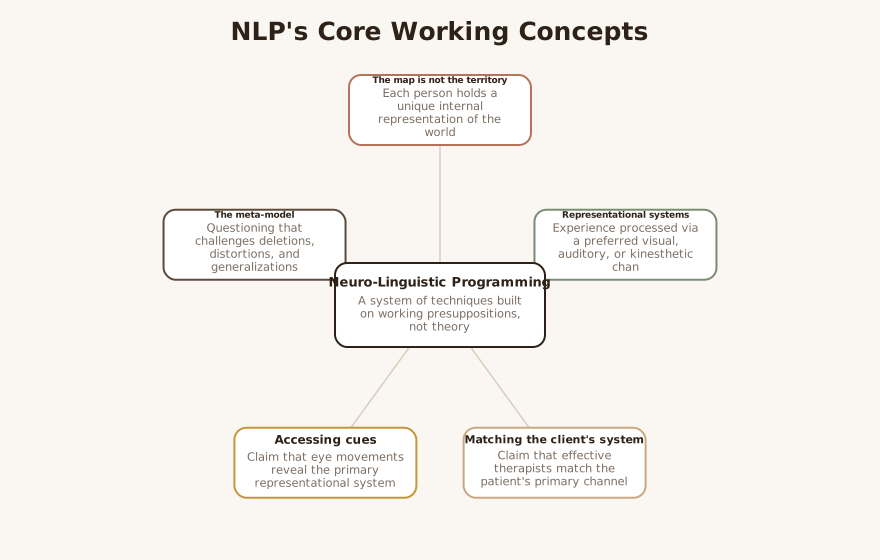
NLP rests on a set of working presuppositions rather than falsifiable theory LLM. The best known is “the map is not the territory,” borrowed from Korzybski — the claim that each person holds a unique internal representation of the world, “limited and distorted through their past experiences and cultural context,” and that the therapist’s task is to work within the client’s map 2. A second pillar is the representational system: the proposal that people process experience through visual, auditory, kinesthetic, olfactory, and gustatory channels, and that “each of us processes the majority of information using one primary representational system” — the preferred representational system, or PRS 2. Bandler and Grinder further claimed that “the most effective therapists matched the patient’s primary representational system” 2. A third concept is accessing cues: the assertion that eye movements would let a practitioner “unequivocally identify the primary representational system of the client” 2. A fourth is the meta-model, a structured questioning framework intended to challenge the deletions, distortions, and generalizations introduced when experience becomes language 3. These principles are pragmatic and outcome-oriented in tone, but it is essential to recognize that the strongest of them — PRS, predicate matching, and eye-accessing cues — are presented as empirical claims while never having been empirically established 12.
Interventions & Techniques
The clinical toolkit is concrete and technique-driven LLM. Reframing offers a client an alternative meaning or context for a behavior, “putting a situation in a different context to elicit an adaptive reaction,” shifting emotional valence without disputing the facts 45. Anchoring pairs a deliberate trigger with a desired state — “associating an external or internal trigger with a healthier response until it becomes automatic” — so the state can later be re-evoked 4. Mirroring matches a client’s breathing, facial expression, and body language to build rapport and a “suggestive state” 5. Meta-model questioning challenges vague or absolute language to recover specific detail, while the Milton model deploys deliberately vague, Erickson-derived hypnotic language for indirect suggestion 3. Practitioners also use predicate matching of sensory language, eye-accessing cue reading, the swish pattern, belief change, visualization, and visual-kinesthetic dissociation, the last marketed as a single-session phobia treatment 34. Most techniques are brief, structured, and directive, which is part of their appeal in time-limited settings — but brevity is not evidence, and several of these procedures rest on the very claims that controlled research has failed to support 12.
Evidence Base
Honesty about the evidence is essential, and here the evidence is unusually clear-cut for a method this popular LLM. NLP is historical in the sense of being long-standing and widely taught, not in the sense of being supported 12. In the most comprehensive psychological review, Witkowski analyzed the NLP research database, identifying 315 articles of which 63 were published in peer-reviewed journals; once descriptive studies were excluded, only 18.2% of results supported NLP, 54.5% were non-supportive, and 27.3% were uncertain 12. Accounting for the file-drawer effect, the positive findings are “akin to what could be expected from the placebo effect,” and Witkowski concluded that “NLP represents pseudoscientific rubbish, which should be mothballed forever” 12. The specific signature claims fare no better. On eye-accessing cues, Wiseman and colleagues ran three studies — coding liars and truth-tellers, testing whether teaching the eye-movement hypothesis improved lie detection, and analyzing high-profile press conferences — and found no support, concluding the “pseudo-scientific claim of eye movement can be reliably dismissed” 2. On preferred representational matching, Sharpley’s reviews found “little supportive evidence” and that PRS “could not be reliably assessed by therapists” 2. In health, Sturt and colleagues’ systematic review concluded “there is currently insufficient evidence to recommend use of NLP for any individual health outcome” 2. Passmore and Rowson’s own review of NLP coaching found 40 peer-reviewed papers across nearly four decades, of which more than half were conceptual, only two were quantitative, and “not a single randomized control trial was identified,” leading them to conclude “unique NLP practices are poorly supported by research evidence” 2. Expert Delphi panels have likewise classed NLP among discredited mental-health interventions 23. Psychology Today and EBSCO converge on the same verdict: “the empirical evidence for its efficacy is limited,” “there has been no clinical data supporting the effectiveness of NLP therapy,” and “the majority of psychological researchers consider NLP to be largely a pseudoscientific philosophy” 45.
Populations & Indications
NLP is marketed for a wide range of non-acute, goal-oriented concerns in motivated, verbally engaged clients, but the breadth of its claimed indications is itself a caution rather than a credential LLM. Psychology Today reports that NLP “purports to address anxiety, depression, phobias, poor self-esteem, weight management, substance misuse, stress, and PTSD” — a sweeping list for a method with no clinical data supporting its efficacy 4. In practice it is most often used with adults seeking change in communication style, confidence, and self-efficacy, and it gained its largest foothold in coaching and organizational settings, where it has been adopted by major commercial and governmental organizations 2. EBSCO notes it rose to prominence “within the broader alternative therapy movement” and continues “among some therapists and self-help advocates for personal development and behavior modification” 5. The defensible reading is that NLP’s indication profile is developmental and performance-focused as marketed, but that no population should be offered NLP as a treatment for a diagnosable condition that has an evidence-based therapy available 45.
Problems-for-Work
NLP techniques are mapped onto several recurring targets, with the strong caveat that the supporting evidence ranges from thin to refuted 12.
- Communication and rapport difficulties. Mirroring, predicate matching, and meta-model questioning are taught as relational skills; rapport-building is the least objectionable application, though its effects likely reflect general factors rather than anything specific to NLP 5LLM.
- Limiting beliefs and low self-esteem. Reframing and belief-change work aim to loosen absolute self-statements and open alternative appraisals 4.
- Performance and presentation anxiety. Anchoring is used to pre-load a calm, resourceful state before a feared event 4.
- Phobias, anxiety, depression, PTSD, weight, and substance misuse. These are marketed indications with no clinical data supporting NLP’s effectiveness, and treating them with NLP in place of an established therapy is a clinical risk 45.
LLM-generated illustrative example (not a guideline): A client requests “the NLP fast phobia cure” for elevator anxiety after seeing it advertised. The clinician explains candidly that the single-session claim is unvalidated, then proposes an evidence-based exposure protocol, integrating only the transparent, consent-based rapport elements as a relational adjunct. LLM
Contraindications, Cautions & Cultural Humility
NLP is not an appropriate primary treatment for any condition with an established evidence-based therapy, and using it in place of such treatment is a meaningful clinical risk 4LLM. The danger is sharpest where NLP has been promoted for serious medical conditions — including, historically, Parkinson’s, HIV/AIDS, and cancer — claims made with “no supporting medical evidence” that risk delaying effective treatment 3. NLP’s confident, often grandiose marketing fosters overclaiming; the coaching literature contains case studies asserting near-“miracle” cures with no described method, diagnosis, or outcome measure, which should make any clinician skeptical of NLP success stories 2. Clinicians should be candid with clients that the mechanism claims are unproven and that any reported benefit may reflect alliance, expectancy, structure, and practice rather than anything specific to NLP 4LLM. Representational-system typing carries a particular hazard of reductive labeling and should never be treated as a stable trait 12. Culturally, predicate-matching, eye-contact reading, mirroring, and touch-based anchoring assume communication norms that are not universal — indeed, one replication found NLP eye patterns simply “do not apply” to a non-Western student sample — so fit and consent must be checked rather than assumed 2.
Treatment-Plan Suggestions & SMART Objectives
The table offers illustrative objectives only; each should be individualized, and where an evidence-based treatment exists for the condition, NLP elements should be subordinated to it or omitted LLM.
| Goal | SMART objective (example) | Mechanism |
|---|---|---|
| Improve rapport in a key relationship | Client will practice matched pacing in three planned interactions over 4 weeks, reviewing outcomes in session 5 | Mirroring supports perceived rapport via general relational factors 5LLM |
| Loosen a limiting self-belief | Client will generate two alternative meanings for a recurring self-judgment per session for 4 sessions 4 | Reframing shifts the context around an experience 4 |
| Reduce presentation anxiety | Client will deliver one timed practice talk using a pre-set calm anchor within 8 weeks 4 | Anchoring re-evokes a resourceful state on cue 4 |
| Increase verbal precision in conflict | Client will use one meta-model clarifying question in two real conversations weekly for 5 weeks 3 | Meta-model questioning recovers specific, workable detail 3 |
| Build a self-soothing routine | Client will pair a chosen trigger with a calm state and rehearse it daily for 3 weeks 4 | Trigger-state association is rehearsed toward automaticity 4 |
| Clarify a personal goal | Client will define one outcome in specific, sensory, achievable terms and review weekly LLM | Well-formed-outcome framing clarifies and motivates LLM |
| Route a phobia to evidence-based care | Client will be referred for an established exposure-based protocol within 2 weeks rather than an NLP “fast phobia” procedure 4 | Substituting validated treatment for an unvalidated claim protects outcomes 4LLM |
Common Misconceptions
The most damaging misconception is that NLP is a validated, neuroscience-grounded technology; the name evokes neurology, but its neural claims are “based on outdated metaphors of the brain’s inner workings” and are not empirically established 3. A second is that everyone has a fixed visual, auditory, or kinesthetic “type” readable from eye movements — a claim that controlled studies have not supported and that one research team said “can be reliably dismissed” 2. A third is that NLP is a regulated profession; in reality “there is no regulation of NLP, nor is there a widely-shared definition of the techniques,” the terms sit in the public domain, and credentialing is so lax that a British presenter reportedly registered his cat with an NLP board 34. A fourth is that rapport techniques such as mirroring are covert influence tools; in legitimate practice they are transparent, consent-based relational skills 5LLM. Finally, the brevity of NLP procedures is mistaken for proof of efficiency — short, structured exercises can still produce change through general factors rather than NLP’s stated mechanisms LLM.
Training & Certification
NLP training operates through a private, non-statutory certification market rather than through licensed mental-health credentialing 34. Following a 2000 legal settlement between Bandler and Grinder, the terms “NLP” and “neuro-linguistic programming” were left in the public domain with no single party holding exclusive rights and “no restrictions on offering NLP certifications” 3. Programs are typically tiered as Practitioner, Master Practitioner, and Trainer, delivered by independent institutes with no centralized standards or oversight, so quality varies enormously 3LLM. Because the field is unregulated, an NLP certificate confers no clinical license and does not, on its own, qualify anyone to provide psychotherapy 3LLM. Psychology Today’s own guidance reflects this: an NLP therapist “should be a licensed mental health professional, social worker, or therapist with additional training in NLP interventions,” meaning the underlying license — not the NLP credential — is what authorizes clinical work 4. For licensed clinicians, the defensible path is to treat any genuinely useful element as an adjunct within an existing scope and supervision, while relying on accredited training for the conditions being treated LLM.
Key Terms
- Map is not the territory — the presupposition, borrowed from Korzybski, that clients respond to their internal representation of reality rather than reality itself 2.
- Preferred representational system (PRS) — the claim that each person processes most information through one primary sensory channel; not reliably assessable and poorly supported 12.
- Eye-accessing cues — the claim that eye movements reveal the active representational system; empirically dismissed 2.
- Meta-model — a structured questioning method to recover deletions, distortions, and generalizations in language 3.
- Milton model — deliberately vague, Erickson-derived hypnotic language used for indirect suggestion 3.
- Anchoring — pairing a deliberate trigger with a desired internal state so the state can be re-evoked 4.
- Reframing — offering an alternative context that changes an experience’s emotional charge 4.
Resources & Further Reading
▶ Watch — a video introduction to this concept:
- Witkowski, T. — Thirty-Five Years of Research on Neuro-Linguistic Programming. NLP Research Data Base. State of the Art or Pseudoscientific Decoration?
- Passmore, J. & Rowson, T. S. — Neuro-linguistic programming: a critical review of NLP research and the application of NLP in coaching
- Neuro-linguistic programming — Wikipedia
- Neuro-Linguistic Programming Therapy — Psychology Today
- Neuro-linguistic programming (NLP) — EBSCO Research Starters
Reflective / Supervision Questions
- When I reach for an NLP technique, can I name the general factor — alliance, expectancy, structure, practice — that may actually be driving any change, and am I prepared to be transparent with the client about it? LLM
- Am I using an NLP element as a minor adjunct within my licensed scope, or am I letting it substitute for an evidence-based treatment this presentation warrants? LLM
- How do I describe NLP’s evidence status — that systematic reviews found it largely unsupported — without either overclaiming or dismissively undercutting a client’s reported benefit? 12LLM
- Where might representational-system, eye-cue, or mirroring techniques carry culturally specific meanings I have not checked with this particular client? 2LLM
- If I find a borrowed technique consistently helpful, what does that suggest I should study more deeply in its parent modality — Ericksonian, Gestalt, or systemic work — where the theory and supervision are stronger? LLM