
Type & Discipline
Social constructivism is a theory of knowledge — a sociological epistemology — rather than a packaged psychotherapy protocol, and it asserts that human development is socially situated and that knowledge is constructed through interaction with others 7. It sits within the broader family of constructivist learning theory and is most closely associated with educational and developmental psychology 3. Unlike social constructionism, which centers on ontology (the nature of social reality), social constructivism emphasizes epistemology — how we come to know what we know 7. For clinicians, the relevance is indirect but pervasive: the assumptions that meaning is co-built, that language mediates change, and that a skilled other can extend a learner’s capacity all flow directly from this framework 1. It is best understood as a meta-theory that shapes how we teach, scaffold, and make meaning with clients rather than as a discrete intervention manual LLM.
Creators & Lineage
The framework is anchored in the work of Lev Vygotsky (1896–1934), a Russian psychologist whose brief but influential career — he died at 37 with incomplete manuscripts — fundamentally reshaped developmental psychology and education 1. Vygotsky’s sociocultural theory emphasizes that culture and interaction drive cognitive development, arguing that “language, writings, and concepts arising from the culture” unlock higher-level thinking 3. His position is usually contrasted with Jean Piaget’s individual constructivism: Piaget favored independent discovery learning and proposed universal developmental stages, whereas Vygotsky held that children require instruction from more learned individuals and that development varies across cultures 31. Where Piaget believed thought precedes language, Vygotsky contended the two merge around age three 1. As an epistemological movement, social constructivism rejects the idea that knowledge emerges from individual genius alone, emphasizing instead the contingency and social factors that shape what we accept as true 7. Later educational scholarship — including work associated with A. Sullivan Palincsar — extended the psychological dimensions of the theory into classroom practice 7.
Core Principles
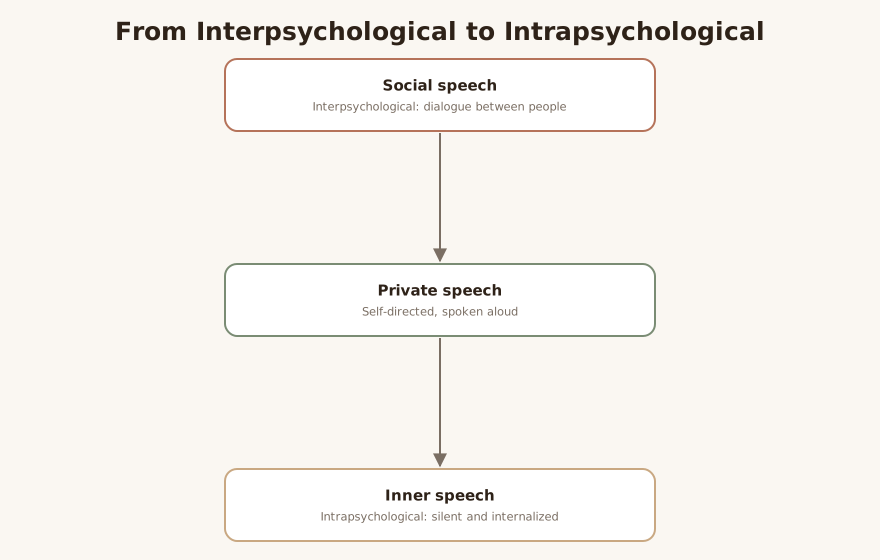
The central claim is that knowledge is constructed through interaction with others rather than transmitted intact from expert to novice 7. Several interlocking principles follow. First, social interaction is primary: Vygotsky argued that interactions with teachers and more knowledgeable peers facilitate a learner’s potential, without which cognitive advancement would be severely limited 3. Second, language is the master tool — Vygotsky viewed it as humanity’s greatest instrument, serving both to transmit cultural knowledge across generations and to enable intellectual adaptation 1. Third, learning moves from the social to the individual: it progresses from the interpsychological (occurring between people through dialogue) to the intrapsychological (internalized within the person) 2. This internalization is visible in the trajectory of speech, which transforms from social speech, through private (self-directed) speech, into silent inner speech 1. Fourth, meaning is negotiated; classroom research frames it as “meaning-making through negotiating with the ideas of others” 7. For the clinician, the through-line is that change is relational and dialogic — what a client can eventually do alone is first practiced with another LLM.
Interventions & Techniques
Although social constructivism is a theory rather than a protocol, it generates a recognizable set of techniques LLM. The most clinically portable is scaffolding: temporary support structures that help a learner master a new skill and are gradually withdrawn as competence grows, analogous to construction scaffolding removed once a building stands 1. Effective scaffolding includes modeling desired strategies, providing hints and prompts, breaking complex tasks into manageable steps, using visual aids, and gradually withdrawing support 2. Three features make scaffolding work: contingency (responsiveness — continuously assessing understanding and adjusting support, giving more direct guidance when the person struggles and encouraging independence when they demonstrate competence), fading (gradual withdrawal as skills are internalized, transferring responsibility from helper to learner), and intersubjectivity (shared understanding between the more knowledgeable other and the learner about goals and process) 2. The more knowledgeable other (MKO) — a teacher, parent, or more capable peer — guides through shared dialogue, hints, and encouragement, and importantly this role is fluid: learners can become MKOs for others as they advance 1. Dynamic assessment, using a test–teach–retest format, reveals potential by showing what a person can achieve with mediation rather than only what they can do unaided 2. Transactive discussion, in which peers challenge one another and must justify and clarify their reasoning, supports co-construction of knowledge and metacognitive awareness 2.
Evidence Base
The maturity of this framework is best described as established as a theory, with a strong and well-documented evidence base specifically in education LLM. Classroom research demonstrates that structured discussion helps students develop reasoning skills, transfer knowledge across contexts, and build self-regulation and collaborative problem-solving capacity 7. The ZPD and scaffolding remain “highly influential in contemporary education,” informing differentiated instruction, dynamic assessment, mixed-ability grouping, and inquiry-based learning 2. Honesty about limits matters here. Implementation is harder than the theory: studies show teachers rarely implement true discussion, with students averaging under three minutes per hour in authentic dialogue 7. The ZPD itself is difficult to operationalize because it is dynamic and context-dependent, resisting clean measurement 2. Critics also note that “strong” social constructivism — which holds that the natural world plays a minimal role in scientific knowledge — overlooks empirical constraints and the success of science 7. For clinical practice specifically, the direct outcome evidence is largely extrapolated from educational and developmental research rather than from controlled psychotherapy trials of “social constructivism” as such LLM.
Populations & Indications
The framework was developed with and is most directly validated in children and students, where the ZPD describes the gap between independent ability and guided potential 2. It extends naturally to adolescents, who benefit from peer scaffolding and transactive discussion as MKO roles shift among capable peers 1. Families are an apt application site because parents and caregivers function as more knowledgeable others and as transmitters of cultural tools and language 1. People with learning differences are well served by the contingency principle — calibrating support to a moving target and fading it as mastery grows — and by mixed-ability collaboration in which advanced learners reinforce their own understanding by teaching 2. Clients in psychoeducation are a strong fit, since the entire model is built around moving a learner from assisted to independent performance through dialogue LLM. The unifying indication is any presentation where the goal is to build a skill or a shared understanding that the client cannot yet sustain alone LLM.
Problems-for-Work
Several common clinical targets map cleanly onto a social-constructivist stance LLM. Skills deficits and learning difficulties are the prototypical fit: identify the ZPD, scaffold within it, and fade support 2. Self-regulation difficulties connect to the developmental move from external dialogue to internalized private and inner speech, the engine Vygotsky proposed for self-direction 1. Low self-efficacy and low motivation are addressed by keeping tasks in the “sweet spot” where success is possible with guidance, so the person experiences earned competence rather than frustration 2. Developmental delays and communication problems are natural targets given the theory’s grounding in language and cultural mediation 1. Adjustment difficulties and meaning-making difficulties fit the principle that understanding is co-constructed through negotiating with others’ ideas 7. Even cognitive distortions can be reframed as meanings built in social context that can be renegotiated in dialogue, a stance consonant with constructivist psychotherapy 7.
LLM-generated illustrative example (not a guideline): A 14-year-old who “freezes” on any independent schoolwork can complete the same problems when a clinician thinks aloud alongside him. The clinician models the first step, then prompts only at points of struggle, and over several sessions fades to silent presence — externalizing the self-talk the teen will eventually internalize. LLM
Contraindications, Cautions & Cultural Humility
There are no formal contraindications to a theory, but several cautions follow from its own literature LLM. The first is dependency risk: if scaffolding is not deliberately faded, the support that should be temporary becomes a permanent crutch 2. The second is measurement humility — because the ZPD is dynamic and context-dependent, clinicians should hold any estimate of a client’s “level” loosely and re-assess continuously 2. The third is a verbal-instruction bias: the framework’s heavy emphasis on dialogue can undervalue non-verbal, experiential, and embodied learning, which matters for clients whose strengths or cultures are not primarily verbal 2. Cultural humility is intrinsic, not optional, here: Vygotsky held that development varies across cultures and that the tools of thought are culturally supplied, so the “more knowledgeable other” must respect the client’s own cultural knowledge rather than impose the clinician’s 1. Cultural variation in teaching styles, recognition of expertise, and communication norms can all complicate scaffolding and should be named explicitly 2.
Treatment-Plan Suggestions & SMART Objectives
| Goal | SMART objective (example) | Mechanism |
|---|---|---|
| Build an unmastered skill | Within 8 weeks, client will independently complete a 3-step coping sequence in 4 of 5 trials, with clinician support faded from full modeling to silent presence | Scaffolding within the ZPD with contingent fading 2 |
| Strengthen self-regulation | Within 6 weeks, client will use a self-directed verbal cue (“name it, pause, choose”) in 3 logged real-world situations per week | Internalization of dialogue into private/inner speech 1 |
| Raise self-efficacy | Within 4 weeks, client will rate confidence ≥7/10 on two tasks previously rated ≤3, after guided practice calibrated to the “sweet spot” | Success-with-guidance in the learning zone 2 |
| Improve meaning-making | Within 8 sessions, client will articulate a revised, less self-critical account of one stuck situation across two consecutive sessions | Co-construction of meaning through dialogue 7 |
| Develop communication skills | Within 6 weeks, client will initiate and sustain one structured perspective-taking exchange per session, justifying their reasoning | Transactive discussion and intersubjectivity 2 |
| Support a caregiver as MKO | Within 4 weeks, caregiver will demonstrate contingent prompting (hint before answer) in 3 of 4 observed interactions | Parent functioning as more knowledgeable other 1 |
| Increase task engagement | Within 4 weeks, client will attempt a previously avoided task in 3 of 5 opportunities when it is broken into modeled sub-steps | Task decomposition and graded challenge 2 |
Common Misconceptions
A frequent error is conflating social constructivism with social constructionism; the former is an epistemology about how individuals come to know, while the latter is more concerned with the social ontology of reality 7. Another is treating it as a license for “anything goes” relativism — but even within the theory, “strong” versions that deny empirical constraint are critiqued, and the more defensible reading acknowledges that the world pushes back 7. A third misconception is that scaffolding means giving answers; in fact its defining moves are hints, prompts, and modeling that are faded, with the explicit goal of transferring responsibility to the learner 2. Clinicians also sometimes assume the MKO must be the most senior person in the room, but the role is fluid and can be held by a peer 1. Finally, the ZPD is not a fixed trait or score; it is a moving, context-dependent band that must be re-estimated as the client changes 2.
Training & Certification
There is no certifying body or credential for “social constructivism” itself, because it is a theoretical framework rather than a licensed modality LLM. Clinicians typically encounter it inside graduate coursework in educational and developmental psychology, where it is taught as Vygotsky’s sociocultural theory alongside Piaget’s constructivism 3. Practical fluency is built by learning the applied techniques the theory generates — scaffolding, contingency, fading, dynamic assessment, and transactive discussion — most of which are taught within education and instructional-design training rather than psychotherapy certification tracks 2. For clinical application, the most direct downstream training routes are the constructivist and narrative psychotherapy traditions that inherit its assumptions about co-constructed meaning LLM.
Key Terms
- Zone of Proximal Development (ZPD): the distance between what a learner can do independently and what they can achieve with guidance from a more knowledgeable other 3.
- Scaffolding: temporary, fading support that helps a learner master a task within the ZPD 1.
- More Knowledgeable Other (MKO): any person (or tool) with greater expertise who guides the learner; the role is fluid 1.
- Contingency: responsive adjustment of support based on continuous assessment of the learner’s understanding 2.
- Fading: the gradual withdrawal of support that transfers responsibility to the learner 2.
- Intersubjectivity: shared understanding between helper and learner about goals and process 2.
- Private/inner speech: self-directed talk that becomes internalized as silent thought and supports self-regulation 1.
- Internalization: the move from interpsychological (between people) to intrapsychological (within the person) functioning 2.
Resources & Further Reading
▶ Watch — a video introduction to this concept:
- Vygotsky’s Sociocultural Theory of Cognitive Development (Simply Psychology)
- Zone of Proximal Development (Simply Psychology)
- Social Constructivism: Vygotsky’s Theory (Educational Psychology, SUNY Create Pressbooks)
- Social constructivism (Encyclopaedia Britannica)
- Social constructivism (Wikipedia)
Reflective / Supervision Questions
- For a current client, where exactly is the boundary between what they can do alone and what they can do with my help — and am I working in that band, or above or below it? LLM
- Am I scaffolding with hints and modeling, or quietly doing the work for the client and calling it support? LLM
- Have I built a concrete plan to fade my support, or am I inadvertently reinforcing dependence? LLM
- Whose cultural tools and language are organizing this work — mine or the client’s — and have I positioned the client (or their family) as a knowledgeable other? LLM
- When I treat the client’s meaning as something we negotiate rather than something I correct, what changes in the alliance and in their motivation? LLM