
Type & Discipline
The Safety Planning Intervention (SPI) is a brief, structured clinical technique within the discipline of clinical psychology, situated in the family of suicide-specific care 1. It is not a stand-alone psychotherapy or theoretical model but a discrete, manualized procedure that a clinician and a person at risk complete together in a single contact, most often lasting twenty to forty-five minutes 1. Its theoretical roots are cognitive-behavioral: it assumes that suicidal states are time-limited and that pre-committing to a graded sequence of coping responses can carry a person through the acute window of highest risk 1. Because it is a technique rather than a modality, SPI is routinely embedded inside larger treatment frameworks — cognitive behavioral therapy, dialectical behavior therapy, or system-level programs such as Zero Suicide — rather than delivered in isolation 4. Understanding SPI as a portable component, not a complete treatment, is essential to using it well LLM.
Creators & Lineage
SPI was developed by Barbara Stanley, PhD, a professor of medical psychology at Columbia University, and Gregory K. Brown, PhD, a research professor at the University of Pennsylvania and director of the Penn Center for the Prevention of Suicide 3. The two published the foundational description of the intervention in 2012 in Cognitive and Behavioral Practice 1. The work grew out of cognitive-behavioral approaches to suicide prevention and was designed in part for use in emergency and acute-care settings, where clinicians need a fast, reproducible procedure to deploy before a person leaves care 1. Stanley and Brown framed safety planning as a deliberate departure from the older “no-suicide contract,” substituting a concrete, person-generated action plan for a promise not to act LLM. SPI now anchors the “engage” and crisis-planning components of the Zero Suicide framework and is treated as a key element of that model 4. Its lineage runs alongside, and is frequently combined with, cognitive therapy for suicide prevention and dialectical behavior therapy, both of which share its premise that suicidal crises are survivable and skill-responsive LLM.
Core Principles
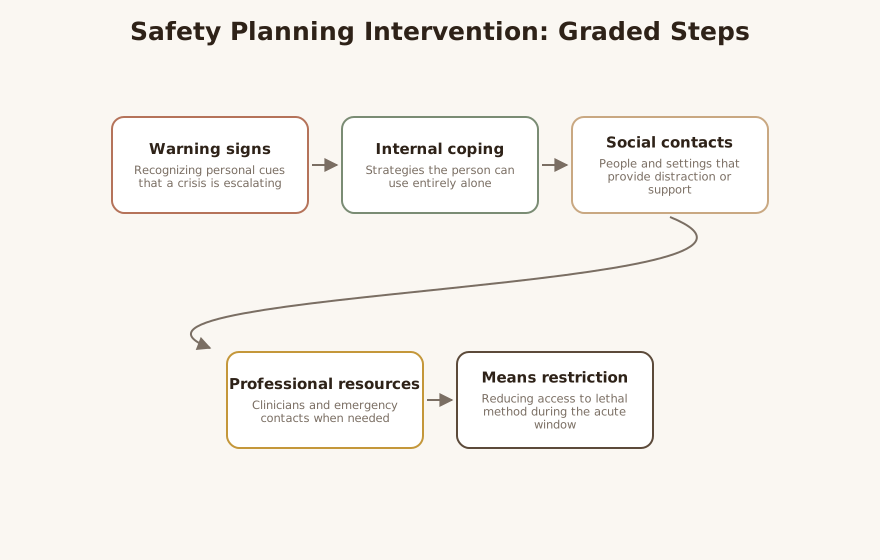
Several principles distinguish SPI from generic crisis advice LLM. First, it is collaborative: the plan is built with the person, in their own words, not handed to them as clinician instructions 6. The Safer Society Foundation describes SPI as “a brief, collaborative intervention” that uses “personalized strategies to aid in the prevention of escalation of suicidal crisis,” and that collaboration is what makes the resulting plan usable under duress 6. Second, it is graded and sequential: the steps move from strategies the person can use entirely alone, outward toward other people, and finally to professional and emergency resources, so that the least restrictive coping response is tried first 1. Third, it is concrete and written: the plan is a tangible artifact the person keeps, not an abstract intention, which matters because cognitive constriction during a crisis narrows access to one’s own coping repertoire 1. Fourth, it treats lethal-means safety as integral, not optional, recognizing that reducing access to method during the acute window is among the most direct ways to interrupt a suicidal act 1. Fifth, it assumes the suicidal state is transient, so the plan’s job is to buy time and connection until the crisis recedes 1.
Interventions & Techniques
The core safety plan comprises six steps, completed in order during a guided conversation 1. Step one is recognizing personal warning signs — the thoughts, images, moods, situations, or behaviors that signal a crisis may be building, written specifically enough that the person will recognize them in the moment 3. Step two is internal coping strategies the person can use alone to take their mind off the crisis without contacting anyone, such as a walk, music, or a grounding routine 3. Step three is social contacts and settings that provide distraction — people or places that pull attention outward, distinct from people the person would ask for help 3. Step four is family members or friends the person can ask directly for help during a crisis 3. Step five is professionals and agencies to contact, including the treating clinician, local crisis services, and a crisis or suicide hotline number 3. Step six is making the environment safer by reducing access to lethal means, developed collaboratively and concretely 3.
Some versions add an optional adjunct prompt for reasons for living, but the canonical plan is the six-step sequence above 3. The technique of construction matters as much as the content: the clinician elicits each item, checks its feasibility (“Could you actually do that at two in the morning?”), and problem-solves obstacles to using the plan, including how to keep it accessible 1. Means-restriction counseling is conducted as a respectful, specific conversation about timeframes, storage, and removal rather than a demand LLM.
LLM-generated illustrative example (not a guideline): A clinician and a client who experiences late-night suicidal urges write that the client’s earliest warning sign is “lying awake replaying the argument.” Internal coping becomes a cold-shower-and-podcast routine; the distraction contact is a sibling who tends to text memes; the help contact is a close friend who knows the history; the professional line is the local crisis number saved in the phone. For means safety, the client agrees to give a roommate the key to a locked box for two weeks. LLM
Evidence Base
SPI is best described as an established intervention, but it is important to be precise about what that means LLM. The 2012 Stanley and Brown paper is a clinical description of the procedure and its rationale, not a controlled outcome trial; it lays out the steps and the cognitive-behavioral logic rather than reporting efficacy data 1. The maturity of SPI rests on two further pillars LLM. First, it has been adopted as a core, named component of the Zero Suicide model and is widely disseminated through clinical and public-health organizations, which reflects strong professional consensus and uptake 4. Second, comparative research conducted outside this source set has supported its use in acute and emergency settings, where it has been associated with better outcomes than usual care; clinicians should consult the primary trial literature for specific effect estimates LLM. Honest framing for practice: SPI has a solid rationale, broad institutional endorsement, and supportive outcome research, but the single foundational citation here documents the method, not the magnitude of effect LLM. Treat it as an evidence-supported standard of care for crisis planning while keeping the distinction between the descriptive paper and the outcome literature clear LLM.
Populations & Indications
SPI is indicated for anyone presenting with suicidal ideation, a recent suicidal crisis, or recent self-harm, across the lifespan and across levels of care 1. It was designed with emergency-department and acute-care presentations in mind, where a brief, reproducible procedure is needed before a person is discharged 1. It is widely used with psychiatric inpatients at the point of discharge, when the post-discharge window carries elevated risk, and with outpatients who carry chronic or recurrent suicidality LLM. It is applied with adolescents and young adults, typically with developmentally appropriate language and, where appropriate, caregiver involvement in the means-restriction step LLM. It is a standard tool in veteran and military behavioral health, where access to firearms makes the means-safety step especially salient LLM. The intervention is deliberately versatile: its structure makes it suitable across settings without losing fidelity 6.
Problems-for-Work
SPI maps cleanly onto several concrete clinical problems LLM.
- Acute suicidal ideation. The plan gives the person a rehearsed, ordered set of responses to reach for when ideation spikes, replacing freeze-and-spiral with a known next step 1.
- Suicidal crisis escalation. The graded sequence is built to interrupt escalation early, at the first warning sign, before the crisis reaches peak intensity 6.
- Access to lethal means. Step six operationalizes means restriction as a collaborative, specific plan for storage, delay, or removal during the high-risk window 1.
- Post-discharge transition risk. Completed before leaving the emergency department or inpatient unit, the plan bridges the dangerous gap between acute care and the next appointment 1.
- Recurrent self-harm urges. For clients with chronic urges, the plan becomes a living document reviewed and revised across sessions as warning signs and supports change LLM.
Contraindications, Cautions & Cultural Humility
SPI has no formal contraindications, but several cautions govern good use LLM. It is not a substitute for clinical assessment: a safety plan does not establish that a person is safe to leave a higher level of care, and it must never be used to justify discharging someone who needs hospitalization LLM. It is not a no-suicide contract and should never be presented as the person promising not to act; conflating the two undermines the collaborative stance and has no evidentiary support LLM. A plan completed perfunctorily — filled in for the chart rather than built with the person — loses the collaborative quality that makes it work 6. The means-restriction conversation requires particular care: it should be specific and respectful, attentive to firearm access, and never coercive LLM. Cultural humility matters throughout: warning signs, acceptable coping strategies, who counts as a safe “help” contact, and attitudes toward professional and crisis services are all shaped by culture, family structure, language, and prior experiences with the health system LLM. For clients who distrust formal services, the social-support steps may carry more weight than the professional ones, and the clinician should follow the client’s own map of safety rather than impose a default LLM.
Treatment-Plan Suggestions & SMART Objectives
| Goal | SMART objective (example) | Mechanism |
|---|---|---|
| Identify personal warning signs | Client will name at least three specific, recognizable early warning signs and record them in the written plan by the end of session | Builds metacognitive awareness so the plan activates before crisis peaks 1 |
| Build internal coping repertoire | Client will list at least two solo coping strategies and rate confidence in using each at least 7/10 within two sessions | Provides least-restrictive first-line responses usable alone 1 |
| Establish social distraction and support | Client will identify two distraction contacts and two help contacts, with names and numbers, by next session | Engages connection as a graded buffer against isolation 3 |
| Link to professional and crisis resources | Client will save the treating clinician’s and a crisis line number in their phone and confirm access before discharge | Ensures rapid escalation path when self- and social steps are insufficient 3 |
| Reduce access to lethal means | Client will agree to one concrete means-safety step (e.g., secured storage) and confirm completion within one week | Lowers act lethality during the acute window 1 |
| Maintain and revise the plan | Client and clinician will review and update the written plan at each session over the next month | Keeps the plan current as warning signs and supports change 6 |
| Increase plan accessibility | Client will report keeping the plan reachable (phone, wallet) and locating it within 30 seconds when asked, by next session | Counters crisis-driven cognitive constriction with an external prompt 1 |
Common Misconceptions
The most consequential misconception is that SPI is a no-suicide or no-harm contract; it is the opposite — a person-generated action plan, not a promise to refrain from acting, and the contract approach it replaced lacks evidence LLM. A second misconception is that completing a safety plan establishes safety or substitutes for risk assessment and disposition decisions; it does neither and should never be used to discharge someone who needs more care LLM. A third is that the steps are interchangeable in order; the sequence is intentionally graded from solo coping outward to professional help, and reordering it dilutes the design 1. A fourth is that the plan is the clinician’s to write; in fact its protective value comes from being built collaboratively in the person’s own words 6. A fifth is that means restriction is an optional add-on rather than a core step — it is integral to the intervention 1.
Training & Certification
Stanley and Brown’s foundational paper provides the procedure in enough detail to learn the structure, and the official Stanley-Brown Safety Planning Intervention site offers virtual and online training in implementing the intervention 13. Organizations disseminating the Zero Suicide model also provide training resources that incorporate SPI as a named component 4. There is no single mandatory license required to use a safety plan in practice, but formal training improves fidelity — particularly in conducting the collaborative elicitation and the means-restriction conversation, which are the steps most often done poorly without instruction LLM. Clinicians new to SPI should seek structured training and supervised practice rather than relying on the one-page form alone LLM.
Key Terms
- Warning signs — the person-specific thoughts, feelings, situations, or behaviors signaling that a suicidal crisis may be developing 1.
- Internal coping strategies — actions a person can take alone, without contacting others, to ride out distress 3.
- Means restriction / lethal-means safety — collaboratively reducing access to methods of self-harm during the high-risk window 1.
- Graded sequence — the ordering of steps from solo coping outward to social and professional help 1.
- No-suicide contract — an older, evidence-poor practice of asking a person to promise not to act, which SPI deliberately replaces LLM.
- Zero Suicide — a health-system framework for suicide prevention within which SPI serves as a core crisis-planning component 4.
Resources & Further Reading
▶ Watch — a video introduction to this concept:
- Stanley & Brown (2012), Safety Planning Intervention — journal abstract
- Stanley & Brown (2012), full-text PDF
- Stanley-Brown Safety Planning Intervention — official site and training
- Zero Suicide / EDC resource record for the Safety Planning Intervention
- Safer Society Foundation — The Safety Planning Intervention in Suicide Prevention
Reflective / Supervision Questions
- When I last completed a safety plan, was it genuinely collaborative, or did I fill it in for the chart? LLM
- Am I clear in my own practice on the difference between a safety plan and establishing that a person is safe to discharge? LLM
- How comfortable and specific am I in the means-restriction conversation, especially around firearm access, and where could I improve? LLM
- Do the social and professional contacts in my clients’ plans reflect their trusted supports, or my defaults? LLM
- How do I ensure plans stay living documents — reviewed and revised — rather than one-time forms? LLM
- When have cultural factors changed what a workable warning sign, coping strategy, or help contact looks like for a client? LLM