
Zero Suicide reframes a familiar and painful clinical reality: most people who die by suicide were recently in contact with a health or behavioral health system, yet that contact often failed to identify or hold their risk. LLM The framework’s organizing claim is that suicide deaths among individuals under care are preventable, and that preventing them is the responsibility of the system rather than of any single clinician’s vigilance. 5 This article orients practicing therapists to what Zero Suicide is, what it asks of clinical care, and how honest we should be about its evidence.
Type & Discipline
Zero Suicide is not a therapy modality. It is a health-system quality-improvement framework — a way of organizing an entire organization’s clinical care around a single safety aim. 1 Its discipline of origin is health-systems improvement and patient safety rather than psychotherapy, drawing explicitly on continuous quality improvement and the “just culture” logic familiar from other patient-safety domains. 4 Because it is a framework rather than a standalone intervention, it functions as a container: it specifies that validated suicide-specific practices be deployed reliably across a population under care, and it specifies the system conditions that make reliable deployment possible, but it does not itself replace the clinical interventions it bundles. LLM
This matters for how a clinician reads the evidence and how a clinician participates. LLM An individual therapist working inside a Zero Suicide organization still delivers recognizable clinical practices — screening, safety planning, suicide-specific psychotherapy, follow-up — but does so inside a workflow that no longer treats those practices as optional, ad hoc, or dependent on individual initiative. 3
Creators & Lineage
The conceptual and empirical seed of Zero Suicide is the Perfect Depression Care initiative launched in 2001 by the Division of Behavioral Health Services at Henry Ford Health System in Detroit, led by C. Edward Coffey. 4 That program applied the Institute of Medicine’s Crossing the Quality Chasm principles to behavioral health, redesigning care around stronger patient partnership, structured clinical care, improved access, and better communication, with suicide prevention as the overarching aim. 4 Its headline result — a roughly 75% reduction in the suicide rate among the patient population — became the proof-of-concept that a system could set an audacious target and move toward it. 4
The framework that became “Zero Suicide” was subsequently developed and disseminated through the National Action Alliance for Suicide Prevention, with leadership figures including Michael Hogan and David Covington shaping it into a transferable model for health and behavioral health systems. 3 The clinical-practice articulation — translating the system aim into specific evidence-based screening, assessment, and treatment steps — was advanced by clinical researchers including Barbara Stanley and Beth Brodsky, whose work situates Zero Suicide as the operational delivery vehicle for practices that already had independent empirical support. 3 The Suicide Prevention Resource Center and the Education Development Center now serve as the principal stewards of the framework, its toolkit, and its dissemination. 5
Core Principles
Zero Suicide rests on a foundational belief that suicide can be eliminated within a population under care by improving the access and quality of services. 1 The word “zero” is deliberately aspirational and deliberately uncomfortable: it is framed as both a bold goal and an aspirational challenge, not as a literal performance threshold or a promise that no patient will ever die. 5 Clinicians sometimes recoil at “zero” as setting up failure; the intended reading is the opposite of blame — it is a commitment that reframes each death as a system event to be examined rather than an inevitability to be accepted. LLM
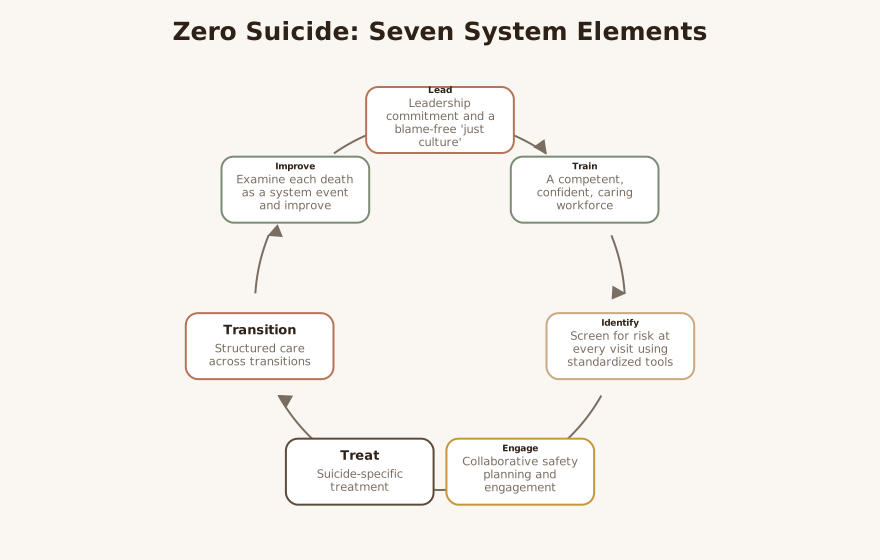
The framework is operationalized as seven elements, often summarized as Lead, Train, Identify, Engage, Treat, Transition, and Improve. 1 Lead establishes top-leadership commitment and front-line champions and fosters a blame-free “just culture.” 1 Train builds a competent, confident, and caring workforce able to engage at-risk people compassionately and to understand patient ambivalence about treatment. 1 Identify means screening for suicide risk at every healthcare visit using standardized tools and asking about suicide directly and without judgment. 1 Engage centers a collaborative safety, wellness, or crisis-response plan that addresses means safety and keeps the patient on a defined high-risk pathway. 1 Treat applies evidence-based treatments that explicitly target suicide risk rather than only the underlying diagnosis. 1 Transition provides warm hand-offs, caring contacts, appointment reminders, and post-discharge support within the first week after psychiatric hospitalization. 1 Improve uses routine data, fidelity monitoring, and continuous quality improvement inside that just culture. 1
Two principles cut across all seven. The first is that risk identification and risk-specific treatment must be systematic — built into workflow so they do not depend on whether a given clinician remembers or feels equipped to ask. 3 The second is that suicide risk is treated as a direct target of care in its own right, not merely as a symptom that will resolve if the depression resolves. 3
Interventions & Techniques
Zero Suicide’s clinical content is a curated bundle of practices with independent evidence, sequenced across the patient journey. 3 On the identification side, the framework relies on standardized screening and assessment instruments such as the Columbia Suicide Severity Rating Scale (C-SSRS), which captures ideation, attempts, and non-suicidal self-injury, and structured approaches such as the SAFE-T (Suicide Assessment Five-step Evaluation and Triage) to organize risk and protective factors. 3
For engagement and immediate risk management, the central technique is the Safety Planning Intervention — a collaborative, stepwise process for identifying warning signs, internal coping strategies, social contacts and settings that provide distraction, people to ask for help, professional and crisis resources, and means restriction. 3 Counseling on access to lethal means is integral to safety planning rather than an add-on, and clinicians are trained to restrict access to lethal means as a core risk-reduction step. 3
For treatment, the framework points to therapies that explicitly target suicidality: Cognitive Therapy for Suicide Prevention, Dialectical Behavior Therapy, and the Collaborative Assessment and Management of Suicidality (CAMS). 1 3 For care transitions — the period of highest risk — Zero Suicide builds in structured follow-up contact via phone, mail, or in person (the “caring contacts” and Brief Intervention and Contact lineage) and warm hand-offs between settings. 3
LLM-generated illustrative example (not a guideline): A clinic adopting the framework might require that every patient screening positive on the C-SSRS leave that same visit with a completed safety plan and a documented means-safety conversation, and receive a caring-contact phone call within 72 hours of any missed appointment — so that “what happens next” is defined by the pathway, not by the individual clinician’s bandwidth that day. LLM
Evidence Base
The maturity of the evidence is best described as established at the system level, and clinicians should hold the distinction between system-level and trial-level evidence clearly. LLM The strongest signal is a set of large pre-post reductions in suicide rates within implementing organizations. Henry Ford’s Perfect Depression Care reduced the suicide rate among its patient population by approximately 75%, from roughly 89–96 per 100,000 at baseline to roughly 22–24 per 100,000 in follow-up. 4 2 Centerstone, a multistate behavioral health nonprofit, reported a drop from about 31 to 11 per 100,000 within two years of implementation — roughly a 65% reduction. 2 A 2021 New York study across 110 outpatient clinics found an inverse relationship between higher fidelity to Zero Suicide and suicide attempts or deaths, and a U.S. Air Force prevention program achieved about a 33% reduction in suicide deaths through systemic interventions. 2 The SPRC summarizes the implementing-organization literature as showing reductions on the order of 60–80%. 5
The honest caveats are important. These are predominantly observational, pre-post organizational outcomes rather than randomized trials of the framework as a whole, and “zero” remains aspirational rather than demonstrated. 5 The individual components carry their own — and varying — levels of trial support, and the framework’s own clinical literature acknowledges that more research is needed to know which psychosocial treatments work best for which populations. 3 The evidence base is explicitly described as maturing and evolving, with the expectation that the framework will change as research does. 2
Populations & Indications
Zero Suicide is a population-level intervention: its unit of action is the patient panel of a health or behavioral health system, not a single diagnosis. 1 It is indicated across settings that have routine contact with at-risk individuals — behavioral health clinics, primary care, emergency departments, and inpatient units. 3 The framework grew from depression care and is especially salient for patients presenting with depression, but its identification step deliberately screens broadly rather than only patients with an obvious mood disorder, because suicide risk is not confined to any one diagnosis. 4 1
The highest-yield population for the framework’s transition element is patients recently discharged from psychiatric inpatient or emergency care, a period of markedly elevated risk and frequent disengagement — up to 70% of emergency department patients never attend a follow-up appointment. 2
Problems-for-Work
The framework is built to address several concrete clinical problems. Missed identification of at-risk patients is targeted by universal, standardized screening so that risk is not left to clinical impression alone. 1 3 Acute suicidal ideation and crisis are addressed through collaborative safety planning and means-safety counseling delivered in the same encounter. 3
LLM-generated illustrative example (not a guideline): A primary care patient endorses passive ideation on a routine screen; rather than a referral that may never connect, the warm hand-off pathway brings a behavioral health clinician into the visit to build a safety plan and lock-box the patient’s firearm before they leave. LLM
Unsafe care transitions and post-discharge disengagement are addressed by caring contacts, appointment reminders, and first-week post-discharge outreach. 1 2 Recurrent suicide attempts are addressed by routing patients into suicide-specific treatments rather than treating only the underlying condition. 3 Access to lethal means is treated as a problem-for-work in its own right through dedicated counseling. 3
Contraindications, Cautions & Cultural Humility
As a system framework, Zero Suicide has no patient-level contraindication, but several cautions deserve clinical attention. LLM The “zero” framing can be experienced by front-line staff as implied blame, which is precisely why the framework insists that implementation occur inside a just, blame-free culture; without that culture, the aspirational target can drive defensive documentation or staff demoralization rather than safer care. 1 Implementation that adds screening and pathways without training and workforce support risks identifying risk it is not equipped to hold — and indeed many behavioral health professionals report low confidence in identifying and treating suicidal patients despite regular contact with them. 2
Sustainability is a structural caution: organizations adopt the framework more readily than they sustain it, and relatively little is known about how systems fund and maintain a Zero Suicide initiative over time. 6 Cultural humility enters at the level of both screening and engagement: standardized instruments and means-safety conversations must be delivered in ways that respect a patient’s cultural framing of distress, help-seeking, and firearm ownership, and the collaborative safety plan is meant to be genuinely co-authored rather than imposed. 1 LLM
Treatment-Plan Suggestions & SMART Objectives
The objectives below illustrate how a system-level framework translates into documentable, patient-level goals. LLM
| Goal | SMART objective (example) | Mechanism |
|---|---|---|
| Reliable risk identification | Patient is screened with the C-SSRS at every visit for 3 consecutive visits, with results documented each time | Systematic screening removes reliance on clinical impression 1 3 |
| Co-created safety plan | Patient and clinician complete a six-step safety plan within the first session and review it at each of the next 4 sessions | Collaborative crisis-response planning 3 |
| Means safety | Patient identifies and implements one concrete lethal-means restriction step within 1 week and confirms it at the next session | Counseling on access to lethal means 3 |
| Suicide-specific treatment engagement | Patient attends 8 consecutive sessions of a suicide-targeted therapy over 10 weeks | Direct treatment of suicidality, not only the underlying diagnosis 1 3 |
| Safe care transition | Patient receives and acknowledges a caring contact within 72 hours of any missed appointment or discharge, for 30 days | Warm hand-offs and structured follow-up 2 |
| Coping-skill acquisition | Patient demonstrates use of two internal coping strategies from the safety plan during 3 separate distress episodes over 6 weeks | Behavioral skills for affect regulation 3 |
| Reduced ideation intensity | Patient reports a measurable decrease in C-SSRS ideation severity across 6 weeks of treatment | Cumulative effect of bundled risk-specific care 3 |
Common Misconceptions
“Zero Suicide promises that no patient will die.” The target is explicitly aspirational — a bold goal and an organizing commitment, not a literal guarantee or a performance threshold for punishing clinicians. 5
“It is a new therapy I need to learn.” It is a framework that bundles existing, separately validated practices (screening, safety planning, suicide-specific therapies, follow-up); the clinical techniques are not new, but their reliable, systematic deployment is. 3 1
“The 75% reductions prove the whole framework is a tested intervention.” Those are observational, system-level pre-post outcomes, not randomized trials of the framework, and the evidence is described as maturing rather than settled. 4 2 5
“It is for psychiatric units only.” It is a population-level approach spanning primary care, emergency, outpatient, and inpatient settings, with universal rather than diagnosis-restricted screening. 1 3
Training & Certification
Zero Suicide is implemented by organizations rather than certified to individuals, but workforce training is one of its seven elements and a recurring point of failure when neglected. 1 2 The Education Development Center and the Suicide Prevention Resource Center steward the framework’s resources, including the Zero Suicide Toolkit — a structured collection of information, tools, resources, and activities for health and behavioral health leadership teams to guide implementation. 5 1 Component skills are trained through their own established curricula, such as safety planning training and counseling-on-access-to-lethal-means training, and the framework expects ongoing capacity-building rather than a one-time workshop. 3 1 The HHS/ASPE implementation work emphasizes that leadership commitment, workforce development, and sustained funding are what separate organizations that adopt the framework from those that sustain it. 6
Key Terms
- Just culture — a blame-free organizational culture in which adverse events, including suicide deaths, are examined as system failures to learn from rather than individual faults to punish. 1
- Population under care — the full patient panel of a health system, which is the unit Zero Suicide aims to protect. 1
- Safety Planning Intervention — a collaborative, stepwise plan covering warning signs, coping strategies, social and professional supports, and means restriction. 3
- Caring contacts — brief, non-demanding follow-up contacts (phone, mail, in person) that maintain connection during high-risk transitions. 3
- Counseling on access to lethal means — structured conversation and action to reduce a person’s access to methods of suicide. 3
- Fidelity — the degree to which an organization actually performs the framework’s elements as designed, associated in research with better outcomes. 2
Resources & Further Reading
▶ Watch — a video introduction to this concept:
- Framework — Zero Suicide (Education Development Center)
- Evidence Base — Zero Suicide (Education Development Center)
- The Zero Suicide Model: Applying Evidence-Based Suicide Prevention Practices to Clinical Care (Brodsky, Spruch-Feiner & Stanley, 2018)
- Building a System of Perfect Depression Care in Behavioral Health (Coffey, 2007)
- Zero Suicide — Suicide Prevention Resource Center
- Implementing and Sustaining Zero Suicide — ASPE (HHS)
Reflective / Supervision Questions
- In your own caseload, how is suicide risk currently identified — by systematic screening, or by clinical impression and patient disclosure? What would change if it were universal? LLM
- The framework treats each suicide death as a system event to examine. Does your setting have a genuinely blame-free way to review adverse events, or would a death be experienced as individual fault? 1
- For your highest-risk patients in care transitions, what concretely happens in the first week after discharge — and who is accountable for it? 2
- When you build a safety plan, is it genuinely co-authored and culturally attuned to how this patient understands distress, help-seeking, and means access — or is it a form being completed? 3 LLM
- Given that the framework’s strongest evidence is system-level and observational, how do you hold appropriate confidence in its components while staying honest with patients and colleagues about what is and is not proven? 5 LLM