
Type & Discipline
Collaborative Assessment and Management of Suicidality (CAMS) is a suicide-specific therapeutic framework rather than a standalone school of psychotherapy 1. It is best understood as a clinical process and a flexible “wrapper” that organizes assessment, treatment planning, and risk management around suicidality itself, and it can be layered over a clinician’s existing theoretical orientation 3. The framework originates in clinical psychology and suicidology, and it is designed to be used across disciplines — psychologists, social workers, counselors, psychiatric nurses, and psychiatrists 3.
What distinguishes CAMS from generic risk assessment is its insistence that suicidal risk be evaluated and treated with the patient rather than on the patient, using a shared clinical document as the working surface for that collaboration 3. It belongs to the broader family of suicide-specific, problem-focused care that emerged alongside the recognition that depression-focused or diagnosis-focused treatment does not reliably resolve suicidal drivers 1.
Creators & Lineage
CAMS was developed by David A. Jobes, a clinical psychologist and suicidologist, over roughly two and a half decades of iterative clinical research 1. The framework grew out of the Suicide Status Form (SSF), which began as a quantitative and qualitative method for assessing suicidal risk and progressively evolved into a full intervention model encompassing assessment, treatment planning, ongoing tracking, and outcome measurement 1.
Conceptually, CAMS is aligned with the Aeschi philosophy of working with suicidal patients, which emphasizes understanding the patient’s suicidality from the inside — as a coping response to unbearable pain — rather than treating it purely as a symptom to be controlled 3. By 2012 the approach was supported by six correlational studies and one randomized controlled trial, with additional well-powered trials underway 1. CAMS is now disseminated and trained through CAMS-care, and is referenced in federal suicide-prevention infrastructure including the Zero Suicide Toolkit and the 2024 National Suicide Prevention Strategy and Federal Action Plan 4.
Core Principles
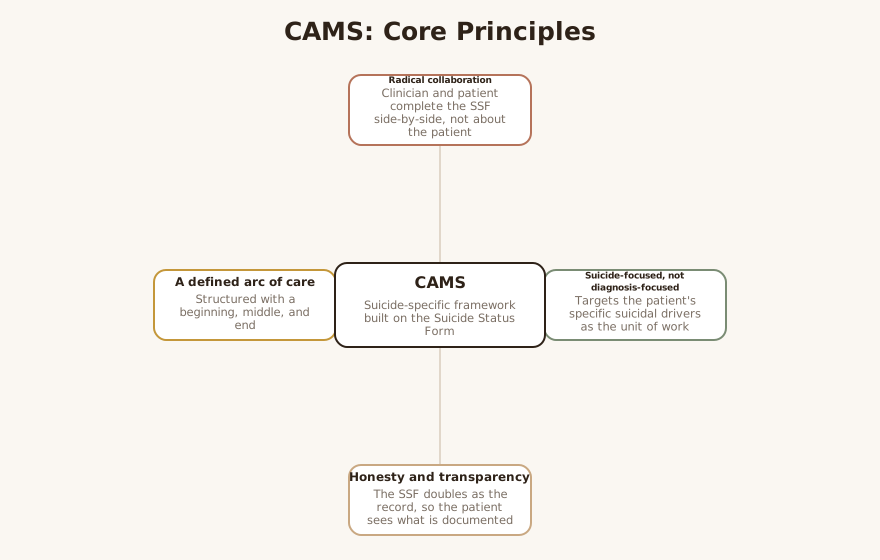
The animating idea of CAMS is radical collaboration: clinician and patient sit side-by-side and complete the Suicide Status Form together, rather than the clinician completing a risk form about the patient 3. The therapeutic relationship is treated as a primary mechanism of change, and the framework explicitly aims to strengthen the alliance and enhance the patient’s motivation for treatment 1.
A second principle is that care must be suicide-focused, not diagnosis-focused. CAMS targets the patient’s specific suicidal drivers — the proximal problems and pain points that make suicide feel like a solution — with the explicit goal of eliminating suicide as a method of coping 1. The aim is framed as reducing suffering and increasing hope and reasons for living, not merely suppressing the behavior 5.
A third principle is honesty and transparency about risk. Because the SSF doubles as the medical record, the patient sees exactly what is being documented, which models candor and reduces the adversarial dynamic that often surrounds suicide risk conversations 3. Finally, CAMS is structured as a defined arc of care with a beginning, middle, and end, so that resolution of suicidal risk is an explicit, trackable goal rather than an open-ended hope 3.
Interventions & Techniques
The central instrument is the Suicide Status Form (SSF), a multipurpose tool that simultaneously functions as assessment, treatment plan, session-by-session tracking sheet, and outcome measure 1. In the first (index) session, clinician and patient complete the SSF together, with the patient rating core SSF constructs — psychological pain, stress, agitation, hopelessness, self-hate, and overall risk — and identifying their reasons for living and reasons for dying in their own words 3.
From these data the dyad collaboratively identifies the patient’s drivers of suicide — the direct and indirect problems fueling the suicidal state — and co-authors a treatment plan that places stabilization at the top 3. The CAMS Stabilization Plan is built jointly, addressing means safety, coping strategies, and access to support so the patient can get through crises without resorting to suicidal behavior 3.
In interim sessions, the dyad re-rates the SSF, reviews and revises the stabilization plan, and works directly on the identified drivers, updating the treatment plan as drivers shift or resolve 3. Sessions typically begin and end with the SSF, anchoring each contact in the suicide-specific work 3. The outcome/disposition phase concludes CAMS when the patient achieves a defined resolution — generally three consecutive sessions of managed suicidal risk — at which point care can transition to standard treatment or step down 3. Adherent clinicians can often reach mastery within roughly four sessions of practice, and many patients move through the suicide-specific arc in approximately six to eight sessions 34.
Evidence Base
The evidence base for CAMS is established and among the stronger ones in suicide-specific care, while still carrying meaningful limits. CAMS has been tested in multiple randomized controlled trials across diverse populations, including U.S. Army soldiers, college students, community outpatients, post-hospitalization aftercare patients, and psychiatric inpatients, with international replications in Denmark, Norway, and Germany 4. An early feasibility pilot in a next-day-appointment outpatient service found improvements in suicidal ideation, symptom distress, and hope, along with better treatment retention and patient satisfaction relative to usual care 2.
Two peer-reviewed meta-analyses (one in 2021 and one in 2022) support CAMS as outperforming comparison conditions in reducing suicidal ideation, with small-to-moderate effect sizes, and also report benefits for symptom distress, hope, and patient satisfaction 4. The military Operation Worth Living trial found CAMS reduced suicidal thoughts faster than usual care and was associated with fewer emergency department visits 4. A head-to-head Danish trial against dialectical behavior therapy in patients with borderline traits found comparable outcomes despite CAMS requiring fewer sessions 4.
Honesty about maturity matters here. The strongest and most consistent signal is reduction of suicidal ideation; evidence for reducing suicide attempts and deaths is more promising than definitive 4. Reflecting this, the VA Rocky Mountain MIRECC/Center of Excellence rates CAMS as “neither for nor against” for reducing suicidal ideation — meaning the body of evidence, while real, was not yet judged sufficient for a strong endorsement, and CAMS is positioned alongside cognitive therapy for suicide prevention and DBT rather than clearly above them 5. Clinicians should therefore present CAMS as well-supported for ideation and engagement, not as a proven method of preventing death 5.
Populations & Indications
CAMS is indicated for individuals presenting with active suicidal ideation who can engage in a collaborative, talking-based process 3. It has been studied and applied with community outpatients, military personnel and veterans, college and university students, psychiatric inpatients, and high-risk patients in the post-discharge aftercare window — a period of especially elevated risk 4. It has also been used with individuals carrying borderline personality traits, where it performed comparably to DBT in a controlled trial 4.
The framework is delivered across a wide range of settings: outpatient clinics, hospitals, schools and universities, military and veteran systems, correctional facilities, and tribal nations 3. Its developers describe CAMS as optimal for the largest clinical population — people with serious suicidal thoughts — rather than being narrowly specialized 4. It is most clearly indicated when suicidality is the presenting clinical problem and the patient is able to participate in identifying and working on their own drivers 1.
Problems-for-Work
CAMS organizes treatment around the patient’s self-identified drivers, which map naturally onto concrete problems-for-work 3. Typical targets include unbearable psychological pain, pervasive hopelessness, self-hatred, agitation, and the situational stressors (relational rupture, financial crisis, shame) that feed the suicidal state 3.
LLM-generated illustrative example (not a guideline): A clinician using CAMS with a graduate student sits beside her to complete the SSF. Her highest-rated construct is hopelessness, and her direct driver is an academic-probation letter she reads as proof she is “a fraud.” The treatment plan names that shame-based self-narrative as a problem-for-work, pairs it with a jointly built stabilization plan limiting access to means, and dedicates interim sessions to testing the catastrophic belief — an application of working a specific suicidal driver rather than her diagnosis LLM.
Other common problems-for-work include treatment disengagement (CAMS uses the collaborative SSF process explicitly to improve retention), the absence of accessible reasons for living, and recurrent crisis states that the stabilization plan is built to interrupt 23. Each is tracked session-to-session through SSF re-rating, so progress on a problem is visible to both parties 3.
Contraindications, Cautions & Cultural Humility
CAMS depends on a patient’s capacity to participate in a reflective, collaborative conversation; acute intoxication, florid psychosis, severe agitation, or any state precluding meaningful collaboration can make the side-by-side SSF process unworkable until the patient is stabilized by other means LLM. It is a framework for ongoing treatment, not a substitute for emergency intervention or hospitalization when imminent danger requires a higher level of care LLM.
Clinicians should also be candid that the evidence supports ideation reduction more than prevention of attempts or death, and should not let the structured, optimistic feel of the framework substitute for sound clinical judgment about acute risk 5. For patients with chronic, treatment-resistant suicidality and multiple prior attempts — particularly some individuals with borderline personality disorder — the developers acknowledge that more intensive, longer-term modalities such as DBT may be a better fit 4.
Cultural humility is intrinsic to CAMS done well: because the patient supplies the drivers, the reasons for living, and the language of their own suffering, the framework cedes interpretive authority to the patient’s lived experience 3. The clinician’s task is to hold that material with curiosity rather than to impose a normative account of why someone “should” want to live 1. Meaning, shame, family obligation, spirituality, and acceptable help-seeking vary across cultures, and a clinician should attend to how a patient’s identity and context shape both their drivers and what stabilization realistically looks like LLM.
Treatment-Plan Suggestions & SMART Objectives
| Goal | SMART objective (example) | Mechanism |
|---|---|---|
| Establish collaborative suicide-focused care | Within session 1, client and clinician jointly complete the Suicide Status Form, with client self-rating all six core constructs | Side-by-side SSF builds alliance and shared formulation 3 |
| Co-author a usable stabilization plan | By end of session 1, produce a written CAMS Stabilization Plan addressing means safety and at least three coping steps | Means restriction and coping access interrupt crises 3 |
| Identify and name suicidal drivers | Within the first two sessions, client articulates one direct and one indirect driver in their own words | Driver-focused work targets proximal causes, not diagnosis 1 |
| Reduce suicidal ideation | Over 6-8 sessions, reduce SSF overall-risk rating by a clinically meaningful margin sustained across sessions | Suicide-focused intervention reduces ideation 4 |
| Increase reasons for living / hope | By session 4, client adds at least two new reasons for living to the SSF | Strengthening reasons for living shifts the dying-vs-living balance 3 |
| Improve treatment engagement | Client attends scheduled CAMS sessions through resolution without disengagement | Collaborative process improves retention 2 |
| Resolve the suicide-specific arc | Achieve three consecutive sessions of managed/resolved risk before stepping down | Defined disposition prevents premature or open-ended care 3 |
Common Misconceptions
A frequent misconception is that CAMS is its own brand of therapy that replaces a clinician’s existing approach; in fact it is a suicide-specific framework that organizes care and can sit on top of an existing orientation while suicidality is the focus 13. Another is that the SSF is “just a risk assessment form.” It is a multipurpose clinical document that doubles as treatment plan, tracking sheet, and outcome measure, and crucially it is completed collaboratively rather than by the clinician alone 1.
Clinicians sometimes assume CAMS is open-ended; it is explicitly time-limited and outcome-driven, oriented toward a defined resolution of suicidal risk rather than indefinite monitoring 3. Some also overstate the evidence, assuming CAMS is proven to prevent suicide deaths — the robust signal is for reducing ideation and improving engagement, with attempt and death outcomes still less established 45. Finally, the collaborative stance is not the same as being passive: the clinician actively guides assessment, formulation, and stabilization while keeping the patient as co-author 3.
Training & Certification
CAMS is disseminated through structured training offered by CAMS-care, which supports clinicians, mental health centers, hospitals, schools, military and veteran systems, correctional settings, and tribal nations 3. A notable feature of the training model is its accessibility: the framework is designed so that a clinician can reach adherent practice relatively quickly, often mastering the approach with their first patient in as few as four sessions of supervised practice 3.
Training typically combines didactic instruction in the framework with role-play and feedback on completing the SSF collaboratively and building stabilization plans, with the goal of fidelity to the CAMS process 3. Clinicians seeking to adopt CAMS should pursue the developer-sanctioned training and consultation pathways to ensure they are using the SSF and the session arc as intended 3.
Key Terms
Suicide Status Form (SSF): the multipurpose CAMS instrument used for collaborative assessment, treatment planning, session tracking, and outcome measurement; it also serves as the clinical record 13.
Drivers: the direct and indirect problems and pain points that fuel a patient’s suicidal state and become the primary targets of treatment 13.
CAMS Stabilization Plan: a jointly authored plan addressing means safety, coping strategies, and access to support to help the patient survive crises without suicidal behavior 3.
Reasons for living / reasons for dying: the patient’s own articulated motivations on both sides of the suicidal balance, captured on the SSF and worked with over time 3.
Resolution / disposition: the defined endpoint of the CAMS arc, generally three consecutive sessions of managed suicidal risk, after which suicide-specific care can step down 3.
Aeschi philosophy: the orienting stance of meeting the suicidal patient empathically as someone coping with unbearable pain, foundational to the CAMS collaborative posture 3.
Resources & Further Reading
▶ Watch — a video introduction to this concept:
- Jobes (2012), The CAMS: an evolving evidence-based clinical approach to suicidal risk (PubMed)
- Pilot RCT of CAMS / next-day-appointment feasibility (PMC full text)
- The CAMS Framework — CAMS-care
- CAMS Evidence-Based Framework — CAMS-care
- CAMS — VA Rocky Mountain MIRECC/CoE Clinical Recommendations
- CAMS: Collaborative treatment for suicidal thoughts — Grow Therapy
- Dr. David Jobes on the CAMS Approach — PsychAlive (video)
Reflective / Supervision Questions
- When I assess suicide risk, am I completing forms about my patient or with my patient — and what would it change in the room to sit side-by-side and let them rate their own pain, hopelessness, and self-hate? 3
- Can I name a specific patient’s direct and indirect drivers of suicidality, in their words, or am I defaulting to treating their diagnosis and assuming the suicidality will follow? 1
- How do I talk with patients about the limits of the evidence — that CAMS reliably reduces ideation but has a less mature record for preventing attempts and deaths — without undermining their hope? 45
- For a chronically, severely suicidal patient with multiple attempts, how do I decide whether CAMS is the right fit or whether a more intensive modality such as DBT is indicated? 4
- Whose reasons for living end up on the SSF — the patient’s, or the ones I think they should hold — and how does my own cultural lens shape what I treat as a legitimate reason to stay alive? 3
- How do I know when a patient has genuinely reached resolution versus when I am ending the suicide-specific arc because the structure says it is time? 3