
Type & Discipline
Role theory is a body of sociological theory, not a psychotherapy model, and it sits within the structural-functionalist tradition that treats society as a system of interlocking social positions, each carrying its own behavioral expectations 4. A “role” in this framework is the set of behaviors and obligations attached to a social position or status — student, parent, employee, friend — and most people occupy several positions at once 5. The theory becomes clinically useful because two of its central constructs name common forms of distress with precision: role strain (felt difficulty fulfilling the obligations within a single role) and role conflict (tension between the demands of two or more roles held simultaneously) 5. For therapists, this is less a treatment and more a conceptual lens — a way to reframe a client’s “I’m failing at everything” into “the structure of your obligations is over-determined,” which is both accurate and de-shaming LLM.
It is worth fixing terms early because the literature is inconsistent. Some sources reserve “role conflict” for clashes across statuses and “role strain” for difficulty within one status 3. Others fold both intra-role and inter-role tension under “role conflict” and treat “strain” as overload accumulating over time 45. In clinical writing, the cleanest convention is: strain = within-role overload or contradiction; conflict = between-role incompatibility 3. The distinction matters for case formulation because the two point toward different interventions LLM.
Creators & Lineage
Role theory has multiple parents. Talcott Parsons, the American structural functionalist, developed the social-systems framework in which roles are the units that bind individuals to institutions, and his work on the “sick role” extended the theory into health and help-seeking behavior 4. Robert K. Merton refined the picture by introducing the idea that a single status carries not one relationship but an array of role partners, and he treated role strain as a normal, expected feature of occupying multiple roles rather than a sign of personal failure 6. William J. Goode’s 1960 paper A Theory of Role Strain is the canonical statement that role strain — “the felt difficulty in fulfilling role obligations” — is the normal experience of social life, because individuals owe more to their total role-set than they can possibly deliver 1. Goode also emphasized gendered strain, noting the overload borne by working women facing unequal domestic expectations 2.
A later strand relevant to therapy is Helen Rose Ebaugh’s work on role exit, which mapped the process of leaving a central role through stages of doubt, seeking alternatives, a turning point, and the construction of a new identity that still carries traces of the old one 5. In the psychotherapy world, the most direct descendant is Interpersonal Psychotherapy, which operationalizes role transitions and role disputes as explicit problem areas for time-limited treatment LLM.
Core Principles
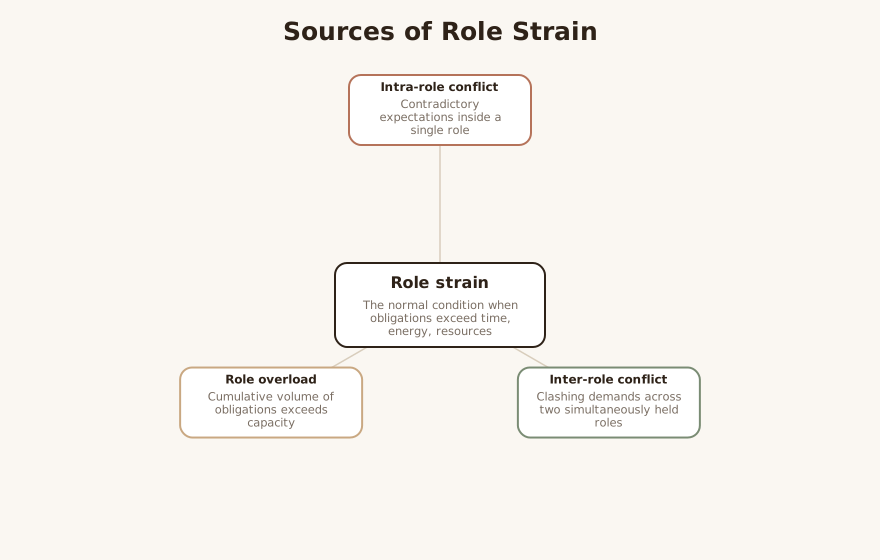
First, every social position carries role expectations — implicit and explicit rules about how the occupant should behave — and these expectations are external to the individual, generated by institutions and role partners rather than chosen freely 5. Second, because a person holds many positions at once, the total set of obligations routinely exceeds available time, energy, and resources; Goode’s key insight is that strain is therefore the normal condition, not an aberration 1. Third, strain has identifiable structural sources: conflicting demands, inadequate resources, unclear or ambiguous expectations, and sheer overload 6.
Fourth, the theory distinguishes the locus of the problem. Intra-role conflict places contradictory expectations inside one role — the manager told by leadership to cut costs while the team expects advocacy for raises 5. Inter-role conflict places the clash between roles — the employee required to stay late while their child performs at school 5. Role overload, a species of strain, is when the cumulative volume of obligations simply exceeds capacity, as with medical residents or single parents 5. Fifth, roles are not static; they change across the life course, and role exit — leaving a role entirely — is a distinct and effortful process with its own identity work 5.
A unifying clinical principle follows from all of this: the distress is located in the configuration of obligations, not in a defective person LLM. That reframing is the main therapeutic value of the theory LLM.
Interventions & Techniques
Role theory is descriptive, so its “interventions” are the coping and adjustment strategies it identifies, which a clinician can scaffold deliberately. The sociological literature names several within-role strategies: prioritizing duties, compartmentalizing different aspects of a role, role distancing (mentally separating the self from the role one is performing), habitualizing routines to cut decision burden, and negotiating compromises with the people who share the role 2. For overload specifically, the recommended moves are prioritizing obligations, renegotiating expectations, and seeking support 5.
A central mechanism Goode described is role bargaining: because no one can satisfy every demand, people actively negotiate and trade among their obligations, shedding or deferring some to protect others 1. Clinically, this legitimizes the deliberate, values-based dropping of obligations rather than framing it as a moral lapse LLM. Broader management strategies from the applied literature include clarifying role expectations, time and stress management, building collegial or social support, and reassessing which responsibilities truly belong to the client 6. At the extreme end of the continuum sits role exit — abandoning a role entirely — which is sometimes the healthiest resolution but carries identity consequences that warrant their own processing 25.
LLM-generated illustrative example (not a guideline): A clinician working with a client overwhelmed as a daughter-caregiver might externalize the role-set on paper, then guide explicit role bargaining — “which of these obligations are yours, which were assigned by others, and which can be renegotiated this week?” — converting diffuse guilt into a concrete, time-limited plan LLM.
In practice these strategies map cleanly onto existing therapy techniques — problem-solving, values clarification, assertiveness and boundary work, and behavioral activation — so role theory functions as the case-formulation scaffold rather than as a free-standing technique set LLM.
Evidence Base
The maturity here should be stated honestly: role theory is an established and durable sociological framework, foundational to the discipline since the mid-twentieth century, but it is a theory of social structure rather than an empirically tested clinical treatment 4. There are no randomized trials of “role theory” as a therapy, because it is not one LLM. Its empirical support is correlational and observational: the constructs of strain and conflict reliably predict outcomes that matter clinically. Role conflict is described as producing psychological tension associated with poorer health and chronic stress 4, and applied reviews link role strain to lower job satisfaction, elevated stress and anxiety, diminished physical and mental well-being, and reduced productivity 6. The applied literature cites meta-analytic work (Jackson and Schuler) finding role strain a significant predictor of job satisfaction and well-being 6.
The honest clinical takeaway is that role theory earns its place as an explanatory and formulation model with strong face validity and decades of sociological grounding, while the treatments one builds on it — Interpersonal Psychotherapy for role transitions and disputes, behavioral and cognitive strategies for overload — carry their own separate evidence bases LLM. Borrowing the vocabulary does not borrow a treatment evidence base, and clinicians should not represent it as one LLM.
Populations & Indications
Role theory is indicated wherever distress tracks the structure of a person’s obligations rather than an internal disorder, though the two frequently co-occur LLM. Sandwich-generation caregivers — simultaneously parenting children and caring for aging parents — are a paradigmatic case of inter-role conflict and overload 5. Caregivers of ill or disabled family members similarly carry within-role strain when the caregiving role itself contains contradictory demands (advocate vs. enforcer of medical regimens) LLM.
Working professionals and employees facing high job demands map onto intra-role conflict and overload 56. New parents and postpartum clients are undergoing one of the most studied role transitions, often with abrupt identity reorganization 5. Graduate and professional students live the role-overload pattern modeled by residents and single parents 5. Military families and spouses contend with repeated role transitions and the strain of absorbing absent partners’ roles LLM. Goode’s original attention to gendered overload remains relevant for women managing paid work alongside disproportionate domestic expectations 2.
Problems-for-Work
Caregiver burden and burnout. Framing burden as within-role strain plus inter-role conflict lets the clinician target the structure (renegotiating who does what, recruiting support) rather than only the client’s coping 56.
Occupational burnout and emotional exhaustion. Intra-role conflict and overload at work are named directly; the work is clarifying expectations, prioritizing, and renegotiating scope 56.
Work-life imbalance / work-family conflict. This is the textbook inter-role conflict — the parent required to stay late while a child performs 5. Intervention centers on boundary-setting and role bargaining across the two domains 1.
Parental burnout. New-parent role transition plus overload; the formulation normalizes the strain as structural while supporting identity integration 5.
Role transitions and loss of identity / role confusion. Transitions and role exit are explicit constructs; Ebaugh’s staged model gives a roadmap for processing the loss and rebuilding identity 5.
Difficulty with boundaries / over-accommodation. Clients who cannot drop any obligation are candidates for explicit role-bargaining work, which legitimizes shedding demands 12.
LLM-generated illustrative example (not a guideline): A mid-career client presenting with emotional exhaustion might be helped to see that their “failure” is actually unresolved intra-role conflict — being told to do more with fewer resources — at which point the work shifts from self-criticism to renegotiating expectations with a supervisor LLM.
Contraindications, Cautions & Cultural Humility
Role theory is a lens, not a diagnosis, and the first caution is not to let structural reframing obscure treatable clinical syndromes; overload-shaped distress can co-exist with major depression, an anxiety disorder, or trauma sequelae that require their own assessment and treatment LLM. Reframing genuine psychopathology as “just role strain” risks under-treatment LLM. Conversely, when the obligations truly are over-determined, pathologizing the individual is the error the theory is meant to correct 1.
Culturally, role expectations are not universal; what counts as a reasonable filial, parental, spousal, or work obligation is shaped by culture, gender, class, and family system, and the structural-functionalist tradition has been critiqued for treating prevailing role arrangements as natural rather than contested LLM. A clinician must not impose a dominant-culture template of “healthy boundaries” onto a client whose role obligations are central to their identity and community standing LLM. Goode’s own emphasis on gendered overload is a reminder that strain is often inequitably distributed, not freely chosen, so interventions that locate the fix solely in the individual’s coping can quietly endorse an unjust arrangement 2. Role exit, too, can carry real social and economic costs that a privileged clinician may underestimate 5.
Treatment-Plan Suggestions & SMART Objectives
| Goal | SMART objective (example) | Mechanism |
|---|---|---|
| Reduce inter-role conflict | Within 4 weeks, client will map all current roles and identify the top two conflict points, naming them in session | Externalizing the role-set makes structural conflict visible and workable 5 |
| Lower overload via prioritization | Over 3 weeks, client will rank weekly obligations and defer or delegate at least two lower-priority tasks | Prioritizing and renegotiating obligations reduces strain 56 |
| Build role-bargaining capacity | By session 6, client will conduct one explicit renegotiation with a role partner (employer or family member) | Role bargaining redistributes demands that exceed capacity 1 |
| Strengthen boundaries | Within 5 weeks, client will decline one non-essential request per week and log the outcome | Compartmentalizing and negotiating compromise counter over-accommodation 2 |
| Process a role transition | Over 6 sessions, client will articulate losses and gains of a current transition and one element of a new identity | Naming the transition supports identity reorganization 5 |
| Support a values-based role exit | Within 8 weeks, client will evaluate exiting a draining role using a structured pros/cons and identity-continuity plan | Ebaugh’s staged role-exit process guides deliberate leaving 5 |
| Reduce emotional exhaustion | Over 4 weeks, client will add two recovery routines and report exhaustion ratings weekly | Habitualizing routines and self-care lowers cumulative strain 26 |
Common Misconceptions
A frequent error is collapsing role strain and role conflict into a single phenomenon; the cleanest usage keeps strain within a role and conflict between roles, and the formulation choice points toward different interventions 35. A second misconception is that role strain signals personal weakness or poor coping; Goode’s foundational claim is the opposite — strain is the normal, expected condition of anyone embedded in a full role-set 1.
Third, clinicians sometimes treat role theory as a stand-alone therapy with its own outcome evidence; it is an explanatory framework that must be paired with an actual treatment model to be delivered LLM. Fourth is the assumption that the solution is always to “do more self-care” or “set boundaries,” when often the structurally honest answer is role bargaining — shedding or renegotiating obligations — or, occasionally, role exit 15. Finally, the structural-functionalist roots can mislead clinicians into treating existing role arrangements as fixed and natural, when many are negotiable and inequitably assigned 2.
Training & Certification
There is no certification in “role theory,” because it is a sociological framework rather than a proprietary clinical method LLM. Therapists typically encounter the constructs through introductory sociology, social-work, and counseling coursework, and the primary literacy required is conceptual: understanding role-set, intra- vs. inter-role tension, overload, role bargaining, and role exit 15. Clinicians who want a credentialed pathway that operationalizes these ideas should look to Interpersonal Psychotherapy training, which formalizes role transitions and role disputes as treatment foci and is taught through recognized IPT training bodies with supervision and case-based certification LLM. Reading Goode’s 1960 paper, Merton on the role-set, and Ebaugh on role exit provides the theoretical grounding 15.
Key Terms
- Role — the behavioral expectations and obligations attached to a social position or status 5.
- Role-set — the array of role relationships a single status entails 4.
- Role strain — felt difficulty fulfilling the obligations within a single role; treated by Goode as the normal condition 15.
- Role conflict — tension between the incompatible demands of two or more simultaneously held roles 3.
- Intra-role conflict — contradictory expectations inside one role 5.
- Inter-role conflict — clashing demands across different roles 5.
- Role overload — obligations exceeding available capacity, a form of strain 5.
- Role bargaining — actively negotiating and trading among obligations no one can fully meet 1.
- Role distancing — mentally separating the self from a role one performs 2.
- Role exit — leaving a central role entirely, with attendant identity reconstruction (Ebaugh’s stages) 5.
Resources & Further Reading
▶ Watch — a video introduction to this concept:
- Goode, W. J. (1960). A Theory of Role Strain — citation record
- Role Strain in Sociology (Simply Psychology)
- Role Strain vs Role Conflict — Similarities and Differences (Helpful Professor)
- Role Theory & Role Strain / Role Conflict (EBSCO Research Starters)
- Dimensions of Social Roles: Conflict, Strain, and Change (Sociology.Institute)
- Understanding Role Strain in Social Theory (Numberanalytics)
Reflective / Supervision Questions
- When a client presents as “failing at everything,” how do I distinguish structural role overload from a treatable mood or anxiety disorder, and am I assessing for both LLM?
- Am I locating the problem in the client’s coping when the more honest formulation is an inequitable distribution of obligations they did not choose 2?
- Whose role expectations am I treating as the baseline — the client’s culture and family system, or my own LLM?
- For this client, is the indicated move within-role adjustment (prioritizing, renegotiating) or a harder inter-role choice up to and including role exit, and have I named the real costs of each 15?
- Where am I borrowing role theory’s vocabulary, and have I paired it with an actual treatment model that carries its own evidence base LLM?