
Cognitive Dissonance Theory is one of social psychology’s most durable explanatory frameworks, and its core mechanism quietly underwrites a surprising range of clinical work 2. For practicing therapists, the practical payoff is not the laboratory history but a transferable principle: when a person acts in a way that contradicts their own values or self-image, the resulting discomfort can be channeled into self-generated motivation for change 2. This article orients the clinician to the theory, then concentrates on how its mechanism shows up in motivational, behavioral, and prevention work LLM.
Type & Discipline
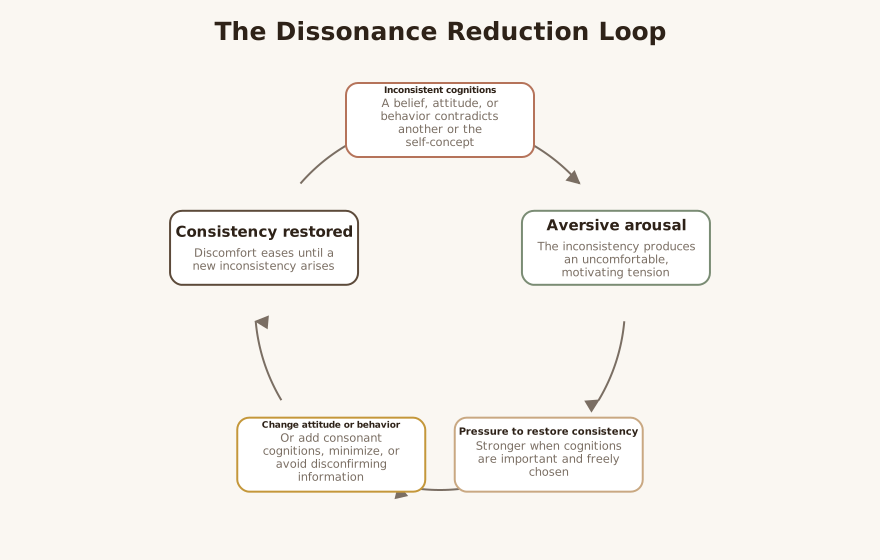
Cognitive Dissonance Theory is a motivational theory within social psychology, specifically within the literature on attitude change 3. It is not a therapy or a standalone modality; it is a construct describing a psychological state and the drive it creates 4. The theory proposes that holding two or more cognitions that are psychologically inconsistent produces an aversive state of arousal, which the person is then motivated to reduce 2. Because the arousal functions like a drive, dissonance has been studied with physiological markers such as skin conductance and, more recently, with neuroimaging of stress-related brain regions 2. For clinicians, the relevant translation is that dissonance is a lever on motivation rather than a diagnosis or a technique in itself LLM.
Creators & Lineage
Leon Festinger introduced the theory in his 1957 book A Theory of Cognitive Dissonance, building on Kurt Lewin’s field theory and breaking sharply from the behaviorist learning theories that dominated the era 12. The foundational 1959 experiment with James Carlsmith showed that participants paid only one dollar to call a boring task interesting later rated it more favorably than those paid twenty dollars, because the smaller incentive gave them too little external justification and forced an internal attitude shift 6. Elliot Aronson and colleagues later developed the hypocrisy paradigm, arousing dissonance by making people aware of gaps between what they advocate and what they actually do 2. Joel Cooper and Russell Fazio refined the theory in their 1984 “New Look” model, which specified the conditions under which dissonance arises 2. The lineage also includes rival and complementary accounts—self-perception theory and self-affirmation theory—that reshaped how the field understands when and why dissonance occurs 6.
Core Principles
Several principles define the theory and shape its clinical use. First, the magnitude of dissonance depends on the importance of the cognitions involved and on the ratio of dissonant to consonant cognitions; trivial inconsistencies produce little pressure, while inconsistencies touching valued self-beliefs produce strong discomfort 6. Second, people reduce dissonance through a limited menu of strategies: changing the behavior or belief, adding consonant cognitions, minimizing the importance of the conflict, or selectively avoiding disconfirming information 6. Third, the New Look model holds that dissonance is strongest when a person freely chooses a behavior, foresees its aversive consequences, and feels personally responsible for them 2. Fourth, dissonance can be experienced vicariously, through identification with a group member who acts inconsistently 2. Clinically, the takeaway is that change is most likely when the person, not the therapist, supplies the argument and owns the choice LLM.
Interventions & Techniques
The theory is operationalized clinically through structured dissonance-induction procedures rather than as a freestanding therapy LLM. The most directly transferable is the hypocrisy or induced-compliance approach, in which a person publicly advocates a healthy position and is then reminded of their own past failures to follow it, creating pressure to align behavior with the advocated stance 26. Counter-attitudinal advocacy, in which participants voluntarily argue against a problematic attitude, is the engine of dissonance-based eating-disorder prevention such as the Body Project 2. Effort justification, where the value people place on a goal rises with the effort invested, has been applied to dietary and behavior-change contexts 6. Within psychotherapy more broadly, dissonance is one proposed mechanism by which committed, effortful treatment shifts attitudes 2. In motivational practice, the same principle appears as “developing discrepancy”—surfacing the gap between a client’s goals and current behavior so the client voices the case for change LLM.
LLM-generated illustrative example (not a guideline): A clinician working with a client ambivalent about cutting back drinking invites the client to list, in their own words, the reasons the change matters to them; hearing themselves argue for change against their continued drinking surfaces a discrepancy the clinician then reflects back rather than supplies LLM.
Evidence Base
The maturity of the underlying theory is best described as established 2. Cognitive dissonance has been called one of the most enduring and successful theories in the history of social psychology, supported by extensive laboratory validation across many domains, physiological confirmation of its arousal component, and neuroimaging evidence of relevant brain activation 2. That foundational status does not by itself certify any particular clinical application, and the theory has been substantially revised over decades, with the self-consistency, self-affirmation, and action-based models each contesting the precise mechanism 6. Translation to applied settings is comparatively newer; reviewers explicitly call for accelerating the move from laboratory to “principles that are important in people’s lives” while maintaining empirical rigor 2. Dissonance-based interventions have shown promise in health behavior, smoking cessation, exercise motivation, and eating-disorder prevention, but clinicians should treat the strength of evidence as application-specific rather than inheriting the prestige of the basic theory 2. Honest framing for clients and supervisees: the principle is robust, the therapeutic packaging is still maturing LLM.
Populations & Indications
Dissonance-based methods have been studied and applied most heavily with college students and other adults seeking attitude or behavior change, populations among whom the classic experiments and many prevention trials were conducted 6. People with body image concerns and those at risk for eating disorders are a central target, given the counter-attitudinal advocacy structure of programs like the Body Project 2. Individuals undergoing health behavior change—around mask-wearing, dietary change, and similar pro-social behaviors—are a documented application area 6. By extension of the mechanism, people in substance use treatment and others presenting with treatment ambivalence are clinically apt candidates, because the work hinges on resolving an attitude-behavior gap the person already half-recognizes LLM. The theory indicates intervention whenever a person endorses a value but acts against it and that gap is accessible to awareness LLM.
Problems-for-Work
Dissonance-informed work maps onto several presenting problems. For disordered eating prevention and body dissatisfaction, counter-attitudinal advocacy asks participants to critique the thin ideal, generating dissonance between their voiced critique and any prior endorsement of that ideal 2. For motivation for behavior change and low motivation, eliciting the client’s own change talk leverages the discomfort of holding a goal while behaving inconsistently with it LLM. For treatment ambivalence and resistance to change, the clinician avoids arguing for change and instead arranges for the client to hear themselves make the argument, sidestepping the reactance that direct persuasion provokes LLM. For health risk behaviors and smoking cessation, induced hypocrisy highlights the gap between stated values and actual behavior to push toward consistency 26. For attitude-behavior inconsistency generally, the mechanism is the work itself: dissonance is the felt pressure that makes realignment attractive 6.
Contraindications, Cautions & Cultural Humility
Dissonance-induction is a form of leverage, and leverage applied carelessly can harm LLM. A central caution is that people reduce dissonance through whichever route is easiest, which is not always the healthy one: a client pressed into discomfort may resolve it by minimizing the issue, derogating the clinician, or avoiding sessions rather than changing behavior 6. The New Look model implies that perceived coercion undercuts the effect, so any whiff of the clinician forcing the advocacy can both fail and rupture the alliance 2. Self-affirmation theory adds an important moderator: affirming a valued part of the self can buffer or eliminate dissonance-driven change, which means highly threatened clients may defend rather than move 6. Cultural humility matters because what counts as an “inconsistency” between values and behavior is defined by the client’s own value system, not the clinician’s, and imposing the therapist’s hierarchy of values as the standard of consistency is both ineffective and disrespectful LLM. With clients carrying shame, trauma, or rigid self-criticism, deliberately heightening discomfort warrants particular care and a strong relational base LLM.
Treatment-Plan Suggestions & SMART Objectives
| Goal | SMART objective (example) | Mechanism |
|---|---|---|
| Reduce treatment ambivalence | Within 4 sessions, client will voice at least three self-generated reasons for change in their own words during session | Eliciting self-stated change talk creates discrepancy with current behavior 2 |
| Decrease body dissatisfaction | Over 6 weeks, client will complete weekly verbal and written critiques of the thin ideal | Counter-attitudinal advocacy provokes dissonance with prior ideal endorsement 2 |
| Increase motivation for health behavior change | Within 30 days, client will publicly state a health commitment and review one past lapse each session | Induced hypocrisy surfaces the value-behavior gap 6 |
| Strengthen commitment to substance use goals | By session 8, client will rate importance and confidence for change and articulate the gap aloud | Making the inconsistency explicit raises dissonance pressure toward consistency 6 |
| Support smoking cessation | Over 8 weeks, client will record advocacy statements for non-smoking and identify triggers for past relapse | Hypocrisy paradigm aligns stated value with behavior 2 |
| Reduce resistance to change | Within 5 sessions, clinician will reflect client-generated arguments rather than supply them, tracked per session | Self-generated argument bypasses reactance and lets the client own the choice LLM |
| Sustain effortful behavior change | Over 12 weeks, client will log effort invested toward a chosen goal weekly | Effort justification raises valuation of the goal 6 |
Common Misconceptions
A first misconception is that dissonance theory is itself a therapy; it is a social-psychological construct that several therapies borrow, not a modality a clinician “delivers” 4. A second is that more pressure always yields more change, when the original Festinger-Carlsmith finding shows the opposite—insufficient external justification, not maximal incentive, drives internalization 6. A third is that dissonance reduction always means healthy change, when avoidance, denial, and rationalization are equally available routes out of discomfort 6. A fourth is that the theory is settled and monolithic, when self-perception theory and self-affirmation theory offer competing accounts of the same phenomena and remain live 6. A fifth, clinically important, is that telling clients about their inconsistency creates productive dissonance; in practice the client must generate and voice the inconsistency for the effect to hold rather than defend LLM.
Training & Certification
There is no certification in cognitive dissonance theory itself, because it is a construct rather than a practice credential LLM. Clinicians most often encounter its applied form through training in modalities that operationalize it, such as motivational approaches that teach developing discrepancy and eliciting change talk LLM. Manualized dissonance-based prevention programs, such as the Body Project for eating-disorder prevention, have their own facilitator training rather than a generic dissonance credential 2. Foundational literacy comes from Festinger’s original 1957 text and from contemporary review articles that trace the theory’s revisions and current applications 12. For supervision purposes, fluency with the New Look conditions—free choice, foreseeability, and personal responsibility—is the practical knowledge base most likely to keep an intervention on the productive side of the line 2.
Key Terms
Cognitive dissonance — the aversive arousal state arising from psychologically inconsistent cognitions 2. Consonant and dissonant cognitions — beliefs or actions that fit together versus those that conflict, with their ratio governing dissonance magnitude 6. Induced compliance — getting a person to act counter to their attitude with minimal justification, prompting attitude change 6. Effort justification — the inflation of a goal’s value in proportion to the effort spent attaining it 6. Hypocrisy paradigm — arousing dissonance by exposing the gap between advocated and actual behavior 2. Counter-attitudinal advocacy — voluntarily arguing against a held attitude, a core mechanism in prevention programs 2. Self-affirmation — affirming a valued aspect of the self, which can buffer dissonance 6. Selective exposure — preferentially seeking attitude-consistent information and avoiding challenges 6.
Resources & Further Reading
▶ Watch — a video introduction to this concept:
- A Theory of Cognitive Dissonance (Festinger, 1957) — Stanford University Press
- Cognitive Dissonance: Where We’ve Been and Where We’re Going (International Review of Social Psychology)
- Cognitive Dissonance Theory (Festinger) — Wiley Encyclopedia of Communication
- Cognitive Dissonance Theory (Research Starter) — EBSCO
- Cognitive Dissonance Theory — overview (ScienceDirect)
- Cognitive dissonance — Wikipedia
Reflective / Supervision Questions
- When a client moved during a session, did the change argument originate from them or from me, and how can I tell the difference? LLM
- Am I creating productive discrepancy, or am I generating discomfort the client is likely to discharge through avoidance or alliance rupture? LLM
- Whose hierarchy of values defines the “inconsistency” I am highlighting—the client’s or mine? LLM
- For a highly self-critical or shame-prone client, is heightening dissonance appropriate now, or do I need more relational and affirmational ground first? LLM
- Where am I conflating the established status of the basic theory with the more limited evidence for the specific application I am using? 2